Parallelograms, trapeziums and prisms
What this lesson covers
- The area of a parallelogram is given by A = bh.
- The area of a trapezium is given by A = 1/2(a + b)h or A = ((a+b)h)/2.
- The volume of a triangular prism is given by V = 1/2bhl.
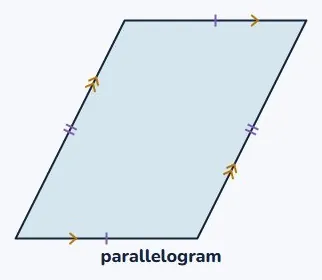
A parallelogram is a leaning rectangle
- Two pairs of parallel sides, but no right angles.
- It looks like a rectangle that has been pushed over.
- And its area turns out to be exactly the same.
Cut the end off and slide it round
- Cut straight down from the top left corner.
- That gives you a triangle. Slide it to the right end.
- It fits exactly, and now you are holding a rectangle.
| Step | Gives | |
|---|---|---|
| Cut the triangle off the left end | ||
| Slide it round to the right end | ||
| Now it is a rectangle | same area | A = bh |
So the area is base times height
- Nothing was added or thrown away, so the area did not change.
- The rectangle is b across and h up.
- A = bh. The same formula as a rectangle, because it is one.
But which length is h?
- Not the sloping side. That went into the triangle you moved.
- h is the straight-up distance between the parallel sides.
- If it is not at right angles to the base, it is not h.
| The length | Which is | Verdict |
|---|---|---|
| The slanting side | is longer | not h |
| The straight-up distance | between the parallel sides | this is h |
| If it is not at 90° | to the base | it is not h |
One worked through
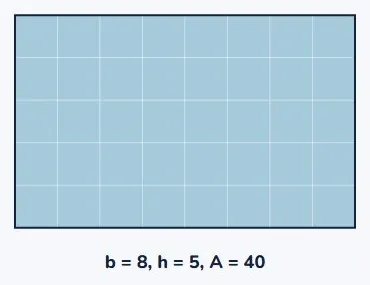
- Base 8 centimetres, perpendicular height 5 centimetres.
- A = 8 × 5.
- 40 square centimetres. The slant side never appears.
| Quantity | Working | Value |
|---|---|---|
| Base | 8 cm | |
| Perpendicular height | 5 cm | |
| A = bh | 8 × 5 | 40 cm² |
Now a trapezium
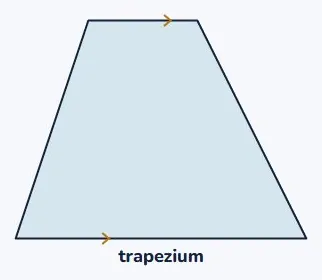
- Only one pair of parallel sides this time.
- So the top and the bottom are different lengths.
- Call them a and b, and the height between them h.
Use the average of the two
- The width changes from 10 at the bottom to 6 at the top.
- On average it is 8.
- So treat it as a rectangle 8 wide: 8 × 4 = 32.
| Step | Working | Gives |
|---|---|---|
| Parallel sides | 6 and 10 | |
| Average width | (6 + 10) ÷ 2 | 8 |
| Times the height | 8 × 4 | 32 cm² |
And that is what the formula says
- A = ½(a + b)h. Add the parallel sides, halve, times the height.
- The half and the bracket together are just "the average".
- Write ½a + bh instead and you have halved only the a.
| Written | Does | Verdict |
|---|---|---|
| A = ½(a + b)h | add first, then halve | right |
| A = ½a + bh | halves only the a | wrong |
| The bracket | is doing real work |
And h means the same thing again
- Perpendicular distance between the two parallel sides.
- Not either of the slanting edges.
- Same trap, same test: is it at right angles to the base?
| The length | Which is | Verdict |
|---|---|---|
| The slanting side | is longer | not h |
| The straight-up distance | between the parallel sides | this is h |
| If it is not at 90° | to the base | it is not h |
Every prism works the same way
- Find the area of the end face.
- Multiply by how long the prism is.
- That is it. For every prism there is.
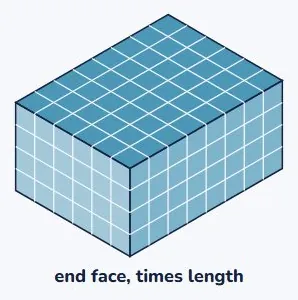
A triangular prism
- The end is a triangle with base 6 and height 4.
- Its area is ½ × 6 × 4, which is 12.
- The prism is 10 long, so 12 × 10 = 120 cubic centimetres.
| Step | Working | Gives |
|---|---|---|
| End face | ½ × 6 × 4 | 12 cm² |
| Length of the prism | 10 cm | |
| Volume | 12 × 10 | 120 cm³ |
So V = ½bhl is not a new formula
- The ½bh part is the triangle at the end.
- The l is the length you multiply by.
- End face, times length, written out in symbols.
| Part | Is | |
|---|---|---|
| ½bh | the triangular end face | |
| l | how long the prism is | |
| ½bhl | the two multiplied |
Two shapes stuck together
- A box with a wedge on top. Split it into the two pieces.
- The box is 5 by 4 by 3, so 60 cubic centimetres.
- The wedge is ½ × 4 × 3 × 5, which is 30. Total 90.
| Part | Working | Volume |
|---|---|---|
| Rectangular part | 5 × 4 × 3 | 60 cm³ |
| Triangular part | ½ × 4 × 3 × 5 | 30 cm³ |
| Together | 60 + 30 | 90 cm³ |
Composite solids are not harder
- Split, do each piece, add. There is no fourth formula.
- They only look hard if you are carrying formulae you cannot place.
- Every piece is still end face times length.
| Step | ||
|---|---|---|
| 1. Split it into pieces you recognise | ||
| 2. Find each volume separately | ||
| 3. Add them |
Now backwards: given the area, find a length
- A parallelogram has area 40 and base 8. What is h?
- 8h = 40. That is an equation.
- Divide both sides by 8. h = 5.
| Step | Working | Gives |
|---|---|---|
| A = 40, b = 8 | so 8h = 40 | |
| Divide both sides by 8 | h = 5 | |
| Same move | as rearranging an equation |
Or given the perimeter, find the area
- A rectangle has perimeter 20 and width 4.
- Half the perimeter is one length plus one width: 10.
- So the length is 6, and the area is 24.
| Step | Working | Gives |
|---|---|---|
| Perimeter 20, width 4 | half of 20 is one length + one width | 10 |
| So the length is | 10 − 4 | 6 |
| Area | 6 × 4 | 24 cm² |
Read what was actually asked for
- These questions have two or three steps in them.
- It is easy to find the length and stop, when it wanted the area.
- Underline the last few words of the question.
| Found | Asked for | Verdict |
|---|---|---|
| the length, 6 | the area | not finished |
| the area, 24 | the area | finished |
Your turn: four questions
- Pause here and try all four.
- Check you are using the perpendicular height in 1 and 2.
- Question 4 asks for the perimeter, not the length.
| Question | |
|---|---|
| 1 | A parallelogram has base 12 cm and height 5 cm. Find its area. |
| 2 | A trapezium has parallel sides 5 cm and 9 cm, height 6 cm. Find its area. |
| 3 | A triangular prism: base 8 cm, height 3 cm, length 10 cm. Find its volume. |
| 4 | A rectangle has area 36 cm² and width 4 cm. Find its perimeter. |
Show answer
1. 60 cm². Base times perpendicular height. 2. 42 cm². The average of 5 and 9 is 7, and 7 × 6 = 42. 3. 120 cm³. The end face is ½ × 8 × 3 = 12, then times the length of 10. 4. 26 cm. The length is 36 ÷ 4 = 9, so the perimeter is 2 × (9 + 4). Note the question asked for the perimeter, not the length.
The answers
- 12 × 5 is 60 square centimetres.
- The average of 5 and 9 is 7, and 7 × 6 is 42.
- The prism is 120 cubic centimetres. And the perimeter is 26.
| Answer | |
|---|---|
| 1 | 60 cm² |
| 2 | 42 cm² |
| 3 | 120 cm³ |
| 4 | 26 cm |
What to take away
- h is always the perpendicular height, never the slanting side.
- A trapezium is the average of its parallel sides, times h.
- And every prism is its end face area, times its length.
| Remember | |
|---|---|
| h | is always the perpendicular height |
| Parallelogram | A = bh, a rectangle rearranged |
| Trapezium | average the parallel sides, times h |
| Any prism | end face area, times length |
| Composite | split it, do each part, add |
Is your child on track?
Take the free placement test