Integers: below zero and back again
What this lesson covers
- The number system extends infinitely, including into negative numbers, and can be represented with a number line.
- Integers are all the whole numbers, including positive whole numbers, negative whole numbers, and zero.
- Every number has an additive inverse, and their sum is zero (e.g. −5 and 5 are additive inverses; −5 + 5 = 0 and 5 + −5 = 0).
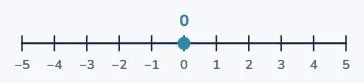
The line does not stop at zero
- Counting back: 3, 2, 1, 0.
- There is no reason to stop there, and we do not.
- The line carries on to the left, for ever.
What we mean by integers
- The whole numbers going up: 1, 2, 3 and onwards.
- The whole numbers going down: −1, −2, −3 and onwards.
- And zero, which is an integer but is neither of the other two.
| Number | Why | Verdict |
|---|---|---|
| 4 | a whole number | integer |
| 0 | neither positive nor negative | integer |
| −17 | a whole number below zero | integer |
| 2.5 | not whole | not an integer |
Finding one on the line
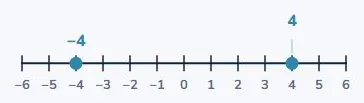
- −4 is four steps to the left of zero.
- Not four steps from somewhere else. Always from zero.
- The minus sign is an instruction about direction.
You already use these
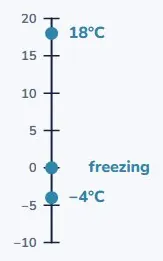
- Four degrees below freezing is −4.
- An overdrawn account, a basement floor, below sea level.
- In all of them, lower on the scale means less.
Which of two numbers is bigger
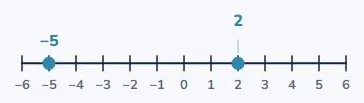
- Whichever is further right. That is the whole rule.
- It worked for positive numbers and it still works here.
- So every negative number is smaller than every positive one.
Where instinct goes wrong
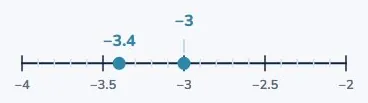
- 3.4 is bigger than 3. Obviously.
- So is −3.4 bigger than −3? It feels like it should be.
- It is not. −3.4 is further left, so it is smaller.
Why that happens
- Going further from zero on the right makes a number bigger.
- Going further from zero on the left makes it smaller.
- Same distance, opposite effect. Read the line, not the digits.
| Pair | On the line | So |
|---|---|---|
| 3.4 and 3 | 3.4 is further right | 3.4 is bigger |
| −3.4 and −3 | −3.4 is further left | −3.4 is smaller |
| The rule | further left is always smaller |
Putting five in order
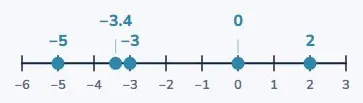
- −5, −3.4, −3, 0 and 2.
- Place them on the line, then read from left to right.
- No comparing needed. The line has already sorted them.
Every number has an opposite
- 5 and −5 are the same distance from zero, opposite sides.
- Add them and you get zero. 5 + −5 = 0.
- That partner is called the additive inverse.
It works for every number there is
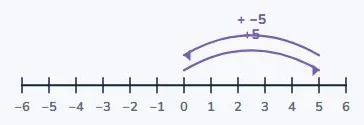
- The inverse of −12 is 12. The inverse of 0.5 is −0.5.
- Zero is its own, because 0 + 0 is 0.
- Two moves, same size, opposite ways. You end up where you began.
| Number | Its inverse | Sum |
|---|---|---|
| 5 | −5 | 0 |
| −12 | 12 | 0 |
| 0.5 | −0.5 | 0 |
| 0 | 0 | 0 |
Adding moves you right
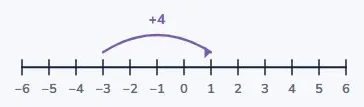
- Start anywhere. Adding 4 means going 4 to the right.
- That is true starting from 3, and from −3 as well.
- The starting point changes. The direction does not.
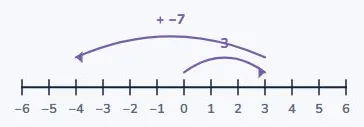
So what does adding −7 do?
- 3 + −7. Start at 3.
- The negative turns you round, so travel 7 to the left.
- You pass zero and land on −4.
Which is exactly what subtracting does
- Now draw 3 − 7. Start at 3, travel 7 to the left.
- It is the same journey. Identical.
- Adding a negative and subtracting are one operation.
| Expression | The journey | Lands on |
|---|---|---|
| 3 + −7 | go 3 right, then 7 left | −4 |
| 3 − 7 | go 3 right, then 7 left | −4 |
| So | adding a negative is subtracting |
Subtracting past zero
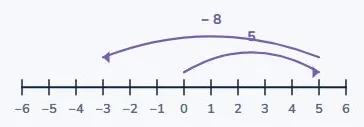
- 5 − 8. Start at 5 and go 8 left.
- After 5 steps you are at zero, with 3 still to travel.
- Those 3 take you to −3.
Starting below zero already
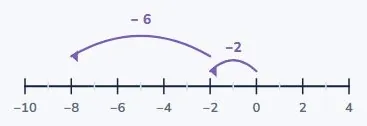
- −2 − 6. Start at −2, which is left of zero.
- Subtracting sends you further left, not back towards it.
- Six more to the left is −8.
A check you can always run
- Ask which way you finished travelling, and how far.
- Ended up left of zero? The answer is negative.
- Four jumps, four answers, no rules memorised.
| Expression | The journey | Lands on |
|---|---|---|
| 5 + −7 | right 5, left 7 | −2 |
| 5 − 8 | right 5, left 8 | −3 |
| −2 − 6 | left 2, left 6 more | −8 |
| −7 + 3 | left 7, right 3 | −4 |
Your turn: four questions
- Pause here and try all four.
- Draw the line for the first two. It is faster than thinking.
- Question 3 is the one from earlier, in disguise.
| Question | |
|---|---|
| 1 | What is 6 + −10? |
| 2 | What is −4 − 5? |
| 3 | Which is smaller, −2.5 or −2? |
| 4 | What is the additive inverse of −8? |
Show answer
1. −4. Start at 6, go 10 to the left, and you pass zero with 4 still to go. 2. −9. Start at −4 and go 5 further left. Both moves are leftward, so they pile up. 3. −2.5, because it sits further left than −2. The commonest wrong answer is −2, from comparing 2.5 and 2 instead. 4. 8. It is whatever cancels −8 to zero, and −8 + 8 = 0.
The answers
- 6 + −10 is −4. 10 left from 6 passes zero with 4 to spare.
- −4 − 5 is −9. Both moves go left, so they pile up.
- −2.5 is smaller. And the inverse of −8 is 8.
| Answer | |
|---|---|
| 1 | −4 |
| 2 | −9 |
| 3 | −2.5 |
| 4 | 8 |
What to take away
- Further left is always smaller, digits notwithstanding.
- A number and its inverse cancel to zero.
- Adding a negative is subtracting. One journey, two spellings.
| Remember | |
|---|---|
| Integers | whole numbers, negative, zero and positive |
| Further left | always means smaller |
| Additive inverse | the number that cancels it to zero |
| Adding a negative | is the same as subtracting |
| Every answer | is a journey along the line |
Is your child on track?
Take the free placement test