Order of operations, integers, and a sensible estimate
What this lesson covers
- Rounding and estimation support efficiently predicting results and checking the reasonableness of calculations.
- The order of operations is important when evaluating or forming expressions. Operations are done as follows: grouped operations (e.g. expressions under a square root, involving the numerator of a fraction, or inside brackets) exponents or powers multiplication and division, from left to right addition and subtraction, from left to right.
- A mnemonic can be used to remember the order of operations, such as GEMA: Grouped (e.g. √(3²+ 4²)), Exponents (e.g. (−2)³), Multiplicative (× and ÷), Additive (+ and −).
Two questions, every single time
- What does this expression actually mean?
- And roughly what should the answer come out as?
- Get both and a slip has nowhere to hide.
The same expression, two answers
- Three plus four times two. Work left to right and you get 14.
- Do the multiply first and you get 11.
- Both are reasonable readings. That is the problem.
| Expression | Read as | Gives |
|---|---|---|
| 3 + 4 × 2 | left to right | 7 × 2 = 14 |
| 3 + 4 × 2 | multiply first | 3 + 8 = 11 |
| Which one? | the convention decides | 11 |
So there is a convention: GEMA
- Four tiers, done strictly in this order.
- Grouped, exponents, multiplicative, additive.
- It is not a law of maths. It is an agreement about reading.
| Tier | What counts | |
|---|---|---|
| G | Grouped | brackets, roots, fraction tops |
| E | Exponents | powers and roots |
| M | Multiplicative | × and ÷, left to right |
| A | Additive | + and −, left to right |
Grouped means more than brackets
- Brackets, obviously. But also anything under a square root.
- And the whole top of a fraction, even with no brackets drawn.
- A fraction bar is a grouping symbol. It is easy to miss.
| Expression | What is grouped | Value |
|---|---|---|
| (8 − 6) | brackets | the obvious one |
| √(3² + 4²) | under the root | √25 = 5 |
| (7 + 5)/3 | the top of a fraction | 12/3 = 4 |
Minus two squared is not what you think
- Minus two, in brackets, squared, is positive four.
- Minus two squared, with no brackets, is negative four.
- The question is what the power is attached to.
| Written | Where the minus is | Value |
|---|---|---|
| (−2)² | the minus is inside | (−2) × (−2) = 4 |
| −2² | the minus is outside | the negative of 2² = −4 |
Multiplication does not beat division
- BEDMAS puts the D before the M and people read that as an order.
- It is not. They share a tier, and you work left to right.
- 20 ÷ 5 × 2 is 8. It is not 2.
| Expression | Working | Gives |
|---|---|---|
| 20 ÷ 5 × 2 | divide first, it is on the left | 4 × 2 = 8 |
| 20 ÷ 5 × 2 | the wrong way | 20 ÷ 10 = 2 |
| 10 − 4 + 3 | subtract first, it is on the left | 6 + 3 = 9 |
| 10 − 4 + 3 | the wrong way | 10 − 7 = 3 |
And addition does not beat subtraction
- Same tier, same rule. Left to right.
- 10 − 4 + 3 is 9, because the subtraction is on the left.
- Doing the addition first gives 3, and that is the classic error.
All four tiers in one expression
- Two plus three times, bracket, eight minus six, squared.
- Bracket first, then the power, then the multiply, then the add.
- One tier at a time and it never gets complicated.
| Line | Step | |
|---|---|---|
| 2 + 3 × (8 − 6)² | start | |
| 2 + 3 × 2² | G: the bracket | |
| 2 + 3 × 4 | E: the power | |
| 2 + 12 | M: the multiply | |
| 14 | A: the add |
Two exponents worth knowing on sight
- Anything to the power of one is just itself.
- Anything to the power of zero is one.
- Not zero. One. The pattern of dividing by the base gets you there.
| Written | Meaning | Value |
|---|---|---|
| 5¹ | one 5 | 5 |
| 5⁰ | no 5s at all | 1 |
| Any a | a⁰ = 1 and a¹ = a | as long as a is not 0 |
Negative numbers, all four operations
- Adding and subtracting: move up or down the line from where you are.
- Multiplying and dividing: count the negative signs.
- One negative gives a negative. Two cancel out.
| Calculation | Reading | Answer |
|---|---|---|
| −3 + 7 | up seven from minus three | 4 |
| −3 − 7 | down seven from minus three | −10 |
| −3 × 7 | one negative | −21 |
| −3 × −7 | two negatives | 21 |
| −21 ÷ 7 | one negative | −3 |
| −21 ÷ −7 | two negatives | 3 |
Why subtracting feels harder than it is
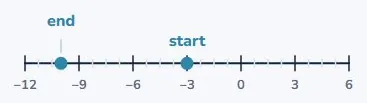
- Minus three, take away seven. Start at minus three.
- Go down seven. You land on minus ten.
- Every one of these is a walk along the line.
How many halves fit in six?
- That question is what six divided by a half is asking.
- Twelve. And notice the answer got bigger than what we started with.
- Do three of these and the shortcut becomes obvious.
| Calculation | The question it asks | Answer |
|---|---|---|
| 6 ÷ 1/2 | how many halves fit in 6? | 12 |
| 6 ÷ 1/3 | how many thirds fit in 6? | 18 |
| 6 ÷ 2/3 | how many two-thirds fit in 6? | 9 |
| 6 × 3/2 | the same answer | 9 |
Now the second question
- You can evaluate an expression. Should you trust your answer?
- An estimate is a cheap prediction you make before calculating.
- Its whole job is to disagree with you when you slip.
Round to what the situation needs
- Money goes to the cent. Heights go to the centimetre.
- People come in whole numbers, and you round up, not down.
- There is no universal number of decimal places. Context decides.
| Value | Context | Rounded |
|---|---|---|
| $12.4567 | money | $12.46 |
| 2.7 people | people come whole | 3 |
| 147.3 cm | height, to the centimetre | 147 cm |
Estimates that catch mistakes
- 48 times 21. Round to 50 times 20 and you predict about 1000.
- The real answer is 1008, so the prediction was close.
- If you had got 208, the estimate would have caught it instantly.
| Calculation | Rounded to | Estimate, and the truth |
|---|---|---|
| 48 × 21 | about 50 × 20 | 1000, and it is 1008 |
| 297 + 412 | about 300 + 400 | 700, and it is 709 |
| 19.6 × 4.9 | about 20 × 5 | 100, and it is 96.04 |
What to take away
- Seven things, and two of them are mistakes to stop making.
| GEMA | grouped, exponents, multiplicative, additive |
| Within a tier | work left to right, always |
| Not a rule | multiplication before division |
| −2² and (−2)² | are different numbers |
| Two negatives | multiply or divide to a positive |
| Dividing by a fraction | asks how many of them fit |
| Estimate first | so a wrong answer has something to fail against |
Your turn
- Pause here and try all four.
- Answers are in the description.
| Question | |
|---|---|
| 1 | Work out 5 + 3 × 2². |
| 2 | Estimate 39 × 51 without calculating it. |
| 3 | Work out −4 × −6 ÷ 3. |
| 4 | Work out 8 ÷ 2/5. |
Show answer
1. 17. The power first, giving 4, then 3 × 4 = 12, then 5 + 12. 2. About 2000, from 40 × 50. The true value is 1989, so the estimate is within about half a percent. 3. 8. Two negatives multiply to 24, then divide by 3. Left to right. 4. 20. How many two-fifths fit in 8? Twenty of them, which is 8 × 5/2.
The answers
- Power first: three fours is twelve, plus five.
- 40 × 50 is 2000. The true value is 1989.
- Two negatives give 24, then divide by 3.
| Answer | |
|---|---|
| 1 | 17 |
| 2 | About 2000 |
| 3 | 8 |
| 4 | 20 |
Is your child on track?
Take the free placement test