Acids and bases: pH scale, alkalis and indicators
What this lesson covers
- How acids and bases differ, and why both can be dangerous
- Common acids and the main types of base
- What makes a base an alkali
- The pH scale from 0 to 14
- How litmus and universal indicator show acidity
- Matching pH to everyday uses
Two groups with opposite properties
- Acids and bases are two families of substances that behave in opposite ways.
- When an acid and a base are mixed in the right amounts they cancel each other out, a reaction called neutralisation.
- Acids often taste sour, like lemon juice and vinegar.
- Bases often taste bitter, like baking soda, and solutions of them feel slippery or soapy on skin.
- Strong acids and strong bases are both corrosive, meaning they damage skin, eyes and other materials. In the lab you never taste or touch a chemical to identify it.
Common acids
- Three acids turn up again and again in labs and industry.
- Weaker acids are found in food: citric acid in citrus fruit, ethanoic acid in vinegar, and carbonic acid in fizzy drinks.
| Acid | Formula | Where you meet it |
|---|---|---|
| Hydrochloric acid | HCl | Your stomach makes it to help digest food; cleaning concrete and bricks |
| Sulfuric acid | H₂SO₄ | Car batteries; making fertilisers |
| Nitric acid | HNO₃ | Making fertilisers and explosives |
Types of base, and which ones are alkalis
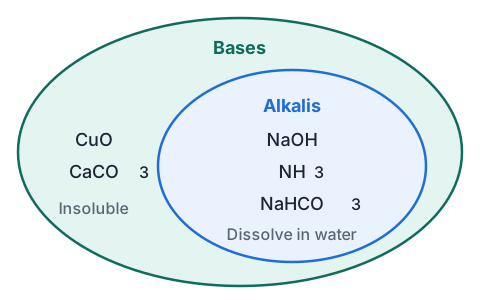
- Most bases belong to a few types: metal oxides, metal hydroxides, metal carbonates, metal hydrogencarbonates (bicarbonates) and ammonia.
- A base that dissolves in water is called an alkali, and its solution has a pH above 7.
- So every alkali is a base, but not every base is an alkali: copper oxide and calcium carbonate are bases that barely dissolve.
- Insoluble bases still neutralise acids, which is why farmers spread ground limestone on acidic paddocks.
| Type of base | Example | Dissolves in water? | Use |
|---|---|---|---|
| Metal oxide | Copper(II) oxide, CuO | No, so not an alkali | Making copper salts in the lab |
| Metal hydroxide | Sodium hydroxide, NaOH | Yes, an alkali | Drain and oven cleaners |
| Metal carbonate | Calcium carbonate, CaCO₃ | No, so not an alkali | Agricultural lime, antacid tablets |
| Bicarbonate | Sodium hydrogencarbonate, NaHCO₃ | Yes, a weak alkali | Baking soda |
| Ammonia | NH₃ | Yes, an alkali | Household glass cleaners |
The pH scale
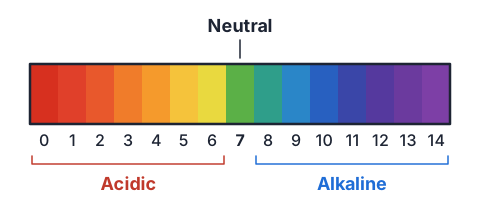
- pH is a number, usually from 0 to 14, that says how acidic or alkaline a solution is.
- A solution under 7 is acidic, one at exactly 7 is neutral, and one over 7 is alkaline.
- The lower the pH, the more acidic the solution; the higher it is above 7, the more alkaline.
- Each step of 1 on the scale is a tenfold change, so pH 3 is ten times more acidic than pH 4.
| pH (about) | Substance | Type |
|---|---|---|
| 1 | Stomach acid | Strongly acidic |
| 2 | Lemon juice | Acidic |
| 3 | Vinegar | Acidic |
| 5 | Black coffee | Weakly acidic |
| 7 | Pure water | Neutral |
| 8 | Sea water around NZ | Weakly alkaline |
| 9 | Baking soda solution | Alkaline |
| 11 | Ammonia cleaner | Alkaline |
| 13 to 14 | Drain cleaner | Strongly alkaline |
How much more acidic?
- Some geothermal lakes near Rotorua, such as Inferno Crater at Waimangu, are about pH 2. Black coffee is about pH 5. How many times more acidic is the lake?
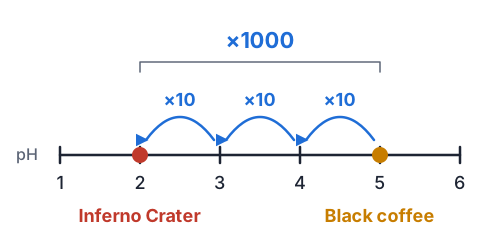
- 5 − 2 = 3 steps on the pH scalefind the gap
- 10 × 10 × 10 = 1000each step is a factor of 10
- The lake is about 1000 times more acidic than black coffee
Indicators: colour tells you pH
- An indicator is a dye that changes colour depending on whether it is in an acid or an alkali.
- Litmus comes as paper strips. Blue litmus turns red in an acid; red litmus turns blue in an alkali; in a neutral solution neither changes.
- Litmus only says acid or alkali, not how strong.
- Universal indicator is a mixture of dyes that shows a different colour at each part of the scale, so you match the colour against a chart to read an approximate pH.
- The exact shades differ a little between brands, so always use the chart that comes with the bottle.
| pH | Universal indicator colour | Meaning |
|---|---|---|
| 0 to 2 | Red | Strong acid |
| 3 to 4 | Orange | Acid |
| 5 to 6 | Yellow | Weak acid |
| 7 | Green | Neutral |
| 8 to 9 | Blue-green to blue | Weak alkali |
| 10 to 11 | Blue to indigo | Alkali |
| 12 to 14 | Violet | Strong alkali |
Choosing the right way to measure pH
- Pick the method by the question you need to answer.
- If you only need to know acid or alkali, litmus is quick and cheap.
- If you need a rough pH number, use universal indicator, but it is hard to read in a solution that already has a strong colour, such as blackcurrant juice.
- If you need an exact value, for example checking a swimming pool or soil for a crop, use a calibrated pH meter.
| Method | Tells you | Good for | Weakness |
|---|---|---|---|
| Litmus paper | Acid, neutral or alkali | Quick sorting | No number |
| Universal indicator | pH to about 1 unit | Comparing strengths | Hard to read in coloured liquids |
| pH meter | pH to 0.1 or better | Accurate measurement | Costs more, needs calibrating |
Linking pH to uses
- Antacid tablets contain weak bases such as calcium carbonate, which neutralise extra stomach acid without harming the stomach lining.
- Drain cleaners are strongly alkaline (pH 13 or more) so they can break down the fats and hair that block pipes, which is also why they burn skin.
- Hydrangeas are a living indicator: in acidic soil their flowers turn blue, while in alkaline soil they turn pink.
Identifying unknown solutions from evidence
- Three unlabelled colourless solutions, A, B and C, are tested. Use the results to decide what each could be.
| Solution | Blue litmus | Red litmus | Universal indicator |
|---|---|---|---|
| A | Turns red | Stays red | Red |
| B | Stays blue | Stays red | Green |
| C | Stays blue | Turns blue | Blue |
- A: blue litmus to red, indicator red, so pH about 1 or 2a strong acid
- B: no litmus change, indicator green, so pH 7neutral
- C: red litmus to blue, indicator blue, so pH about 8 or 9a weak alkali
- A could be dilute hydrochloric acid, B pure water or salt water, C baking soda solution
Common mistakes
- pH 2 is only a little more acidic than pH 3, because the numbers are just 1 apart.Each step on the pH scale is a tenfold change, so pH 2 is ten times more acidic than pH 3.
- The higher the pH number, the stronger the acid.Acids are below 7 and get stronger as the number goes down; a high pH means a strong alkali.
- Alkali and base mean the same thing.An alkali is a base that dissolves in water, so every alkali is a base, but insoluble bases such as copper oxide are not alkalis.
- Litmus paper tells you the pH of a solution.Litmus only shows acid or alkali; you need universal indicator for a rough pH number or a pH meter for an exact one.
Make a red cabbage indicator
You need: 2 red cabbage leaves, hot tap water, a jug, 4 clear glasses or cups, vinegar, lemon juice, baking soda, a teaspoon
- Tear the cabbage leaves into small pieces in the jug, cover them with hot tap water and leave it for 10 minutes until the water is dark purple.
- Let it cool, then pour the purple water into the four glasses, leaving the cabbage behind, so each is about a quarter full.
- Leave the first glass as it is. Add a teaspoon of vinegar to the second and a teaspoon of lemon juice to the third.
- Stir half a teaspoon of baking soda into the fourth glass.
- Look for the colours: the vinegar and lemon glasses turn pink or red because they are acids, the baking soda glass turns blue or green because it is alkaline, and the plain glass stays purple, close to neutral.
Safety: Hot tap water can scald and the purple dye stains clothes and benches, so pour slowly over the sink, and do not drink any of the mixtures.
Your turn
- 1. A solution has pH 4. Is it acidic, neutral or alkaline, and what colour would universal indicator turn?
- 2. Magnesium oxide hardly dissolves in water. Is it a base, an alkali, or both?
- 3. You need to check whether a farmer's paddock soil is pH 5.8 or 6.2. Which method should you use, and why?
- 4. Why is it a bad idea to identify a liquid in the lab by tasting it, even though acids taste sour?
- 5. Oven cleaner has pH 13 and lemon juice has pH 2. Which is further from neutral, and what does that tell you about handling it?
Show answer
1. Acidic, because it is below 7; universal indicator turns orange. 2. A base only. It neutralises acids, but an alkali must dissolve in water. 3. A pH meter, because universal indicator cannot tell apart values only 0.4 apart. 4. The liquid could be corrosive or poisonous, and tasting is never a safe lab test. 5. Oven cleaner: it is 6 units above 7, while lemon juice is 5 units below. It is a strong alkali and corrosive, so wear gloves and eye protection and rinse any splash with plenty of water.
pH Scale: Basics
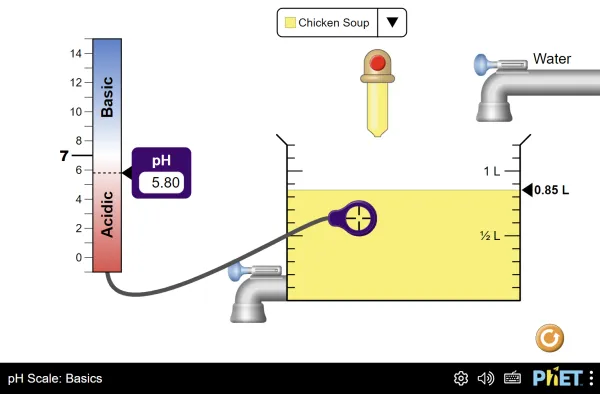
Full screen · PhET Interactive Simulations, University of Colorado Boulder, CC BY 4.0
Recap
- Acids and bases have opposite properties and neutralise each other; strong ones of either kind are corrosive.
- Hydrochloric, sulfuric and nitric acids are common acids; oxides, hydroxides, carbonates, bicarbonates and ammonia are bases.
- An alkali is a base that dissolves in water.
- pH under 7 means acidic, exactly 7 means neutral and over 7 means alkaline; each unit is a tenfold change.
- Litmus shows acid or alkali, universal indicator gives an approximate pH by colour, and a pH meter gives an exact value.
- A substance's pH explains its uses, from antacids to drain cleaners.
How is Year 9 maths going?
See the Year 9 maths guide