Tests for hydrogen, oxygen, carbon dioxide and water
What this lesson covers
- Why invisible gases need chemical tests
- The pop test for hydrogen
- The glowing splint test for oxygen
- The limewater test for carbon dioxide
- The cobalt chloride paper test for water
- Natural indicators such as red cabbage for sorting acids and alkalis
- Safe handling of corrosive substances
Why we need tests
- Hydrogen, oxygen and carbon dioxide are all colourless and have no smell, so you cannot tell them apart by looking or sniffing.
- A standard test is a reaction with a clear, agreed result that only one substance gives.
- Because everyone uses the same test, a result in an Auckland lab means the same as a result in a Dunedin one.
| Substance | Test | Positive result |
|---|---|---|
| Hydrogen gas | Hold a lit splint at the mouth of the tube | Squeaky pop |
| Oxygen gas | Put a glowing splint into the tube | Splint relights |
| Carbon dioxide gas | Bubble the gas through limewater | Limewater turns milky |
| Water (liquid) | Touch with dry blue cobalt chloride paper | Paper turns pink |
Hydrogen: the pop test
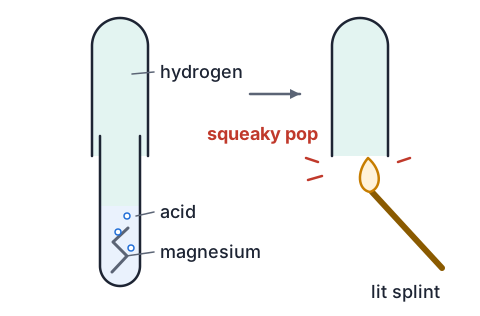
- A simple way to make hydrogen is to drop a piece of magnesium ribbon into dilute hydrochloric acid: magnesium + hydrochloric acid → magnesium chloride + hydrogen.
- Hydrogen is lighter than air, so collect it in a test tube held upside down.
- Bring a lit splint to the mouth of the tube. The hydrogen burns very quickly with the oxygen in the air and makes a squeaky pop.
- The product of that tiny explosion is water: hydrogen + oxygen → water.
Oxygen: the glowing splint test
- Oxygen can be made by adding a pinch of manganese dioxide to hydrogen peroxide; the manganese dioxide speeds up the breakdown without being used up.
- Light a wooden splint, then blow it out so only the tip glows.
- Lower the glowing splint into the tube. If it bursts back into flame, the gas is oxygen.
- Air is only about 21 percent oxygen, which is not enough to relight the splint; nearly pure oxygen is needed.
Carbon dioxide: the limewater test
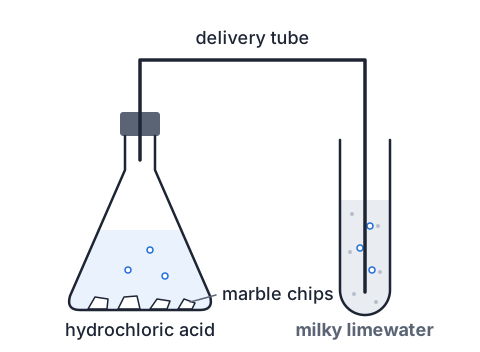
- Carbon dioxide forms when an acid reacts with a carbonate, such as marble chips in hydrochloric acid or baking soda in vinegar.
- Limewater is a clear solution of calcium hydroxide in water.
- Bubble the gas through it with a delivery tube. If the limewater turns cloudy or milky, the gas is carbon dioxide.
- The cloudiness is tiny grains of solid calcium carbonate: carbon dioxide + calcium hydroxide → calcium carbonate + water.
- A lit splint goes out in carbon dioxide, but it also goes out in nitrogen, so that is not a reliable test on its own.
Water: cobalt chloride paper
- Cobalt chloride paper is blue when completely dry and turns pink when it touches water.
- Dry the paper in a warm oven or keep it sealed with a drying agent, otherwise moisture in the air turns it pink before you start.
- A positive result shows that water is present, not that the liquid is pure water; sea water and orange juice also turn it pink.
- To show a liquid is pure water, you also measure its boiling point (100 °C at sea level) and its freezing point (0 °C).
- Cobalt chloride is toxic, so handle the paper with tweezers and wash your hands afterwards.
Which gas came off the zinc?
- A student adds zinc granules to dilute sulfuric acid and collects the bubbles. A glowing splint does not relight. A lit splint gives a squeaky pop. Identify the gas.
- Glowing splint does not relightso it is not oxygen
- Lit splint makes a squeaky popthe positive result for hydrogen
- Metal + acid fitsreactive metals and acids give off hydrogen
- The gas is hydrogen
Is there carbon dioxide in your breath?
- You breathe out gently through a straw into limewater for a minute. Air from a pump is bubbled through a second tube of limewater for the same time. What result shows your breath contains extra carbon dioxide?
- Pumped air: limewater stays clear or turns cloudy very slowlyair has only about 0.04 percent carbon dioxide
- Breath: limewater turns milky within a minuteexhaled air has about 4 percent carbon dioxide
- Same time and same volume of limewatera fair comparison
- Breath contains much more carbon dioxide than airyour cells make it in respiration
Making a natural pH indicator
- Many plants contain coloured chemicals that change colour with pH, so you can make an indicator in a kitchen.
- Chop some red cabbage, cover it with hot water for about ten minutes, then strain off the purple liquid.
- Add a few drops to each test liquid in a clean, clear container and compare the colours against a white background.
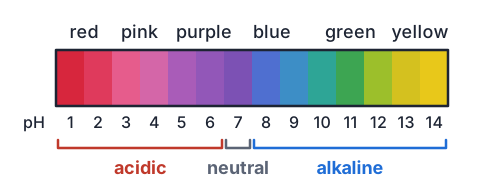
- To check your colour chart, test something you already know: vinegar for acid, tap water for roughly neutral, and baking soda solution for alkali.
- Turmeric works too, but it only changes from yellow to red-brown in alkalis, so it cannot tell an acid from a neutral liquid.
| Liquid | Red cabbage colour | Turmeric colour | Conclusion |
|---|---|---|---|
| Lemon juice | Red to pink | Yellow | Acidic |
| Vinegar | Pink | Yellow | Acidic |
| Distilled water | Purple | Yellow | Neutral |
| Baking soda solution | Blue to green | Orange-red | Alkaline |
| Washing soda solution | Green to yellow | Red-brown | Strongly alkaline |
Handling corrosive substances safely
- A corrosive substance destroys skin and damages metal; containers show a hazard symbol of liquid dripping onto a hand and a bar of metal.
- Wear safety glasses for any acid or alkali, even a dilute one, because an eye is damaged far faster than skin.
- When diluting, add the acid slowly to water, never water to concentrated acid, because the heat released can make it spit.
- If any splashes onto skin or into an eye, rinse it with running water for at least 15 minutes and tell a teacher or get medical help.
- At home, never mix bleach with acidic toilet cleaners or with ammonia cleaners, because both mixtures release toxic gases.
- In New Zealand workplaces, every hazardous chemical comes with a safety data sheet that lists its dangers, the protective gear to wear and the first aid to give.
| Setting | Example corrosive | Key safety steps |
|---|---|---|
| School lab | Dilute hydrochloric acid | Safety glasses, small volumes, wipe spills, wash hands |
| Home | Drain or oven cleaner | Gloves, ventilation, never mix products, store away from children |
| Workplace | Concentrated sulfuric acid | Read the safety data sheet, face shield and gloves, eyewash station nearby |
Common mistakes
- A lit splint went out in the gas, so it must be carbon dioxide.A splint also goes out in nitrogen and other gases, so only limewater turning milky confirms carbon dioxide.
- Hydrogen relights a glowing splint, and oxygen pops with a lit one.It is the other way round: hydrogen gives a squeaky pop with a lit splint, and oxygen relights a glowing one.
- The liquid turned cobalt chloride paper pink, so it is pure water.Pink only shows water is present; a pure sample also has a boiling point of exactly 100 °C at sea level.
- To dilute an acid, pour the water into the acid.Add the acid slowly to the water, because water poured into concentrated acid heats up fast and can spit acid out.
Identify four mystery white powders
You need: salt, sugar, baking soda, cornflour, vinegar, 4 small cups or saucers, a teaspoon, a helper
- Your helper puts half a teaspoon of each powder into a cup and labels the cups only A, B, C and D, keeping a secret list of which is which.
- Water test: add 2 teaspoons of cold water to half of each sample and stir. Three dissolve to a clear liquid; one stays cloudy and settles to the bottom. That one is cornflour.
- Vinegar test: add a few drops of vinegar to the other half of each sample. One fizzes as carbon dioxide forms. That one is baking soda.
- Crystal test: put a few drops of the two remaining clear liquids on a dark plate and leave them on a windowsill overnight. Salt leaves small square crystals; sugar leaves a sticky film.
- Look for: each test sorts the powders by one property, so together they name all four without tasting any; check your answers against your helper's list.
Safety: Never identify a powder by tasting or sniffing it, even in a kitchen, and keep vinegar splashes away from your eyes.
Your turn
- 1. A gas relights a glowing splint. What is it?
- 2. Marble chips are added to hydrochloric acid. Which test would you use on the gas, and what result do you expect?
- 3. A clear liquid turns blue cobalt chloride paper pink. Does this prove the liquid is pure water? Explain.
- 4. Red cabbage indicator turns blue-green in a cleaning spray. Is the spray acidic, neutral or alkaline?
- 5. A student spills dilute sodium hydroxide on their hand. What should they do first?
Show answer
1. Oxygen; only nearly pure oxygen relights a glowing splint. 2. Bubble it through limewater; the limewater turns milky because the gas is carbon dioxide from the acid and carbonate. 3. No. It shows water is present, but the liquid could have other things dissolved in it; you would also check its boiling point is 100 °C. 4. Alkaline, since red cabbage turns blue to green above pH 7. 5. Rinse the hand under running water for at least 15 minutes and tell the teacher; sodium hydroxide is corrosive even when dilute.
Recap
- Hydrogen gives a squeaky pop with a lit splint.
- Oxygen relights a glowing splint.
- Carbon dioxide turns limewater milky as calcium carbonate forms.
- Water turns dry blue cobalt chloride paper pink, though that shows water is present, not that it is pure.
- Plant dyes such as red cabbage act as indicators; check them with known acids and alkalis first.
- Treat acids and alkalis with eye protection, dilute acid into water, never mix cleaning products, and rinse any splash for 15 minutes.
How is Year 9 maths going?
See the Year 9 maths guide