Mass number, electron shells and valence electrons
What this lesson covers
- Mass number, and how to find the number of neutrons
- Why electrons add almost nothing to an atom's mass
- Writing atoms in standard notation
- Electron arrangements for the first 20 elements, shell by shell
- Valence electrons and why they control reactions
- Why some useful elements are running short
Picking up from Part 1
- Part 1 built the Bohr model: protons and neutrons in a tiny nucleus, electrons in shells around it.
- It also showed that the atomic number counts the protons and, in a neutral atom, the electrons too.
- This part counts the neutrons, sorts the electrons into shells, and uses that arrangement to explain why atoms react.
Where an atom's mass comes from
- A proton and a neutron have almost exactly the same mass, so each is counted as 1 unit.
- An electron is about 1836 times lighter than a proton, so for counting mass it is treated as zero.
- That means almost all of an atom's mass is in its nucleus, which matches what Rutherford found.
| Particle | Charge | Relative mass | Where |
|---|---|---|---|
| Proton | +1 | 1 | Nucleus |
| Neutron | 0 | 1 | Nucleus |
| Electron | −1 | about 1/1836, taken as 0 | Shells |
Mass number and counting neutrons
- The mass number is the total count of particles in the nucleus: protons plus neutrons.
- Because the atomic number already gives the protons, you can find the neutrons by subtraction.
- Neutrons = mass number − atomic number.
- Atoms of one element always have the same number of protons but can have different numbers of neutrons; these versions are called isotopes, such as carbon-12 and carbon-14.
Writing an atom in standard notation
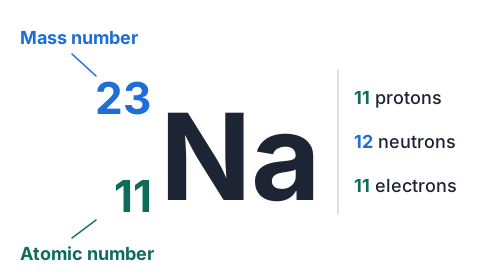
- Chemists write the mass number at the top left of the symbol and the atomic number at the bottom left.
- So ²³₁₁Na means a sodium atom with mass number 23 and atomic number 11.
- In plain text the same atom can be written as sodium-23 or Na-23.
- The bigger number is always the mass number, because the nucleus can never have fewer particles than protons.
| Symbol | Atomic number (protons) | Mass number | Neutrons | Electrons (neutral) |
|---|---|---|---|---|
| ¹H | 1 | 1 | 0 | 1 |
| ¹²C | 6 | 12 | 6 | 6 |
| ²³Na | 11 | 23 | 12 | 11 |
| ⁴⁰Ca | 20 | 40 | 20 | 20 |
Counting the particles in chlorine-35
- Chlorine has atomic number 17. Find the protons, neutrons and electrons in a neutral atom of chlorine-35.
- Protons = 17equal to the atomic number
- Neutrons = 35 − 17 = 18mass number minus atomic number
- Electrons = 17neutral, so electrons match protons
- 17 protons, 18 neutrons, 17 electrons
Filling the shells: 2, 8, 8
- For the first 20 elements, the first shell holds up to 2 electrons, the second up to 8 and the third up to 8, with any extra going into a fourth.
- Electrons fill the innermost shell first, because it is closest to the positive nucleus and lowest in energy.
- The shell sizes match the row lengths: period 1 has 2 elements, and periods 2 and 3 have 8 each.
- The period number tells you how many shells are in use, and for groups 1, 2 and 13 to 17 the outer shell count is the group number (or its last digit).
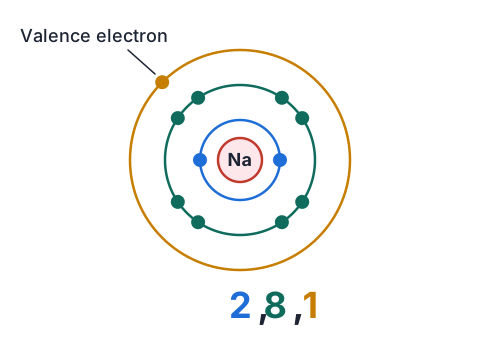
- An arrangement is written as numbers separated by commas, innermost first, so sodium is 2,8,1.
| Element | Atomic number | Arrangement | Period | Group |
|---|---|---|---|---|
| Hydrogen | 1 | 1 | 1 | 1 |
| Helium | 2 | 2 | 1 | 18 |
| Carbon | 6 | 2,4 | 2 | 14 |
| Oxygen | 8 | 2,6 | 2 | 16 |
| Neon | 10 | 2,8 | 2 | 18 |
| Sodium | 11 | 2,8,1 | 3 | 1 |
| Chlorine | 17 | 2,8,7 | 3 | 17 |
| Argon | 18 | 2,8,8 | 3 | 18 |
| Potassium | 19 | 2,8,8,1 | 4 | 1 |
| Calcium | 20 | 2,8,8,2 | 4 | 2 |
Valence electrons do the reacting
- The outermost shell that holds electrons is the valence shell, and the electrons in it are valence electrons.
- When atoms meet, only these outer electrons come into contact, so they are the ones that form bonds.
- Elements in the same group have the same number of valence electrons, which is why they behave alike.
- Noble gases already have a full outer shell, which is why they hardly react.
Losing, gaining or sharing to get a full shell
- Atoms become more stable when their valence shell is full, and they reach this in the easiest way available.
- Metals with 1, 2 or 3 valence electrons tend to give them away, leaving a full shell underneath and becoming positive ions.
- Non-metals with 5, 6 or 7 valence electrons tend to take extra electrons from a metal and become negative ions.
- Two non-metals cannot both take electrons, so instead they share pairs of electrons; that is how two hydrogen atoms join to make H₂ and how water forms.
| Atom | Arrangement | Easiest change | Result |
|---|---|---|---|
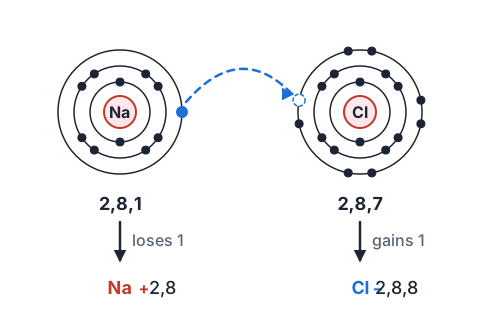
| Sodium | 2,8,1 | Lose 1 electron | Na⁺, arrangement 2,8 |
| Magnesium | 2,8,2 | Lose 2 electrons | Mg²⁺, arrangement 2,8 |
| Chlorine | 2,8,7 | Gain 1 electron | Cl⁻, arrangement 2,8,8 |
| Oxygen | 2,6 | Gain 2 or share 2 | O²⁻ with metals, shares with hydrogen in water |
| Hydrogen | 1 | Share 1 | H₂, each atom has 2 in its shell |
Predicting how magnesium reacts
- Magnesium-24 has atomic number 12. Find its particles, its arrangement, and the ion it forms.
- Protons = 12, electrons = 12atomic number, neutral atom
- Neutrons = 24 − 12 = 12mass number minus atomic number
- Arrangement: 2,8,2fill 2, then 8, then the last 2 go in shell three
- Losing 2 is easier than gaining 6fewer electrons to move
- Mg²⁺ with arrangement 2,812 protons and 10 electrons give +2
Elements we could run short of
- Every atom on Earth was already here; we cannot make more of a stable element in useful amounts, only move it around.
- Helium for MRI scanners comes from natural gas wells, and once released it rises out of the atmosphere into space, so it is lost for good.
- Lithium and cobalt for batteries, and neodymium for the magnets in wind turbines and electric car motors, are mined in only a few countries, so supply and price can change suddenly.
- New Zealand farms rely on imported phosphate rock for fertiliser, and much of the world's supply comes from a single region.
- Recycling old phones and batteries, designing products that last, and using less where possible all reduce the pressure on these supplies.
Common mistakes
- The mass number of chlorine-35 means it has 35 neutrons.The mass number counts protons and neutrons together, so neutrons = 35 − 17 = 18.
- Potassium is 2,8,9, because the third shell can take more electrons.For the first 20 elements the third shell holds 8 before the fourth starts, so potassium is 2,8,8,1.
- Chlorine is in group 17, so it has 7 electrons.Chlorine has 17 electrons, arranged 2,8,7; the 7 is only the number in its outer, valence shell.
- Sodium loses an electron, so it becomes a negative ion.Losing a negative electron leaves 11 protons and 10 electrons, so sodium becomes a positive ion, Na⁺.
Build sodium and chlorine atoms on paper
You need: 2 sheets of paper, a pen, about 30 dried beans or chickpeas, about 30 lentils or split peas, about 30 grains of rice
- On each sheet draw a small circle for the nucleus with three bigger rings around it, and label the rings 2, 8 and 8 for how many electrons each can hold.
- Build sodium-23 on the first sheet: put 11 beans (protons) and 12 lentils (neutrons) in the nucleus, then place 11 rice grains (electrons), filling the inner ring first.
- Build chlorine-35 on the second sheet with 17 beans, 18 lentils and 17 rice grains, and write both electron arrangements underneath.
- Slide sodium's single outer rice grain across onto chlorine's outer ring.
- Look for the result: sodium now has a full outer shell, 2,8, with one more proton than electrons (+1), and chlorine has 2,8,8 with one extra electron (−1).
Safety: Dried beans, lentils and rice are a choking risk for young children and raw dried beans can make you sick, so keep them away from little ones and do not eat any.
Your turn
- 1. Aluminium-27 has atomic number 13. How many protons, neutrons and electrons does a neutral atom have?
- 2. Write the electron arrangement for sulfur, atomic number 16.
- 3. Potassium has atomic number 19. How many valence electrons does it have, and in which shell?
- 4. Fluorine is 2,7. Will it tend to lose or gain electrons, and how many?
- 5. Why is it harder to recycle helium than to recycle copper?
Show answer
1. 13 protons, 14 neutrons (27 − 13), 13 electrons. 2. 2,8,6. 3. One valence electron in the fourth shell, because the arrangement is 2,8,8,1. 4. Gain 1, since one more electron fills its outer shell, while losing 7 would take far more energy. 5. Copper stays in the wire or pipe and can be collected and melted down, but released helium escapes into the air and then into space.
Build an Atom
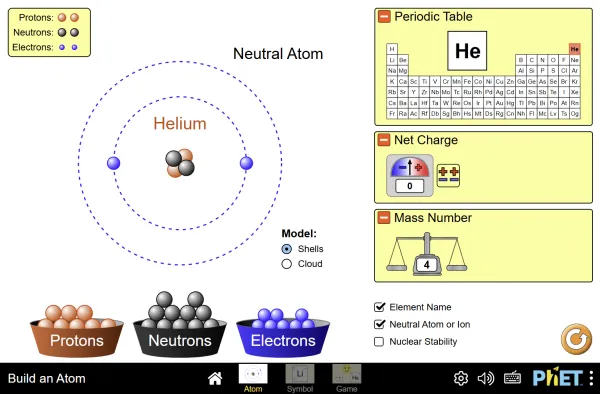
Full screen · PhET Interactive Simulations, University of Colorado Boulder, CC BY 4.0
Recap
- Mass number = protons + neutrons, so neutrons = mass number − atomic number.
- Protons and neutrons each have a relative mass of about 1; an electron's mass is tiny and taken as 0.
- In ²³₁₁Na the top number is the mass number and the bottom number is the atomic number.
- For the first 20 elements, shells fill 2, then 8, then 8, matching the lengths of the first three rows.
- Valence electrons are in the outer shell and are the ones used in bonding.
- Atoms lose, gain or share electrons to get a full outer shell, which makes them more stable.
How is Year 9 maths going?
See the Year 9 maths guide