Disease and immunity: pathogens, white blood cells and vaccines
What this lesson covers
- Bacteria, viruses, protists and fungi as causes of infectious disease, and how they spread
- Hygiene, quarantine and other ways to control infectious disease
- Non-infectious diseases, which cannot be caught
- The body's first defences: barriers, chemicals and helpful microbes
- How white blood cells and antibodies fight pathogens, and how vaccines prepare them
- How Pasteur and Koch showed that microbes cause disease
- Reading outbreak data and judging health information for accuracy and bias
Pathogens: the microbes that make us sick
- A pathogen is a microbe or other tiny agent that causes disease when it gets into a host, which can be a person, an animal or a plant.
- Diseases caused by pathogens are infectious, meaning they can pass from one host to another.
- There are four main kinds: bacteria, viruses, protists and fungi. They differ in size, structure and how they can be treated.
- Most microbes are harmless or even helpful; only a small fraction are pathogens.
| Type | What it is | Human example | Plant or NZ example | Treated with |
|---|---|---|---|---|
| Bacteria | single prokaryotic cells | Salmonella food poisoning, tuberculosis | Psa in kiwifruit vines | antibiotics |
| Viruses | not cells; DNA or RNA in a protein coat that can only copy itself inside a host cell | influenza, measles, COVID-19 | viruses that stunt potatoes | antibiotics do not work; vaccines prevent many |
| Protists | single eukaryotic cells | malaria, Giardia from untreated stream water | kauri dieback (its water mould is grouped with protists in many textbooks) | specific medicines |
| Fungi | eukaryotes that spread by spores | athlete's foot, thrush | myrtle rust on pōhutukawa and rātā | antifungal medicines |
How pathogens spread
- Pathogens need a route from one host to the next, and knowing the route tells you how to block it.
- Some travel in bodily fluids such as blood or saliva, some on contaminated food, water, hands and surfaces, and some through the air.
- Influenza spreads in tiny droplets coughed or breathed out, and measles is so contagious it can hang in the air of a room for up to two hours after an infected person leaves.
- Myrtle rust spores are light enough to blow across the Tasman, which is how the fungus is thought to have reached New Zealand in 2017.
- Kauri dieback, caused by a fungus-like water mould, moves in soil, so a speck of mud on a boot can carry it to a healthy tree.
| Route | Examples | Blocked by |
|---|---|---|
| Air (droplets, spores) | influenza, measles, myrtle rust | masks, ventilation, staying home when sick, vaccination |
| Contaminated food or water | Salmonella, Giardia | cooking food well, washing hands, boiling or treating water |
| Contaminated objects or soil | athlete's foot, kauri dieback | cleaning surfaces, cleaning boots, keeping to tracks |
| Bodily fluids | hepatitis B (blood), glandular fever (saliva) | not sharing needles or drink bottles, vaccination |
Diseases you cannot catch
- Non-infectious diseases have no pathogen behind them, so they cannot pass from person to person.
- They can be caused by genes, diet, lifestyle, ageing or the environment, often several together.
- Examples include type 2 diabetes, asthma, heart disease, most cancers and cystic fibrosis, which is inherited.
- Sitting next to someone with asthma cannot give you asthma, but sitting next to someone with flu can give you flu.
The first line of defence
- Your body tries to stop any pathogen getting in at all, using defences that work the same way against every invader. These are called non-specific defences.
- Unbroken skin is a tough waterproof barrier, which is why cuts need to be kept clean.
- Chemical defences kill or slow microbes in the places they are likely to enter.
- The trillions of harmless bacteria living on your skin and in your gut, called your microbiome, take up space and food that pathogens would otherwise use.
| Defence | Type | How it works |
|---|---|---|
| Skin | physical barrier | a dry, tough outer layer microbes cannot get through unless it is broken |
| Hairs in the nose | physical barrier | trap dust and microbes in the air you breathe |
| Cilia and mucus in the airways | physical barrier | sticky mucus traps microbes and tiny hairs sweep it up to be swallowed |
| Tears and saliva | chemical | contain an enzyme that breaks down bacterial cell walls |
| Stomach acid | chemical | about pH 2, strong enough to kill most microbes in food |
| Microbiome | helpful microbes | crowd out pathogens by using the space and nutrients first |
White blood cells fight back
- If a pathogen gets past the first defences, white blood cells in your blood and lymph take over.
- Some white blood cells, called phagocytes, engulf any microbe they meet and digest it.
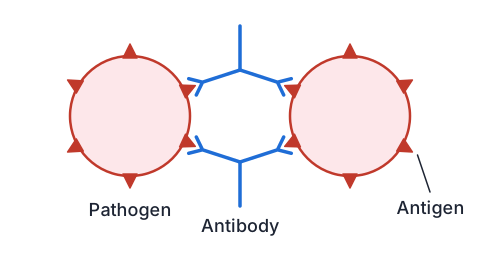
- Other white blood cells recognise the particular shapes, called antigens, on the surface of one kind of pathogen.
- Some of these make antibodies: Y-shaped proteins that fit one antigen like a key in a lock, clump the pathogens together and mark them for destruction.
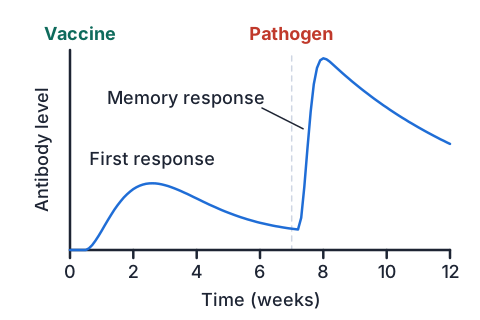
- The first time you meet a new pathogen this takes about one to two weeks, which is why you feel ill. Memory cells stay behind afterwards, so a second attack is crushed before you notice it.
Vaccines: a practice run
- A vaccine shows your immune system the antigens of a pathogen without giving you the disease.
- It might contain a weakened or killed pathogen, just one of its proteins, or instructions that let your own cells make that protein for a short time.
- Your white blood cells respond by making antibodies and memory cells, so if the real pathogen arrives they respond fast and strongly.
- When enough people are immune, about 95 percent for measles, the pathogen cannot find enough hosts to keep spreading, which also protects babies too young to be vaccinated. This is called herd immunity.
Pasteur, Koch and germ theory
- Before the 1860s many people blamed disease on bad air or an imbalance in the body, and believed microbes could appear from nothing.
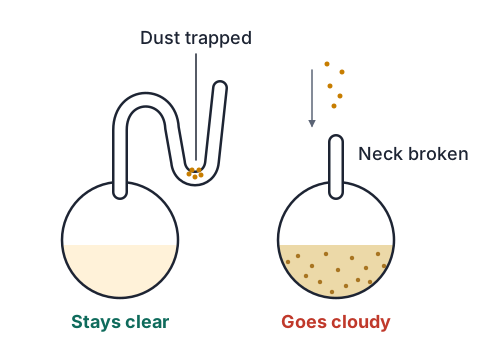
- Louis Pasteur boiled broth in flasks with long curved necks: dust and microbes settled in the bend and the broth stayed fresh, but when the neck was snapped off it soon went cloudy. Microbes came from the air, not from the broth itself.
- Robert Koch linked particular bacteria to particular diseases, anthrax in 1876 and tuberculosis in 1882, by growing each microbe on its own and showing it caused the same disease in a healthy animal.
- Together their work established germ theory: specific microbes cause specific infectious diseases.
- Edward Jenner had protected people against smallpox using cowpox in 1796. Pasteur extended the idea, making vaccines against chicken cholera, anthrax and rabies.
Reading outbreak data
- In 2019 New Zealand had a large measles outbreak: 2168 confirmed cases by mid-December, 1721 of them in the Auckland region.
- The table gives the new confirmed cases reported each week from late July to late October.
- Of the 1275 cases up to 13 September, 633 had not been vaccinated, 28 were partly vaccinated, 75 were fully vaccinated, and for 539 it was not known.
- Describe the pattern, and use the vaccination figures to say who caught measles.
| Week ending (2019) | New confirmed cases |
|---|---|
| 2 August | 32 |
| 9 August | 69 |
| 16 August | 106 |
| 23 August | 132 |
| 30 August | 159 |
| 6 September | 162 |
| 13 September | 165 |
| 20 September | 133 |
| 27 September | 119 |
| 4 October | 120 |
| 11 October | 86 |
| 18 October | 85 |
| 25 October | 42 |
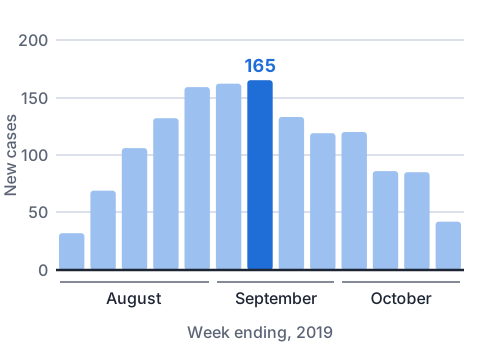
- 32 → 69more than doubled in one week
- 69 → 106 → 132 → 159still rising, by about 25 to 40 a week
- 159, 162, 165levels off in early September
- 133 → 42 by late Octoberthen falls
- 1275 − 539 = 736 cases with a known statusleave out the unknowns
- 633 + 28 = 661, and 661 ÷ 736 ≈ 0.9not fully vaccinated
- Cases rose fast, peaked at about 165 a week in September, then fell; about 9 in 10 cases with a known status were not fully vaccinated
- The table alone cannot show why cases fell: that needs more evidence, such as vaccination and contact-tracing records
What 97 percent effective means
- Two doses of the MMR vaccine are about 97 percent effective at preventing measles. Around 90 in every 100 unvaccinated people exposed in a household catch it.
- How many of 100 fully vaccinated people exposed in the same way would be expected to catch it?
- Without the vaccine: 90 of 100 illthe starting risk
- 97% effective → 3% of that risk remains100% − 97% = 3%
- 3% of 90 = 0.03 × 90 = 2.7scale the risk
- About 3 of 100 vaccinated people, compared with 90 of 100 unvaccinated
Comparing prevention, using evidence
- Hygiene, quarantine and vaccination each block a different step, and the best choice depends on how the pathogen spreads.
- Evidence comes from studies that compare a group using the strategy with a similar group that is not, so any difference can be linked to the strategy.
- Strategies are strongest combined, as in the 2019 measles outbreak, with more than 2,000 cases in New Zealand and most of them in Auckland, where vaccination drives were run alongside asking unvaccinated contacts to stay home.
| Strategy | How it works | Evidence of effect | Limitation |
|---|---|---|---|
| Hand washing | removes pathogens before they reach the mouth or food | in 1847 Semmelweis had doctors wash hands and deaths of new mothers fell to around 2%; modern studies find about a third fewer bouts of diarrhoea | people must keep doing it; does little against airborne spread |
| Quarantine and isolation | keeps infected or exposed people away from others | border quarantine kept NZ's community COVID-19 cases very low for most of 2020 | costly and hard to keep up; does not give lasting protection |
| Vaccination | builds immunity before exposure | smallpox was wiped out worldwide by 1980; two MMR doses about 97% effective | needs high coverage; a few people cannot be vaccinated |
| Biosecurity hygiene | cleaning boots and gear, closing tracks | Waitākere Ranges tracks closed from 2018 to stop kauri dieback spreading in soil | slows spread but does not cure infected trees |
Is this health claim trustworthy?
- A website selling herbal drops says: "Our drops protect your children against measles better than any vaccine. Thousands of happy parents can't be wrong!"
- Check it for accuracy, bias and evidence.
- Who is saying it? The seller of the dropsthey profit if you believe it, so the source is biased
- What evidence? Customer stories onlyno comparison group, so we cannot tell if the drops did anything
- Does it match other evidence? Nolarge studies of millions of children show MMR prevents measles; none support the drops
- The claim is not reliable; check official sources such as the Ministry of Health or a doctor
Common mistakes
- Antibiotics will cure a cold or the flu.Antibiotics only kill bacteria, and colds and flu are caused by viruses, so antibiotics do nothing against them.
- A vaccine gives you a mild case of the disease.A vaccine shows your immune system the pathogen's antigens without causing the disease, so it makes antibodies and memory cells in advance.
- You do not catch chickenpox twice because the antibodies stay in your blood forever.Antibody levels fall after an illness; memory cells stay behind and make new antibodies quickly if the pathogen comes back.
- You can catch asthma or type 2 diabetes from someone who has it.They are non-infectious diseases with no pathogen behind them, so they cannot pass from person to person.
Spread and wash off cinnamon germs
You need: cooking oil, ground cinnamon, a plate, a cup and a sheet of white paper, soap, paper towels, a timer or phone
- Rub half a teaspoon of cooking oil over your hands, then rub in a teaspoon of ground cinnamon; the cinnamon stands for a pathogen.
- Pick up the plate and the cup, touch the paper, and shake hands with someone, then count how many places now have brown specks.
- Rinse your hands under cold running water only for 20 seconds, pat them with a paper towel and check how much cinnamon is left.
- Now wash them with soap and water for 20 seconds and check again.
- Look for the difference: water alone leaves plenty of cinnamon stuck in the oil, but soap lifts the oil and the specks with it, which is why hand washing with soap blocks spread on hands and objects.
Safety: Cinnamon stings if it gets in your eyes or nose, so keep your hands away from your face until they are washed, and wipe up any oil so nobody slips.
Your turn
- 1. Sort into infectious or non-infectious, and name the pathogen type for the infectious ones: measles, asthma, athlete's foot, Giardia infection, type 2 diabetes.
- 2. Why will a doctor not give antibiotics for a cold?
- 3. Explain why someone who had chickenpox as a child usually does not get sick from it again.
- 4. School absences from flu over four days were 4, 8, 15 and 31. Describe the pattern, predict day 5, and suggest one measure to slow it.
- 5. Boot-cleaning stations stand at track entrances in the Waitākere Ranges. Which prevention strategy is this, and which spread route does it block?
Show answer
1. Measles: infectious, virus. Asthma: non-infectious. Athlete's foot: infectious, fungus. Giardia infection: infectious, protist. Type 2 diabetes: non-infectious. 2. Colds are caused by viruses, and antibiotics only work on bacteria. 3. Memory cells made during the first infection stay in the body and respond so fast to a second exposure that the virus is destroyed before symptoms appear. 4. The number roughly doubles each day, so about 60 on day 5. Measures include staying home when sick, covering coughs, hand washing, better ventilation or flu vaccination. 5. Hygiene; it blocks spread in contaminated soil carried on footwear.
What to take away
- Bacteria, viruses, protists and fungi cause infectious diseases, which spread through the air, in bodily fluids, or on contaminated food, water, objects and soil.
- Non-infectious diseases have no pathogen and cannot be caught.
- Skin, hairs, cilia, tears, saliva, stomach acid and your microbiome stop most pathogens getting in.
- White blood cells engulf pathogens or make antibodies that fit their antigens, and memory cells give lasting protection.
- Vaccines create that protection without the illness, and high coverage protects the whole community.
- Pasteur and Koch showed that specific microbes cause specific diseases; judge health claims by their source, their evidence and whether they agree with research.
How is Year 9 maths going?
See the Year 9 maths guide