Electric circuits: charge, current, voltage and resistance
What this lesson covers
- Electric charge, attraction and repulsion, and static electricity
- Current in amperes, voltage in volts and resistance in ohms
- Using V = IR to link the three
- Why a circuit must be a complete loop, and why metals conduct
- Series circuits: one path, shared voltage, one break stops everything
- Parallel circuits: many paths, same voltage, branch currents add up
Electric charge pushes and pulls
- Charge is a property of the particles in matter: protons carry positive charge and electrons carry negative charge.
- Two objects with the same kind of charge push each other away, and objects with opposite charges pull together.
- Rub a balloon on a wool jumper and electrons move from the wool onto the balloon, so the balloon ends up negative and the jumper positive.
- That extra charge stays put on the balloon's surface, which is why it can cling to a wall. Charge that builds up and sits still is called static electricity.
- When charge moves steadily through a material instead, we have an electric current.
| Charges | What happens | Example |
|---|---|---|
| Positive and positive | Repel (push apart) | Two rubbed plastic straws swing away from each other |
| Negative and negative | Repel (push apart) | Hair strands stand apart after a hat is pulled off |
| Positive and negative | Attract (pull together) | A charged balloon pulls on your hair |
| Charge piles up then jumps | A spark | A small shock from a car door, or lightning over the Tasman |
Conductors let charge travel
- A conductor is a material that charge can move through easily.
- Metals are good conductors because some of their electrons are not tied to one atom and can drift through the whole metal.
- This is why the wires inside a phone charger cable are copper, one of the best and cheapest conductors.
- Water with dissolved salts, like sea water or tap water, also conducts, which is why electrical gear and wet hands are a dangerous mix.
Current: how fast charge flows
- Current is the amount of charge passing a point in a circuit each second.
- It is measured in amperes, usually shortened to amps, with the symbol A. One amp means one coulomb of charge passes each second.
- An ammeter measures current, and it must be placed in the loop so the charge flows through it.
- Think of water in a pipe: current is like the number of litres going past each second.
- By convention, current is drawn flowing from the positive terminal of the battery to the negative, even though the electrons themselves drift the other way.
Voltage: the push that drives the charge
- Voltage is the difference in electrical potential between two points, and it is what makes charge move from one point to the other.
- It is measured in volts (V) with a voltmeter, which is connected across a component, one lead on each side.
- In the water picture, voltage is like the pressure difference that drives the water along the pipe. No difference, no flow.
- Around 1800 the Italian scientist Alessandro Volta stacked discs of zinc and copper separated by card soaked in salt water. His pile gave a steady current for the first time, where before people only had brief static sparks.
- The volt is named after him, and every battery is a descendant of his pile.
| Source | Typical voltage |
|---|---|
| AA battery | 1.5 V |
| Phone battery | about 3.7 V |
| Car battery | 12 V |
| NZ wall socket | 230 V (dangerous) |
Resistance: what holds the current back
- Resistance is how much a material or component opposes the flow of charge through it.
- It is measured in ohms, with the symbol Ω (the Greek letter omega).
- For the same voltage, more resistance means less current.
- A wire has more resistance when it is longer, thinner, made of a poorer conductor, or hotter.
- The three quantities are linked by V = IR: voltage equals current times resistance. Rearranged, I = V ÷ R and R = V ÷ I.
| Quantity | Symbol in formulas | Unit | Measured with |
|---|---|---|---|
| Current | I | ampere (A) | Ammeter, in the loop |
| Voltage | V | volt (V) | Voltmeter, across the component |
| Resistance | R | ohm (Ω) | Ohmmeter, or work out V ÷ I |
Using V = IR
- Example 1: a 6 V battery is connected to a 3 Ω resistor. What current flows?
- Example 2: a heater element on 230 V draws 10 A. What is its resistance?
- I = V ÷ RExample 1: rearrange V = IR to get the current
- I = 6 V ÷ 3 Ωsubstitute the values
- I = 2 A
- R = V ÷ IExample 2: rearrange for resistance
- R = 230 V ÷ 10 Asubstitute the values
- R = 23 Ω
A circuit has to be a complete loop
- Charge only flows when there is an unbroken path of conductors from one terminal of the battery, through the components, and back to the other terminal.
- Any gap, even a tiny one, stops the current everywhere in that loop.
- A switch works by making a gap (off, open) or closing it (on, closed).
- A circuit diagram uses standard symbols so anyone can rebuild it. The table describes the ones you need.
| Component | Symbol described | Job |
|---|---|---|
| Cell | A long thin line beside a short thick line; the long line is positive | Provides the voltage |
| Battery | Two or more cells joined | Bigger voltage |
| Lamp (bulb) | A circle with a cross inside | Turns electrical energy into light |
| Switch | A line with a gap and a hinged lever | Opens or closes the loop |
| Resistor | A small rectangle | Limits the current |
| Ammeter | A circle with A inside | Measures current |
| Voltmeter | A circle with V inside | Measures voltage |
Series circuits: one path
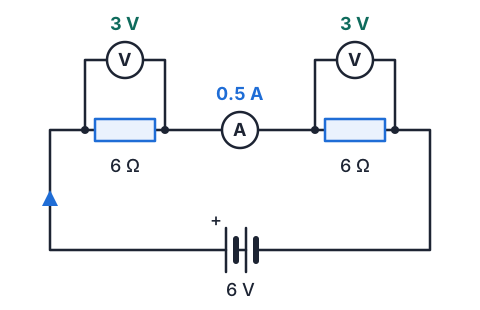
- In a series circuit the components are joined one after another, so there is only one route for the charge.
- The current is the same at every point in the loop, because all the charge has to pass through every component.
- The battery's voltage is shared between the components.
- Each extra component adds its resistance to the total, so the current drops and lamps get dimmer.
- If one lamp breaks, the loop is broken and every lamp goes out.
| Circuit: 6 V battery, two 6 Ω resistors in series | Reading |
|---|---|
| Total resistance | 6 + 6 = 12 Ω |
| Current anywhere in the loop | 6 V ÷ 12 Ω = 0.5 A |
| Voltage across each resistor | 3 V |
| Voltages added up | 3 V + 3 V = 6 V, the battery voltage |
Parallel circuits: several paths
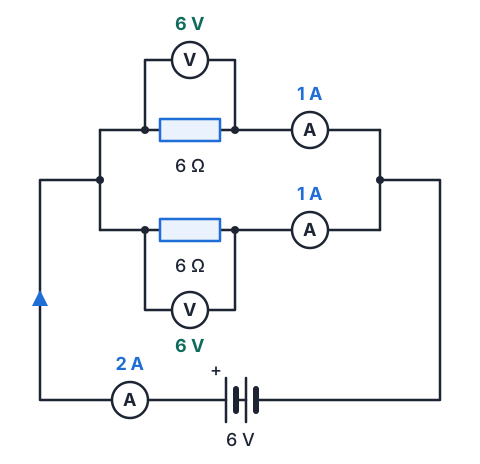
- In a parallel circuit each component sits on its own branch, so the charge has more than one route back to the battery.
- Every branch gets the full battery voltage.
- The current splits at a junction and joins up again, so the total current from the battery equals the branch currents added together.
- Adding another branch gives the charge an extra path, so the total current goes up while each lamp stays just as bright.
- If one branch breaks, current keeps flowing in the others. Houses in New Zealand are wired in parallel, which is why turning off the toaster leaves the lights on.
| Circuit: 6 V battery, two 6 Ω resistors in parallel | Reading |
|---|---|
| Voltage across each branch | 6 V |
| Current in each branch | 6 V ÷ 6 Ω = 1 A |
| Total current from the battery | 1 A + 1 A = 2 A |
| Compared with the series circuit | Four times the total current from the same battery |
Series and parallel side by side
- The same two resistors and the same battery behave very differently depending on how they are joined.
- A parallel circuit drains a battery faster, because it draws more total current.
| Series | Parallel | |
|---|---|---|
| Paths for charge | One | One per branch |
| Current | Same everywhere | Splits; branch currents add to the total |
| Voltage | Shared between components | Full battery voltage across each branch |
| Add a lamp | Total resistance up, current down, all lamps dimmer | Total current up, each lamp the same |
| One lamp breaks | Everything goes off | The other branches stay on |
| Everyday use | A switch in series with the lamp it controls | House wiring, car headlights |
Predict, then test: adding a third lamp
- Two identical lamps are lit by a 3 V battery. A third identical lamp is added. Predict the brightness, first in series and then in parallel.
- Build each circuit with an ammeter next to the battery and compare the readings before and after.
- Series: 2 lamps → 3 lampsone path, so resistances add
- Total resistance rises by half3 lamps instead of 2
- Current falls to two thirds of what it wassame voltage, more resistance
- Series: all three lamps dimmer
- Parallel: the new lamp gets its own brancheach branch has the full 3 V
- Total current rises by halfone more branch current to add
- Parallel: all three lamps as bright as before
Investigation: does a longer wire carry less current?
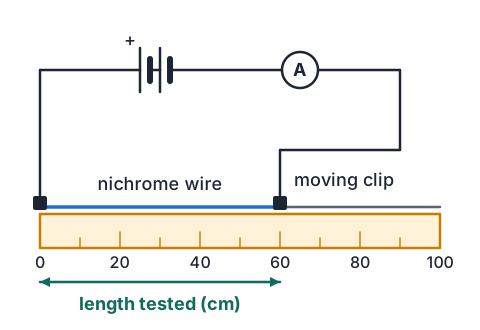
- Clamp a length of thin nichrome wire along a metre ruler and connect it to a battery and an ammeter with crocodile clips.
- Change the length of wire in the circuit by moving one clip: 20 cm, 40 cm, 60 cm, 80 cm, 100 cm.
- Record the current for each length, and repeat each reading three times.
- Keep the battery, the wire material and thickness, and the room temperature the same. Switch off between readings so the wire does not heat up.
- If the current falls as the length grows, longer wire has more resistance. Swapping the wire for resistors of 10 Ω, 20 Ω and 47 Ω tests the same idea with components.
| Variable | In this test |
|---|---|
| Changed (independent) | Length of wire |
| Measured (dependent) | Current in amps |
| Kept the same (controlled) | Battery voltage, wire material, wire thickness, temperature |
Common mistakes
- Current gets used up by the first bulb, so less comes out the other side.Current is the same all the way round a series loop; the bulbs take energy from the charge, not the charge itself.
- Adding a lamp in parallel makes all the lamps dimmer, just like in series.Each parallel branch still gets the full battery voltage, so every lamp stays as bright; the battery just supplies more current and goes flat sooner.
- With 6 V across 3 Ω, the current is 6 × 3 = 18 A.Rearrange V = IR to I = V ÷ R, so the current is 6 ÷ 3 = 2 A; more resistance means less current, not more.
- A rubbed balloon becomes positive because it picks up protons from the jumper.Only electrons move when you rub; the balloon gains electrons and becomes negative, leaving the jumper positive.
Push and pull with static charge
You need: 2 balloons, a wool jumper, or clean dry hair, 50 cm of thread, a tissue torn into small bits, a cold tap
- Blow up and tie both balloons, and tie a 25 cm length of thread to each one.
- Rub one balloon hard on the jumper or your hair for 20 seconds, then hold it just above the tissue bits.
- Rub both balloons on the jumper, then hold them by their threads so they hang side by side, close together.
- Turn the cold tap on to a thin, steady stream and bring a freshly rubbed balloon close to it without touching the water.
- Look for the tissue bits jumping up to the balloon, the two hanging balloons pushing apart because both carry extra electrons and like charges repel, and the stream of water bending towards the balloon. It works best on a dry day.
Safety: Burst balloon pieces can choke small children, so pick up every piece straight away, and skip the balloons if anyone at home has a latex allergy.
Your turn
- 1. A 9 V battery is connected to a 3 Ω resistor. What current flows?
- 2. In a series circuit an ammeter before the first lamp reads 0.4 A. What does an ammeter after the second lamp read?
- 3. A parallel circuit has two branches carrying 0.3 A and 0.5 A. What current comes out of the battery?
- 4. One lamp in a string of three blows. What happens to the other two if the string is in series, and if it is in parallel?
- 5. A balloon rubbed on hair sticks to the ceiling. Explain why, using the word electrons.
Show answer
1. 3 A, because I = V ÷ R = 9 ÷ 3. 2. 0.4 A, because the current is the same everywhere in a series loop. 3. 0.8 A, because branch currents add: 0.3 + 0.5. 4. In series both go out, because the only path is broken. In parallel both stay lit, because each has its own path. 5. Rubbing moves electrons from the hair onto the balloon, so the balloon becomes negatively charged. Its charge pulls on the opposite charges in the ceiling surface, and the attraction holds it up.
Circuit Construction Kit: DC
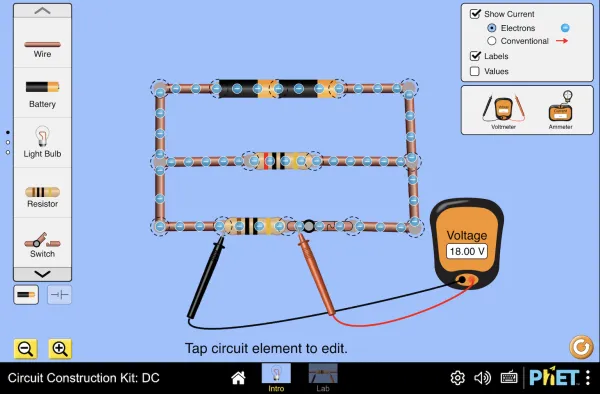
Full screen · PhET Interactive Simulations, University of Colorado Boulder, CC BY 4.0
Recap
- Like charges repel and opposite charges attract; static electricity is charge that has built up and stays put.
- Current (A) is the flow of charge, voltage (V) is the push, resistance (Ω) holds it back, and V = IR links them.
- Charge flows only around a complete loop of conductors such as copper.
- Series: one path, the same current everywhere, voltage shared, one break stops it all.
- Parallel: many paths, the same voltage on each branch, branch currents add, a break only stops its own branch.
How is Year 9 maths going?
See the Year 9 maths guide