Electric circuits: insulators, resistors, energy and efficiency
What this lesson covers
- Insulators, and how to test a material in a simple circuit
- What resistors are for, and electric fields around charges
- Placing ammeters and voltmeters, and reporting results the scientific way
- Energy in joules: conserved, and calculated from other measurements
- Energy transfers in a circuit, efficiency and energy flow diagrams
- How electricity is generated, and which methods suit New Zealand
Where part 1 left off
- Part 1 covered charge, current, voltage and resistance, and how series and parallel circuits share them out.
- This part asks what stops charge, how to control it, and what the moving charge actually delivers: energy.
Insulators keep charge where it belongs
- An insulator is a material that charge cannot move through easily, because its electrons are held tightly to their atoms.
- Plastic, rubber, glass, dry wood and air are all insulators.
- Cables have a copper core to carry the current and a plastic coat so the charge cannot reach your hand.
- The big glass or ceramic discs on power pylons stop the charge in the lines leaking down into the tower.
- Because charge cannot flow away through an insulator, rubbed insulators are the objects that hold static charge best.
Investigation: conductor or insulator?
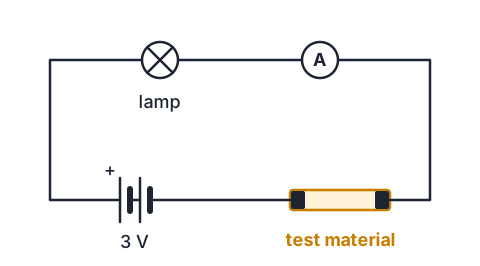
- Build a series circuit with a battery, a lamp and two crocodile clips with a gap between them.
- Clip each test material across the gap in turn. If the lamp lights, the material conducts; if not, it insulates.
- Use the same battery, lamp and clip spacing for every material so only the material changes.
- A lamp needs quite a lot of current, so add an ammeter to catch materials like graphite or salty water that conduct only weakly.
| Material | Lamp | Ammeter (A) | Group |
|---|---|---|---|
| Copper wire | Bright | 0.30 | Conductor |
| Aluminium foil | Bright | 0.30 | Conductor |
| Pencil graphite | Dim | 0.12 | Conductor (weak) |
| Plastic ruler | Off | 0.00 | Insulator |
| Dry pōhutukawa twig | Off | 0.00 | Insulator |
| Rubber band | Off | 0.00 | Insulator |
Resistors: resistance on purpose
- A resistor is a component made to have a set, often large, resistance.
- Its job is to limit the current in its part of the circuit, for example to stop an LED burning out.
- Coloured bands printed on the resistor give its value in ohms.
- A variable resistor lets you change the resistance by turning a knob, which is how a dimmer switch or a volume control works.
Choosing a resistor for an LED
- An LED needs 2 V across it and a current of 0.02 A. It is in series with a resistor on a 9 V battery. What resistance is needed?
- In series the battery voltage is shared, so the resistor takes whatever the LED does not use.
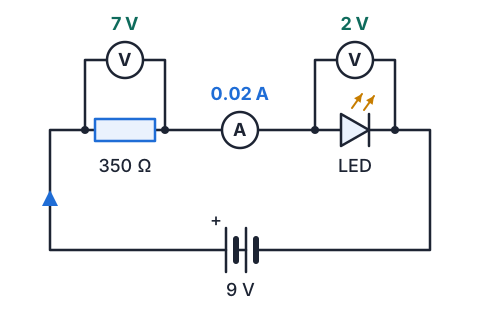
- V across resistor = 9 V − 2 V = 7 Vseries voltages add up to the battery voltage
- I = 0.02 Aseries current is the same through the LED and the resistor
- R = V ÷ I = 7 V ÷ 0.02 Arearranged V = IR
- R = 350 Ω
Electric fields: forces without touching
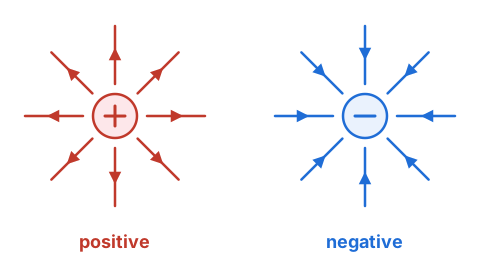
- Every charged object is surrounded by an electric field, the space where another charge will feel a push or a pull.
- That is how a charged balloon can lift your hair before it touches it.
- The field is strongest close to the charge and weakens with distance.
- Field lines are drawn pointing outward from a positive charge and inward toward a negative one; they show the direction a small positive charge would be pushed.
- In a circuit, the battery sets up a field along the wires, and that field is what pushes the charge round.
Measuring current and voltage, and reporting it
- An ammeter goes in series, in the loop, because it counts the charge flowing through it.
- A voltmeter goes in parallel, across a component, because it compares two points.
- Connect the red lead toward the positive terminal; a reversed meter shows a negative reading or a needle pushed backwards.
- Report each value with its unit symbol and a space, such as 0.25 A or 4.5 V. Unit symbols named after people take a capital letter (A, V, Ω, J), but the unit names do not (amp, volt).
- Draw circuits with standard symbols and straight lines, record repeated readings in a table with units in the headings, and round to the precision the meter gives.
| Meter | Connected | Reads in | Wrongly connected |
|---|---|---|---|
| Ammeter | In series, in the loop | amps (A) | Across a component it can short the circuit and blow its fuse |
| Voltmeter | In parallel, across a component | volts (V) | In the loop it blocks the current almost entirely |
Energy is counted in joules
- Energy is never made or destroyed, only moved or changed from one form to another. Scientists say it is conserved.
- It is measured in joules (J). Lifting a 100 g apple up 1 m takes about 1 J.
- There is no meter that reads energy directly; we work it out from things we can measure.
- Work done by a force: energy = force × distance moved. Kinetic energy of a moving object: ½ × mass × speed².
- In a circuit, voltage is the energy each coulomb of charge carries, so energy = voltage × current × time.
Three energy calculations
- A: you push a box 3 m across the floor with a force of 50 N.
- B: a 2 kg rugby ball flies at 3 m/s. (A real one is about 0.4 kg; 2 kg keeps the numbers simple.)
- C: a lamp on a 6 V battery draws 0.5 A for one minute.
- A: E = F × d = 50 N × 3 mwork done by a force
- E = 150 J
- B: E = ½ × 2 kg × (3 m/s)² = ½ × 2 × 9square the speed first
- E = 9 J
- C: t = 1 min = 60 stime must be in seconds
- E = V × I × t = 6 V × 0.5 A × 60 senergy delivered by the battery
- E = 180 J
Where the energy goes in a circuit
- A battery stores energy in chemicals. As charge leaves it, the charge carries electrical energy around the loop.
- In each component the moving charge bumps into particles and hands over energy: as light and heat in a lamp, as movement in a motor, as sound in a speaker.
- The charge itself is not used up; the same charge comes back to the battery to pick up more energy.
- Every transfer wastes some energy as heat. Wires warm a little, a lamp gets hot, a laptop charger feels warm.
- That heat spreads into the room and cannot easily be collected again, so it counts as lost from the useful system even though it still exists.
Efficiency and energy flow diagrams
- Efficiency is the share of the input energy that ends up as the useful output.
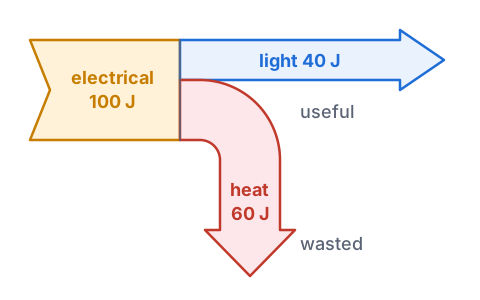
- An energy flow (Sankey) diagram draws the input as a wide arrow that splits into useful and wasted arrows, each as wide as the energy it carries. The table below is that diagram in numbers.
- Compare an old filament bulb and an LED, both given 100 J of electrical energy.
| Lamp | Energy in | Light out (useful) | Heat out (wasted) | Efficiency |
|---|---|---|---|---|
| Filament bulb | 100 J | 10 J | 90 J | 10% |
| LED | 100 J | 40 J | 60 J | 40% |
- efficiency = useful energy out ÷ total energy in × 100%the definition
- LED: 40 J ÷ 100 J × 100%substitute
- LED efficiency = 40%
- 40 J + 60 J = 100 Joutputs add to the input
How electricity is generated
- Most power stations spin a turbine. The turbine turns a generator, where magnets rotating near coils of wire push charge along the wire.
- The difference between stations is what spins the turbine: falling water, wind, or steam from geothermal heat or burning gas and coal.
- Solar panels have no moving parts. Light falling on silicon frees charge in the panel directly.
- No method is perfectly efficient. A large hydro station turns about 90% of the water's energy into electricity, a solar panel about 20% of the sunlight.
| Method | What drives it | NZ example |
|---|---|---|
| Hydro | Water falling from a lake through turbines | Manapōuri, Clyde, the Waikato River stations |
| Geothermal | Steam from hot rock deep underground | Wairākei and others near Taupō and Rotorua |
| Wind | Moving air turning large blades | Wind farms near Palmerston North and in Southland |
| Gas and coal | Steam or hot gas from burning fuel | Huntly Power Station |
| Solar | Sunlight on photovoltaic cells | Rooftop panels and new solar farms |
Which methods suit New Zealand?
- In recent years about 85 to 90% of New Zealand's electricity has come from renewable sources, with hydro alone supplying over half.
- Hydro can be turned up and down quickly to match demand, but in a dry year the southern lakes run low.
- When that happens, Huntly burns gas and coal to fill the gap, which releases carbon dioxide.
- Geothermal runs steadily day and night, but only in the volcanic centre of the North Island.
- Wind and solar are cheap to run and growing fast, but they only produce when the wind blows or the sun shines, so they work best alongside hydro that can store water for later.
Common mistakes
- A voltmeter goes in the loop, the same as an ammeter.A voltmeter goes across the component; in the loop its very high resistance almost stops the current.
- The lamp uses up the energy, so it no longer exists.Energy is conserved: the lamp changes electrical energy into light and heat, and the heat spreads into the room rather than disappearing.
- A lamp on 6 V drawing 0.5 A for one minute uses 6 × 0.5 × 1 = 3 J.Time must be in seconds for joules, so E = 6 × 0.5 × 60 = 180 J.
- A lamp with 100 J in and 40 J of light out is 250% efficient, from 100 ÷ 40.Efficiency is useful out ÷ total in × 100%, so 40 ÷ 100 × 100% = 40%; it can never pass 100%, because no device makes energy.
How efficient is a bouncing ball?
You need: a tennis ball, one or two other balls, such as a ping-pong ball or a rubber ball, a tape measure, sticky tape, a phone camera, a hard floor next to a wall
- Tape the tape measure up the wall so it reads 0 at the floor and reaches past 1 m.
- Hold a ball with its bottom level with the 100 cm mark and let it go without throwing it, while someone films it against the tape.
- Go through the recording frame by frame and read the height of the bottom of the ball at the top of its first bounce.
- Do three drops for each ball, leave out any result that does not fit, and average the bounce heights.
- Lifting a ball gives it energy equal to its weight × the height, so its efficiency is bounce height ÷ drop height × 100%.
- Look for every ball coming back lower than 100 cm, because each bounce turns some energy into heat and sound; a tennis ball gets back only a little over half its height, so it is about 55% efficient.
Safety: Drop the balls from your hand while standing on the floor, never from a chair or table, and keep clear of windows and anything breakable in case a bounce goes sideways.
Your turn
- 1. Why is the inside of a cable copper and the outside plastic?
- 2. A student puts a voltmeter in the loop of a series circuit and the lamp goes out. Explain what went wrong.
- 3. A kettle element on 230 V draws 8 A for 120 s. How much energy is transferred?
- 4. A motor receives 500 J of electrical energy and gives 350 J of movement energy. How much is wasted, and what is its efficiency?
- 5. Give one advantage and one disadvantage of relying on hydro for most of New Zealand's electricity.
Show answer
1. Copper is a conductor, so it carries the current; plastic is an insulator, so the charge cannot reach whoever holds the cable. 2. A voltmeter has a very high resistance, so in the loop it almost stops the current. It should be connected across the lamp. 3. 220 800 J (about 221 kJ), from E = V × I × t = 230 × 8 × 120. 4. 150 J is wasted, mostly as heat, and the efficiency is 350 ÷ 500 × 100% = 70%. 5. Advantage: renewable, with no carbon dioxide while running, and it can be turned up quickly when demand rises. Disadvantage: dry years leave the lakes low, so fossil fuel stations like Huntly have to make up the shortfall.
Resistance in a Wire
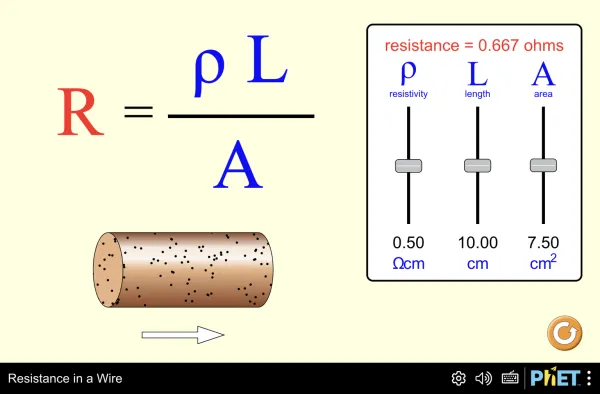
Full screen · PhET Interactive Simulations, University of Colorado Boulder, CC BY 4.0
Recap
- Insulators such as plastic and rubber hold their electrons tightly and stop charge flowing; test materials with a lamp and an ammeter.
- Resistors limit current; electric fields surround charges and push or pull other charges without contact.
- Ammeters go in series, voltmeters go across; report values with the right unit symbol.
- Energy is conserved, measured in joules, and calculated: F × d, ½mv², or V × I × t in a circuit.
- Some energy is always wasted as heat; efficiency = useful out ÷ total in × 100%, shown with an energy flow diagram.
- Turbines (hydro, geothermal, wind, gas) and solar panels generate electricity; New Zealand leans on hydro and geothermal.
How is Year 9 maths going?
See the Year 9 maths guide