Net force, balanced and unbalanced forces, and pressure
What this lesson covers
- Forces in newtons, and where the unit's name comes from
- Finding the net force by combining forces and their directions
- Zero net force: still objects stay still, moving ones keep a steady speed in a straight line
- A non-zero net force changes speed or direction
- Variables, reliability and accuracy in a motion experiment
- Calculating pressure, force and area with P = F ÷ A
Forces are measured in newtons
- A force is a push or a pull, and it always has a size and a direction.
- Forces are measured in newtons (N), named after Isaac Newton, the English scientist who published his three laws of motion in 1687.
- One newton is roughly the weight of a small apple, about 100 g, resting on your hand.
- A force meter (a spring balance) measures force by how far a spring stretches.
- On a diagram, a force is drawn as an arrow: the arrow points the way the force acts, and a longer arrow means a bigger force.
Net force: what all the forces add up to
- Most objects have several forces on them at once. The net force is the single force that has the same effect as all of them together.
- Forces in the same direction add.
- Forces in opposite directions subtract, and the net force points the way of the bigger one.
- If opposite forces are equal, they cancel and the net force is zero. The forces are then called balanced.
| Situation | Forces | Net force |
|---|---|---|
| Two people push a stuck car forward | 300 N forward + 250 N forward | 550 N forward |
| Tug of war | 400 N left, 400 N right | 0 N (balanced) |
| Tug of war | 450 N left, 400 N right | 50 N left |
| Kererū perched on a branch | Weight 6 N down, branch pushes 6 N up | 0 N (balanced) |
Working out a net force
- A car on the motorway has a 2000 N driving force forward. Air resistance pushes back with 500 N and road friction with 300 N.
- Find the net force and say what the car does.
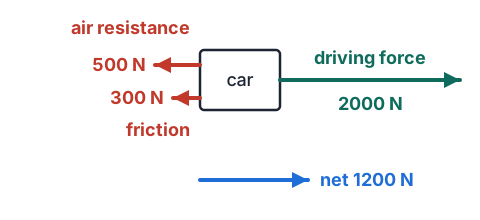
- Forces backward = 500 N + 300 N = 800 Nsame direction, so add
- Net force = 2000 N − 800 Nopposite directions, so subtract
- Net force = 1200 N forwardthe forward force is bigger
- 1200 N forward: the car speeds up
Zero net force: no change in motion
- If the net force is zero, an object at rest stays at rest.
- An object that is already moving keeps going at the same speed in the same straight line.
- This surprises people, because everyday things seem to need a push to keep moving. They do, but only to cancel friction and air resistance.
- A car cruising at a steady 100 km/h has its driving force exactly matched by the forces pushing back, so the net force is zero.
- A puck on smooth ice glides a long way because there is almost no friction to unbalance it.
Unbalanced forces change motion
- If the net force is not zero, the forces are unbalanced and the motion changes.
- The object speeds up if the net force points the way it is moving, and slows down if the net force points against it.
- A net force from the side changes the direction of motion.
- The change does not happen instantly; it builds up for as long as the net force acts. Push a shopping trolley for two seconds and it keeps gaining speed for those two seconds.
| Net force on a moving trolley | What happens |
|---|---|
| Zero | Keeps the same speed in a straight line |
| Forward (you push harder than friction) | Speeds up |
| Backward (you let go, friction acts) | Slows down and stops |
| Sideways (you pull the handle to one side) | Turns a corner |
Reasoning about a falling skydiver
- A skydiver jumps from a plane over Taupō. Describe the forces and motion from the jump until her speed stops rising.
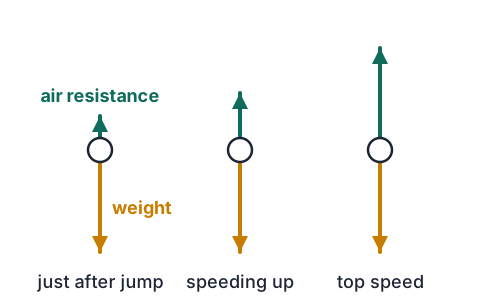
- Just after the jump: weight down, almost no air resistanceshe is barely moving yet
- Net force down, so she speeds upforces unbalanced
- Faster fall → more air resistanceair pushes harder on faster objects
- Net force shrinks, so she speeds up more slowlystill unbalanced, but less
- Air resistance = weight: net force 0, steady top speed
Planning a motion experiment
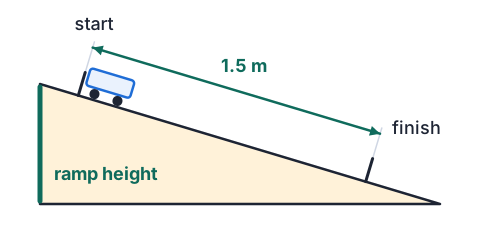
- Question: does a trolley reach the bottom of a ramp faster when the ramp is steeper?
- The independent variable is the one you change on purpose: the height of the raised end of the ramp.
- The dependent variable is the one you measure: the time to roll 1.5 m down the ramp.
- The controlled variables are everything else that could change the result, kept the same so the test is fair.
- If the times fall as the height rises, a steeper ramp gives the trolley a larger net force down the slope.
| Variable type | In this experiment |
|---|---|
| Independent (changed) | Ramp height: 10, 20, 30, 40 cm |
| Dependent (measured) | Time to travel 1.5 m, in seconds |
| Controlled (kept the same) | Same trolley and load, same ramp surface, same distance, released from rest without a push, same timer |
Making results reliable
- A result is reliable when you get nearly the same value each time you repeat it.
- Predict what could make the trials differ: giving the trolley a small push, starting it from a slightly different spot, or the timer reacting late.
- Repeat each height at least three times, look for any trial that does not fit, then average the rest.
- Times for the 20 cm ramp: 2.31 s, 2.28 s, 2.95 s, 2.34 s.
- 2.95 s is far from the other threelikely a mistake, such as a late start
- Leave out 2.95 s as an outlierbut record it and say why
- Mean = (2.31 + 2.28 + 2.34) ÷ 3 = 6.93 ÷ 3add, then divide by the number of trials
- Mean time = 2.31 s
Making measurements accurate
- A measurement is accurate when it is close to the true value.
- Hand timing is the weak point: people take about 0.2 s to react, which is nearly 10% of a 2.3 s run.
- The table lists ways to cut each source of error.
| Source of error | Improvement |
|---|---|
| Reaction time on a stopwatch | Use light gates, or film on a phone and count frames |
| Short times are hard to judge | Use a longer ramp so the time is bigger |
| Release point varies | Mark a start line and hold the trolley against a ruler, then lift the ruler |
| Distance read by eye | Use a tape measure in millimetres and read it at eye level |
| Different people timing | Keep the same person on the timer for every trial |
Pressure: force spread over an area
- Pressure tells you how concentrated a force is: how much force pushes on each square metre.
- Pressure = force ÷ area, written P = F ÷ A.
- With force in newtons and area in square metres, pressure is in pascals (Pa). 1 Pa = 1 N/m².
- Rearranged: F = P × A to find the force, and A = F ÷ P to find the area.
- Areas are often measured in cm². There are 100 × 100 = 10 000 cm² in 1 m², so divide cm² by 10 000 to get m².
Pressure, force and area
- A: a student weighing 600 N stands on two shoes with 200 cm² of contact each. Find the pressure on the floor.
- B: a car tyre presses on the road over 0.02 m² at a pressure of 200 000 Pa. Find the force.
- C: a crate with a weight of 900 N must not press on a deck with more than 3000 Pa. Find the smallest base area.
- A: area = 2 × 200 cm² = 400 cm² = 0.04 m²two shoes, then ÷ 10 000
- P = F ÷ A = 600 N ÷ 0.04 m²the pressure formula
- P = 15 000 Pa
- B: F = P × A = 200 000 Pa × 0.02 m²rearranged for force
- F = 4000 N
- C: A = F ÷ P = 900 N ÷ 3000 Parearranged for area
- A = 0.3 m²
Common mistakes
- A moving object needs a forward net force to keep going at a steady speed.At a steady speed in a straight line the net force is zero; the forward push only cancels friction and air resistance.
- 450 N to the left and 400 N to the right give a net force of 850 N.Opposite forces subtract, so the net force is 450 − 400 = 50 N to the left, the way of the bigger force.
- 600 N on 400 cm² gives a pressure of 600 ÷ 400 = 1.5 Pa.Pascals need square metres, so convert 400 cm² to 0.04 m² first: 600 ÷ 0.04 = 15 000 Pa.
- One careful run is enough, and an odd result can just be deleted.Repeat each test at least three times so an outlier stands out, and record any result you leave out along with the reason.
Ramp height and stopping distance
You need: a toy car, a large hardcover book or a flat board, a stack of books, a ruler, a tape measure, masking tape
- On a hard floor, rest one end of the board on books so the raised end is 5 cm high, and stick a strip of tape across it as the start line.
- Hold the car with its back wheels on the start line and let go without pushing it.
- Measure how far the car travels from the bottom of the ramp to where it stops, and do three runs.
- Raise the end to 10 cm and then 15 cm, keeping the same car, start line, board and floor, with three runs at each height.
- For each height, leave out any run far from the other two, say why, and average the rest.
- Look for the car going further from a higher ramp, because it reaches the floor faster; on the floor, friction is an unbalanced force pointing backwards, so the car slows down and stops.
Safety: A toy car on a hard floor is easy to step on and slip, so pick it up after every run and keep the books out of walkways.
Your turn
- 1. A boat's engine pushes forward with 800 N. Water drag is 650 N backward. Find the net force and say what the boat does.
- 2. A cyclist moves at a steady 20 km/h in a straight line. What is the net force on her, and how do you know?
- 3. In a test of how the mass of a trolley affects its speed down a ramp, name the independent, dependent and two controlled variables.
- 4. Trial times: 3.10 s, 3.06 s, 3.62 s, 3.08 s. Which is the outlier, and what is the mean of the others?
- 5. A 50 N box sits on a base of 0.25 m². What pressure does it exert?
Show answer
1. 150 N forward, from 800 − 650, so the boat speeds up. 2. Zero, because her speed and direction are not changing; her pedalling force exactly matches friction and air resistance. 3. Independent: the trolley's mass. Dependent: the time (or speed) down the ramp. Controlled: any two of ramp height, ramp length, surface, release method and the timer. 4. 3.62 s is the outlier. Mean = (3.10 + 3.06 + 3.08) ÷ 3 = 9.24 ÷ 3 = 3.08 s. 5. 200 Pa, from 50 ÷ 0.25.
Forces and Motion: Basics
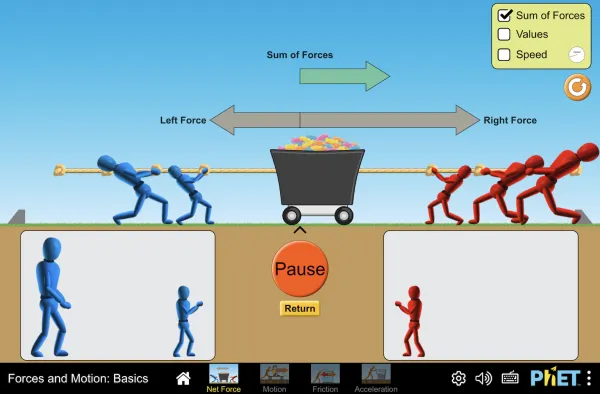
Full screen · PhET Interactive Simulations, University of Colorado Boulder, CC BY 4.0
Recap
- Forces are measured in newtons (N); forces the same way add, opposite ways subtract, giving the net force.
- Net force zero: at rest stays at rest, moving keeps a steady speed in a straight line.
- Net force not zero: the object speeds up, slows down or turns, and the change builds up while the force acts.
- Fair tests change one independent variable, measure one dependent variable and control the rest; repeat, drop outliers, average.
- Accuracy improves with better timing, longer distances and careful reading of scales.
- Pressure P = F ÷ A in pascals; rearrange to F = P × A or A = F ÷ P, and convert cm² to m² first.
How is Year 9 maths going?
See the Year 9 maths guide