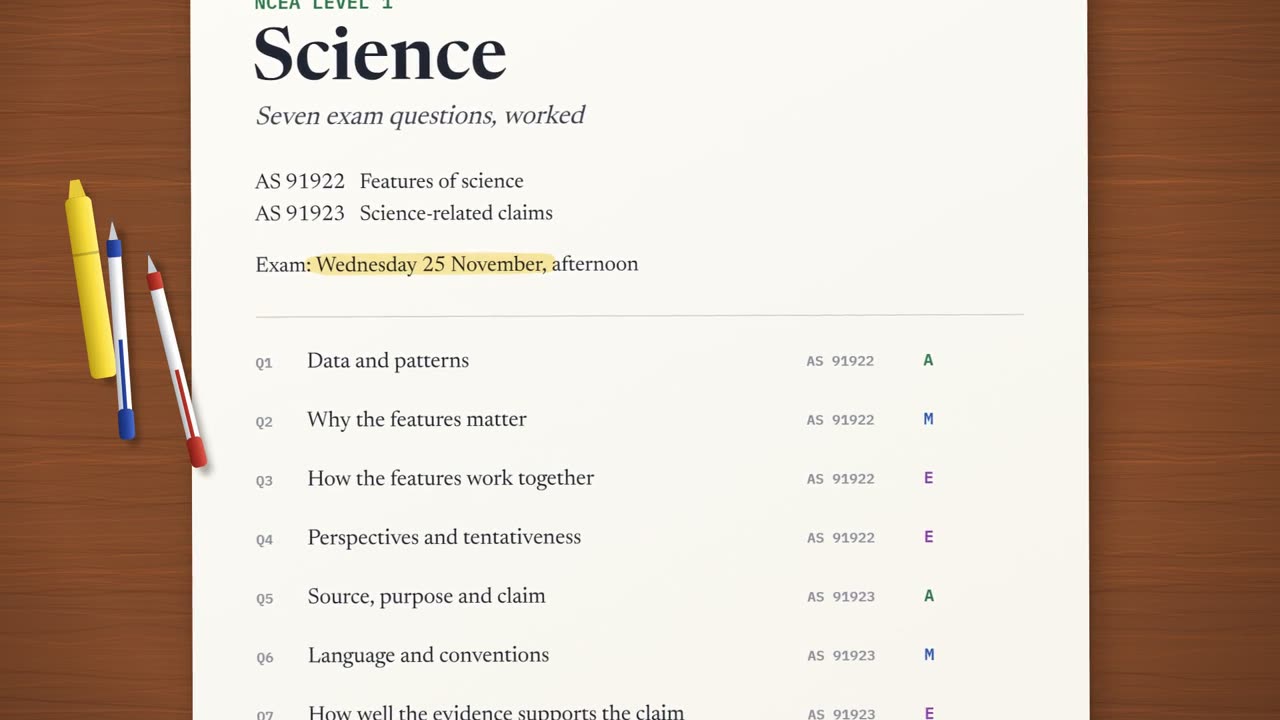
NCEA Level 1 Science revision
- Exam Wednesday 25 November, afternoon
- AS 91922
- AS 91923
What comes up
AS 91922
Question 1 · Data and patterns
Resource: Kākāpō recovery and the rimu
Kākāpō are flightless, nocturnal parrots found only in Aotearoa New Zealand, and a taonga species to Ngāi Tahu. When the Kākāpō Recovery Programme began in 1995 there were just 51 birds, only 20 of them female. The Department of Conservation (DOC) and Ngāi Tahu have worked together on the programme ever since, with rangers, scientists, volunteers and, since 2016, Meridian Energy.
Kākāpō breed only when rimu trees mast (produce a huge crop of fruit), about once every two to four years, because mothers feed their chicks rimu fruit. Before each season rangers collect sample rimu branches on each breeding island and count the tips carrying fruit. Over many seasons the team found that some kākāpō breed when more than 10% of rimu tips carry fruit, and more kākāpō breed as that percentage rises. Summer temperature patterns now let them predict a mast up to two years ahead. For 2026 the counts predicted record fruiting, around 50 to 60% of tips on all three islands.
The breeding birds live on three predator-free islands: Whenua Hou (Codfish Island), Pukenui (Anchor Island) and Te Kāhaku (Chalky Island). Every kākāpō wears a small backpack radio transmitter, and remote monitoring records mating and nesting, so rangers can follow each bird.
In 2019 a record 73 chicks fledged, but a fungal disease, aspergillosis, killed nine kākāpō. Scientists later showed that a single strain of the fungus caused the outbreak.
Low genetic diversity means many eggs are infertile or fail to hatch, so for years rangers checked nests often, raised many eggs in incubators and gave mothers extra food. In 2026, the biggest season so far, the team trialled a more hands-off approach: fewer nest checks guided by remote nest data, more eggs left to hatch in the nest, and less extra food. Ngāi Tahu's aim is to restore the mauri (life force) of kākāpō so they can one day thrive without intensive help, and some 2026 chicks will stay unnamed as a first step back to their natural ways.
On 1 September 2026, 90 chicks from the season joined the official count, taking the population to 325, the highest since the programme began. DOC's modelling suggests the next breeding season could come in 2028, only two years later.
The science idea: kākāpō breed when the rimu masts, so their recovery can be planned around the rimu.
For this question, focus on two features of science:
• replicable, verifiable data collection
• interpreting patterns and interactions.
Describe how each of these two features has contributed to the development of the science idea. Use examples from the resource.
Hint
For each feature, say what the scientists actually did, then point at the line in the resource that shows it. Data collection: what is counted, and is it counted the same way each time? Patterns: what goes up when something else goes up?
Answer
Replicable, verifiable data collection: before every season rangers count the fruiting tips on sample rimu branches from each breeding island, in the same way each time, so the counts can be compared between islands and years and checked by others. Each kākāpō also wears a radio transmitter, and remote monitoring records mating and nesting the same way for every bird. Interpreting patterns and interactions: comparing the tip counts with which kākāpō bred showed a pattern: some kākāpō breed when more than 10% of rimu tips carry fruit, and more breed as the percentage rises. A second pattern, between summer temperatures and masting, lets the team predict a breeding season up to two years ahead.
Step by step
- Name the first feature: replicable, verifiable data collection.
- Outline it with the resource: rangers count the fruiting tips on sample rimu branches on each island before every season, in the same way, so the numbers can be compared and checked.
- A second example of the same feature: every bird wears a radio transmitter, and remote monitoring records mating and nesting.
- Name the second feature: interpreting patterns and interactions.
- Outline it: an interaction between two variables, the percentage of rimu tips fruiting and the number of kākāpō that breed. Above 10%, some breed; the higher the percentage, the more breed.
- A second pattern: summer temperatures predict a mast up to two years ahead.
- Two features, each outlined with an example from the resource, is Achieved.
Full working
- replicable data: rimu tips counted the same way, every island, every seasonoutlined
- transmitters and remote monitoring record every birdsecond example
- pattern: over 10% of tips fruiting, some kākāpō breed; more fruit, more breedoutlined
- summer temperatures predict a mast up to 2 years aheadsecond pattern
Question 2 · Why the features matter
Explain why each of these two features of science has been important to the development of the science idea. Give an example from the resource for each feature.
Hint
Merit is the word because. For each feature, finish the sentence: this mattered because, without it, ...
Answer
Replicable, verifiable data collection was important because the rimu counts are only useful if every island and every season is counted the same way. If rangers counted differently from year to year, a change in the numbers could come from the method rather than the trees, and the 10% threshold could not be trusted. Because the method is repeated, other scientists can check the counts and should get similar results. Interpreting patterns was important because the tip counts on their own are just numbers: it was by linking the fruiting percentage with breeding that the team learned when kākāpō will breed. That lets them predict a season, up to two years ahead from summer temperatures, and prepare staff, nest monitoring and extra food in time. This matters for a species that was down to 51 birds, where every chick counts.
Step by step
- Start from the Achieved outline, then add why it mattered.
- Data: the counts must be taken the same way, BECAUSE otherwise a change could come from the counting, not from the rimu.
- So repeatable counts let the team, and other scientists, trust the 10% threshold.
- Patterns: the counts become useful only when linked to breeding, BECAUSE that link is what tells the team when kākāpō will breed.
- So the pattern turns data into a prediction, and the team can have staff, monitoring and food ready.
- Tie it to the context: with only 51 birds in 1995, missing a breeding season would cost chicks the species could not spare.
- Why each feature mattered, with an example for each, is Merit.
Full working
- same method every season, because otherwise a change could come from the counting, not the treeswhy data mattered
- so the 10% threshold can be trusted and checked by othersconsequence
- pattern turns counts into a prediction, because it links fruit to breedingwhy patterns mattered
- team has staff and food ready for a mast; vital with only 51 birds in 1995example from the resource
Question 3 · How the features work together
Discuss how these two features of science have worked together to develop the science idea.
Hint
Excellence is about the link between the features. Ask: could the pattern have been found without the careful data? And once the pattern was known, what did it change about the data the team collects?
Answer
The two features depend on each other. The pattern, that more than 10% of rimu tips fruiting means some kākāpō breed, could only be found because tip counts had been collected the same way, on the same islands, over many seasons; with inconsistent counts, any pattern could have been an accident of the method. In return, the pattern tells the team which data is worth collecting: because tip counts and summer temperatures predict breeding, they keep counting tips and recording temperatures every year. Each new season then adds fresh, comparable data that tests whether the pattern still holds. In 2026 the counts predicted record fruiting, and the season produced a record 90 chicks, which supports the pattern. Without reliable data there would be no trustworthy pattern, and without the pattern the data could not be used to plan a breeding season.
Step by step
- Excellence discusses an interaction: how one feature makes the other possible or useful.
- Data to pattern: the 10% pattern could only be trusted because the counts were taken the same way over many seasons.
- Pattern to data: once the pattern was known, it told the team what to keep measuring every year (rimu tips and summer temperatures).
- The loop: each new season's data tests the pattern again. In 2026 high fruiting was predicted, and a record 90 chicks followed.
- Finish with what would be lost without either feature: no trustworthy pattern without reliable data, and no use for the data without the pattern.
- Two interactions discussed with examples from the resource is E8.
Full working
- the 10% pattern can only be trusted because counts were consistent for yearsdata makes the pattern
- the pattern tells the team what to keep counting: rimu tips, summer temperaturespattern shapes the data
- each season's counts test the pattern again: 2026 predicted high, record 90 chicksthey check each other
- without one, the other is useless for planning a seasonconclusion
Question 4 · Perspectives and tentativeness
Discuss how these two features of science have worked together to develop the science idea.
Hint
A new perspective raises a new question. Because science is tentative, the team tests it instead of defending the old way, and the test produces new evidence. Follow that loop with the 2026 season.
Answer
The two features feed each other. Ngāi Tahu's perspective raised a new question: can kākāpō breed well with less human help, so their mauri is restored? Because scientific ideas are tentative, the team did not defend intensive management as the only right way; it tested the new idea in the 2026 season with fewer nest checks guided by remote nest data, more eggs left in the nest and less extra food. That trial produces new evidence. The season still gave a record 90 chicks, which supports trying less intervention, and the results will show where intensive help is still needed. If hands-off nests do as well as managed ones, the idea of what kākāpō need will change again; if they do worse, it will change back where needed. In the same way, the 2019 outbreak was new evidence that showed the programme's ideas were incomplete, and being tentative let the team respond by studying the disease instead of treating it as bad luck. Without openness to change, new perspectives and evidence would be ignored; without new perspectives and evidence, there would be nothing to change the ideas.
Step by step
- Excellence: show the loop between the two features, with examples.
- Perspective to tentative: Ngāi Tahu's mauri aim raised a new question, and because ideas are tentative the team tested it in 2026 instead of defending the old method.
- Tentative to new evidence: the test (fewer checks, eggs left in nests, less food) produces new evidence; 90 chicks so far supports the idea.
- The idea stays open: the results could push the method further, or back where help is still needed.
- A second interaction: the 2019 outbreak was new evidence the old ideas did not cover, and being tentative is what let the team study it.
- Conclusion: each feature is useless without the other. Two interactions discussed with examples is E8.
Full working
- Ngāi Tahu perspective raises a new question: can kākāpō breed with less help?perspective
- ideas are tentative, so the team tests it in 2026 instead of defending the old waytentative
- the trial gives new evidence: record 90 chicks with less interventionthe loop
- 2019 outbreak: new evidence the old ideas missed; an open team studies itsecond interaction
Question 5 · Source, purpose and claim
Resource A: NightOwl Optics website (product page)
SLEEP BETTER TONIGHT with NightOwl Blue-Block Glasses.
Phones and laptops give off blue light, which tells your brain it is still daytime. Our patented amber lenses block 99% of blue light, so your body can make melatonin, the sleep hormone, naturally.
Clinically tested: in our 2025 trial, 20 NightOwl customers wore the glasses for two hours before bed for one week. On average they fell asleep in 31 minutes, compared with 37 minutes the week before.
"I fall asleep so much faster now!" Aroha, Hamilton
$89 with free shipping anywhere in New Zealand.
Use Resource A.
(i) Who published this information?
(ii) Why was this information published?
(iii) What is a science-related claim in this resource?
Hint
The publisher is whoever owns the page, not the person in the quote. For the purpose, look for a price. A claim is something testable that they want you to believe.
Answer
(i) NightOwl Optics, the company that makes and sells the glasses, on its own website. (ii) To persuade people to buy NightOwl glasses; it also informs readers about blue light, but the price and free shipping show its main purpose is to sell. (iii) Wearing NightOwl glasses for two hours before bed helps you fall asleep faster.
Step by step
- (i) Look at whose page it is: NightOwl Optics, the company selling the glasses.
- (ii) The price ($89) and free shipping show the purpose is to sell. Informing about blue light is a second purpose.
- (iii) A science-related claim is a testable conclusion backed by evidence: the glasses help you fall asleep faster.
- Another acceptable claim: the lenses block 99% of blue light.
Full working
- (i) NightOwl Optics, the company that sells the glassespublisher
- (ii) to persuade people to buy them ($89, free shipping)purpose
- (iii) wearing the glasses before bed helps you fall asleep fasterclaim
Question 6 · Language and conventions
What science language or conventions are used to support the claim you gave in (a)(iii)? Explain how each one is used to make the claim more believable.
Hint
Science language: which technical words appear? Conventions: is there a trial, numbers with units, a graph? For each, say what it makes a reader think.
Answer
Science language: blue light, melatonin, the sleep hormone, patented and clinically tested. Words like melatonin link the claim to real body chemistry many readers have heard of, so it sounds like it is based on science, and clinically tested suggests a proper trial was done. Conventions: a trial with a number of people (20 customers), average times with units (31 minutes compared with 37 minutes), and a bar graph. Giving numbers with units makes the result look precise and measured. The bar graph makes the improvement look large, because its axis starts at 28 minutes: the before bar is drawn three times as tall as the after bar, even though the real difference is 6 minutes, about 16%.
Step by step
- List the science language: blue light, melatonin, sleep hormone, patented, clinically tested.
- Explain the effect: these words make the claim sound scientific, and clinically tested suggests a proper trial.
- List the conventions: a trial (20 people), averages with units (31 and 37 minutes), a bar graph.
- Explain the effect: numbers with units look precise and measured.
- The graph: the axis starts at 28, so the bars are 37 − 28 = 9 and 31 − 28 = 3 units tall. The before bar looks three times as tall.
- The real change: 37 − 31 = 6 minutes, and 6 ÷ 37 ≈ 16%.
Full working
- language: blue light, melatonin, sleep hormone, clinically testedsounds scientific
- conventions: trial of 20, averages with units (31 vs 37 minutes)looks measured
- bar graph axis starts at 28: bars 9 and 3 tall, three times as talllooks bigger
- real change 6 minutes, 6 ÷ 37 ≈ 16%the truth
Question 7 · How well the evidence supports the claim
Resource B: news article from a university news website
Blue-light glasses probably won't help you sleep, review finds. Southern University News, 12 March 2026.
A team at the university's Southern Sleep Lab has combined the results of 14 randomised controlled trials, involving 540 adults in total, published in peer-reviewed journals between 2008 and 2025. In each trial, some people wore blue-light-filtering glasses in the evening and a control group wore glasses with clear lenses that looked the same. Nobody knew which glasses they had.
The review, now published in a peer-reviewed journal, found no clear difference between the two groups in how long people took to fall asleep or how well they slept.
"The evidence is low certainty, because most of the trials were small and lasted only a few weeks," said the lead author. "We can't rule out a small effect, but there is no good evidence that these glasses improve sleep."
The review was funded by a government health research grant. The authors declared no conflicts of interest.
How well do the science language and conventions in Resource B support its claim that blue-light glasses make little or no difference to sleep? Use evidence from the resource to support your answer.
Hint
Weigh the strengths against the limits the article itself admits. Then compare with Resource A: which claim is better supported, and why?
Answer
Well, with limits. Combining 14 randomised controlled trials with 540 adults gives far more evidence than one small trial, and because every trial had a control group wearing clear lenses that looked the same, with nobody knowing which glasses they had, a difference would show the effect of the filter rather than expectation. The trials and the review were peer reviewed, so independent experts checked the methods, and the funding is public with no declared conflicts, so the authors gain nothing from either result. However, the lead author says the evidence is low certainty because most trials were small and lasted only a few weeks, so a small effect, or an effect over months, cannot be ruled out. The cautious wording, probably and no good evidence, matches this, which makes the claim more believable rather than less. Compared with Resource A, whose 20 customers had no control group and whose trial was run by the seller, Resource B supports its claim much better, but it does not prove the glasses never help.
Step by step
- Verdict first: well supported, with limits.
- Strength: 14 trials and 540 adults, far more than 20 people.
- Strength: identical-looking clear lenses as a control, and nobody knew, so expectation is ruled out.
- Strength: peer review, public funding and no conflicts of interest.
- Limit: the authors admit low certainty, small and short trials, so a small or long-term effect is possible.
- The careful wording matches the evidence, which adds trust.
- Compare with Resource A to finish: B's evidence is much stronger, but it does not prove the glasses never work.
Full working
- verdict: well supported, with limitsweigh it
- 14 trials, 540 adults, identical clear-lens control, nobody knewstrong method
- peer reviewed, public funding, no conflictsindependent
- limit: low certainty, small short trials; a small effect not ruled outhonest limits
- far better than A's 20 customers with no control, but not proof they never helpcompare