Science claims: who is saying it and why
What this lesson covers
- A science-related claim is a conclusion that someone backs up with scientific evidence.
- The source is the person or organisation who made, or paid for, the information; the purpose is why they made it.
- Adverts, news, research papers, social media and government sites are checked in different ways before you see them.
- Peer review is checking by other experts before publication, and it makes a claim more trustworthy but not certain.
- Bias and conflicts of interest can make a source leave out evidence that goes against its claim.
- In the exam you answer five parts for each resource: who, why, the claim, the language or conventions, and how well they support it.
What a science-related claim is
- A science-related claim is a conclusion that uses scientific evidence to justify it: "This sunscreen blocks 97% of UVB rays" or "Kauri dieback spreads in soil carried on boots".
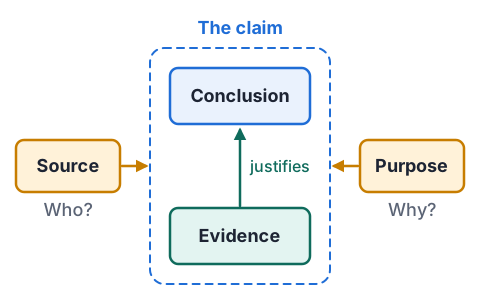
- Every claim has two halves: the conclusion (what they want you to believe) and the evidence (why you should believe it).
- Not every sentence is a claim. "Our cream smells like rose petals" is a description; "our cream reduces wrinkles in four weeks" is a claim, because it says something testable happens.
- A good way to find the claim is to ask: what does the writer want me to believe or do after reading this?
- In the exam, write the claim in one clear sentence in your own words, and make sure it is something the resource actually says.
Source and purpose: who made it, and why
- The source is the person, people or organisation who created the information, or who paid for it to be made.
- Look past the website name: an article on a news site may be a press release from a company, and a study may be funded by the firm whose product it tests.
- The purpose is the reason it was made: to inform, to persuade, to sell, to warn, to report new research, to entertain or to get clicks.
- Most information has more than one purpose. A company blog can inform you about plastics and also sell its own packaging.
- Achieved answers name the source and purpose; better answers say how that source and purpose could shape which evidence is shown.
| Ask | Where to look |
|---|---|
| Who wrote it? | By-line, author box, "About us" page |
| Who published or paid for it? | Website owner, sponsor, funding statement |
| When? | Date at the top or bottom |
| Why? | Is there something to buy, sign up to or share? |
Example: a news story about a sports drink
- A news website runs a story headed "Electrolyte drink helps teens train longer". At the bottom it says the article was supplied by FizzFuel Ltd, the company that makes the drink.
- The story says 30 club rugby players ran 8% longer on a treadmill after drinking FizzFuel than after drinking water.
- Name the source, the purpose and the claim.
- source: FizzFuel Ltd, which wrote the article; the news site only published itwho created it
- purpose: to persuade people to buy FizzFuel, presented as newsthe maker gains from sales
- claim: drinking FizzFuel lets teenagers exercise for longerthe conclusion they want you to believe
- evidence offered: a treadmill test on 30 rugby playerswhat they use to justify it
- a source with something to sell, using a small test it ran itself
Adverts, news, research and social media compared
- Where information comes from changes how much checking it had before it reached you.
- Adverts in Aotearoa must follow the Advertising Standards Code, which says advertisers must hold evidence for their claims and that testimonials do not count as that evidence.
- A news reporter checks facts but is not usually a scientist, and a headline is written to be read, so it often sounds more certain than the study.
- Social media posts usually have no checking at all; likes and shares show popularity, not accuracy.
- Mātauranga Māori is knowledge built and tested over generations by iwi and hapū; a claim drawing on it is stronger when it names the knowledge holders and the iwi it comes from.
| Channel | Checked by | Usual purpose |
|---|---|---|
| Advert | Advertising rules, complaints after | Sell |
| News article | Editor and reporter | Inform, get readers |
| Research paper | Other experts (peer review) | Report new findings |
| Government or agency site | Experts in that agency | Inform, advise |
| Social media post | Usually nobody | Share, persuade, get followers |
Peer review: experts check it first
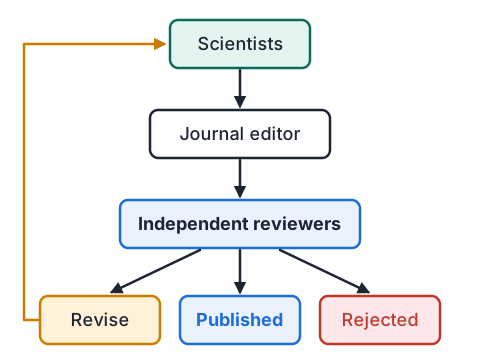
- Peer review means other scientists in the same field read a study before a journal publishes it, checking the method, the data and whether the conclusion follows.
- It makes a claim more believable because people with no stake in the result have looked for mistakes.
- It does not make a claim certain: reviewers only see what the authors report, and science stays open to new evidence.
- A famous case: a 1998 paper in The Lancet linked the MMR vaccine to autism using only 12 children. Larger studies found no link, and the journal retracted (withdrew) the paper in 2010.
- So a single peer-reviewed study is good evidence, and several studies by different teams that agree is much better.
| Wakefield and others, The Lancet | Detail |
|---|---|
| Published | February 1998 |
| Children studied | 12 |
| Retracted by the journal | February 2010 |
Bias and conflicts of interest
- Bias is a leaning that makes someone more likely to show one side, for example only quoting the studies that agree with them.
- A conflict of interest is when the source gains (money, reputation, followers) if you believe the claim, such as a company selling the product it is praising.
- A conflict of interest does not make a claim false; it means you should ask what evidence might have been left out.
- Look for funding statements in research ("This study was funded by...") and for links to buy something on websites.
- A strong answer weighs both sides: the company gains from sales, but it could also lose trust, or face a complaint to the Advertising Standards Authority, if its claim is false.
Example: Achieved, Merit and Excellence on the same point
- Resource: a honey company's website says its mānuka honey "soothes sore throats", quoting a study it paid for.
- Here is the same idea, conflict of interest, written at each grade.
| Grade | What the answer does | Sample sentence |
|---|---|---|
| Achieved | Names the convention | There is a conflict of interest because the company sells the honey. |
| Merit | Explains its effect on the claim | The company profits if people believe the honey works, so it may only show results that help it. This makes the claim less believable. |
| Excellence | Weighs it, links it to another convention, suggests a fix | The paid study may favour the honey, and we are not told if it was peer reviewed, so nobody independent has checked it. The claim would be stronger if the study were peer reviewed or repeated by a university with no link to the company. |
Common mistakes
- The source is Google, because that is where I found it.The source is whoever created or paid for the information, such as the company or researchers, not the search engine or app.
- The company sells the product, so the claim is false.A conflict of interest makes a claim less trustworthy, not automatically false; say what evidence might be missing.
- It was peer reviewed, so it is proven.Peer review makes a claim more reliable, but science is never proven for good; new evidence can still change it.
- I know from experience that honey does not work, so the claim is wrong.Judge the claim on the evidence in the resource, not your own opinion or extra research; markers do not credit that.
Test a paper towel claim
You need: two brands of paper towel, a measuring jug, two bowls, water, a tray or the sink
- Find a claim on a paper towel packet, such as "super absorbent" or "twice as strong", and write down who made the claim and why.
- Pour 100 mL of water into each bowl.
- Fold one sheet of each brand the same way, dip it fully into its bowl for 10 seconds, then lift it out and let it drip for 10 seconds.
- Pour what is left in each bowl back into the jug to see how much each sheet soaked up, and repeat three times with fresh sheets.
- Look for: whether your results back the packet's claim, and how keeping the sheet size, timing and water the same made the test fair.
Safety: Spilt water makes kitchen floors slippery, so work over a tray or the sink and wipe up drips straight away.
Your turn: name the source and purpose
A Facebook post from a fitness influencer says a protein powder "burns fat while you sleep" and gives a discount code. What is the main purpose?
A university research team publishes a study on kauri dieback in a peer-reviewed journal. Who is the source?
A news site runs a story that, at the bottom, says it was supplied by the company that makes the product. Who is the source?
A company paid for a study showing its toothpaste whitens teeth. Name the convention this raises, and its effect on the claim.
Show answer
1. To sell the protein powder (and earn from the discount code); persuading, not informing. 2. The university research team that did the study. 3. The company, because it created the article; the news site only published it. 4. A conflict of interest: the company gains if you believe it, so it might leave out unhelpful results, making the claim less believable.
Exam-style question: a sunscreen advert
- Resource: SunShield Ltd's website says "Our new SPF 50 lotion is scientifically proven to block 98% of UVB rays. Dermatologist tested. Trusted by 10,000 Kiwi families." A footnote says the lab test was done on 20 volunteers by a lab SunShield hired, and was not published in a journal. There is a "Buy now" button.
(a) Who published this information?
(b) Why was it published?
(c) State one science-related claim the resource makes.
(d) Identify the science language or conventions used to support the claim.
(e) How well do they support the claim? Use evidence from the resource.
Show answer
1. SunShield Ltd, the company that makes and sells the sunscreen (Achieved). 2. To persuade people to buy the lotion, while informing them about UV protection (Achieved). 3. The lotion blocks 98% of UVB rays (Achieved). 4. Language: SPF 50, UVB, dermatologist tested, scientifically proven. Conventions: a percentage result, a lab test, a sample of 20 people, no peer review, a conflict of interest (Achieved for naming these). 5. Merit: SunShield sells the lotion, so it gains if people believe it and may only report good results, which weakens the claim; words like "dermatologist tested" make it sound expert, but we are not told what the test found. Excellence: the 98% figure and the hired lab make the claim look scientific, but 20 people is a small sample, so the result could be a fluke, and because the test was not peer reviewed nobody independent has checked the method. "Trusted by 10,000 families" is a testimonial, which is popularity, not evidence. Overall the claim is only weakly supported; it would be stronger with a larger test by an independent lab, published and peer reviewed.
Recap
- A science-related claim is a conclusion backed by scientific evidence; find it by asking what you are meant to believe.
- The source is who created or paid for it; the purpose is why, and there is often more than one.
- Adverts, news, research, agency sites and social media get very different checking before you see them.
- Peer review raises trust but never proves a claim for good.
- A conflict of interest is a reason to look for missing evidence, not proof the claim is false.
- For Merit say how each point changes the claim's believability; for Excellence weigh several points together and suggest what would make it stronger.
| Exam part | What to write |
|---|---|
| (a) Who | The person or organisation who made or paid for it |
| (b) Why | Inform, persuade, sell, warn, report research |
| (c) Claim | One sentence, your own words |
| (d) Language or conventions | Name specific words and conventions from the resource |
| (e) How well | Explain each one's effect, weigh them, suggest improvements |
The maths behind it
How is NCEA Level 1 maths going?
See the NCEA Level 1 maths guide