The features of science and how to write about them
What this lesson covers
- The exam gives a resource booklet with two science ideas; you pick one and write about two named features of science in each part.
- Features about evidence: repeatable and checkable data, patterns and interactions between variables, linking new evidence to existing models, checking claims, shared language, and tentativeness.
- Features about society: social and cultural influences, technology, needs and opportunities, and varied perspectives such as mātauranga Māori and Pacific knowledge.
- Features about people: curiosity, collaboration, competitiveness, creativity and critical thinking.
- Achieved names a feature and outlines how it helped, with an example from the resource; Merit explains why it mattered; Excellence discusses how two features worked together.
What the exam looks like
- On the day you get a resource booklet describing two science ideas from Aotearoa or the Pacific, such as seaweed in cattle feed to cut methane (2025) or ocean pH around Otago (2024). You choose ONE and use it for every part.
- There are three parts. Each part names two features of science and asks how each one helped the idea develop, why each mattered, and how the two worked together.
- Your whole answer gets one score out of 8: 3 to 4 is Achieved, 5 to 6 is Merit and 7 to 8 is Excellence. To reach 7 or 8 you must show how features interact, not just explain each one.
- You are not tested on the science content itself. You are tested on how science works, using the resource as your evidence, so every sentence should name a feature and point at something in the booklet.
- For 2026 NZQA has said the features will be chosen from five: repeatable and checkable data, patterns and interactions, new evidence or varied perspectives, tentativeness, and the attributes of the people. Learn all eleven anyway, because the list can change.
Eleven features in three families
- It is easier to remember the features in three families: how science handles evidence, how society shapes science, and what the people doing it are like.
- In the exam, check which family a feature belongs to before you write. A society feature needs something from outside the lab (money, culture, a problem, a new tool); an evidence feature needs data, a pattern or a model.
- One event in a resource can show several features. A new scanner is technology, but the clearer images it gives are also new evidence.
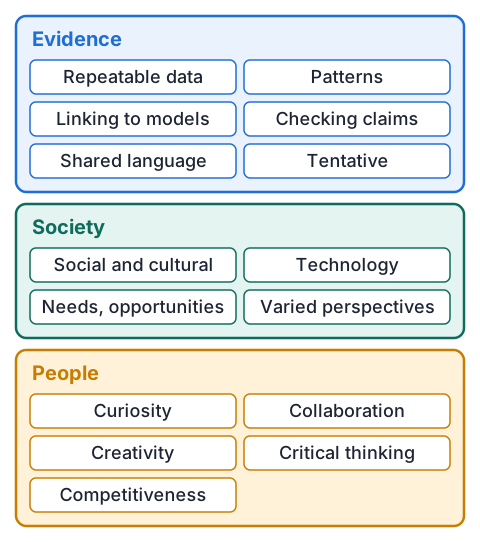
Features about evidence
- Repeatable, checkable data: measurements are taken the same careful way each time, written up so another team could do the same and get similar results.
- Patterns and interactions: a pattern is a trend in data over time or place; an interaction is a link between two variables, such as more carbon dioxide in the air and lower ocean pH. It is not people interacting.
- Linking new evidence to existing models: new results are fitted to ideas already known, which either supports the idea, extends it or forces a change.
- Checking claims and shared language: results are peer reviewed and repeated before they are trusted, and scientists use agreed units, symbols and words (ppm, pH, CH₄) so results can be compared anywhere.
| Feature | What to look for in a resource |
|---|---|
| Repeatable, checkable data | Same method every time, many samples, a long time series, other teams repeating it |
| Patterns and interactions | A graph or trend, or one variable changing with another |
| Linking to existing models | A result that supports, extends or changes an earlier idea |
| Checking claims | Peer review, publication, independent testing |
| Shared language and symbols | Units, chemical formulas, defined terms, standard methods |
Science is tentative
- Every science idea can change if better evidence turns up. Data can support an idea strongly, but it never proves it for ever.
- A single solid result can show an idea is wrong, so being disproved is the one thing that is final.
- In a resource, tentativeness shows up as words like may, could, early results, more research is needed, or an idea that changed, such as whole seaweed working better than the chemical bromoform on its own.
- Never write that a study proved something. Markers in 2024 marked down answers that said evidence proved a conclusion.
Features about society
- Social and cultural factors: what people value, earn and believe shapes which questions get asked and funded. The arrow points from society to the science, not from the science to society.
- Needs and opportunities: a need is a problem that must be solved (astronaut safety, cutting emissions); an opportunity is a chance that opens up (a new partnership, a native seaweed that grows here). Say which one you mean.
- Technology: new tools let scientists measure things that could not be measured before, more precisely or more often, and science in turn designs new tools.
- Varied perspectives: people with different knowledge, backgrounds and knowledge systems notice different things and ask different questions, which helps an idea grow faster and fairer.
Mātauranga Māori and Pacific knowledge
- Mātauranga Māori is a knowledge system built from generations of close observation of te taiao (the natural world), passed on by whānau, hapū and iwi and tested against what happens year after year.
- Tuna (eels) are a good example. Iwi have long used hīnaki, woven traps, and their knowledge of when and where tuna migrate, and they read the health of tuna as a sign of the health of a river.
- When NIWA scientists study eels alongside iwi, the two perspectives add to each other: long-term local knowledge suggests where and when to sample, and modern methods add counts and measurements that can be compared across the country.
- Pacific navigators found islands across the Pacific by reading stars, swells and birds, a knowledge system built on careful, repeated observation.
- Write about mātauranga as knowledge with its own evidence and methods, not as a story science corrects, and link it to a specific part of the resource.
Features about people
- Curiosity: asking why something happens, or wanting to know more, starts most research.
- Collaboration: teams from different places and fields share data, equipment and skills, which lets them check each other and tackle bigger questions.
- Competitiveness: wanting to be first, or to win funding, pushes people to work faster, though it must not cut corners on evidence.
- Creativity and critical thinking: inventing a new method or design, then questioning results, looking for errors and asking what else could explain them.
From Achieved to Excellence
- Achieved: name the feature, give an example from the resource, and outline how it helped the idea develop. One or two sentences per feature.
- Merit: say why the feature was significant. The quickest test is the without sentence: without this feature, what would scientists not know or not be able to do?
- Excellence: discuss how two features interact. Show that one feature caused, enabled or shaped the other, with resource examples, and say what that did for the idea.
- Useful linking words for Excellence: because of this, which meant that, this in turn, without the first the second could not.
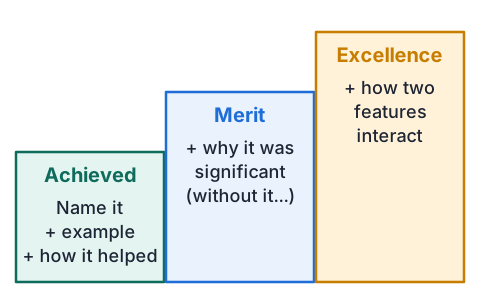
Example: one feature at three grades
- Context: New Zealand farms many cattle, and their gut microbes make methane, a greenhouse gas. Researchers found that a native red seaweed, Asparagopsis, added to feed in small amounts sharply cuts that methane. A company now grows it in aerated tanks at Bluff, where light, temperature and nutrients can be controlled.
- Question: How did the development and use of technology contribute to this science idea?
- Achieved: Technology is used to grow the seaweed in big aerated tanks at Bluff, so scientists have seaweed to test.names the feature, uses the resource, outlines how it helped
- Merit: The tanks keep conditions the same all year, so every batch has a similar amount of the active chemical. Without this, trials on cattle would give results that differ because the seaweed differed.adds why it was significant, with a without sentence
- Excellence: The need to cut emissions without cutting herd numbers drove the building of the tanks. Their steady supply allows larger, repeatable feeding trials, and those trials produced new evidence, such as whole seaweed working better than bromoform alone.two features, and how one drives the other
- each grade keeps the one before it and adds a step
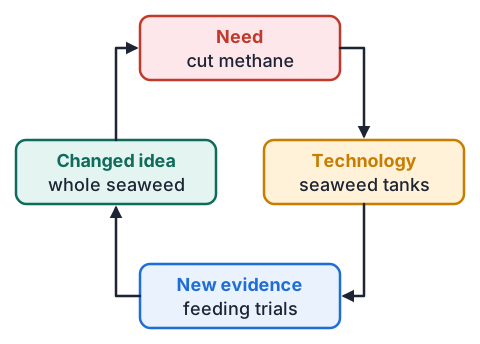
Example: how features interact
- Excellence answers show a chain, not two separate paragraphs. Draw the chain first, then write it out.
- In the seaweed idea, the need to cut methane made people build growing tanks; the tanks gave enough seaweed for repeated trials; the trials gave new evidence that refined the idea; and the refined idea raised new questions about scaling up and animal health.
- So the features are not a list, they feed each other. Your answer should say which way each arrow points and why.
Common mistakes
- Cattle farming is important, so the science helps farmers keep their jobs.That is science helping society. For a social factor, show society shaping the science: farming matters, so researchers looked for ways to cut methane without cutting herds.
- The study proved that the seaweed reduces methane.Evidence supports an idea but never proves it; say the trials gave strong evidence, and that more research is still testing it.
- Interactions: the scientists interacted with farmers and other scientists.In science an interaction is a link between variables, such as more seaweed in the feed and less methane; people working together is collaboration.
- Technology made the data more accurate.Data must always be reliable; say what the technology let them measure or do that they could not before, using the resource.
Is your method repeatable? The paper towel test
You need: paper towels, two different kinds, a measuring jug, a bowl, tap water, a pen and paper, a family member or friend
- Write a method for finding which paper towel holds more water: how big a piece, how long it soaks, how long it drips, and how you measure what it held.
- Do the test three times for each kind of towel and record every result in a table.
- Give your written method, without talking, to someone else and ask them to do one trial of each towel.
- Compare their results with yours, and mark every step where they did something different from what you meant.
- Look for: where your method was exact, their results match yours; where it was vague, they do not. That is why science needs repeatable methods and precise shared language.
Safety: Spilled water makes a hard floor slippery, so work over the bowl on a tray or the bench and wipe up drips straight away.
Your turn: name the feature
- Name the main feature of science shown by each sentence.
Scientists at Baring Head near Wellington have measured carbon dioxide in the air the same way for over fifty years, so other stations can compare with them.
Tuna counts in a river fall in the years after a dam is built upstream.
NIWA researchers worked with iwi who use hīnaki and know when tuna migrate.
A study's results were checked by other experts before the journal published them.
Early results suggested the chemical alone was enough, but later work found the whole seaweed worked better.
Show answer
1. Repeatable, checkable data (a long record taken the same way). 2. Patterns and interactions (tuna numbers linked to a dam). 3. Varied perspectives, including mātauranga Māori. 4. Checking claims (peer review). 5. Tentativeness: the idea changed when new evidence came in.
Your turn: an exam-style question
- Resource: Longfin tuna are taonga to many iwi, and they are sensitive to pollution, so their health shows the health of a river. Iwi have caught tuna in hīnaki for generations and know their seasons. NIWA now samples eels with fyke nets, which catch eels above a set size, and with electric fishing, which stuns eels briefly so they can be measured and returned. Results from many rivers are compared to see which factors, such as farming or dams, change eel numbers.
- Focus on two features: varied perspectives (including mātauranga Māori) and the development and use of technology.
How does varied perspectives contribute to the idea? (Achieved)
How does technology contribute to the idea? (Achieved)
Why is each of these features significant to the idea? (Merit)
How do the two features work together to develop the idea? (Excellence)
Show answer
1. Achieved: Iwi have long-term knowledge of where and when tuna run and use them to judge river health; this tells scientists where and when to sample. 2. Achieved: Fyke nets and electric fishing let scientists catch, measure and return eels, so they can count them without killing them. 3. Merit: Mātauranga is significant because it holds observations over many generations, far longer than any science record, so it shows changes a short study would miss; without it, sampling could be at the wrong place or season. Technology is significant because standard nets and electric fishing give counts taken the same way everywhere, so rivers can be compared; without that, a pattern linking farming or dams to eel numbers could not be seen. 4. Excellence: Mātauranga points to where and when eels gather, so the nets and electric fishing are used where they give the most useful data; the standard counts then test and add numbers to what iwi have noticed, such as fewer tuna below a dam. Each makes the other stronger, and together they give evidence that can guide kaitiakitanga of the river.
Recap
- Pick one science idea from the booklet and use it for every part.
- Know the features in three families: evidence, society and people.
- Achieved: name the feature, give a resource example, outline how it helped.
- Merit: say why it was significant; use a without sentence.
- Excellence: show how two features drive or enable each other, with examples, and what that did for the idea.
- Never write that science proved something; social factors shape the science, not the other way round.
How is NCEA Level 1 maths going?
See the NCEA Level 1 maths guide