Where genetic variation comes from
What this lesson covers
- Chromosomes are long coiled molecules of DNA; a gene is a section of DNA at a fixed place, and alleles are different versions of one gene.
- Genotype is the pair of alleles an individual has; phenotype is the trait we see, shaped by the genotype and the environment.
- Mutation is the original source of new alleles, and only mutations in cells that make gametes are passed to children.
- Meiosis (crossing over and independent assortment) and random fertilisation shuffle alleles into new combinations every generation.
- Dominant and recessive alleles, Punnett squares, ratios and probabilities for a single gene.
- How to write about one identified characteristic at Achieved, Merit and Excellence level.
DNA, chromosomes, genes and alleles
- DNA is a long double-stranded molecule twisted into a double helix. Each strand is a chain of units made of a sugar, a phosphate and a base, and the four bases pair up across the strands: A with T, and C with G.
- In the nucleus the DNA is wound tightly into chromosomes. Human body cells have 46 chromosomes in 23 pairs; one of each pair came from the mother and one from the father.
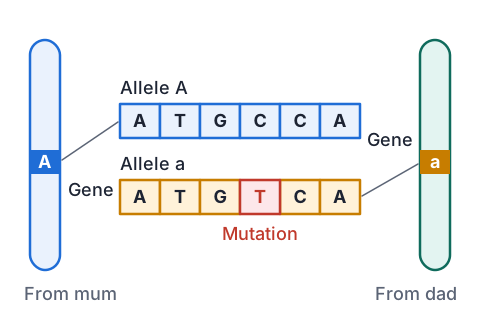
- A gene is a section of DNA at a fixed place (its locus) on a chromosome. The order of its bases is the code for one protein, and that protein affects a trait.
- An allele is one version of a gene. Alleles of the same gene differ slightly in their base sequence, so they can code for slightly different proteins.
- Because chromosomes come in pairs, every person carries two alleles for each gene, one on each chromosome of the pair. The two can be the same or different.
Genotype, phenotype, dominant and recessive
- The genotype is the pair of alleles an individual has for a gene, written with letters such as AA, Aa or aa.
- The phenotype is the characteristic that shows: skin colour, blood group, whether someone has a genetic condition.
- A dominant allele shows in the phenotype whenever it is present. A recessive allele only shows when there is no dominant allele, so only in the homozygous recessive genotype.
- Phenotype also depends on the environment. Two people with identical alleles for skin colour can look different after a summer outdoors, but a suntan is not passed on to children.
| Genotype | Name | Phenotype if A is dominant |
|---|---|---|
| AA | Homozygous dominant | Dominant trait |
| Aa | Heterozygous (a carrier of a) | Dominant trait |
| aa | Homozygous recessive | Recessive trait |
Mutation: where new alleles come from
- A mutation is a lasting change to the order of bases in DNA. It can happen as a copying error when a cell divides, or be caused by mutagens such as UV light, X-rays and some chemicals.
- A changed base sequence can change the protein, and so the phenotype. Many mutations have no effect, some are harmful, and a few are useful.
- A mutation in a body (somatic) cell, such as a skin cell, affects only the cells that grow from it. It dies with the person and is not inherited.
- A mutation in a cell that makes gametes (eggs or sperm) can end up in a child, and then in every cell of that child. These heritable mutations are the only ones that add new alleles to a population.
- Every allele that exists today began as a mutation in a gamete-making cell, often many generations ago.
| Somatic mutation | Gametic mutation | |
|---|---|---|
| Where | Body cells (skin, lung, gut) | Cells that make eggs or sperm |
| Passed on? | No: non-heritable | Yes: heritable |
| Example | A skin cancer after sunburn | A new albinism allele in a family |
Meiosis: making gametes that all differ
- Meiosis is the cell division that makes gametes. One cell with 46 chromosomes divides twice to give four cells with 23 chromosomes each, one from every pair.
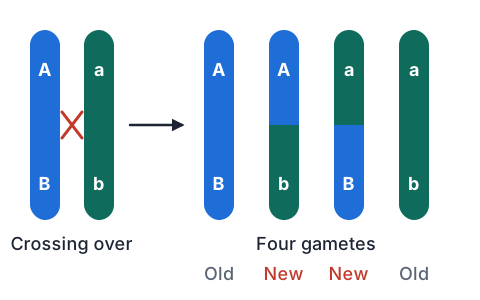
- Crossing over: before the first division, the two chromosomes of a pair line up side by side and swap matching sections. Alleles that sat together on one chromosome are recombined into new mixes.
- Independent assortment: the pairs line up in the middle of the cell in a random order, so which chromosome of each pair goes into a gamete is chance. With 23 pairs this alone gives 2 to the power 23, about 8.4 million, possible gametes.
- So the four gametes from meiosis are genetically different from each other and from the parent cell. Meiosis does not make new alleles; it makes new combinations of the alleles a person already has.
Sexual reproduction and random fertilisation
- Fertilisation joins one egg and one sperm, each with 23 chromosomes, into a zygote with 46. The child gets one allele of every gene from each parent.
- Which sperm meets which egg is random, so each parent's millions of possible gametes can pair with any of the other's.
- That is why brothers and sisters (apart from identical twins) all differ, and why two parents who both lack a trait can have a child who shows it.
- The three sources in an individual work together: mutation makes new alleles, meiosis reshuffles them, and fertilisation combines two shuffled sets.
- gametes from one parent = 2²³ = 8 388 608independent assortment only
- combinations for a child = 2²³ × 2²³ = 2⁴⁶any egg with any sperm
- 2⁴⁶ ≈ 70 000 000 000 000about 70 trillion
- crossing over adds far more, so each child is unique
The nature of variation: helpful, harmful or neutral
- The source of variation is where it comes from; its nature is the effect it has on the individual or population.
- Beneficial: a mutant allele of the CCR5 gene removes the doorway that most strains of HIV use to enter white blood cells, so people with two copies are strongly resistant to those strains.
- Harmful: albinism alleles stop the body making the pigment melanin. In wild animals an albino stands out to predators and prey, and burns or has poor eyesight, so it is less likely to survive and breed.
- Neutral: many differences, such as small changes in DNA between genes, have no effect on survival at all.
- Whether an allele helps can depend on the place: an allele that gives pale fur is harmful in a dark forest but can help on snow.
An identified characteristic: albinism
- The commonest type of albinism, OCA1, is caused by recessive alleles of the TYR gene on chromosome 11.
- The normal allele (A) codes for tyrosinase, the enzyme that starts the making of melanin. A mutant allele (a) has a changed base sequence, so the enzyme it codes for does not work.
- AA and Aa people make melanin and have normal pigment: in Aa, one working allele makes enough enzyme. Only aa people make no working enzyme and have very pale skin and hair, light eyes and weaker eyesight.
- Heterozygous carriers look the same as AA people, so the a allele can be passed down quietly for many generations before two carriers have a child together.
Example: two carriers have children
- Two parents both have normal pigment, but their first child has albinism. Work out the parents' genotypes and the chances for their next child.
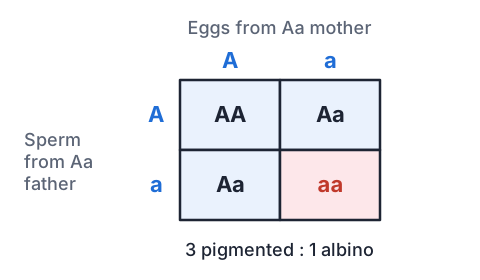
- child is aa, so it got an a from each parenta recessive trait needs two a alleles
- parents have normal pigment, so each has an Aso both parents are Aa
- gametes: A or a from each, with a ½ chance eachmeiosis separates the pair
- offspring: 1 AA : 2 Aa : 1 aathe four boxes of the square
- phenotype ratio 3 pigmented : 1 albinoAA and Aa look the same
- P(albino) = ¼ = 25% for every child
- P(next child is a carrier) = 2 in 4 = ½
- having one albino child does not change the odds for the nexteach fertilisation is a new, independent event
Example: a carrier and a person with albinism
- A woman with albinism has children with a man who is a carrier. What fraction of their children are expected to have albinism?
- If a pigmented child of theirs is chosen, what is that child's genotype?
- aa × Aawoman is aa; carrier man is Aa
- her eggs are all a; his sperm are A or ashe can only pass on a
- offspring: Aa, Aa, aa, aathe four boxes
- genotype ratio 1 Aa : 1 aa, phenotype ratio 1 : 1
- P(albino) = ½ = 50%
- every pigmented child is Aa, a carriereach one got an a from the mother
Example: one question, three grades
- Question: Explain how two parents with normal pigment can have a child with albinism.
- Each answer below adds to the one before. Notice that Merit explains how and why, and Excellence links every idea together and back to the context.
| Grade | What the answer does | Sample answer |
|---|---|---|
| Achieved | Describes with correct terms | Albinism is recessive. Both parents are carriers (Aa) and each passed an a allele to the child, who is aa. |
| Merit | Explains how and why | Each parent is Aa. In meiosis the two alleles separate, so half of each parent's gametes carry a. If an a sperm fertilises an a egg, the child is aa, makes no working tyrosinase and so no melanin. The chance is ¼ each time. |
| Excellence | Links the ideas and judges them | The a allele began as a mutation in a gamete-making cell of an ancestor, so it is heritable. Carriers make enough enzyme from one A, so it stayed hidden for generations. Meiosis and random fertilisation brought two a alleles together. A 1 in 4 chance is a probability, not a promise: the family could have several pigmented children, or more than one with albinism. |
Exam-style question: drinking milk as an adult
- Context: Lactase is the enzyme that breaks down lactose, the sugar in milk. Most mammals stop making it after weaning, and so do many people. In some human populations, a mutation in a stretch of DNA that switches the lactase gene on lets people keep making lactase as adults. This allele for lactase persistence (L) is dominant over the allele for lactase non-persistence (l).
Describe the difference between genotype and phenotype, using lactase persistence as your example.
Two adults who both digest milk easily have a son who, as an adult, gets sick after drinking milk. Explain how this happened, using a Punnett square, and give the chance for each of their children.
Discuss how the L allele first appeared and why it became common in populations with a long history of keeping dairy animals but stayed rare in others. In your answer, explain why the first mutation must have happened in a gamete-making cell, and link the nature of the allele to survival.
Show answer
1. (Achieved) Genotype is the pair of alleles a person has for the gene: LL, Ll or ll. Phenotype is what shows: being able to digest milk as an adult (LL or Ll) or not (ll). Merit adds that Ll and LL give the same phenotype because L is dominant, so you cannot tell a carrier by looking. 2. (Merit) The son is ll, so he received an l from each parent; the parents can digest milk, so each has an L; both parents are Ll. Punnett square: L and l eggs against L and l sperm gives LL, Ll, Ll, ll: 3 persistent to 1 non-persistent, so each child has a ¼ (25%) chance of being ll. Meiosis separates each parent's L and l into different gametes, and random fertilisation joined two l gametes. 3. (Excellence) The L allele arose as a change in the base sequence of the DNA that controls the lactase gene. It must have occurred in a cell that makes eggs or sperm, because only then can it be inherited and spread through later generations; a somatic mutation would have died with that person. In dairying populations the allele was beneficial: adults who could digest milk had an extra food and drink source, so they were more likely to survive famines and raise children, who inherited L. Over many generations differing survival raised the frequency of L. Where people did not keep dairy animals, L gave no advantage, so it stayed rare. Because L is dominant, Ll carriers of l are persistent too, so the l allele is not removed and still turns up when two carriers have children, as in part 2.
Common mistakes
- A gene and an allele are the same thing.A gene is the section of DNA for a trait; alleles are the different versions of that gene, such as A and a.
- Their first child had albinism, so the next three will not.Each fertilisation is independent, so every child of two carriers has the same ¼ chance, whatever the earlier children were.
- Getting skin cancer from the sun is a mutation, so the person's children can inherit it.That is a somatic mutation in skin cells; only mutations in cells that make eggs or sperm are heritable.
- Meiosis makes new alleles.Only mutation makes new alleles; crossing over and independent assortment make new combinations of alleles that already exist.
Two carriers, forty children: a coin Punnett square
You need: 2 coins, a pen, paper, a timer or phone stopwatch
- Let heads stand for allele A and tails for allele a; each coin is one Aa parent making a gamete.
- Toss both coins together. Two heads is AA, one of each is Aa, two tails is aa; tally the result.
- Repeat until you have 40 children, then count AA, Aa and aa and work out the pigmented to albino ratio.
- Run a second set of 40 and compare it with the first and with the 1 : 2 : 1 the Punnett square predicts.
- Look for: totals near 10 AA, 20 Aa and 10 aa, but not exactly, and a run of several aa in a row now and then; each toss is a new random fertilisation, just as each child is.
Safety: Coins are a choking hazard for small children, so keep them away from toddlers and put them away afterwards.
Your turn
A woman who is a carrier for albinism (Aa) has children with a man who is homozygous dominant (AA). What is the chance that a child has albinism?
In question 1, what fraction of the children are expected to be carriers?
Two parents with normal pigment have a child with albinism, then a second child with normal pigment. What is the chance that the second child is a carrier?
A man's skin cell mutates after years of sunburn. Can the mutation be passed to his children? Explain.
Name the two events in meiosis that make each gamete different, and say which one swaps parts between chromosomes.
Show answer
1. 0: every child gets an A from the father, so children are AA or Aa and none is aa. 2. ½ (50%): the Punnett square gives AA, AA, Aa, Aa. 3. ⅔: both parents are Aa; a pigmented child is AA, Aa or Aa (the aa box is ruled out), and 2 of those 3 are carriers. 4. No: it is a somatic mutation in a skin cell, and only mutations in cells that make eggs or sperm are inherited. 5. Crossing over and independent assortment; crossing over is the one where the two chromosomes of a pair swap sections.
Recap
- DNA is coiled into chromosomes; a gene is a section of DNA at a set locus; alleles are versions of that gene.
- Genotype is the pair of alleles; phenotype is what shows, shaped by genotype and environment.
- Mutation is the only source of new alleles, and only gametic mutations are heritable.
- Crossing over, independent assortment and random fertilisation give new combinations of alleles, so each offspring is unique.
- Two carriers (Aa × Aa) give 1 AA : 2 Aa : 1 aa, a 3 : 1 phenotype ratio and a ¼ chance of the recessive trait for every child.
| Cross | Genotypes | Chance of recessive trait |
|---|---|---|
| AA × aa | All Aa | 0 |
| Aa × Aa | 1 AA : 2 Aa : 1 aa | ¼ (25%) |
| Aa × aa | 1 Aa : 1 aa | ½ (50%) |
| aa × aa | All aa | 1 (100%) |
The maths behind it
How is NCEA Level 1 maths going?
See the NCEA Level 1 maths guide