Tides: the Moon, the Sun and real New Zealand tide data
What this lesson covers
- The Moon's gravity pulls hardest on the near side of Earth and least on the far side, making two bulges of water.
- Earth spins through both bulges, so most places get two high and two low tides a day, about 12 hours 25 minutes apart.
- High tide comes about 50 minutes later each day because the Moon moves along its orbit.
- Spring tides (biggest range) come at new and full moon; neap tides (smallest range) at the quarter moons.
- Perigean spring tides (king tides) happen when a new or full moon falls near perigee.
- Tide times and ranges differ from place to place around New Zealand.
What a tide is
- A tide is the regular rise and fall of the sea. High tide is the highest level in a cycle, low tide the lowest, and the tidal range is the difference in height between a high and the next low.
- Tides are caused mainly by the Moon's gravity, and partly by the Sun's.
- The Sun is far more massive than the Moon, but it is about 390 times further away. Tides depend on how much the pull changes from one side of Earth to the other, and that drops away fast with distance, so the Sun's effect is only about half the Moon's.
- LINZ publishes tide predictions for New Zealand ports. Heights are measured above chart datum, a level close to the lowest tides, so even low tide has a positive height.
| Body | Tide-raising effect on Earth |
|---|---|
| Moon | 1 (the main cause) |
| Sun | about half the Moon's |
Two bulges of water
- Gravity gets weaker with distance, so the Moon pulls hardest on the ocean facing it, less on the centre of Earth, and least on the ocean on the far side.
- On the near side the water is pulled towards the Moon more than Earth is, so it heaps up: a bulge, and high tide.
- On the far side Earth is pulled towards the Moon more than the water there is, so the water is left behind: a second bulge, and another high tide.
- Water flows into the two bulges from the parts of the ocean in between, so those places have low tide.
- The bulges stay roughly lined up with the Moon while Earth spins underneath them.
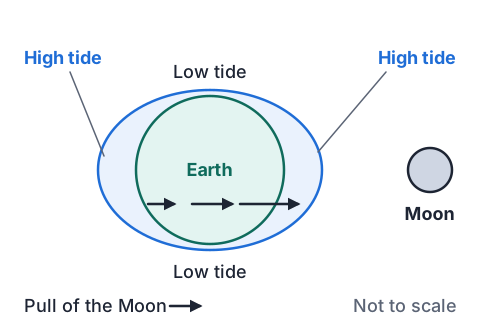
Two high tides a day, about 50 minutes later each day
- As Earth spins, each place is carried through both bulges and both low areas, so it gets two high tides and two low tides.
- While Earth spins once, the Moon moves about 13° further along its orbit in the same direction. Earth has to turn for about 50 minutes more to bring a place back under the Moon.
- So a full tide cycle takes about 24 hours 50 minutes (a lunar day), high tides are about 12 hours 25 minutes apart, and each day's tides come about 50 minutes later than the day before.
- Because the cycle is longer than a calendar day, some days have only three tides: on 6 November 2026 Auckland had two highs and only one low.
Example: reading Auckland's tide table
- The table shows LINZ predictions for Auckland (Waitematā Harbour) for 10 and 11 November 2026, in NZDT.
- Find the tidal range on the morning of 10 November, the time between the two high tides, and how much later the morning high tide is on 11 November.
| Date | Low | High | Low | High |
|---|---|---|---|---|
| 10 Nov | 02:30, 0.6 m | 08:55, 3.2 m | 14:48, 0.8 m | 21:06, 3.1 m |
| 11 Nov | 03:09, 0.6 m | 09:36, 3.2 m | 15:28, 0.8 m | 21:48, 3.0 m |
- range = 3.2 − 0.6 = 2.6 mhigh minus the low before it
- 21:06 − 08:55 = 12 h 11 mintime between the two highs
- 09:36 − 08:55 = 41 min laternext day's morning high
- 2.6 m range; highs 12 h 11 min apart; 41 min later the next day
- over 2026 Auckland's highs average 12 h 25 min apart and 50 min later each daysingle days vary, from under 40 to nearly 70 minutes
Spring and neap tides
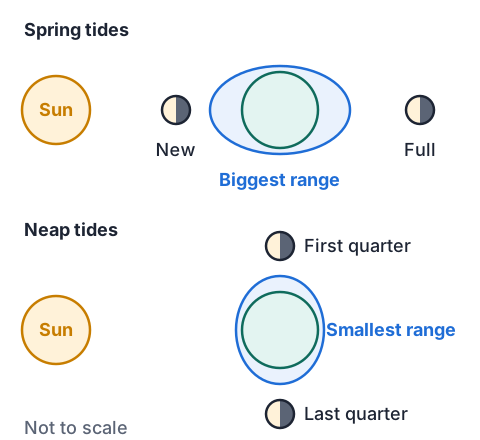
- The Sun makes its own pair of smaller bulges, lined up with the Sun.
- At new moon and full moon the Sun, Earth and Moon are in a line, so the Sun's bulges add to the Moon's: high tides are higher and low tides lower. These are spring tides, with the biggest range.
- At first and last quarter the Moon is at right angles to the Sun, so the Sun's bulges sit where the Moon's low tides are and partly cancel them: high tides are lower and low tides higher. These are neap tides, with the smallest range.
- There are two of each every lunar month, so spring and neap tides each come about every 14 to 15 days, all year round. The name spring has nothing to do with the season.
Example: a month of Auckland tides
- The graph shows each day's highest high tide and lowest low tide at Auckland in November 2026, with the Moon's phases marked.
- Describe the pattern and link it to the Moon.
| Moon | Days | Highest high | Lowest low | Range |
|---|---|---|---|---|
| New moon, 9 Nov | 9 to 11 Nov | 3.2 m | 0.6 m | 2.6 m |
| First quarter, 18 Nov | 18 Nov | 2.8 m | 1.1 m | 1.7 m |
| Full moon, 25 Nov | 26 to 28 Nov | 3.5 m | 0.3 m | 3.2 m |
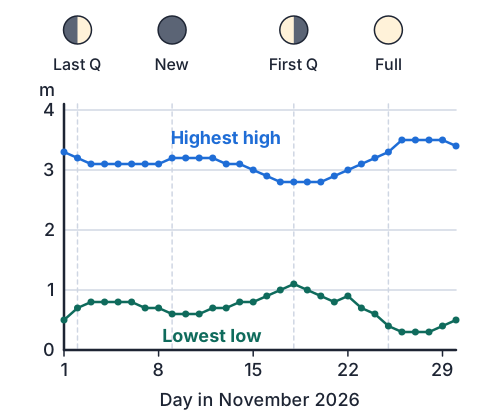
- range peaks after new and full moon, and is smallest at first quarterdescribe the pattern
- spring tides: Sun, Earth and Moon in line, so their bulges addexplain the big ranges
- neap tide: Moon at 90° to the Sun, so the bulges partly cancelexplain the small range
- biggest range 3.2 m, 1 to 3 days after full moon; smallest 1.7 m at first quarter
- the oceans take a day or two to respond fully, so springs lag the phasea useful Excellence detail
King tides: spring tides at perigee
- The Moon's orbit is an ellipse. At perigee it is closest to Earth and its tide-raising effect is strongest; at apogee it is weakest.
- When a new or full moon falls close to perigee, the spring tide is extra large: a perigean spring tide, often called a king tide.
- This explains November 2026. The full moon (25 November) came less than a day before perigee (26 November), so Auckland's range reached 3.2 m. The new moon (9 November) came five days before apogee (14 November), so that spring range was only 2.6 m.
- Perigee comes round every 27.5 days but new and full moons every 29.5 days, so they line up only now and then. King tides arrive at irregular intervals, and they are when coastal flooding is most likely, especially with a storm surge.
| Event | Date and time | Distance |
|---|---|---|
| Apogee | 13 Nov, 17:50 | 405 619 km |
| Perigee | 25 Nov, 20:58 | 359 348 km |
Tides differ around New Zealand
- Every port feels the same Moon and Sun, but the size and timing of its tides depend on the shape of the coast, harbour and seabed.
- On 27 November 2026 Nelson's range was 3.8 m but Wellington's only 1.4 m, though the two cities are only about 120 km apart.
- Auckland's Waitematā Harbour opens to the east and Onehunga's Manukau Harbour to the west. They are about 10 km apart, but on 27 November high tide was at 10:06 am in Auckland and 1:25 pm at Onehunga, because the tide reaches the two coasts at different times.
- Spring and neap tides still come at the same points in the Moon's cycle everywhere, which shows the cause is the Sun and Moon, while the local shape sets the size.
| Port | 18 Nov (neap) | 27 Nov (spring) |
|---|---|---|
| Auckland | 1.7 m | 3.2 m |
| Onehunga | 1.9 m | 3.7 m |
| Tauranga | 1.2 m | 1.9 m |
| Wellington | 0.9 m | 1.4 m |
| Nelson | 1.8 m | 3.8 m |
| Dunedin | 1.3 m | 2.2 m |
Tides, the Moon and the maramataka
- Long before tide tables, Māori tracked the Moon night by night in the maramataka, the lunar calendar, to plan fishing, gathering kaimoana and planting.
- In the Ngāti Kahungunu list recorded by Te Ara, the nights around the full moon (Rākau-nui) are linked with food from the sea, and the Tangaroa nights are good for fishing. Each iwi has its own names and guidance.
- Because tides follow the Moon, a calendar built on the Moon's phases also tracks the cycle of spring and neap tides.
What Achieved, Merit and Excellence look like
- Achieved describes: the Moon's gravity causes tides, spring tides are big and neap tides small. Merit explains using positions: why two bulges, why the Sun and Moon add or partly cancel. Excellence links positions, timing and the data, for example why the ranges change over a fortnight and why one spring tide beats another.
- Question: Explain why Auckland's tidal range was 3.2 m on 27 November 2026 but 1.7 m on 18 November.
| Grade | A model answer |
|---|---|
| Achieved | 27 November was a spring tide and 18 November was a neap tide. Spring tides have a bigger range. |
| Merit | On 27 November the Moon had just been full, so the Sun, Earth and Moon were in a line and the Sun's pull added to the Moon's, making higher highs and lower lows. On 18 November the Moon was at first quarter, at right angles to the Sun, so their pulls partly cancelled. |
| Excellence | The Moon's gravity makes two bulges, and the Sun makes two smaller ones. Just after the full moon of 25 November the bodies were in line, so the bulges added: Auckland's highs reached 3.5 m and lows 0.3 m. At first quarter on 18 November the Sun's bulges sat where the Moon's low tides were, so highs only reached 2.8 m and lows stayed at 1.1 m. The 27 November spring was also boosted because perigee came on 26 November, which is why it beat the new-moon spring of 9 November (2.6 m). |
Common mistakes
- There is one high tide a day, when the Moon is overhead.There are two bulges, one facing the Moon and one on the far side, so most places get two high tides a day.
- Spring tides happen in spring.Spring tides come at every new and full moon, about every two weeks all year; the name is not about the season.
- Neap tides happen when the Moon is furthest away.Neap tides come at first and last quarter, when the Moon is at right angles to the Sun; distance changes the size of king tides.
- The Sun is much bigger, so it causes bigger tides than the Moon.The Sun is about 390 times further away, so its tide-raising effect is only about half the Moon's.
Graph two weeks of your local tides
You need: a phone or computer to open the LINZ tide predictions, squared paper or a maths exercise book, a pencil, a ruler, a calendar with the Moon's phases (or a Moon phase website)
- Open the LINZ tide predictions and choose the major port nearest you.
- Draw axes: day (1 to 14) across the bottom and height (0 to 4 m) up the side.
- For 14 days in a row, plot that day's highest high tide and lowest low tide as two dots, and join each set of dots with a line.
- Mark the days of new moon, first quarter, full moon and last quarter along the top.
- Look for: the two lines are furthest apart a day or two after new or full moon (spring tides) and closest together near first or last quarter (neap tides).
Safety: If you visit the shore to see a high or low tide for yourself, go with an adult and stay well above the waterline, because an incoming tide can cut off rocks and sandbanks quickly.
Your turn
Auckland had a high tide at 08:55 on 10 November 2026. Using the average of 12 h 25 min, predict the time of the next high tide.
At which two Moon phases do spring tides happen?
On 18 November 2026 Auckland's highest high tide was 2.8 m and its lowest low tide 1.1 m. Calculate the tidal range.
Explain why there is also a high tide on the far side of Earth, opposite the Moon.
On 27 November 2026 Nelson's tidal range was 3.8 m and Wellington's was 1.4 m. Explain why the ranges differ when both feel the same Moon and Sun.
Show answer
1. 08:55 + 12 h 25 min = 21:20 (the LINZ prediction is 21:06, as single days vary). 2. New moon and full moon, when the Sun, Earth and Moon are in a line. 3. 2.8 − 1.1 = 1.7 m. 4. The Moon pulls Earth more strongly than the water on the far side, so that water is left behind as a second bulge. 5. The size of the tide depends on the local shape of the coast, harbour and seabed, which channels and amplifies the tide more in Tasman Bay than in Wellington.
Exam-style question: November tides in Auckland
- Use the LINZ data in this lesson for Auckland in November 2026: high tides about 12 h 25 min apart, a range of 1.7 m on 18 November (first quarter) and 3.2 m on 26 to 28 November (full moon on 25 November, perigee on 26 November).
Describe what causes high and low tides.
Explain why Auckland has two high tides most days, and why they come about 50 minutes later each day.
Discuss why the tidal range changes over the month, and why the spring tides of 26 to 28 November were bigger than those of 9 to 11 November (range 2.6 m, new moon on 9 November, apogee on 14 November).
Show answer
1. The Moon's gravity, and to a lesser extent the Sun's, pulls on Earth's oceans, making bulges of water. Places in a bulge have high tide; places between the bulges have low tide (Achieved). 2. The Moon pulls the near-side ocean more than Earth's centre, and Earth's centre more than the far-side ocean, so there are two bulges on opposite sides of Earth. Earth spins through both, giving two highs and two lows. The Moon moves about 13° along its orbit each day in the direction Earth spins, so Earth needs about 50 extra minutes to bring Auckland back under the Moon: the cycle is 24 h 50 min, highs are 12 h 25 min apart, and each day's tides are about 50 minutes later (Merit). 3. Excellence links positions, timing and data: at new and full moon the Sun, Earth and Moon line up, the Sun's smaller bulges add to the Moon's, and the range is largest (spring tides, 3.2 m after the 25 November full moon). At first quarter the Moon is at 90° to the Sun, the Sun's bulges fall where the Moon's lows are, and the range is smallest (neap tide, 1.7 m on 18 November). This repeats about every 14 to 15 days. The late-November springs were bigger because the full moon came within a day of perigee, when the Moon is closest and its tidal effect strongest, a perigean spring or king tide; the 9 November new moon came near apogee, when the Moon is furthest away, so that spring range was only 2.6 m. Because perigee repeats every 27.5 days but full and new moons every 29.5 days, king tides happen only at irregular intervals.
Recap
- The Moon's pull is strongest on the near side and weakest on the far side, making two bulges of water.
- Earth spins through both bulges: two high and two low tides about every 24 h 50 min, so tides come about 50 minutes later each day.
- Spring tides (biggest range) at new and full moon; neap tides (smallest range) at the quarters, each about every two weeks.
- A new or full moon near perigee gives a king tide.
- The Moon and Sun set the rhythm; the coast and seabed set the size and timing at each port.
| Tide | When | Line-up |
|---|---|---|
| High tides | about 12 h 25 min apart | place under a bulge |
| Spring tide | new and full moon | Sun, Earth and Moon in a line |
| Neap tide | first and last quarter | Moon at 90° to the Sun |
| King tide | spring tide near perigee | in a line, Moon closest |
The maths behind it
How is NCEA Level 1 maths going?
See the NCEA Level 1 maths guide