Kinetic energy, potential energy and work
What this lesson covers
- Energy is measured in joules, is never made or destroyed, and only changes form or moves between objects.
- Kinetic energy depends on mass and speed squared: Ek = ½mv².
- Gravitational potential energy depends on mass, g and height: Ep = mgh, with g = 10 N/kg in NCEA papers.
- Work is energy transferred by a force moving something: W = Fd, and power is how fast energy is transferred: P = E ÷ t.
- In a real system some energy always ends up as thermal energy and sound, so efficiency is below 100%.
A physical system and its energy
- A physical system is the object or objects you are studying, such as a falling paint tin, a lift, or a kid on a slide.
- Energy is the ability to make something happen, and it is measured in joules (J).
- Energy is conserved: it cannot be created or destroyed, only transformed from one form to another or transferred from one object to another.
- In mechanics the two forms that matter most are kinetic energy (energy of motion) and gravitational potential energy (energy stored by height).
- The exam gives you the formulae, so the marks are for choosing the right one, showing your working and finishing with a unit.
| Quantity | Formula | Units |
|---|---|---|
| Kinetic energy | Ek = ½mv² | J (m in kg, v in m/s) |
| Gravitational potential energy | Ep = mgh | J (m in kg, g = 10 N/kg, h in m) |
| Work | W = Fd | J (F in N, d in m) |
| Power | P = E ÷ t (so E = Pt) | W, which is J/s (t in s) |
Kinetic and potential energy
- Anything moving has kinetic energy, Ek = ½mv², so a heavier or faster object has more.
- Because speed is squared, doubling the speed makes the kinetic energy four times as big; this is why a car at 100 km/h is so much more dangerous than one at 50 km/h.
- Lifting an object against gravity gives it gravitational potential energy, Ep = mgh, where h is the height it was raised.
- g is the gravitational field strength, about 10 N/kg on Earth; NCEA's resource sheet uses g = 10 N/kg, so use that unless a question says otherwise.
- mg is just the object's weight in newtons, so Ep is weight × height.
Example: lifting a bag of cement
- A builder lifts a 25 kg bag of cement from the ground onto a ute tray 1.2 m high, at a steady speed, in 2.0 s.
- Find the work done, the gain in gravitational potential energy and the builder's power output.
- F = mg = 25 × 10 = 250 Nat steady speed the lifting force equals the weight
- W = Fd = 250 × 1.2 = 300 Jwork done lifting
- Ep = mgh = 25 × 10 × 1.2 = 300 Jthe same 300 J is now stored as Ep
- P = E ÷ t = 300 ÷ 2.0 = 150 Wenergy transferred each second
- W = 300 J, Ep gained = 300 J, P = 150 W
A falling object: Ep becomes Ek
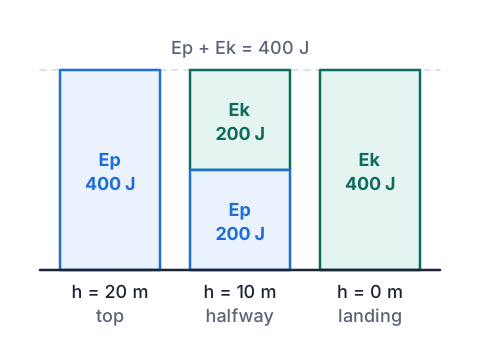
- A 2 kg ball dropped from 20 m starts with Ep = 2 × 10 × 20 = 400 J and no Ek.
- As it falls it loses height and gains speed, so Ep is transformed into Ek.
- Halfway down (10 m) it has lost 200 J of Ep, so it has 200 J of Ep left and has gained 200 J of Ek.
- Just before it lands, all 400 J is Ek, if we ignore air resistance.
- At every point Ep + Ek = 400 J: that is conservation of energy, and it lets you find the speed at any height.
Example: how fast does an apple land?
- A 0.2 kg apple falls 3.2 m from a branch to the ground.
- Calculate its speed just before it lands, and state your assumption.
- Ep = mgh = 0.2 × 10 × 3.2 = 6.4 Jenergy stored at the top
- assume all Ep becomes Ek, so Ek = 6.4 Jno air resistance; this must be written down, not just used
- 6.4 = ½ × 0.2 × v²Ek = ½mv²
- v² = 6.4 × 2 ÷ 0.2 = 64rearrange for v²
- v = √64 = 8 m/sdo not forget the square root
- v = √(2gh) = √(2 × 10 × 3.2) = 8 m/sthe mass cancels, so any object dropped 3.2 m gives the same answer
Where the "lost" energy goes
- In real life the apple lands a little slower than 8 m/s, because not all of its Ep becomes Ek.
- As it falls it collides with air particles, pushing them aside and making them move faster, and rubbing them against its surface: this is air resistance.
- That energy becomes thermal energy (the air and the apple warm very slightly) and some becomes sound.
- The energy is not destroyed; it has been transferred to the surroundings in a form that is no longer useful to us.
- Efficiency = useful energy out ÷ total energy in × 100%, and in every real system it is less than 100%.
Example: a motor lifting roofing iron
- A 400 W electric hoist lifts 60 kg of roofing iron 8.0 m up the side of a house in 15 s.
- Compare the electrical energy used with the Ep gained, explain the difference and find the efficiency.
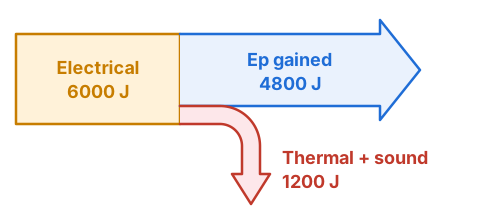
- E = Pt = 400 × 15 = 6000 Jelectrical energy supplied to the motor
- Ep = mgh = 60 × 10 × 8.0 = 4800 Juseful energy gained by the load
- 6000 − 4800 = 1200 Jenergy not stored as Ep
- efficiency = 4800 ÷ 6000 × 100% = 80%useful out ÷ total in
- 1200 J becomes thermal energy and sound: current heating the motor's wires, friction in its bearings and the pulley, and noise
What Achieved, Merit and Excellence look like
- Achieved describes: it names the energy change or gets one step of a calculation right.
- Merit explains: it gives the reason (how or why) and finishes multi-step calculations with full working.
- Excellence analyses: it links the calculation, the assumption and the particle-level reason into one connected answer, with units.
- Write the formula first, then the numbers, then the answer with a unit; NZQA's markers said many students lost marks by writing only the numbers.
| Grade | A model answer |
|---|---|
| Achieved | The real speed will be less than 8 m/s because some energy is lost to air resistance. |
| Merit | The real speed is less than 8 m/s because some of the Ep is changed into thermal energy and sound by air resistance, so less than 6.4 J becomes Ek. |
| Excellence | I assumed all 6.4 J of Ep became Ek. In reality air particles hit the apple as it falls, gaining kinetic energy and warming the air and the apple's surface. That energy is transferred to the surroundings, so Ek at the bottom is less than 6.4 J and, since Ek = ½mv², the apple lands slower than 8 m/s. |
Common mistakes
- v² = 64, so the apple lands at 64 m/s.That is v², not v; take the square root to get v = 8 m/s, a step markers often see missed.
- Energy is lost when the object hits air resistance, so the total energy goes down.Energy is never lost; it is transferred to the air as thermal energy and sound, so the total stays the same.
- A 500 g ball dropped 2 m has Ep = 500 × 10 × 2 = 10 000 J.Mass must be in kilograms: 500 g = 0.5 kg, so Ep = 0.5 × 10 × 2 = 10 J.
- Doubling the speed doubles the kinetic energy.Speed is squared in Ek = ½mv², so doubling the speed makes the kinetic energy four times as big.
How much energy does a bouncing ball keep?
You need: a tennis ball or other bouncy ball, a tape measure, masking tape, a phone camera, a hard floor beside a wall
- Stick a strip of masking tape up the wall and mark it every 10 cm from the floor to 1 m.
- Start the phone recording, then hold the bottom of the ball level with the 1 m mark and let it go without throwing it.
- Play the recording back frame by frame and read the highest point of the first bounce; repeat three times and take the average.
- Work out the percentage of Ep the ball kept: bounce height ÷ 1 m × 100%, since Ep = mgh is proportional to height.
- Look for: the ball never comes back to 1 m; the rest of its energy became thermal energy in the ball and floor and the sound of the bounce.
Safety: Drop the ball from standing height only, never from a chair or the stairs, because a fall while leaning out to follow the ball is the real danger here.
Your turn
Calculate the kinetic energy of a 1200 kg car travelling at 15 m/s.
A 0.5 kg book is lifted from the floor onto a shelf 1.8 m high. How much Ep does it gain?
A shopper pushes a trolley 25 m along an aisle with a force of 80 N. How much work is done?
A diver steps off a 5.0 m platform. Ignoring air resistance, how fast is she going when she reaches the water?
A 55 kg student runs up stairs with a total height of 12 m in 20 s. Find the Ep gained and her power.
Show answer
1. Ek = ½mv² = ½ × 1200 × 15² = 135 000 J. 2. Ep = mgh = 0.5 × 10 × 1.8 = 9 J. 3. W = Fd = 80 × 25 = 2000 J. 4. All Ep becomes Ek, so v = √(2gh) = √(2 × 10 × 5.0) = √100 = 10 m/s. 5. Ep = 55 × 10 × 12 = 6600 J; P = E ÷ t = 6600 ÷ 20 = 330 W (assuming all her work goes into Ep).
Exam-style question: the playground slide
- Aroha has a mass of 40 kg. She climbs to the top of a playground slide 2.5 m above the ground and slides down from rest. Use g = 10 N/kg.
Describe the energy changes as Aroha goes down the slide.
Calculate the greatest speed Aroha could have at the bottom, and state the assumption you made.
Her real speed at the bottom is 6.0 m/s. Discuss what happened to the rest of her energy, using calculations, and explain why the slide feels slightly warm afterwards.
Show answer
1. Gravitational potential energy is transformed into kinetic energy as she loses height and gains speed, and some becomes thermal energy and sound because of friction (Achieved). 2. Ep = mgh = 40 × 10 × 2.5 = 1000 J. Assume all the Ep becomes Ek (no friction or air resistance): 1000 = ½ × 40 × v², so v² = 50 and v = 7.1 m/s. Full working earns Merit; the correct unit and the stated assumption are needed for Excellence. 3. Real Ek = ½ × 40 × 6.0² = 720 J, so 1000 − 720 = 280 J did not become Ek (Merit for the calculation and naming friction). Excellence links it all: friction between her clothes and the slide makes the particles at both surfaces vibrate faster, raising their temperature, and she also pushes air particles aside; that 280 J is transferred to the slide, her clothes and the air as thermal energy and sound. Energy is conserved (720 + 280 = 1000 J), but only 72% of the Ep became Ek, so she reaches 6.0 m/s instead of 7.1 m/s.
Energy Skate Park: Basics
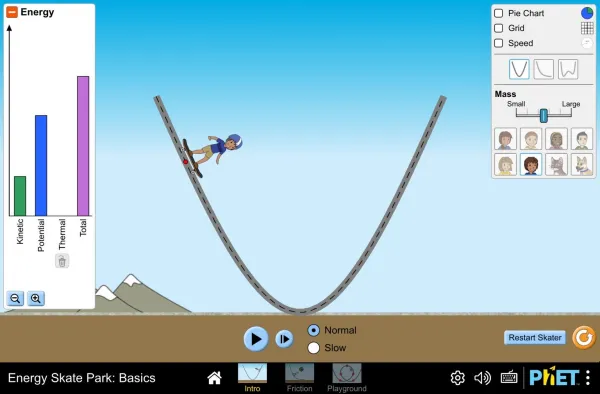
Full screen · PhET Interactive Simulations, University of Colorado Boulder, CC BY 4.0
Recap
- Energy is conserved: it changes form or moves, but the total stays the same.
- Ek = ½mv², Ep = mgh with g = 10 N/kg, W = Fd and E = Pt.
- A falling object turns Ep into Ek; assume no air resistance to find the greatest possible speed, and say so.
- Real objects land slower because some energy becomes thermal energy and sound through friction and air resistance.
- Efficiency = useful energy out ÷ total energy in × 100%.
| Situation | Energy change |
|---|---|
| Lifting a load | work done → Ep |
| Falling object | Ep → Ek (+ thermal energy and sound) |
| Electric motor lifting | electrical → Ep (+ thermal energy and sound) |
| Sliding to a stop | Ek → thermal energy by friction |
The maths behind it
How is NCEA Level 1 maths going?
See the NCEA Level 1 maths guide