Thermal energy, heating and insulation
What this lesson covers
- Temperature measures the average kinetic energy of particles; thermal energy is their total kinetic energy.
- Specific heat capacity is the energy needed to warm 1 kg of a substance by 1 °C: E = mcΔT.
- During a change of state the temperature stays the same while energy changes the arrangement of particles: E = mL.
- Heat moves by conduction, convection and radiation, each explained by what the particles or waves do.
- A vacuum flask and an insulated home work by blocking all three ways heat moves.
Temperature is not the same as thermal energy
- All particles are always moving: in a solid they vibrate, in a liquid and gas they move about.
- Temperature (in °C) measures the average kinetic energy of the particles, so it tells you how fast a typical particle is moving.
- Thermal energy (in J) is the total kinetic energy of all the particles, so it depends on how many particles there are as well as how fast they move.
- A bath at 40 °C has a lower temperature than a cup of tea at 80 °C, but far more thermal energy, because it has so many more particles.
- Heat is thermal energy moving from a hotter object to a colder one; it always flows that way until both reach the same temperature.
Specific heat capacity: E = mcΔT
- Specific heat capacity (c) is the energy needed to raise the temperature of 1 kg of a substance by 1 °C, without it changing state.
- The energy needed to warm any mass is E = mcΔT, where ΔT is the change in temperature (final minus starting), not the final temperature.
- Water has a very high specific heat capacity, so it takes a lot of energy to warm up and gives out a lot as it cools; that is why hot water bottles and the sea store so much heat.
- Metals have low values, so a metal pan heats up quickly for the same energy.
| Substance | c (J kg⁻¹ °C⁻¹), approximate |
|---|---|
| Water | 4200 |
| Aluminium | 900 |
| Iron | 450 |
| Copper | 390 |
Example: boiling water in a kettle
- A kettle holds 1.5 kg of water at 15 °C. Its element has a power of 2400 W.
- Find the energy needed to bring the water to 100 °C, and the shortest time it could take.
- ΔT = 100 − 15 = 85 °Cchange in temperature
- E = mcΔT = 1.5 × 4200 × 85 = 535 500 Jenergy the water must gain
- t = E ÷ P = 535 500 ÷ 2400 = 223 sfrom E = Pt
- 535 500 J, at least 223 s (about 3.7 minutes)
- in reality it takes longer: some energy heats the kettle itself and escapes to the air
Changes of state and latent heat: E = mL
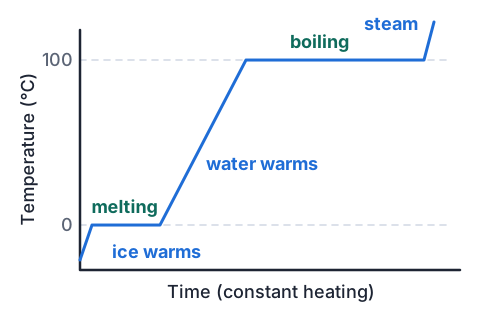
- When ice is heated, its temperature rises to 0 °C and then stays at 0 °C until all of it has melted, even though energy is still going in.
- During melting the energy weakens the forces of attraction holding the particles in their fixed places, so their kinetic energy (and temperature) does not rise.
- Latent heat (L) is the energy needed to change the state of 1 kg of a substance with no change in temperature: E = mL.
- For water, melting takes 334 000 J/kg (latent heat of fusion) and boiling takes 2 260 000 J/kg (latent heat of vaporisation).
- Boiling needs far more energy than melting because the particles must be pulled completely apart, so the flat boiling section is much longer.
Example: melting a frozen drink bottle
- A bottle holds 0.5 kg of ice at 0 °C. It melts, and the water then warms to 20 °C.
- Find the energy for each stage, and explain why melting takes so much longer.
- melt: E = mL = 0.5 × 334 000 = 167 000 Jall at 0 °C
- warm: E = mcΔT = 0.5 × 4200 × 20 = 42 000 Jfrom 0 °C to 20 °C
- total = 167 000 + 42 000 = 209 000 Jadd the stages
- 167 000 ÷ 42 000 ≈ 4melting needs about four times the energy of warming
- melting needs about four times the energy, so it takes much longer: freeing the particles from their fixed places costs far more than speeding them up by 20 °C
Conduction, convection and radiation
- Conduction: hot particles vibrate faster and bump into their neighbours, passing on kinetic energy; it happens best in solids, and metals are the best conductors because their free electrons carry energy quickly.
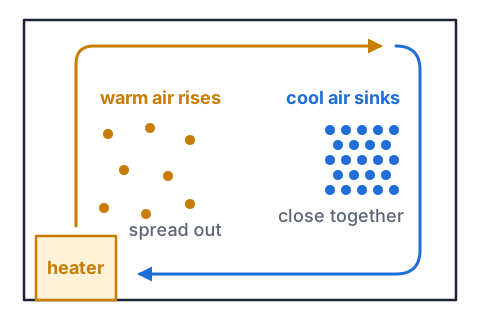
- Convection: in a liquid or gas, heated particles move faster and spread further apart, so that part of the fluid becomes less dense and rises; cooler, denser fluid sinks to take its place, setting up a convection current.
- Radiation: every warm object gives out infrared waves, which need no particles and can cross a vacuum, like the Sun's heat reaching Earth.
- Dark, dull surfaces absorb and give out infrared well; shiny, silvery surfaces reflect it.
- Air is a poor conductor because its particles are far apart, so trapped air is the main idea behind almost every insulator.
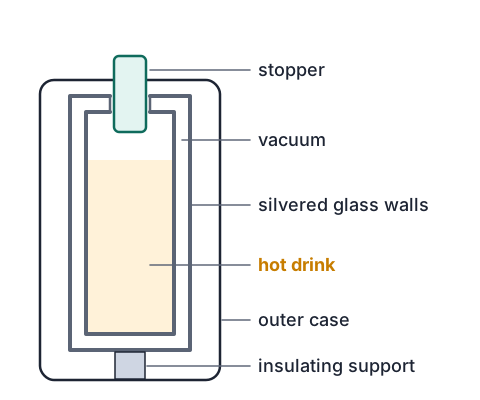
How a vacuum flask keeps a drink hot
- A vacuum flask is built to slow every type of heat transfer, so hot drinks stay hot and cold drinks stay cold.
- Each feature targets one way heat moves, and an exam answer needs the feature, the type of transfer and the reason.
| Feature | Stops | Why |
|---|---|---|
| Vacuum between the walls | Conduction and convection | Both need particles, and a vacuum has almost none |
| Silvered walls | Radiation | Shiny surfaces reflect infrared back towards the drink |
| Stopper (plastic or cork) | Convection and evaporation | Hot air cannot rise out, and it is a poor conductor |
| Glass walls and small supports | Conduction | Glass is a poor conductor, and small contact areas give little path for heat |
Where an uninsulated house loses heat
- A house is a physical system too: heaters put thermal energy in, and it leaks out through the roof, walls, windows and floor, and with air that escapes.
- Warm air rises by convection, so in an uninsulated house the ceiling and roof are the biggest leak.
- Ceiling insulation, wall insulation and underfloor insulation trap still air in fibres or foam, cutting conduction and stopping convection.
- Double glazing traps a layer of air or gas between two panes; thick, lined curtains trap air against the window.
| Where | Share of heat lost |
|---|---|
| Roof | 30 to 35% |
| Windows | 21 to 31% |
| Walls | 18 to 25% |
| Floor | 12 to 14% |
| Air leakage | 6 to 9% |
Once a house is insulated, the windows matter most
- In a house insulated to the Building Code minimum, the roof's share of the heat loss falls to 5 to 10%.
- The windows now lose 35 to 50% of the heat, the largest single share, because glass is thin and conducts heat far better than an insulated wall.
- The shares are percentages of a much smaller total, so the windows do not lose more heat than before; everything else just loses much less.
- This is why double glazing and good curtains are the next step once the ceiling and floor are done.
| Where | Share of heat lost |
|---|---|
| Windows | 35 to 50% |
| Floor | 10 to 20% |
| Air leakage | 10 to 20% |
| Walls | 10 to 15% |
| Roof | 5 to 10% |
What Achieved, Merit and Excellence look like
- Achieved names the process or states one fact; Merit gives the reason; Excellence links particle behaviour to density and then to the pattern of movement.
- NZQA's markers noted that Merit answers often stopped at "less dense" without saying why, and that some students mixed up convection and conduction.
| Grade | A model answer |
|---|---|
| Achieved | Warm air rises and cold air sinks, which makes a convection current. |
| Merit | Air above the heater warms up and becomes less dense, so it rises; at the far wall it cools, becomes denser and sinks. |
| Excellence | The heater gives the air particles above it more kinetic energy, so they move faster and spread further apart, making the air less dense, and it rises. Near the cold far wall the particles lose energy, slow down and move closer together, so the air is denser and sinks, then flows back along the floor to the heater, forming a convection current. |
Common mistakes
- Water heated from 20 °C to 70 °C: E = 0.5 × 4200 × 70.Use the change in temperature, ΔT = 70 − 20 = 50 °C, not the final temperature.
- Cold gets into the flask through the walls.There is no such thing as cold flowing; heat (thermal energy) always moves from the hotter object to the colder one.
- Hot air rises because heat rises.Heated air particles move faster and spread apart, so the air becomes less dense than the air around it and rises.
- While ice melts its temperature rises because energy is going in.The temperature stays at 0 °C while it melts; the energy goes into breaking the fixed arrangement of particles, not speeding them up.
The ice cube insulation race
You need: 3 ice cubes of the same size, 3 zip-lock sandwich bags, a woolly sock, aluminium foil, 3 saucers, a clock or phone timer
- Seal one ice cube in each bag, squeezing out the air, and lay each bag on a saucer on the same bench.
- Leave the first bag bare, wrap the second loosely in two layers of foil, and push the third into the woolly sock.
- Every 10 minutes, open the foil and peek into the sock, then close them again, and note which ice cubes are still solid.
- Write down the time when each cube has completely melted.
- Look for: the cube in the sock lasts longest, because the wool traps still air, which conducts heat poorly and cannot form convection currents, so heat from the room reaches the ice slowly.
Safety: Keep each ice cube sealed in its bag and wipe up any drips straight away, because meltwater on a hard floor is a slipping hazard.
Your turn
How much energy is needed to heat 2.0 kg of water from 20 °C to 45 °C?
9000 J of energy raises the temperature of a 0.5 kg metal block by 20 °C. Find its specific heat capacity and use the table to name the metal.
How much energy is needed to boil away 0.2 kg of water that is already at 100 °C?
21 000 J is given to 0.25 kg of water. By how much does its temperature rise?
Explain why a puffer jacket keeps you warm, in terms of heat transfer.
Show answer
1. ΔT = 45 − 20 = 25 °C; E = mcΔT = 2.0 × 4200 × 25 = 210 000 J. 2. c = E ÷ (mΔT) = 9000 ÷ (0.5 × 20) = 900 J kg⁻¹ °C⁻¹, so it is aluminium. 3. E = mL = 0.2 × 2 260 000 = 452 000 J. 4. ΔT = E ÷ (mc) = 21 000 ÷ (0.25 × 4200) = 20 °C. 5. The filling traps lots of still air; air is a poor conductor because its particles are far apart, and trapped air cannot move to form convection currents, so heat leaves your body only slowly.
Exam-style question: the hot water bottle
- Sione fills a hot water bottle with 1.5 kg of water at 60 °C and puts it in his bed. Eight hours later the water is at 20 °C. The specific heat capacity of water is 4200 J kg⁻¹ °C⁻¹.
Calculate the thermal energy the water gives out over the eight hours.
Calculate the average rate at which the bottle gives out energy, with a unit.
Sione's grandmother knits a thick woollen cover for the bottle. Discuss how the cover affects conduction, convection and radiation, and what this means for how long his bed stays warm.
Show answer
1. ΔT = 60 − 20 = 40 °C; E = mcΔT = 1.5 × 4200 × 40 = 252 000 J (Achieved for the right formula with numbers; Merit for the correct answer). 2. 8 hours = 8 × 3600 = 28 800 s; P = E ÷ t = 252 000 ÷ 28 800 = 8.75 W, about 8.8 W (Excellence needs both calculations with units). 3. Achieved: the wool is an insulator so it keeps the heat in. Merit: wool traps air, which is a poor conductor, and the trapped air cannot move, so conduction and convection are reduced. Excellence: air particles are far apart, so they pass on kinetic energy slowly by collisions, and air held still in the fibres cannot rise and carry heat away; the cover's outer surface also stays cooler, so less infrared is radiated. The water still gives out about 252 000 J as it cools to 20 °C, but over a longer time, so the power is lower and the bed stays warm for longer.
Energy Forms and Changes
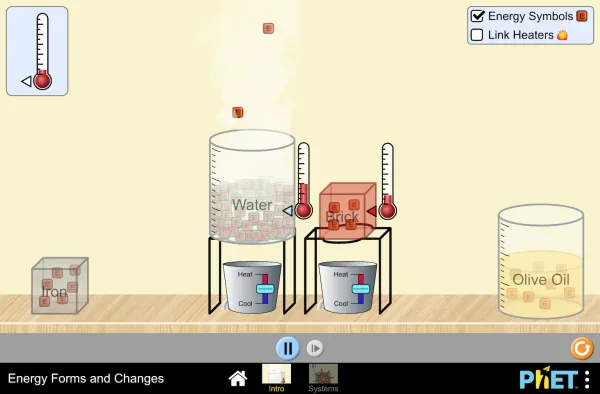
Full screen · PhET Interactive Simulations, University of Colorado Boulder, CC BY 4.0
Recap
- Temperature is the average kinetic energy of particles; thermal energy is the total.
- E = mcΔT warms a substance; E = mL changes its state at a constant temperature.
- Conduction passes energy by collisions, convection moves heated fluid as density changes, and radiation is infrared waves that need no particles.
- Flasks and insulated houses work by trapping still air or a vacuum and reflecting infrared.
- For Merit and Excellence, always say what the particles are doing.
| Idea | Formula or fact |
|---|---|
| Heating | E = mcΔT, c of water = 4200 J kg⁻¹ °C⁻¹ |
| Change of state | E = mL, temperature constant |
| Water | melt 334 000 J/kg, boil 2 260 000 J/kg |
| Conduction | collisions, best in metals |
| Convection | less dense fluid rises, denser sinks |
| Radiation | infrared, crosses a vacuum |
The maths behind it
How is NCEA Level 1 maths going?
See the NCEA Level 1 maths guide