The sine and cosine rules
What this lesson covers
- Use the sine rule when you have a side and its opposite angle.
- Use the cosine rule for two sides and the angle between them.
- Use the cosine rule for three sides.
Which rule
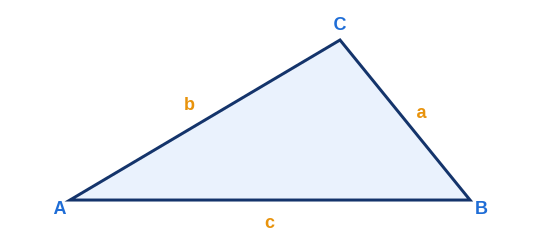
- Sine rule: a/sin A = b/sin B = c/sin C.
- Cosine rule: a² = b² + c² − 2bc cos A.
- To find an angle from three sides: cos A = (b² + c² − a²) ÷ 2bc.
Sine rule
- A = 40°, B = 60°, a = 10. Find b.
- b/sin 60° = 10/sin 40°
- b = 10 × 0.8660 ÷ 0.6428
- b = 13.47
Cosine rule for a side
- b = 7, c = 9, A = 50°. Find a.
- a² = 49 + 81 − 126 cos 50°
- a² = 130 − 80.99 = 49.01
- a = 7.00
Cosine rule for an angle
- The sides are 5, 6 and 7. Find the largest angle, opposite the 7.
- cos C = (25 + 36 − 49) ÷ 60
- cos C = 0.2
- C = 78.5°
Try it: change the triangle
- Set two sides and the angle between them. The cosine rule gives the third side.
Triangle solver
Two possible triangles
- a = 8, b = 10, A = 40°. An angle from sin B may have two answers.
- sin B = 10 sin 40° ÷ 8 = 0.8035
- B = 53.5° or B = 126.5°
- both fit: A + B is under 180°
Try it: two possible triangles
Common mistakes
- Using a calculator set to radians.Check it shows degrees before you start.
- Calculating (b² + c² − 2bc) × cos A.Only the last term carries cos A.
Your turn
Two angles and a side are known. Which rule?
Three sides are known. Which rule finds an angle?
A = 30°, a = 5, B = 90°. Find b.
Sides 3 and 4 with 60° between. Find the third side.
Show answer
1. Sine rule 2. Cosine rule 3. b = 5 sin 90° ÷ sin 30° = 10 4. √13 = 3.61
Sample question: Achieved
In triangle ABC, A = 52°, B = 71° and a = 15 cm. Find b.
Hint
You have a side and its opposite angle, so use the sine rule.
Answer
b ≈ 18.00 cm
Step by step
- Side a and angle A are opposite each other: a matching pair. That means the sine rule.
- bsin B = asin A, so bsin 71° = 15sin 52°.
- Multiply both sides by sin 71°: b = 15 sin 71°sin 52°.
- b ≈ 15 × 0.9455 ÷ 0.7880 ≈ 18.00 cm.
- Check: the bigger angle is opposite the bigger side. 71° > 52° and 18.00 > 15. Correct.
- Classic mistake: putting sin 52° on top. Keep the unknown side on top so it is easy to solve.
Full working
- bsin 71° = 15sin 52°sine rule
- b = 15 sin 71°sin 52°
- b ≈ 18.00 cm
Sample questions: Merit
A triangle has sides 8 cm, 11 cm and 15 cm. Find all three angles.
Hint
Use the cosine rule for the largest angle first; then the other two angles must be acute, so the sine rule is safe.
Answer
About 31.3°, 45.6° and 103.1°
Step by step
- With three sides and no angles, the cosine rule is the only way in.
- Find the largest angle first, opposite the 15 cm side: cos C = (8² + 11² − 15²) ÷ (2 × 8 × 11) = (64 + 121 − 225) ÷ 176 = −40176.
- cos C is negative, so C is obtuse: C ≈ 103.14°.
- Why largest first? A triangle has at most one obtuse angle, so the other two are now known to be acute. The sine rule cannot mislead us.
- Angle opposite 8 cm: sin A = 8 sin 103.14°15 ≈ 0.5194, so A ≈ 31.29°.
- The last angle: 180° − 103.14° − 31.29° ≈ 45.57°.
- Classic mistake: finding a small angle first with the sine rule and then the largest angle by sine too. The calculator would give an acute answer for the obtuse angle.
- Check the 45.57° with the cosine rule: cos B = (64 + 225 − 121) ÷ 240 = 0.7, which gives 45.57°. It matches.
Full working
- cos C = 64 + 121 − 225176 = −40176cosine rule, largest angle
- C ≈ 103.14°
- sin A = 8 sin 103.14°15, so A ≈ 31.29°sine rule, acute
- B = 180° − 103.14° − 31.29° ≈ 45.57°angle sum
- 31.3°, 45.6° and 103.1°
In triangle ABC, a = 9 cm, b = 12 cm and A = 38°. Find the two possible lengths of side c.
Hint
Use the sine rule to find B. Sine gives two angles between 0° and 180°, so check whether both fit.
Answer
c ≈ 14.60 cm or c ≈ 4.32 cm
Step by step
- A and a are a matching pair, so the sine rule finds B: sin B = 12 sin 38°9 ≈ 0.8209.
- B ≈ 55.17°, or B = 180° − 55.17° = 124.83°. Sine is positive in both places.
- Do both fit? 38° + 55.17° and 38° + 124.83° = 162.83° are both under 180°. So there are two triangles.
- Case 1: C = 180° − 38° − 55.17° = 86.83°. c = 9 sin 86.83°sin 38° ≈ 14.60 cm.
- Case 2: C = 180° − 38° − 124.83° = 17.17°. c = 9 sin 17.17°sin 38° ≈ 4.32 cm.
- Why two? The side a = 9 is opposite the given angle and shorter than b = 12, so it can swing to meet the base line in two places.
- Classic mistake: stopping at the calculator's B = 55.17° and giving one answer.
- Check case 2 with the cosine rule: 9² should equal 12² + 4.32² − 2 × 12 × 4.32 × cos 38°: 144 + 18.63 − 81.63 ≈ 81. Correct.
Full working
- sin B = 12 sin 38°9 ≈ 0.8209sine rule
- B ≈ 55.17° or 124.83°both under 180° − 38°
- C ≈ 86.83° or 17.17°angle sum
- c = 9 sin Csin 38°sine rule
- c ≈ 14.60 cm or c ≈ 4.32 cm
Sample questions: Excellence
In triangle ABC, A = 30°, a = 5 cm and b = x cm. Find the range of values of x for which two different triangles are possible. Then, for x = 8, find both possible lengths of side c.
Hint
With sin 30° = 12, the sine rule gives sin B = x10. Two triangles need 0 < sin B < 1 and the obtuse B to still fit.
Answer
Two triangles when 5 < x < 10; for x = 8, c ≈ 9.93 cm or c ≈ 3.93 cm
Step by step
- Sine rule: sin Bx = sin 30°5, so sin B = x × ½ ÷ 5 = x10.
- If sin B > 1 (x > 10) there is no triangle. If sin B = 1 (x = 10) there is exactly one, with a right angle at B.
- If x < 10, sin B < 1 gives two angles: an acute B and an obtuse 180° − B.
- The obtuse one only fits if A + (180° − B) < 180°, that is, B > 30°. That needs sin B > ½, so x10 > ½ and x > 5.
- If x ≤ 5, side a is at least as long as b, and only the acute B works. One triangle.
- So two triangles exist exactly when 5 < x < 10.
- For x = 8: sin B = 0.8, so B ≈ 53.13° or 126.87°.
- Then C ≈ 180° − 30° − 53.13° = 96.87°, or C ≈ 180° − 30° − 126.87° = 23.13°.
- c = 5 sin Csin 30° = 10 sin C, so c ≈ 10 × 0.9928 = 9.93 cm, or c ≈ 10 × 0.3928 = 3.93 cm.
- Check: 8 is between 5 and 10, so two triangles is what the range predicts.
- Classic mistake: giving 0 < x < 10. For x ≤ 5 the obtuse angle makes the angle sum too big.
Full working
- sin B = x sin 30°5 = x10sine rule
- two values of B need x10 < 1x < 10
- obtuse B fits only if B > 30°, so x10 > 12x > 5
- 5 < x < 10
- x = 8: B ≈ 53.13° or 126.87°, C ≈ 96.87° or 23.13°
- c = 10 sin C ≈ 9.93 or 3.93
- 5 < x < 10; c ≈ 9.93 cm or 3.93 cm
From a point A on flat ground, the angle of elevation of the top T of a hill is 18°. A surveyor walks 400 m straight towards the hill to point B, where the angle of elevation is 27°. Find the height of the hill.
Hint
Work in triangle ABT first: find its angles, use the sine rule for BT, then use the right triangle under T.
Answer
About 358.7 m
Step by step
- Let F be the point on the ground directly below T. The height is TF.
- Triangle ABT: angle at A is 18°. Angle ABT is 180° − 27° = 153°, because it sits next to the 27° on a straight line.
- Angle ATB = 180° − 18° − 153° = 9°.
- Sine rule: BTsin 18° = 400sin 9°, so BT = 400 sin 18°sin 9° ≈ 790.15 m.
- Right triangle BFT: TF = BT sin 27° ≈ 790.15 × 0.4540 ≈ 358.7 m.
- Why not tan straight away? Neither right triangle has a known side: we know only the gap of 400 m between A and B. Triangle ABT links them.
- Classic mistake: using 27° − 18° as an angle at A. The 9° is the angle at the top of the hill.
- Check: AF should be 358.7 ÷ tan 18° ≈ 1104 m and BF = 358.7 ÷ tan 27° ≈ 704 m. Their difference is 400 m. Correct.
- Limitation: this assumes the ground is level and that B is on the straight line from A to the hill.
Full working
- ∠ABT = 180° − 27° = 153°straight line at B
- ∠ATB = 180° − 18° − 153° = 9°angle sum
- BT = 400 sin 18°sin 9° ≈ 790.15 msine rule
- h = BT sin 27°right triangle BFT
- about 358.7 m
What to take away
- A matching side and angle: sine rule.
- Otherwise: cosine rule.
Practise this
Report a mistake
More in AS 91259
Is your child on track?
Take the free placement test