Radians, arcs and sectors
What this lesson covers
- π radians equals 180°.
- Arc length is rθ.
- Sector area is ½r²θ.
Measuring in radians
- Π radians = 180°.
- Multiply by π/180 to reach radians and by 180/π to return.
- With θ in radians: s = rθ and A = ½r²θ.
Try it: arcs and sectors
r = 8, θ = 1.5 radians
- These are direct substitutions.
- s = 8 × 1.5 = 12
- A = ½ × 64 × 1.5
- A = 48 square units
Try it: radians round the circle
r = 6, angle 120°
- Convert first.
- 120° = 2π/3 radians
- s = 6 × 2π/3 = 4π = 12.57
- A = ½ × 36 × 2π/3
- A = 12π = 37.70 square units
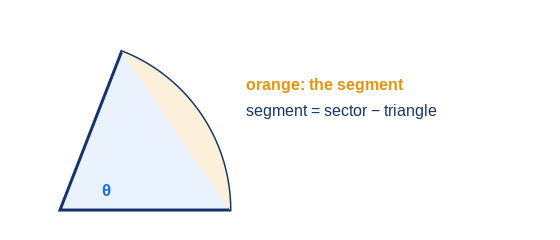
A segment
- r = 10, θ = 1.2. A segment is the sector minus the triangle.
- sector = ½ × 100 × 1.2 = 60
- triangle = ½ × 100 × sin 1.2 = 46.60
- segment = 13.40 square units
Sector and segment
- The segment is the part between the chord and the arc.
Common mistakes
- Using s = rθ with θ in degrees.These formulas only work in radians.
- Leaving the calculator in degrees for sin 1.2.Switch to radians.
Your turn
Convert 90° to radians.
Convert π/3 to degrees.
r = 4, θ = 1.5. Find the arc.
r = 4, θ = 0.5. Find the sector area.
Show answer
1. π/2 2. 60° 3. 6 4. ½ × 16 × 0.5 = 4
Sample question: Achieved
A sector has radius 9 cm and angle 2π5 radians. Find its exact arc length and area, then give each to 2 decimal places.
Hint
The angle is already in radians, so use s = rθ and A = ½r²θ directly.
Answer
Arc 18π5 ≈ 11.31 cm; area 81π5 ≈ 50.89 cm²
Step by step
- The angle is in radians, so the formulas s = rθ and A = ½r²θ can be used straight away.
- Arc length: s = 9 × 2π5 = 18π5 ≈ 11.31 cm.
- Area: A = ½ × 81 × 2π5 = 81π5 ≈ 50.89 cm².
- Classic mistake: using these formulas with an angle in degrees. They only work in radians.
- Check: 2π5 is a fifth of a full turn (2π). A fifth of the circumference 18π is 18π5, and a fifth of the area 81π is 81π5. Both match.
Full working
- s = 9 × 2π5 = 18π5s = rθ
- A = ½ × 81 × 2π5 = 81π5A = ½r²θ
- s ≈ 11.31 cm, A ≈ 50.89 cm²
Sample questions: Merit
A sector has area 48 cm² and arc length 12 cm. Find its radius and its angle in radians and in degrees.
Hint
Write both facts as equations in r and θ. Replacing rθ with 12 in the area formula leaves just r.
Answer
r = 8 cm and θ = 1.5 radians ≈ 85.9°
Step by step
- Two facts give two equations: rθ = 12 and ½r²θ = 48.
- Notice ½r²θ = ½ × r × (rθ). The bracket is the arc length, 12.
- So ½ × r × 12 = 48, which gives 6r = 48 and r = 8 cm.
- Then θ = 12 ÷ 8 = 1.5 radians.
- In degrees: 1.5 × 180π ≈ 85.9°.
- Classic mistake: dividing the two equations the wrong way round and getting r = 18. Check the sizes make sense.
- Check: arc 8 × 1.5 = 12 and area ½ × 64 × 1.5 = 48. Both correct.
Full working
- rθ = 12 and ½r²θ = 48
- ½ × r × 12 = 48replace rθ with 12
- r = 8, θ = 12 ÷ 8 = 1.5
- 1.5 × 180π ≈ 85.9°
- r = 8 cm, θ = 1.5 radians ≈ 85.9°
A chord 10 cm long is drawn in a circle of radius 8 cm. Find the area of the smaller segment cut off by the chord.
Hint
Find the angle at the centre first: split the isosceles triangle into two right triangles. Then segment = sector − triangle, in radians.
Answer
About 11.98 cm²
Step by step
- A segment is the sector minus the triangle, and both need the angle θ at the centre.
- The triangle from the centre to the chord is isosceles with sides 8, 8 and 10. Halve it: a right triangle with hypotenuse 8 and opposite side 5.
- sin(θ2) = 58, so θ2 ≈ 0.6751 radians and θ ≈ 1.3503 radians. Use radian mode.
- Sector area: ½ × 8² × 1.3503 ≈ 43.21 cm².
- Triangle area: ½ × 8² × sin 1.3503 ≈ 32 × 0.9758 ≈ 31.22 cm².
- Segment = 43.21 − 31.22 ≈ 11.98 cm² (using unrounded values).
- Classic mistake: mixing modes. If θ is found in degrees, it must be converted before using ½r²θ.
- Check with the cosine rule: cos θ = (64 + 64 − 100) ÷ 128 = 0.21875, which also gives θ ≈ 1.3503.
Full working
- sin(θ2) = 58, so θ ≈ 1.3503 radhalf the isosceles triangle
- sector = ½ × 64 × 1.3503 ≈ 43.21
- triangle = ½ × 64 × sin 1.3503 ≈ 31.22
- segment = 43.208 − 31.225sector − triangle
- about 11.98 cm²
Sample questions: Excellence
A sector has a perimeter of 30 cm. Show that its area is A = 15r − r², where r is the radius. Hence find the radius and the angle that give the largest possible area, and that area.
Hint
The perimeter is two radii plus the arc, so the arc is 30 − 2r. Then use A = ½rs, which is ½r²θ with s = rθ.
Answer
A = 15r − r²; the largest area is 56.25 cm², when r = 7.5 cm and θ = 2 radians
Step by step
- The perimeter of a sector is two radii plus the arc: 2r + s = 30, so s = 30 − 2r.
- Sector area is ½r²θ = ½r(rθ) = ½rs.
- So A = ½r(30 − 2r) = 15r − r². That is what we had to show.
- "Hence": A = 15r − r² is a parabola in r that opens downwards, so its greatest value is at the vertex.
- Complete the square: 15r − r² = −(r − 7.5)² + 56.25. The vertex is at r = 7.5, with A = 56.25.
- Then the arc is s = 30 − 15 = 15 cm and θ = s ÷ r = 15 ÷ 7.5 = 2 radians.
- Interesting: the best sector has its arc equal to two radii, for any perimeter.
- Limits: r must be more than 0, and s must be positive, so r < 15. Also θ cannot pass 2π, which needs r > 302 + 2π ≈ 3.62. r = 7.5 is inside all of these.
- Classic mistake: thinking the perimeter is just the arc. The two straight edges count too.
- Check: r = 7 gives 105 − 49 = 56, and r = 8 gives 120 − 64 = 56. Both are less than 56.25.
Full working
- s = 30 − 2rperimeter 2r + s = 30
- A = ½rs = ½r(30 − 2r) = 15r − r²shown
- A = −(r − 7.5)² + 56.25complete the square
- r = 7.5, s = 15, θ = 15 ÷ 7.5 = 2
- largest area 56.25 cm² at r = 7.5 cm, θ = 2 radians
Two circles each have radius 6 cm, and each centre lies on the other circle. Find the exact area of the region inside both circles, then give it to 2 decimal places.
Hint
Join the two centres to the two points where the circles cross. You get two equilateral triangles, so the angle at each centre is 2π3.
Answer
24π − 18√3 ≈ 44.22 cm²
Step by step
- Call the centres A and B and the crossing points P and Q. AB = 6, because each centre is on the other circle.
- AP, BP, AQ and BQ are all radii, so all are 6. Triangles ABP and ABQ are equilateral.
- So angle PAQ = 60° + 60° = 120° = 2π3 radians. The same is true at B.
- The overlap is two equal segments, one cut from each circle by the chord PQ.
- One segment = sector − triangle = ½r²θ − ½r² sin θ = ½ × 36 × (2π3 − sin(2π3)).
- sin(2π3) = √32, so one segment = 18(2π3 − √32) = 12π − 9√3.
- Two segments: 24π − 18√3 ≈ 75.40 − 31.18 ≈ 44.22 cm².
- Classic mistake: adding two sectors. The two sectors overlap in the rhombus APBQ, so that counts the middle twice.
- Sense check: one circle has area 36π ≈ 113.10, and the overlap is about 39% of it. Looking at the picture, a bit over a third seems right.
Full working
- AB = AP = BP = 6equilateral triangles
- ∠PAQ = 2π360° + 60°
- segment = ½ × 36(2π3 − √32) = 12π − 9√3sector − triangle
- overlap = 2(12π − 9√3)two equal segments
- 24π − 18√3 ≈ 44.22 cm²
What to take away
- Convert to radians before using the formulas.
- Segment = sector − triangle.
Practise this
Report a mistake
More in AS 91259
Is your child on track?
Take the free placement test