The chemistry behind the lithium-ion battery
What this lesson covers
- What the standard asks: an account of the chemistry, links between chemistry and development, and an evaluation.
- Why lithium: its low mass and its strong tendency to lose an electron.
- How a lithium-ion cell works: intercalation, oxidation at the graphite and reduction at the metal oxide, with half equations.
- Why the electrolyte is an organic solvent and not water, and what that means for safety.
- How Whittingham, Goodenough and Yoshino each changed the chemistry, and the trade-offs in newer cells.
- Using and citing sources in your own words.
What the report asks of you
- You write a report on one technology in use today, such as lithium-ion batteries, green hydrogen, catalytic converters, non-stick coatings or sunscreens. Your teacher gives you resource material, and you may add your own.
- Achieved: give an account of the chemistry the technology uses, with correct names, formulae and equations.
- Merit: make and explain links between that chemistry and how the technology was developed: why a chemical property led to a particular design choice.
- Excellence: evaluate how the chemistry influenced the development: weigh what each chemical choice gained and cost, and judge which mattered most.
- Copying research is not enough at any grade. Every fact has to be put in your own words and used to explain something.
Why lithium?
- Lithium is the lightest metal (molar mass 6.94 g mol⁻¹, density 0.53 g cm⁻³), so a battery that stores charge in lithium can be light.
- It has only one valence electron, held weakly, so it loses it easily: Li → Li⁺ + e⁻. Its standard electrode potential, −3.04 V, is the most negative of any element, so pairing it with a strong oxidant gives a high cell voltage.
- The Li⁺ ion is very small, so it can slip between the layers of a solid without breaking them. This is called intercalation.
- High voltage and low mass together mean a lot of energy for each kilogram, which is what phones and cars need.
How the cell works
- The negative electrode is graphite, layers of carbon with lithium stored between them (LiC₆). The positive electrode is lithium cobalt oxide, LiCoO₂, which is also layered.
- On discharge, lithium in the graphite is oxidised. The Li⁺ ions move through the electrolyte to the cobalt oxide, while the electrons travel through the external circuit and do work in your phone.
- At the cobalt oxide, cobalt is reduced from +4 to +3 as the ions and electrons arrive.
- Charging pushes the ions and electrons back the other way. Because the ions only slide in and out of the layers, the electrodes are not dissolved and rebuilt each cycle, so the cell lasts for hundreds of charges.
- A thin porous plastic separator keeps the electrodes apart, so electrons cannot short-circuit straight across while ions can still pass.
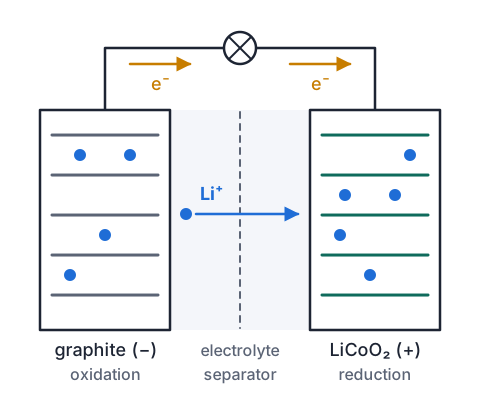
Example: the half equations on discharge
- Write the half equation at each electrode during discharge, the overall equation, and the oxidation number change of cobalt.
- LiC₆ → C₆ + Li⁺ + e⁻graphite electrode: lithium loses an electron, oxidation
- CoO₂ + Li⁺ + e⁻ → LiCoO₂cobalt oxide electrode: gains an electron, reduction
- LiC₆ + CoO₂ → C₆ + LiCoO₂add them; Li⁺ and e⁻ cancel
- Co in CoO₂: x + 2(−2) = 0, so x = +4oxygen is −2
- Co in LiCoO₂: (+1) + x + 2(−2) = 0, so x = +3lithium is +1
- charge check: 0 = (+1) + (−1) on the left half equation
- cobalt is reduced from +4 to +3 on discharge; on charging it is oxidised back to +4
Why the electrolyte is not water
- The electrolyte must carry Li⁺ ions, so it is a lithium salt, usually LiPF₆, dissolved in organic carbonate solvents.
- Water cannot be used. Water is split by any voltage above about 1.23 V, and these cells run at close to 4 V.
- Water also reacts with lithium metal and with lithium in graphite: 2Li + 2H₂O → 2LiOH + H₂.
- The cost of the organic solvent is that it is flammable. If a cell is damaged or overheats, the solvent can catch fire, which is why lithium-ion batteries must never be punctured or crushed.
How the chemistry shaped the development
- In the 1970s, Stanley Whittingham found that titanium disulfide, TiS₂, takes lithium ions between its layers. With a lithium metal electrode this gave just over 2 V, but metallic lithium grew whiskers (dendrites) when charged, which could short-circuit the cell and start fires.
- John Goodenough reasoned that an oxide would give a higher voltage than a sulfide. In 1980 he showed that lithium cobalt oxide gives about 4 V, almost twice as much energy per lithium ion.
- In 1985 Akira Yoshino replaced the lithium metal with a carbon material that also intercalates lithium ions. With no metallic lithium, there were no dendrites, and the cell was safe enough to sell.
- The first lithium-ion batteries went on sale in 1991, and the three chemists shared the 2019 Nobel Prize in Chemistry.
| Year | Chemist | Chemical change | Result |
|---|---|---|---|
| 1976 | Whittingham | TiS₂ positive electrode, lithium metal negative | Just over 2 V; dendrites made it unsafe |
| 1980 | Goodenough | Lithium cobalt oxide positive electrode | About 4 V |
| 1985 | Yoshino | Carbon (petroleum coke) in place of lithium metal | First commercially viable cell |
| 1991 | First lithium-ion batteries sold | Portable electronics |
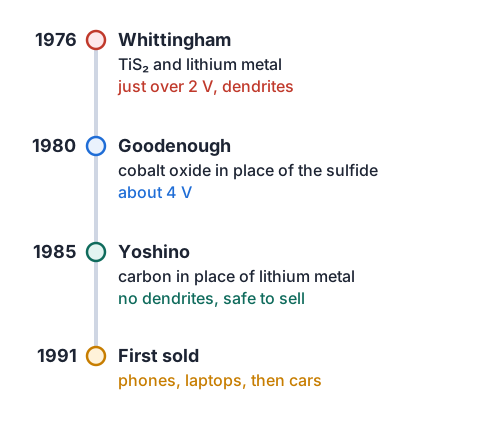
Evaluating: every chemical choice is a trade-off
- Carbon instead of lithium metal: safer and longer lasting, but the graphite adds mass and holds less lithium than pure metal would, so some energy per kilogram was given up for safety.
- Oxide instead of sulfide: a higher voltage, because the cobalt oxide is a much stronger oxidant than TiS₂. But cobalt is costly and much of it is mined in conditions that raise human rights concerns.
- That cost has driven newer chemistries such as lithium iron phosphate, LiFePO₄: FePO₄ + Li⁺ + e⁻ → LiFePO₄, with iron reduced from +3 to +2.
- Iron phosphate gives a lower voltage than cobalt oxide, so less energy per kilogram, but iron is cheap and the strong P–O bonds hold the oxygen in place when the cell overheats, making fires less likely.
- An Excellence evaluation weighs these and reaches a judgement, for example that each step traded a little energy for a lot of safety or cost, and that the choice depends on the use: a phone needs light, a home battery does not.
Example: one idea written up for each grade
- The same point, Yoshino's carbon electrode, written three ways. Each grade keeps what the one before it said and adds to it.
| Grade | What the student wrote |
|---|---|
| Achieved | Early lithium batteries used lithium metal as the negative electrode. Yoshino used carbon instead. During discharge, lithium is oxidised: LiC₆ → C₆ + Li⁺ + e⁻. |
| Merit | Lithium metal formed dendrites when charged, which could short-circuit the cell. Carbon stores lithium as ions between its layers (intercalation), so no metal is deposited and no dendrites grow. This is why the carbon electrode let the battery be sold safely. |
| Excellence | Replacing lithium metal with carbon gave up some energy per kilogram, because the carbon adds mass, but removed dendrites, the main cause of fires. Together with Goodenough's 4 V cobalt oxide, which made up for the lost energy with a higher voltage, it made the battery safe and powerful. I judge the carbon electrode the more important step, because without it the cell could not have been sold at all. |
Using and citing sources
- Prefer sources written by the scientists or organisations involved: the Nobel Prize site, university and government pages, the Science Learning Hub, and the resource booklet your teacher gives you.
- Check each fact in a second source if you can, and be wary of sites that are selling batteries or cars.
- Put every idea in your own words and add the chemistry the source leaves out: the half equation, the oxidation numbers, the reason.
- Give a reference list at the end, with the author or organisation, year, title and web address, for example: The Royal Swedish Academy of Sciences. (2019). The Nobel Prize in Chemistry 2019 [Press release]. nobelprize.org.
Common mistakes
- Electrons travel through the electrolyte from one electrode to the other.Electrons go through the external circuit; only ions, Li⁺, move through the electrolyte and separator.
- The lithium-ion battery runs out because the lithium gets used up.The lithium ions just move to the other electrode; recharging moves them back. Cells wear out slowly through side reactions.
- My report lists the history and the equations in separate sections.Merit and Excellence need links: say which chemical property caused each design change, and evaluate the trade-off.
- CoO₂ + e⁻ → LiCoO₂ is the reduction half equation.The lithium has to appear on both sides: CoO₂ + Li⁺ + e⁻ → LiCoO₂, balanced for atoms and charge.
Read the chemistry on your battery labels
You need: a phone, power bank or laptop with a battery label (or its settings screen), an AA battery, a torch or magnifying glass for small print, paper and a pen, a calculator
- Find the battery label on a power bank, laptop or cordless tool, or look up the phone's battery in its settings or manual. Write down the voltage and the capacity in mAh or Wh.
- Read the voltage on an AA battery. It is 1.5 V, from zinc and manganese dioxide.
- Most lithium-ion labels say 3.6, 3.7 or 3.85 V for one cell. If yours is higher, divide by 3.7 to see how many cells are joined in series (11.1 V is three).
- Work out the energy: watt-hours = volts × amp-hours, so 3.85 V × 4.000 Ah = 15.4 Wh. Check your answer against any Wh figure on the label.
- Look for: every lithium-ion cell is near 3.7 V, more than twice an AA, because lithium and cobalt oxide are much further apart in how strongly they hold electrons.
Safety: Never open, bend or puncture a lithium-ion battery or device; a damaged or swollen one can catch fire, so only read the labels and leave it whole.
Your turn
Write the oxidation half equation at the graphite electrode during discharge.
Give the oxidation number of cobalt in CoO₂ and in LiCoO₂, and say whether cobalt is oxidised or reduced on discharge.
Explain why water cannot be used as the solvent in the electrolyte.
Explain why Yoshino's carbon electrode made the battery safer than Whittingham's.
A laptop battery is labelled 11.1 V and 4.0 Ah. How many 3.7 V cells are in series, and how much energy does it store in Wh?
Show answer
1. LiC₆ → C₆ + Li⁺ + e⁻. 2. +4 in CoO₂ and +3 in LiCoO₂; cobalt gains an electron, so it is reduced. 3. The cell runs at about 4 V, far above the 1.23 V that splits water, and lithium reacts with water to make hydrogen: 2Li + 2H₂O → 2LiOH + H₂. 4. Carbon holds lithium as ions between its layers, so no lithium metal is deposited on charging and no dendrites grow to short-circuit the cell. 5. 11.1 ÷ 3.7 = 3 cells; energy = 11.1 V × 4.0 Ah = 44.4 Wh.
Recap
- Lithium is light and loses its electron easily, so it gives a high voltage for a low mass.
- On discharge, lithium in graphite is oxidised and cobalt in the oxide is reduced from +4 to +3; Li⁺ ions cross the electrolyte, electrons go round the circuit.
- Each step in the development was a chemical choice: oxide for voltage, carbon for safety, iron phosphate for cost and stability.
- Achieved gives an account, Merit explains the links, Excellence evaluates the trade-offs and reaches a judgement.
| Chemical choice | Gain | Cost |
|---|---|---|
| Cobalt oxide, not a sulfide | About 4 V instead of 2 V | Cobalt is costly and hard to source |
| Carbon, not lithium metal | No dendrites, safe to sell | Some energy per kilogram |
| Organic solvent, not water | Works at 4 V | Flammable |
| Iron phosphate, not cobalt | Cheaper, less fire risk | Lower voltage |
How is NCEA Level 2 maths going?
See the NCEA Level 2 maths guide