Lewis structures, shapes and polarity
What this lesson covers
- A Lewis structure shows every valence electron as a bonding pair or a lone pair, and the total must match the count from the formula.
- Regions of electron density around the central atom repel each other to be as far apart as possible, which sets the arrangement and the bond angle.
- Lone pairs are part of the arrangement but not of the shape, so four regions can give a tetrahedral, trigonal pyramid or bent molecule.
- A bond is polar when the two atoms differ in electronegativity, giving one end δ+ and the other δ−.
- A molecule is non-polar when equal bond dipoles are arranged symmetrically and cancel, and polar when they do not cancel.
Counting valence electrons
- Only the outer shell (valence) electrons take part in bonding, and the group number tells you how many each atom has: group 1 has 1, group 13 has 3, and groups 14 to 17 have 4 to 7.
- Add up the valence electrons of every atom in the formula; for a negative ion add one electron per negative charge, and for a positive ion take one away per positive charge.
- Halve the total to get the number of electron pairs you must place, either as bonds between atoms or as lone pairs on an atom.
- Most atoms end up with eight electrons around them (an octet), hydrogen has only two, and boron in BF3 or BCl3 has only six.
| Element | Group | Valence electrons | Usual bonds |
|---|---|---|---|
| H | 1 | 1 | 1 |
| B | 13 | 3 | 3 |
| C, Si | 14 | 4 | 4 |
| N, P | 15 | 5 | 3, plus 1 lone pair |
| O, S | 16 | 6 | 2, plus 2 lone pairs |
| F, Cl, Br, I | 17 | 7 | 1, plus 3 lone pairs |
Drawing a Lewis structure, step by step
- Count the total valence electrons and halve it to get the number of pairs.
- Put the atom that makes the most bonds in the middle (never hydrogen), and join each outer atom to it with a single bond.
- Give each outer atom lone pairs until it has an octet (hydrogen needs none), then put any pairs left over on the central atom.
- If the central atom still has fewer than eight electrons, turn a lone pair on an outer atom into a second bond, making a double bond, or a triple bond if needed.
- Check: the pairs you drew must equal the pairs you counted, and every atom except H (and B) has an octet.
- An ion goes in square brackets with its charge outside: NH4+ has 5 + 4 − 1 = 8 electrons, four N–H bonds and no lone pairs.
Example: Lewis structures of CO2 and HCN
- Draw the Lewis structures of carbon dioxide, CO2, and hydrogen cyanide, HCN.
- Count the electrons first, then place them, then check the count again.
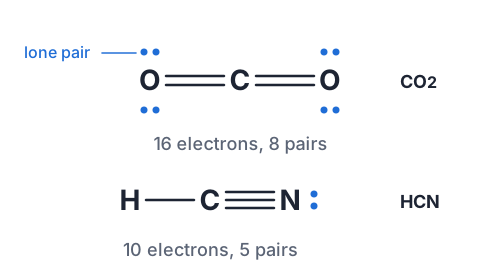
- CO2: 4 + 6 + 6 = 16 electrons = 8 pairsC is group 14, O is group 16
- O–C–O with 3 lone pairs on each O uses 2 + 6 = 8 pairs, but C has only 4 electronssingle bonds first, outer atoms filled
- move one lone pair from each O into a bond: O=C=OC now has 8 electrons, each O has 2 lone pairs
- check: 4 bonding pairs + 4 lone pairs = 8 pairs
- HCN: 1 + 4 + 5 = 10 electrons = 5 pairsC goes in the middle, it makes 4 bonds
- H–C≡N with one lone pair on N: 4 bonding pairs + 1 lone pair = 5 pairsa triple bond gives both C and N an octet
- CO2 is O=C=O; HCN is H–C≡N
Regions of electron density decide the shape
- Each bond or lone pair around the central atom is a region of negative charge, and a double or triple bond counts as one region, not two or three.
- The regions repel each other, so they spread out to be as far apart as possible, which gives the least repulsion: this sets the arrangement and the bond angle.
- The shape is named from the atoms only: a lone pair still pushes the bonds, but it is not part of the shape.
- Lone pairs repel a little more than bonds, so the measured angle in NH3 is 107° and in H2O is 104.5°; Level 2 marking accepts 109.5° for every four-region molecule.
| Regions | Bonded | Lone pairs | Shape | Angle | Example |
|---|---|---|---|---|---|
| 2 | 2 | 0 | linear | 180° | CO2, HCN |
| 3 | 3 | 0 | trigonal planar | 120° | BF3, H2CO |
| 3 | 2 | 1 | bent | about 120° | SO2 |
| 4 | 4 | 0 | tetrahedral | 109.5° | CH4, NH4+ |
| 4 | 3 | 1 | trigonal pyramid | about 109.5° | NH3, PCl3 |
| 4 | 2 | 2 | bent | about 109.5° | H2O, OF2 |
Example: why CH4, NH3 and H2O have different shapes
- Explain why methane, ammonia and water all have four regions of electron density but different shapes.
- This is the reasoning NZQA rewards: count regions, give the arrangement and angle, then say how many are bonded.
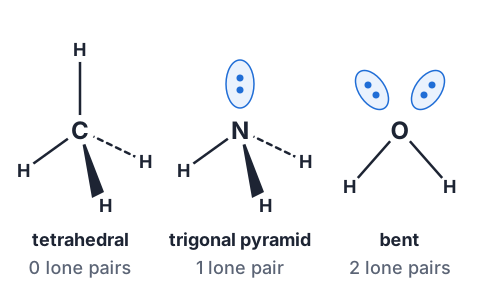
- C in CH4: 4 bonding pairs, 0 lone pairs = 4 regionsfrom the Lewis structure
- 4 regions repel to maximum separation: tetrahedral arrangement, 109.5°minimum repulsion
- CH4: all 4 regions bonded, so the shape is tetrahedral
- NH3: 3 bonded + 1 lone pair, same arrangement, shape trigonal pyramid
- H2O: 2 bonded + 2 lone pairs, same arrangement, shape bent
- same arrangement each time; only the number of lone pairs changes the shape
Electronegativity and polar bonds
- Electronegativity is how strongly an atom attracts the shared electrons in a covalent bond; it rises across a period and falls down a group, so F, O and N are the highest.
- When the two atoms in a bond have different electronegativities, the bonding electrons are shared unequally: the more electronegative atom becomes δ− and the other δ+, so the bond is polar and has a dipole.
- Two identical atoms (Cl–Cl, H–H) share equally, so the bond is non-polar; a very small difference, such as C–H, gives a bond that is only slightly polar.
- Use the difference to compare bonds: O–H (3.44 − 2.20 = 1.24) is more polar than N–H (3.04 − 2.20 = 0.84).
| Element | H | B | C | N | O | F | P | S | Cl |
|---|---|---|---|---|---|---|---|---|---|
| Electronegativity | 2.20 | 2.04 | 2.55 | 3.04 | 3.44 | 3.98 | 2.19 | 2.58 | 3.16 |
Polar and non-polar molecules
- A molecule with no polar bonds (Cl2, N2) is non-polar.
- A molecule with polar bonds is non-polar only if the bonds are equal in polarity and arranged symmetrically around the central atom, so the dipoles cancel: CO2, BF3, CH4 and CCl4.
- If the shape is not symmetrical (lone pairs on the central atom, as in H2O and NH3) or the outer atoms differ (CH3Cl, HCN), the dipoles do not cancel and the molecule is polar.
- For Excellence, mention both things every time: the size of the bond dipoles and how symmetrically they are arranged.
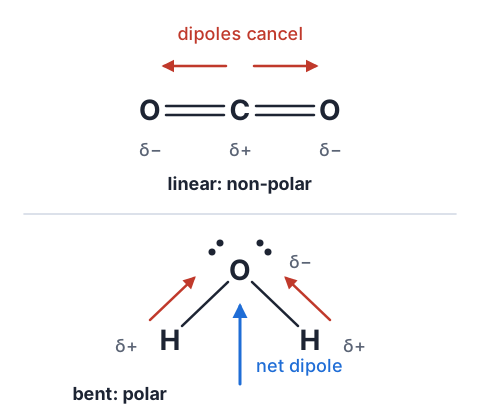
Example: CCl4 is non-polar but CHCl3 is polar
- Tetrachloromethane, CCl4, and trichloromethane, CHCl3, are both tetrahedral. Explain why only one of them is polar.
- C–Cl: 3.16 − 2.55 = 0.61, a polar bond, Cl is δ−electronegativity difference
- C–H: 2.55 − 2.20 = 0.35, much less polarso C–H and C–Cl dipoles are not equal
- CCl4: 4 equal C–Cl dipoles, arranged symmetrically (tetrahedral), cancel
- CHCl3: 3 C–Cl dipoles and 1 weaker C–H dipole, unequal, so they do not cancel
- CCl4 is non-polar; CHCl3 is polar, with its δ− end at the chlorines
What Achieved, Merit and Excellence look like
- Achieved names the shape and angle; Merit explains them from regions of electron density and lone pairs; Excellence links the shape to polarity, saying why the dipoles do or do not cancel.
| Grade | A model answer |
|---|---|
| Achieved | Water is bent with a bond angle of about 109.5°. It is polar because O–H bonds are polar. |
| Merit | O has four regions of electron density (2 bonds and 2 lone pairs) that repel as far apart as possible into a tetrahedral arrangement, 109.5°. Only two regions are bonded, so the shape is bent. |
| Excellence | As for Merit, then: O (3.44) is more electronegative than H (2.20), so each O–H bond is polar with O δ−. The bent shape is not symmetrical, so the two dipoles do not cancel and water is a polar molecule. |
Common mistakes
- CO2 is bent like water, because it has three atoms.C in CO2 has two double-bond regions and no lone pairs, so the regions sit 180° apart and the molecule is linear.
- A double bond counts as two regions of electron density.A double or triple bond is one region, because all its electrons sit between the same two atoms.
- CCl4 has polar bonds, so it must be a polar molecule.Its four equal C–Cl dipoles are arranged symmetrically, so they cancel and CCl4 is non-polar.
- In a Lewis structure of PCl3 only the bonds and the P lone pair need drawing.Every valence electron is shown: each Cl also has three lone pairs, making 13 pairs (26 electrons) in total.
Make molecule shapes with balloons
You need: 4 round balloons of the same size, a marker pen, sticky tape
- Blow up the four balloons to about the same size and tie each one off.
- Twist two balloons together at their knots and let go: they settle pointing opposite ways, like the two regions in CO2 (180°).
- Twist in a third balloon: the three spread into a flat triangle, like BF3 (120°).
- Twist in the fourth: they jump into a 3D tetrahedron, like CH4 (109.5°), not a flat cross.
- Mark one balloon "lone pair" and look at the other three tips: they form a trigonal pyramid, the shape of NH3, because each region pushes the others as far away as it can.
Safety: Burst balloon pieces can choke small children, so pick up every piece straight away, and skip the activity if anyone at home has a latex allergy.
Your turn
How many valence electrons are shown in the Lewis structure of HCN?
Give the shape and bond angle of methanal, H2CO (C in the middle, double bonded to O).
What is the bond angle in silane, SiH4?
Name the shape of oxygen difluoride, OF2.
Is dichloromethane, CH2Cl2, polar or non-polar?
Show answer
1. 1 + 4 + 5 = 10 electrons (5 pairs: H–C≡N with one lone pair on N). 2. C has three regions (two C–H and one C=O) and no lone pairs, so it is trigonal planar with angles of 120°. 3. Si has four bonding regions and no lone pairs, so it is tetrahedral, 109.5°. 4. O has 2 bonds and 2 lone pairs (20 electrons in all), so four regions give a bent shape. 5. Polar: it is tetrahedral, but the C–Cl dipoles are bigger than the C–H dipoles, so they do not cancel.
Exam-style question: BCl3 and PCl3
- Boron trichloride, BCl3, and phosphorus trichloride, PCl3, are both used to make other chemicals in industry. Each has three Cl atoms bonded to a central atom.
Give the total number of valence electrons in the Lewis structure of each molecule.
Name the shape of each molecule and give its bond angle.
Explain why the two molecules have different shapes.
Both molecules contain polar bonds. Discuss why BCl3 is non-polar but PCl3 is polar.
Show answer
1. BCl3: 3 + (3 × 7) = 24 electrons, 12 pairs: three B–Cl bonds and three lone pairs on each Cl; B has only 6 electrons. PCl3: 5 + (3 × 7) = 26 electrons, 13 pairs: three P–Cl bonds, three lone pairs on each Cl and one lone pair on P (Achieved for a correct Lewis structure). 2. BCl3 is trigonal planar, 120°; PCl3 is a trigonal pyramid, about 109.5° (Achieved for both). 3. Merit: B has three regions of electron density, all bonded, which repel to maximum separation in a flat triangle at 120°. P has four regions (three bonds and a lone pair), which repel into a tetrahedral arrangement at 109.5°; only three are bonded, so the shape is a trigonal pyramid. Excellence links the lone pair on P to both the different arrangement and the different shape. 4. Excellence: B–Cl (3.16 − 2.04) and P–Cl (3.16 − 2.19) are both polar, with Cl δ−. In BCl3 the three equal dipoles are arranged symmetrically in a plane, so they cancel and the molecule is non-polar. In PCl3 the lone pair makes the shape a pyramid, which is not symmetrical, so the three dipoles do not cancel and the molecule is polar.
Molecule Shapes
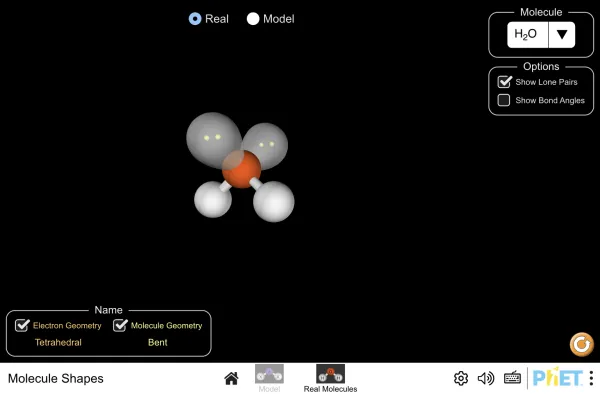
Full screen · PhET Interactive Simulations, University of Colorado Boulder, CC BY 4.0
Recap
- Count valence electrons, place bonds then lone pairs, use double or triple bonds to complete octets, and check the total.
- Regions of electron density repel to maximum separation: 2 give 180°, 3 give 120°, 4 give 109.5°.
- Lone pairs set the arrangement but are left out of the shape name.
- Polar bonds come from an electronegativity difference; a polar molecule needs dipoles that do not cancel.
- Excellence answers link regions, lone pairs, shape, bond dipoles and symmetry in one chain.
| Central atom | Shape | Polar? |
|---|---|---|
| 2 regions, 0 lone pairs | linear | no, if both ends are the same |
| 3 regions, 0 lone pairs | trigonal planar | no, if all outer atoms are the same |
| 4 regions, 0 lone pairs | tetrahedral | no, if all outer atoms are the same |
| 4 regions, 1 lone pair | trigonal pyramid | yes |
| 4 regions, 2 lone pairs | bent | yes |
How is NCEA Level 2 maths going?
See the NCEA Level 2 maths guide