Energy changes in reactions
What this lesson covers
- An exothermic change releases energy to the surroundings (ΔH negative); an endothermic change absorbs it (ΔH positive).
- Breaking bonds or attractions absorbs energy and making them releases energy, so melting and evaporating are endothermic and freezing and condensing are exothermic.
- An energy diagram shows reactants and products as levels, with ΔH as the gap between them.
- ΔrH in kJ mol⁻¹ is for the amounts in the equation as written, so energy scales with moles: use n = m ÷ M.
- ΔrH = sum of bond enthalpies of bonds broken − sum of bond enthalpies of bonds formed.
Exothermic and endothermic
- The system is the reacting chemicals; the surroundings are everything else, including the water, the beaker and the air.
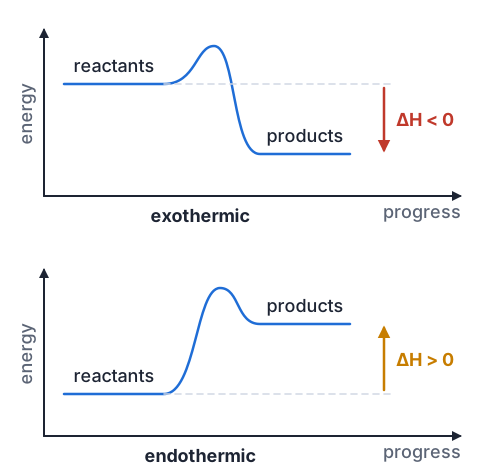
- An exothermic reaction releases energy to the surroundings, which warm up; the products have less energy than the reactants, so ΔH is negative.
- An endothermic reaction absorbs energy from the surroundings, which cool down; the products end up with more energy than the reactants had, so ΔH is positive.
- Combustion, respiration and neutralisation are exothermic; photosynthesis and dissolving ammonium nitrate (inside instant cold packs) are endothermic.
- ΔH is the enthalpy change, measured in kJ, or kJ mol⁻¹ when it is given for a balanced equation.
Breaking absorbs, making releases
- Breaking a bond, or overcoming an attraction between particles, always absorbs energy; forming one always releases energy.
- A reaction is exothermic when more energy is released forming the new bonds than was absorbed breaking the old ones, and endothermic when the reverse is true.
- Changes of state follow the same rule: melting, evaporating and subliming overcome attractions between particles, so they are endothermic.
- Freezing and condensing form attractions, so they are exothermic: this is why steam at 100 °C scalds worse than water at 100 °C, because it releases extra energy as it condenses on your skin.
- Sweating cools you because the water absorbs energy from your skin as it evaporates.
Energy diagrams
- An energy diagram has energy (enthalpy) up the side and reaction progress along the bottom, with a level for the reactants and a level for the products.
- ΔH is the vertical gap from reactants to products: an arrow pointing down means energy released (exothermic, negative), up means energy absorbed (endothermic, positive).
- The hump between them is the energy needed to start breaking bonds; its height does not change ΔH.
- Label both levels with formulas and states, and label the ΔH arrow with its sign and value when you know it.
Thermochemical equations
- A thermochemical equation gives ΔrH for the amounts written: CH4(g) + 2O2(g) → CO2(g) + 2H2O(l), ΔrH = −890 kJ mol⁻¹ means 890 kJ is released when 1 mol of CH4 burns with 2 mol of O2.
- Double the equation and ΔrH doubles; reverse it and ΔrH changes sign, so 2H2O(l) → 2H2(g) + O2(g) has ΔrH = +572 kJ mol⁻¹.
- States matter: forming liquid water releases more energy than forming steam, because condensing is exothermic.
- To find the energy for any mass: n = m ÷ M, then scale ΔrH by the moles of that substance in the equation.
| Reaction | ΔrH (kJ mol⁻¹) |
|---|---|
| 2H2(g) + O2(g) → 2H2O(l) | −572 |
| 2H2(g) + O2(g) → 2H2O(g) | −484 |
Example: energy from burning 1.00 kg of methane
- Natural gas piped to New Zealand homes is mostly methane, CH4.
- CH4(g) + 2O2(g) → CO2(g) + 2H2O(l), ΔrH = −890 kJ mol⁻¹. Calculate the energy released when 1.00 kg of methane burns. M(CH4) = 16.0 g mol⁻¹.
- m = 1.00 kg = 1000 gM is in g mol⁻¹, so use grams
- n(CH4) = m ÷ M = 1000 ÷ 16.0 = 62.5 mol
- energy = 62.5 mol × 890 kJ mol⁻¹ = 55 625 kJ1 mol of CH4 in the equation releases 890 kJ
- ΔH = −55 600 kJ (5.56 × 10⁴ kJ released)
- negative, because energy is released
Example: ΔrH from data, and mass from energy
- 1. Burning 2.30 g of ethanol, C2H5OH, releases 68.4 kJ. Calculate ΔcH for ethanol. M(C2H5OH) = 46.0 g mol⁻¹.
- 2. Using that value, what mass of ethanol must burn to release 500 kJ?
- n = 2.30 ÷ 46.0 = 0.0500 mol
- ΔcH = −68.4 kJ ÷ 0.0500 mol = −1368 kJ mol⁻¹energy per mole; negative because released
- ΔcH = −1370 kJ mol⁻¹ (3 significant figures)
- n = 500 kJ ÷ 1368 kJ mol⁻¹ = 0.3655 molkeep the unrounded value
- m = n × M = 0.3655 × 46.0 = 16.8 g
Bond enthalpies
- A bond enthalpy is the energy needed to break one mole of a bond in gaseous molecules; the values are averages over many different molecules.
- ΔrH = Σ(bond enthalpies of bonds broken) − Σ(bond enthalpies of bonds formed).
- Draw every molecule's structure first, count each bond, and multiply by the coefficient in the equation.
- Answers from average bond enthalpies differ a little from measured values, because the bonds in a particular molecule are not exactly average, and because the method assumes everything is a gas.
| Bond | kJ mol⁻¹ | Bond | kJ mol⁻¹ |
|---|---|---|---|
| H–H | 436 | C–H | 415 |
| Cl–Cl | 243 | C–C | 345 |
| H–Cl | 432 | C=C | 611 |
| Br–Br | 190 | O=O | 498 |
| H–Br | 370 | O–H | 464 |
| N≡N | 946 | N–H | 390 |
Example: ΔrH for H2 + Cl2 → 2HCl
- Use the bond enthalpy table to calculate ΔrH for H2(g) + Cl2(g) → 2HCl(g).
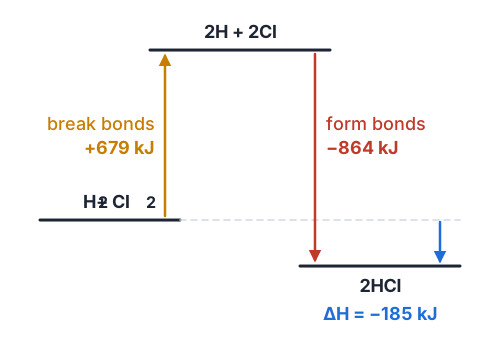
- broken: 1 × H–H + 1 × Cl–Cl = 436 + 243 = 679 kJenergy absorbed
- formed: 2 × H–Cl = 2 × 432 = 864 kJenergy released
- ΔrH = 679 − 864 = −185 kJ mol⁻¹
- more energy released forming bonds than absorbed breaking them, so exothermic
Example: adding hydrogen to ethene
- Calculate ΔrH for C2H4(g) + H2(g) → C2H6(g). Ethene is H2C=CH2 and ethane is H3C–CH3.
- broken: 4 C–H + 1 C=C + 1 H–H = 4(415) + 611 + 436 = 2707 kJevery bond in the reactants
- formed: 6 C–H + 1 C–C = 6(415) + 345 = 2835 kJevery bond in the product
- ΔrH = 2707 − 2835 = −128 kJ mol⁻¹
- shortcut: 4 C–H cancel, so 611 + 436 − (345 + 2 × 415) = −128 kJ mol⁻¹
What Achieved, Merit and Excellence look like
- In calculations, Achieved is one correct step, Merit is the right answer with its unit, and Excellence is the full chain correct, with sign, unit and sensible significant figures.
- In explanations, Excellence links bond breaking and making (or changes of state) to the energy absorbed or released and to the sign of ΔH.
| Grade | A model answer |
|---|---|
| Achieved | It is exothermic because energy is released. |
| Merit | As the gas condenses, attractions form between water molecules. Forming attractions releases energy to the surroundings, so the change is exothermic. |
| Excellence | As for Merit, then: the liquid has less energy than the gas, so ΔH is negative. No covalent bonds inside the molecules break or form; only the attractions between molecules change. |
Common mistakes
- Breaking bonds releases energy, which is why fuels give out heat.Breaking bonds always absorbs energy; fuels release energy because forming the bonds in CO2 and H2O releases more.
- ΔrH = bonds formed − bonds broken.ΔrH = bonds broken − bonds formed, so a reaction that forms stronger bonds gets a negative ΔrH.
- For N2 + 3H2 → 2NH3, bonds formed = 3 × N–H.Two NH3 molecules each have three N–H bonds, so 6 × N–H are formed: multiply by the coefficient.
- An endothermic reaction feels hot, because it takes in heat.It takes energy from the surroundings, so the beaker and your hand feel colder.
Feel an endothermic reaction
You need: white vinegar, baking soda, a plastic cup, a teaspoon, a kitchen thermometer, if you have one, a damp cloth
- Pour about 100 mL (half a cup) of vinegar into the plastic cup and hold the cup in your hand for a minute to feel its temperature, or measure it with the thermometer.
- Add two teaspoons of baking soda, a little at a time, so it does not froth over.
- Hold the cup again, or read the thermometer, once the fizzing slows.
- Wipe the damp cloth on the back of your hand and blow on it gently.
- Look for: the cup gets colder because the reaction absorbs energy from the surroundings (endothermic), and your hand cools as the water evaporates, which is also endothermic.
Safety: The mixture froths up quickly, so use a big enough cup over a sink, and keep vinegar away from your eyes, rinsing with water if it splashes.
Your turn
Is ice melting endothermic or exothermic?
CH4 + 2O2 → CO2 + 2H2O, ΔrH = −890 kJ mol⁻¹. How much energy is released by burning 4.00 g of methane? M(CH4) = 16.0 g mol⁻¹.
Using the same equation, what mass of methane must burn to release 1780 kJ?
Use the bond enthalpy table to calculate ΔrH for H2(g) + Br2(g) → 2HBr(g).
N2 + 3H2 → 2NH3 has ΔrH = −92 kJ mol⁻¹. What is ΔrH for 2NH3 → N2 + 3H2?
Show answer
1. Endothermic: energy is absorbed to overcome the attractions between water molecules. 2. n = 4.00 ÷ 16.0 = 0.250 mol; energy = 0.250 × 890 = 222.5 kJ, so about 223 kJ released (ΔH = −223 kJ). 3. n = 1780 ÷ 890 = 2.00 mol; m = 2.00 × 16.0 = 32.0 g. 4. Broken: 436 + 190 = 626 kJ; formed: 2 × 370 = 740 kJ; ΔrH = 626 − 740 = −114 kJ mol⁻¹. 5. Reversing the equation changes the sign: ΔrH = +92 kJ mol⁻¹.
Exam-style question: hydrogen as a fuel
- Hydrogen can power vehicles, either burned in an engine or in a fuel cell, and the only product is water. 2H2(g) + O2(g) → 2H2O(l), ΔrH = −572 kJ mol⁻¹. M(H2) = 2.0 g mol⁻¹.
State whether the reaction is exothermic or endothermic, and explain your choice in terms of bonds.
Calculate the energy released when 1.00 kg of hydrogen reacts.
Calculate the mass of hydrogen that must react to release 2000 kJ.
When the water forms as a gas, ΔrH = −484 kJ mol⁻¹. Use this and H–H = 436 and O=O = 498 kJ mol⁻¹ to calculate the average O–H bond enthalpy.
Explain why ΔrH is more negative when liquid water forms than when water vapour forms.
Show answer
1. Exothermic: ΔrH is negative, because more energy is released forming the O–H bonds than is absorbed breaking the H–H and O=O bonds (Achieved for exothermic with a reason). 2. n(H2) = 1000 ÷ 2.0 = 500 mol; 2 mol H2 releases 572 kJ, so 1 mol releases 286 kJ; energy = 500 × 286 = 143 000 kJ released, ΔH = −1.43 × 10⁵ kJ (Merit for the answer with unit). 3. n(H2) = 2000 ÷ 286 = 6.99 mol; m = 6.99 × 2.0 = 14.0 g (Excellence needs both 2 and 3 correct). 4. Broken: 2 × 436 + 498 = 1370 kJ; formed: 4 × (O–H), since 2 H2O have 4 O–H bonds; −484 = 1370 − 4(O–H); 4(O–H) = 1854; O–H = 463.5, about 464 kJ mol⁻¹ (Excellence for the correct answer with unit; Merit for the right process with one slip). 5. Excellence: going from 2 mol of water vapour to 2 mol of liquid forms attractions between water molecules, which releases energy, so condensing is exothermic. That extra 572 − 484 = 88 kJ is released on top of the energy from the reaction, making ΔrH more negative.
Recap
- Exothermic: energy released, surroundings warm, ΔH negative. Endothermic: energy absorbed, surroundings cool, ΔH positive.
- Breaking bonds or attractions absorbs energy; making them releases it, including in changes of state.
- ΔrH applies to the equation as written: double it, double ΔH; reverse it, flip the sign.
- Energy for any mass: n = m ÷ M, then scale by ΔrH and the coefficient.
- ΔrH = bonds broken − bonds formed; count every bond and multiply by the coefficients.
| To find | Use |
|---|---|
| moles | n = m ÷ M |
| energy for a mass | n × ΔrH ÷ coefficient of that substance |
| ΔrH from data | energy released ÷ moles, with a − sign |
| ΔrH from bonds | Σ broken − Σ formed |
How is NCEA Level 2 maths going?
See the NCEA Level 2 maths guide