Naming and drawing organic compounds
What this lesson covers
- The seven Level 2 families: alkanes, alkenes, alkynes, haloalkanes, alcohols, carboxylic acids and primary amines, and the functional group of each.
- IUPAC names: find the longest chain holding the functional group, number it so the group gets the lowest number, and list branches alphabetically.
- Constitutional isomers share a molecular formula but have their atoms joined in a different order.
- Cis and trans isomers need a C=C double bond with two different groups on each of its carbons.
- Alcohols and haloalkanes are primary, secondary or tertiary by how many carbons are bonded to the carbon carrying the OH or halogen.
- Boiling points rise with chain length; polar groups raise boiling points and water solubility until a long chain takes over.
The seven families
- Organic compounds are built on chains of carbon atoms, and each family is defined by its functional group, the part of the molecule that reacts.
- The stem gives the number of carbons in the longest chain: meth 1, eth 2, prop 3, but 4, pent 5, hex 6, hept 7, oct 8. Level 2 questions stop at eight.
- Alkanes have only C–C single bonds and are saturated; alkenes have a C=C double bond and alkynes a C≡C triple bond, so both are unsaturated.
- Haloalkanes carry F, Cl, Br or I; alcohols carry an OH; carboxylic acids end in a COOH group; primary amines carry an NH₂ group.
| Family | Functional group | Name pattern | Example |
|---|---|---|---|
| Alkane | C–C only | -ane | propane, CH₃CH₂CH₃ |
| Alkene | C=C | -ene | propene, CH₂=CHCH₃ |
| Alkyne | C≡C | -yne | propyne, CH≡CCH₃ |
| Haloalkane | –F, –Cl, –Br, –I | fluoro-, chloro-, bromo-, iodo- | 1-chloropropane, CH₂ClCH₂CH₃ |
| Alcohol | –OH | -ol | propan-1-ol, CH₃CH₂CH₂OH |
| Carboxylic acid | –COOH | -oic acid | propanoic acid, CH₃CH₂COOH |
| Primary amine | –NH₂ | -amine | propan-1-amine, CH₃CH₂CH₂NH₂ |
Naming in four steps
- 1. Find the longest continuous carbon chain that contains the functional group (or the C=C or C≡C), even if it bends on the page.
- 2. Number the chain from the end that gives the -ene, -yne, -ol or -amine the lowest number. The COOH carbon of an acid is always carbon 1, so it needs no number. In an alkane or haloalkane, start from the end nearer the first branch or halogen.
- 3. Name each branch or halogen as a prefix with its position: methyl (CH₃), ethyl (C₂H₅), chloro, bromo. Use di- and tri- for repeats, and put the prefixes in alphabetical order, ignoring di- and tri-.
- 4. If there is still a tie, number so the branches get the lowest numbers at the first point of difference.
- Numbers are separated by commas and joined to words by hyphens: 2,3-dimethylbutane, 4-methylpentan-2-ol. NZQA also accepts the older style with the number at the front, such as 1-pentyne for pent-1-yne.
Example: naming a haloalkane
- Name CH₃CHBrCH(CH₃)CH₂CH₃, drawn below as a full structural formula.
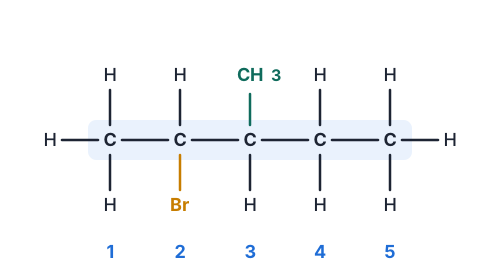
- longest chain: 5 carbons, all single bondsthe parent name is pentane
- from the left: Br on C2, CH₃ on C3, so {2, 3}
- from the right: CH₃ on C3, Br on C4, so {3, 4}2 beats 3 at the first difference
- prefixes in alphabetical order: bromo before methyl
- 2-bromo-3-methylpentane
- C₆H₁₃Br: 6 carbons in all, counting the branch
Examples: names with an ending
- Each of these follows the same four steps; the last column gives the step that decides the numbers.
| Condensed formula | Name | Why |
|---|---|---|
| CH₃CH(OH)CH₂CH(CH₃)CH₃ | 4-methylpentan-2-ol | number from the OH end: OH on C2, not C4 |
| CH₃CH=C(CH₃)CH₂CH₃ | 3-methylpent-2-ene | the double bond starts at C2 from the left, C3 from the right |
| (CH₃)₂CHCOOH | 2-methylpropanoic acid | the COOH carbon is C1, so the branch is on C2 |
| CH≡CCH₂CH₃ | but-1-yne | the triple bond starts at C1 |
| CH₃CH₂CH(NH₂)CH₃ | butan-2-amine | NH₂ on C2, counting from the right |
| CH₂ClCHClCH₃ | 1,2-dichloropropane | two chlorines, and {1, 2} is lower than {2, 3} |
Constitutional isomers
- Isomers have the same molecular formula but different structures, so they are different compounds with different properties.
- Constitutional (structural) isomers have their atoms joined in a different order: a different chain, a branch in a different place, or the functional group on a different carbon.
- C₄H₁₀ has two: butane and 2-methylpropane. C₃H₇Cl has two: 1-chloropropane and 2-chloropropane.
- C₄H₉OH has four alcohols: butan-1-ol, butan-2-ol, 2-methylpropan-1-ol and 2-methylpropan-2-ol.
- To check a pair, count every C, H and other atom: if the formulas match and the names differ, they are isomers; if the names are the same, you have drawn one molecule twice.
Cis and trans isomers
- A C=C double bond cannot rotate, so the groups on either side of it stay where they are.
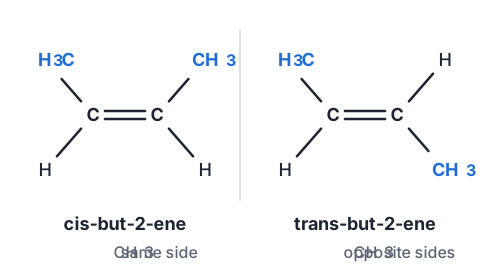
- If each carbon of the double bond holds two different atoms or groups, two arrangements exist: cis, with the matching groups on the same side, and trans, with them on opposite sides.
- But-2-ene, CH₃CH=CHCH₃, has cis and trans isomers, because each carbon of the double bond holds one H and one CH₃.
- But-1-ene, CH₂=CHCH₂CH₃, has none: its first carbon carries two H atoms, so swapping sides gives the same molecule.
- Single bonds rotate freely, so alkanes never have cis and trans isomers.
Primary, secondary and tertiary
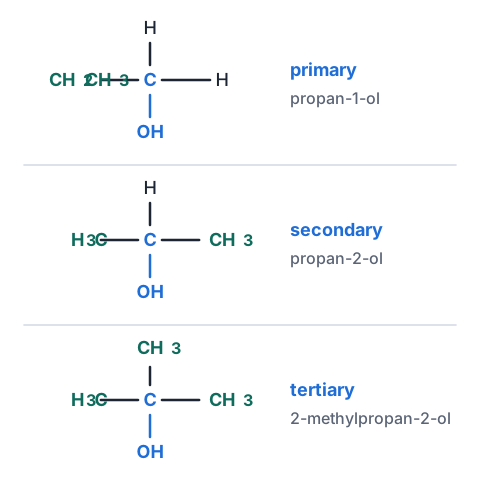
- Find the carbon that carries the OH (or the halogen) and count the other carbon atoms bonded to it.
- One carbon: primary, as in propan-1-ol. Two: secondary, as in propan-2-ol. Three: tertiary, as in 2-methylpropan-2-ol.
- The same count works for haloalkanes: 2-chlorobutane is secondary and 2-chloro-2-methylpropane is tertiary.
- The class matters in reactions: acidified dichromate oxidises a primary alcohol to a carboxylic acid, but leaves a tertiary alcohol unchanged.
Boiling points and solubility
- Boiling separates whole molecules from each other; it never breaks the covalent bonds inside them.
- Longer chains have more electrons and more surface in contact, so the attractions between molecules are stronger and the boiling point rises: the first four alkanes are gases at room temperature, and pentane to octane are liquids.
- Alkanes, alkenes and alkynes are non-polar: they do not dissolve in water and, being less dense, float on it.
- Alcohols, carboxylic acids and amines have polar OH, COOH or NH₂ groups that hydrogen bond to each other and to water, so they boil far higher than an alkane of similar size and the short ones dissolve in water.
- As the non-polar chain grows it outweighs the polar group, so solubility falls: ethanol mixes with water in any amount, but octan-1-ol barely dissolves.
- Haloalkanes are only slightly polar and cannot hydrogen bond with water, so they are mostly insoluble.
| Alkane | Carbons | Boiling point (°C) | State at 25 °C |
|---|---|---|---|
| methane | 1 | −162 | gas |
| ethane | 2 | −89 | gas |
| propane | 3 | −42 | gas |
| butane | 4 | 0 | gas |
| pentane | 5 | 36 | liquid |
| hexane | 6 | 69 | liquid |
| heptane | 7 | 98 | liquid |
| octane | 8 | 126 | liquid |
Example: putting boiling points in order
- Put butane, pentane and butan-1-ol in order of boiling point, lowest first, and give the reason for each step up.
- butane: 4 carbons, non-polaronly weak attractions between molecules
- pentane: 5 carbons, non-polara longer chain gives more contact, so stronger attractions
- butan-1-ol: 4 carbons and a polar OHhydrogen bonds between OH groups are much stronger again
- butane (0 °C) < pentane (36 °C) < butan-1-ol
- butan-1-ol is a liquid that boils well above pentane, even though its chain is shorter
What Achieved, Merit and Excellence look like
- Achieved names the right idea; Merit links it to the structure; Excellence compares both compounds and explains the attractions on each side.
- Use the words polar, non-polar, chain length and attraction to water in every solubility answer.
| Grade | A model answer |
|---|---|
| Achieved | Propan-1-ol has a short chain, so it dissolves; hexan-1-ol has a longer chain. |
| Merit | Both have a polar OH group that is attracted to water. Propan-1-ol's chain is short, so the OH dominates and it dissolves; hexan-1-ol has a long non-polar chain that water does not attract. |
| Excellence | Both have a polar OH group that hydrogen bonds with water. In propan-1-ol the non-polar part is only three carbons, so these attractions are enough for it to mix with water. In hexan-1-ol the six-carbon non-polar chain is a much bigger part of the molecule and cannot hydrogen bond, so water molecules stay attracted to each other and most of the hexan-1-ol forms a separate layer. |
Common mistakes
- CH₃CH₂CH₂CH(CH₃)CH₃ is 4-methylpentane.Number from the end nearer the branch: it is 2-methylpentane. Always check the other direction.
- CH₃CH₂CH(CH₂CH₃)CH₃ is 2-ethylbutane.The longest chain runs through the ethyl group, giving five carbons: it is 3-methylpentane.
- But-1-ene has cis and trans isomers because it has a C=C double bond.A double bond is not enough: each of its carbons needs two different groups, and C1 of but-1-ene has two H atoms.
- Butan-1-ol boils higher than butane because its O–H bond takes more energy to break.Boiling never breaks covalent bonds; butan-1-ol boils higher because its molecules attract each other more strongly, through hydrogen bonds.
Build the isomers
You need: about 20 jelly lollies or balls of playdough in two colours (at least 5 of one colour and 12 of the other), about 20 toothpicks, paper and a pen
- Use one colour for carbon and the other for hydrogen; each carbon needs exactly four toothpicks and each hydrogen exactly one.
- Build pentane, C₅H₁₂, as one straight chain of five carbons, then pull it apart and rebuild the same atoms into every different shape you can find.
- For each model, find the longest chain and write its name; if two models get the same name, they are the same molecule turned around.
- Now build but-2-ene, C₄H₈, joining the middle two carbons with two toothpicks for the double bond, and try to twist one end while holding the other.
- Look for: exactly three isomers of C₅H₁₂ (pentane, 2-methylbutane and 2,2-dimethylpropane), and a double bond that will not twist, so the CH₃ groups stay on the same side (cis) or on opposite sides (trans).
Safety: Toothpicks have sharp points, so push them into the lollies on the table rather than towards your fingers, and do not eat lollies that have been handled and pierced.
Your turn
Name CH₃CH₂CH₂CH₂OH.
Name CH₃CH(CH₃)CH₂CH₂CH₃.
Name CH₃CH₂CH=CHCH₃.
Name CH₃CH₂CH₂COOH.
Is CH₃CBr(CH₃)CH₃ primary, secondary or tertiary, and what is its name?
Show answer
1. Butan-1-ol: the OH is on C1 of a four-carbon chain. 2. 2-Methylpentane: number from the left so the branch is on C2, not C4. 3. Pent-2-ene: number from the right so the double bond starts at C2, not C3; it has cis and trans isomers. 4. Butanoic acid: four carbons, counting the COOH carbon. 5. Tertiary, because the carbon holding the Br is bonded to three other carbons; its name is 2-bromo-2-methylpropane.
Exam-style question: three bottles of C₄H₁₀O
- A technician finds three unlabelled bottles, each holding a compound with the formula C₄H₁₀O: butan-1-ol, butan-2-ol and 2-methylpropan-2-ol.
Draw the structural formula of butan-2-ol and classify it as primary, secondary or tertiary.
Name a constitutional isomer of butan-1-ol, also an alcohol, that is not in the bottles.
The technician also has but-1-ene and but-2-ene. Explain which of the two forms geometric isomers.
Butan-1-ol dissolves only partly in water, but ethanol mixes completely. Discuss why, using the structure of each molecule.
Show answer
1. CH₃CH(OH)CH₂CH₃ drawn with every C–H bond shown; it is secondary, because the carbon holding the OH is bonded to two other carbons (Achieved). 2. 2-Methylpropan-1-ol, (CH₃)₂CHCH₂OH: the same formula with a branched chain (Achieved). 3. But-2-ene: the C=C cannot rotate, and each of its carbons holds two different groups (H and CH₃), so the CH₃ groups can sit on the same side (cis) or opposite sides (trans). But-1-ene has two H atoms on C1, so it has no geometric isomers (Merit for one requirement explained, Excellence for both requirements applied to both molecules). 4. Both have a polar OH group that hydrogen bonds with water. Ethanol's non-polar part is only two carbons, so it mixes in any amount; in butan-1-ol the four-carbon non-polar chain is a bigger part of the molecule and is not attracted to water, so only some dissolves and the rest forms a layer (Achieved names chain length, Merit links it to the polar OH, Excellence compares both molecules).
Recap
- Stem for chain length, ending for the functional group, prefixes for branches and halogens in alphabetical order.
- Number from the end that gives the functional group, then the branches, the lowest numbers.
- Constitutional isomers: same formula, atoms joined differently. Cis and trans: a C=C with two different groups on each carbon.
- Count the carbons on the carbon holding the OH or halogen: one is primary, two secondary, three tertiary.
- Longer chains boil higher; polar OH, COOH and NH₂ groups raise boiling points and help short molecules dissolve in water.
How is NCEA Level 2 maths going?
See the NCEA Level 2 maths guide