Structure and properties of solids
What this lesson covers
- Solids are molecular, ionic, metallic or covalent network, depending on their particles and the forces holding them together.
- Melting and boiling points show how much energy is needed to overcome the forces between the particles.
- A substance conducts electricity only if it has charged particles that are free to move.
- Hardness, brittleness, malleability and ductility depend on whether the bonding is directional and what happens when layers shift.
- A solute dissolves when its attractions to the solvent are strong enough to overcome the attractions inside both.
The four types of solid
- Every answer in this topic starts the same way: name the particles, then name the force between them.
- Molecular solids are made of molecules; inside each molecule the atoms are joined by strong covalent bonds, but between the molecules there are only weak intermolecular forces.
- Ionic solids are a 3D lattice of positive and negative ions, held by ionic bonds: the strong electrostatic attraction between oppositely charged ions, acting in all directions.
- Metallic solids are a lattice of metal atoms (cations) in a sea of delocalised valence electrons, held by strong metallic bonding that is non-directional.
- Covalent network solids are atoms joined by strong covalent bonds throughout the whole structure, in 3D (diamond, SiO2) or in 2D layers (graphite).
| Solid | Particles | Forces between particles | Examples |
|---|---|---|---|
| Molecular | molecules | weak intermolecular forces | ice, iodine I2, sugar, dry ice CO2 |
| Ionic | positive and negative ions | strong ionic bonds | NaCl, MgO, CaF2 |
| Metallic | metal cations and delocalised electrons | strong metallic bonds | Cu, Au, Zn |
| Covalent network | atoms | strong covalent bonds | diamond, graphite, SiO2 |
Telling them apart from the formula
- A metal on its own (Cu, Mg, Zn) is a metallic solid.
- A metal combined with a non-metal (NaCl, MgO, CuSO4) is ionic.
- Non-metals on their own or combined (I2, H2O, CO2, NH3, sugar) are molecular.
- The exceptions to learn are the covalent networks: carbon as diamond or graphite, silicon, silicon dioxide (SiO2, sand and quartz) and silicon carbide (SiC).
Melting points measure the forces
- To melt a solid, its particles must gain enough energy to overcome the forces holding them in place, so a high melting point means strong forces between the particles.
- When a molecular solid melts, only the weak forces between molecules are overcome; the covalent bonds inside each molecule are not broken, so melting points are low.
- Ionic, metallic and covalent network solids must have strong bonds broken to melt, so their melting points are high.
- Metals vary widely: mercury is a liquid at room temperature, while gold needs over 1000 °C.
| Substance | Type of solid | Melting point (°C) |
|---|---|---|
| mercury, Hg | metallic | −39 |
| ice, H2O | molecular | 0 |
| iodine, I2 | molecular | 114 |
| sodium chloride, NaCl | ionic | 801 |
| gold, Au | metallic | 1064 |
| silicon dioxide, SiO2 | covalent network | 1600 |
| diamond, C | covalent network | 3500 |
Conductivity needs mobile charges
- To conduct electricity a substance needs charged particles that are free to move: electrons or ions.
- Metals conduct as solids and liquids, because their delocalised valence electrons can move through the lattice.
- Ionic solids do not conduct, because their ions are held in fixed positions; once molten or dissolved in water the ions can move, so they conduct.
- Molecular substances do not conduct in any state, because molecules have no overall charge.
- Diamond does not conduct, because every valence electron is used in the four bonds each C atom makes; graphite does, because each C bonds to only three others and its fourth valence electron is delocalised along the layer.
| Solid | Conducts as a solid? | Conducts when molten? |
|---|---|---|
| Molecular | no | no |
| Ionic | no | yes (also when dissolved) |
| Metallic | yes | yes |
| Covalent network | no (graphite: yes) | melts only when very hot |
Hard, brittle, malleable or ductile
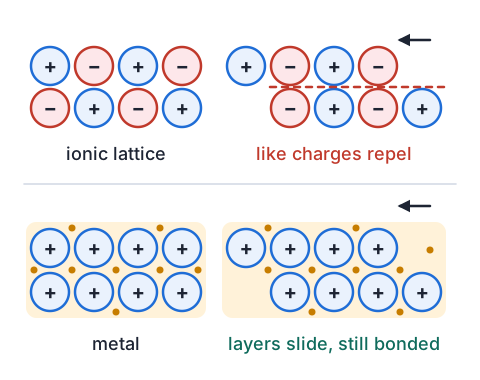
- Ionic solids are hard but brittle: a sharp blow shifts one layer of ions so that ions with the same charge line up side by side, they repel each other, and the crystal splits.
- Metals are malleable (hammered into sheets) and ductile (drawn into wires): the bonding is non-directional, so when a force makes layers of cations slide, the delocalised electrons move with them and hold the new arrangement together.
- Diamond is very hard because every C atom is held by four strong, directional covalent bonds in 3D, so a huge force is needed to break them.
- Graphite is soft and slippery because its layers are held to each other only by weak forces, so they slide; inside each layer the covalent bonds stay strong.
- Molecular solids are usually soft, because only weak intermolecular forces hold the molecules in place.
What dissolves in what
- A solute dissolves when the new attractions between solute and solvent particles are strong enough to overcome the attractions within the solute and within the solvent.
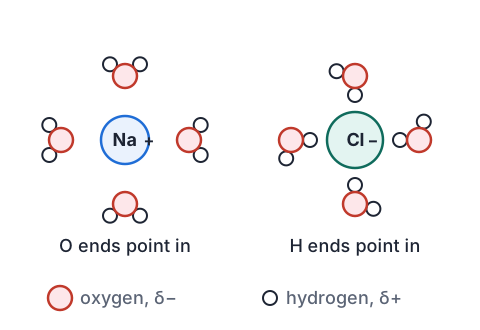
- Water is polar. In many ionic solids, such as NaCl, the δ− O ends of water molecules are attracted to the cations and the δ+ H ends to the anions, strongly enough to pull the ions out of the lattice.
- Polar molecular solids such as sugar also dissolve in water, because they are attracted to the polar water molecules.
- Non-polar molecules such as I2 and wax do not dissolve in water, because they have no charges to attract water, which stays held to itself; they dissolve in non-polar solvents such as hexane.
- Ionic solids do not dissolve in hexane, because hexane has no partial charges to attract the ions; metals and covalent networks dissolve in neither (some metals react with water instead).
Example: diamond and graphite
- Diamond and graphite are both pure carbon. Explain why diamond is very hard and does not conduct, while graphite is soft and conducts.
- Build the answer as a chain: structure, bonding, then the property.
- both are covalent network solids made only of C atomsname the particles and forces
- diamond: each C bonded to 4 others in a 3D tetrahedral networkstrong directional covalent bonds everywhere
- breaking diamond means breaking many strong covalent bonds, so it is very hard
- diamond: all 4 valence electrons are in bonds, so no free charges and no conduction
- graphite: each C bonded to 3 others in flat hexagonal layers, with weak forces between layersthe fourth valence electron is delocalised
- graphite: delocalised electrons move along the layers, so it conducts; layers slide, so it is soft
Example: when does sodium chloride conduct?
- A student tests sodium chloride as a solid, when molten and when dissolved in water. Predict and explain the results.
| Sodium chloride | Conducts? | Why |
|---|---|---|
| solid | no | Na+ and Cl− ions held in fixed lattice positions |
| molten | yes | lattice broken, ions free to move |
| dissolved in water | yes | ions separated by water and free to move |
- the charged particles in NaCl are ions, not electronsit has no delocalised electrons
- it conducts only when the ions are free to move: molten or dissolved
What Achieved, Merit and Excellence look like
- Achieved describes the structure or names the property; Merit links the structure and bonding of one solid to its property; Excellence explains both solids and compares them.
| Grade | A model answer |
|---|---|
| Achieved | Copper is a metal with metallic bonds and NaCl is ionic with ionic bonds. Copper is malleable. |
| Merit | Copper is a lattice of cations in a sea of delocalised electrons. The bonding is non-directional, so layers can slide over each other without breaking the metallic bonds, and the copper changes shape. |
| Excellence | As for Merit, then: NaCl is a lattice of alternating Na+ and Cl− ions. When it is hit, a layer shifts by one ion, so ions of the same charge sit next to each other and repel, and the crystal splits. In copper there are no like charges brought together, because the electrons move with the cations. |
Common mistakes
- When iodine melts, the covalent bonds between the iodine atoms break.Only the weak intermolecular forces between I2 molecules are overcome; the I–I covalent bonds stay intact.
- Solid sodium chloride conducts because it is made of ions.The ions in a solid are held in fixed positions, so it conducts only when molten or dissolved.
- Metals conduct because their positive ions move through the metal.The cations stay in the lattice; it is the delocalised electrons that move and carry the current.
- Graphite conducts because its layers can slide over each other.Sliding layers explain softness; graphite conducts because of the delocalised electrons in each layer.
Sort solids by their properties
You need: table salt, white sugar, a square of aluminium foil, cooking oil, water, 4 small clear glasses, a teaspoon, a plate
- Put a few grains of salt and sugar on the plate and press each firmly with the back of the spoon; then fold the foil in half and in half again.
- Half fill two glasses with water and two with cooking oil.
- Stir half a teaspoon of salt into one glass of water and one of oil, and half a teaspoon of sugar into the others, for one minute each.
- Pour a teaspoon of oil into a glass of water and stir.
- Look for: the crystals crush and shatter while the foil bends without breaking; salt (ionic) and sugar (polar) dissolve in water but sit at the bottom of the oil, and the non-polar oil will not mix with water.
Safety: Wipe up any spilled oil straight away because it makes the floor slippery, and do not eat or drink the mixtures afterwards.
Your turn
What type of solid is magnesium, Mg?
What type of solid is silicon dioxide, SiO2?
What type of solid is dry ice, solid CO2?
Does solid potassium bromide, KBr, conduct electricity?
Will iodine, I2, dissolve in hexane?
Show answer
1. Metallic: a lattice of Mg cations in delocalised electrons. 2. Covalent network: Si and O atoms joined by covalent bonds in 3D. 3. Molecular: CO2 molecules held by weak intermolecular forces. 4. No: K+ and Br− ions are fixed in the lattice; it conducts only when molten or dissolved. 5. Yes: I2 and hexane are both non-polar, so their attractions to each other are similar to those they replace.
Exam-style question: copper, magnesium chloride and iodine
- Copper, Cu, is used for electrical wiring; magnesium chloride, MgCl2, is a salt found in seawater; and iodine, I2, is a dark grey solid.
Give the type of solid and the particles in each of copper, magnesium chloride and iodine.
Explain why copper conducts electricity as a solid, but magnesium chloride conducts only when molten or dissolved.
Explain why iodine has a much lower melting point than magnesium chloride.
Predict and explain whether magnesium chloride and iodine will dissolve in hexane, a non-polar solvent.
Show answer
1. Copper: metallic, cations in delocalised electrons. Magnesium chloride: ionic, Mg2+ and Cl− ions. Iodine: molecular, I2 molecules (Achieved for all three). 2. Merit: copper has delocalised valence electrons that are free to move through the lattice, so it conducts as a solid. In solid MgCl2 the ions are held in fixed positions; when molten or dissolved the lattice breaks up and the ions are free to move and carry charge. 3. Merit: melting iodine only overcomes weak intermolecular forces between I2 molecules, which needs little energy. Melting MgCl2 means breaking strong ionic bonds between Mg2+ and Cl− ions throughout the lattice, which needs much more energy, so its melting point is much higher. 4. Excellence: iodine dissolves: I2 and hexane are both non-polar, and the weak attractions between them are similar in strength to the ones broken in each. Magnesium chloride does not: hexane has no partial charges to attract the ions, so there are no attractions strong enough to overcome the strong ionic bonds.
Recap
- Name the particles and the forces between them before any property.
- Melting point: weak intermolecular forces give low values; ionic, metallic and covalent network bonds give high ones.
- Conductivity needs charged particles free to move: electrons in metals and graphite, ions in molten or dissolved ionic compounds.
- Ionic solids shatter as like charges line up; metals bend because the bonding is non-directional.
- Like dissolves like: ionic and polar in water, non-polar in non-polar solvents.
| Molecular | Ionic | Metallic | Covalent network | |
|---|---|---|---|---|
| Melting point | low | high | usually high | very high |
| Conducts as a solid | no | no | yes | no (graphite yes) |
| Hardness | soft | hard, brittle | malleable, ductile | very hard (graphite soft) |
| Dissolves in water | if polar | often | no | no |
How is NCEA Level 2 maths going?
See the NCEA Level 2 maths guide