Reactions of organic compounds
What this lesson covers
- Addition to alkenes: H₂ with a Pt catalyst, Cl₂ or Br₂, hydrogen halides, and water with an acid catalyst.
- Markovnikov's rule: on an asymmetric alkene, the H adds to the carbon that already has more H atoms, giving the major product.
- Substitution: alkanes with halogens in UV light, alcohols to haloalkanes, and haloalkanes to alcohols with KOH(aq) or to amines with NH₃.
- Elimination: alcohols with concentrated H₂SO₄ and haloalkanes with KOH(alc) give alkenes, with major and minor products.
- Oxidation of primary alcohols to carboxylic acids with acidified dichromate or permanganate, and of alkenes with permanganate.
- Carboxylic acids as weak acids and amines as weak bases, and addition polymerisation of alkenes.
Six kinds of reaction
- Every Level 2 organic reaction is one of a few types, and the type is set by the functional group and the reagent.
- In answers, give the type, the reagent and the conditions (heat, a catalyst, UV light, concentrated or aqueous), and draw the organic product.
| Type | What happens | Example |
|---|---|---|
| Addition | two molecules join into one; a C=C becomes C–C | ethene + Br₂ → 1,2-dibromoethane |
| Substitution | one atom or group swaps for another | chloroethane + KOH(aq) → ethanol + KCl |
| Elimination | a small molecule (H₂O or HX) leaves, making a C=C | ethanol → ethene + H₂O (conc. H₂SO₄, heat) |
| Oxidation | a primary alcohol becomes a carboxylic acid | ethanol → ethanoic acid (Cr₂O₇²⁻/H⁺, heat) |
| Acid-base | a proton moves to or from the functional group | ethanoic acid + NaOH → sodium ethanoate + water |
| Polymerisation | many alkene molecules add together | ethene → polyethene |
Addition to alkenes
- Alkenes are unsaturated: one bond of the C=C breaks and each of its carbons gains a new atom or group, leaving a saturated product.
- H₂ with a platinum (Pt) catalyst gives an alkane: ethene becomes ethane.
- Cl₂ or Br₂ add across the double bond: propene and bromine give 1,2-dibromopropane. Orange bromine water loses its colour quickly, which is the test for a C=C; an alkane only does so slowly, in UV light, by substitution.
- Hydrogen halides add an H and a halogen: ethene and HCl give chloroethane.
- Water adds with an acid catalyst (concentrated H₂SO₄, then water) to make an alcohol: ethene gives ethanol.
- Alkynes can add twice, because the triple bond can open twice: ethyne with excess H₂ on Pt gives ethane.
Major and minor products: Markovnikov's rule
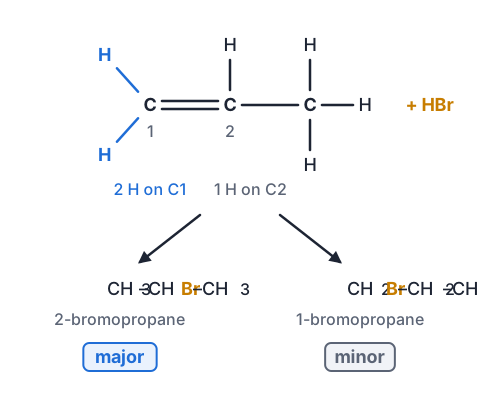
- When HX or H₂O adds to an asymmetric alkene, one whose double-bond carbons carry different numbers of H atoms, two products are possible.
- Markovnikov's rule: the H goes mainly to the carbon of the double bond that already has more H atoms, and the Cl, Br or OH to the other carbon.
- Propene and HBr give mainly 2-bromopropane (major), with some 1-bromopropane (minor).
- Propene and water with an acid catalyst give propan-2-ol (major) and propan-1-ol (minor).
- Symmetric alkenes such as ethene and but-2-ene give one product, and so does H₂, Cl₂ or Br₂ with any alkene, because both added atoms are the same.
Substitution reactions
- Alkanes are unreactive, but with Cl₂ or Br₂ in UV light one H atom is swapped for a halogen: methane and chlorine give chloromethane and HCl.
- Alcohols become haloalkanes when the OH is swapped for a halogen, using HCl or HBr, or PCl₃, PCl₅ or SOCl₂: propan-1-ol and HCl give 1-chloropropane and water.
- Haloalkanes heated with aqueous KOH swap the halogen for OH and become alcohols: 1-bromobutane gives butan-1-ol and KBr.
- Haloalkanes heated with ammonia in alcohol swap the halogen for NH₂ and become amines: chloroethane gives ethanamine.
- Substitution changes the functional group but not the carbon chain, so the new group keeps the old group's position number.
Elimination
- Elimination removes a small molecule from two neighbouring carbons and leaves a C=C double bond.
- Alcohols lose water when heated with concentrated H₂SO₄: ethanol gives ethene.
- Haloalkanes lose HX when heated with KOH dissolved in alcohol, KOH(alc): 2-chloropropane gives propene.
- The solvent decides the reaction: KOH(aq) substitutes to give an alcohol, while KOH(alc) eliminates to give an alkene.
- If the OH or halogen is on an inner carbon with two different neighbours, two alkenes form. The major one comes from removing the H from the neighbouring carbon with fewer H atoms (Saytzeff's rule).
Example: butan-2-ol and concentrated H₂SO₄
- Butan-2-ol, CH₃CH(OH)CH₂CH₃, is heated with concentrated sulfuric acid. Name the products and say which is major.
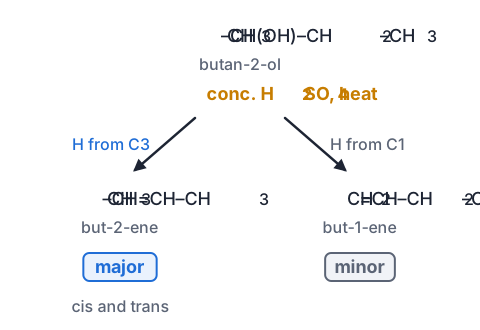
- the OH is on C2; its neighbours are C1 (CH₃, 3 H) and C3 (CH₂, 2 H)the H can leave from either neighbour
- H from C3: CH₃CH=CHCH₃, but-2-eneC3 has fewer H atoms, so this is the major product
- H from C1: CH₂=CHCH₂CH₃, but-1-enethe minor product
- but-2-ene forms as both cis and trans isomers
- major: but-2-ene; minor: but-1-ene
Oxidation of alcohols and alkenes
- Primary alcohols are oxidised to carboxylic acids when heated with acidified dichromate, Cr₂O₇²⁻/H⁺, or acidified permanganate, MnO₄⁻/H⁺: propan-1-ol gives propanoic acid.
- Dichromate turns from orange to green as Cr₂O₇²⁻ becomes Cr³⁺; permanganate turns from purple to colourless as MnO₄⁻ becomes Mn²⁺.
- Tertiary alcohols are not oxidised, so the colour stays. Secondary alcohols are oxidised to ketones, which belong to Level 3.
- Alkenes react with permanganate too: an OH adds to each carbon of the C=C, so ethene gives ethane-1,2-diol and the purple colour fades. Without acid, a brown solid, MnO₂, forms instead.
- Alkanes and haloalkanes react with neither oxidant, so a colour change shows that an alcohol or an alkene is present.
Carboxylic acids and amines as acids and bases
- Carboxylic acids are weak acids: in water some molecules give a proton to water, so their solutions turn blue litmus red.
- They fizz with carbonates and hydrogencarbonates as carbon dioxide forms: CH₃COOH + NaHCO₃ → CH₃COONa + H₂O + CO₂. Alcohols do not fizz, which tells the two apart.
- With hydroxides they form a salt and water: CH₃COOH + NaOH → CH₃COONa + H₂O.
- Amines are weak bases: the N accepts a proton from water, so their solutions turn red litmus blue, and small amines smell fishy.
- Amines react with acids to form salts: CH₃CH₂NH₂ + HCl → CH₃CH₂NH₃⁺Cl⁻.
Addition polymerisation
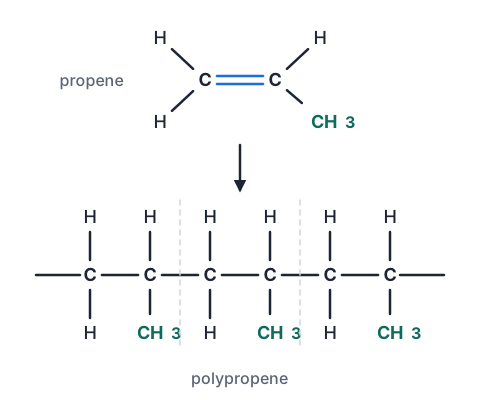
- An alkene monomer can join to many others: one bond of each C=C opens, and each monomer forms single bonds to its neighbours.
- Propene gives polypropene; the CH₃ becomes a side group on every second carbon of the chain.
- To draw the polymer, draw the monomer's two double-bonded carbons as a single-bonded pair carrying the same four groups, repeat the pair, and leave a bond open at each end.
- To find the monomer from a polymer, pick out the repeating two-carbon unit and put the double bond back between them.
- The polymer is saturated, with only C–C single bonds, so it is far less reactive than its monomer; that is why plastics such as polypropene and PTFE (Teflon, from CF₂=CF₂) are stable.
Example: following a reaction scheme
- Start with 1-chloropropane, CH₂ClCH₂CH₃. Give the product, the reaction type and the reagent for each step.
- 1-chloropropane + KOH(aq), heat → propan-1-olsubstitution: OH replaces Cl
- propan-1-ol + Cr₂O₇²⁻/H⁺, heat → propanoic acidoxidation of a primary alcohol; orange to green
- propanoic acid + Na₂CO₃ → sodium propanoate + CO₂ + H₂Oacid-base; it fizzes
- 1-chloropropane + KOH(alc), heat → propeneelimination of HCl
- propene + H₂O/H⁺ → propan-2-ol (major) and propan-1-ol (minor)addition, by Markovnikov's rule
- substitution keeps the OH on C1, but addition to propene puts it mainly on C2
What Achieved, Merit and Excellence look like
- Achieved names the products; Merit says why there are two and uses the rule; Excellence applies the rule to the actual structure, carbon by carbon.
| Grade | A model answer |
|---|---|
| Achieved | Two products form: 2-chloropropane and 1-chloropropane. |
| Merit | Propene is asymmetric, so the H and Cl can add either way round across the C=C. By Markovnikov's rule, 2-chloropropane is the major product. |
| Excellence | Propene is an asymmetric alkene: C1 of the double bond has two H atoms and C2 has one. HCl can add with H on C1 and Cl on C2, giving 2-chloropropane, or the other way round, giving 1-chloropropane. Markovnikov's rule says the H goes mainly to the carbon that already holds more H atoms (C1), so 2-chloropropane is major and 1-chloropropane is minor. |
Common mistakes
- 1-Bromopropane heated with KOH gives propene.It depends on the solvent: KOH(aq) substitutes to give propan-1-ol, and only KOH(alc) eliminates to give propene.
- In the major product, the Br adds to the carbon with more H atoms.It is the H that goes to the carbon with more H atoms; the Br goes to the other carbon.
- 2-Methylpropan-2-ol turns acidified dichromate green.It is a tertiary alcohol, so it is not oxidised and the dichromate stays orange.
- Polypropene is drawn with a double bond in each repeating unit.The double bonds open to form the chain, so the polymer has only single bonds and is saturated.
Acid or alcohol? The fizz test
You need: white vinegar, baking soda, sugar, water, 3 clear glasses, a teaspoon
- Pour a quarter of a cup of white vinegar into the first glass, and a quarter of a cup of water into each of the other two.
- Stir two teaspoons of sugar into the second glass until it dissolves, and leave the third as plain water.
- Add half a teaspoon of baking soda to each glass, one at a time, and look at each for 30 seconds.
- Look for: only the vinegar fizzes. Vinegar holds ethanoic acid, whose COOH group gives a proton to the hydrogencarbonate and makes carbon dioxide; sugar is covered in OH groups like an alcohol's, which do not, so nothing happens.
Safety: The vinegar can foam up quickly, so stand the glasses in a sink or tray and keep your face back so it cannot splash into your eyes.
Your turn
Ethene with H₂ and a Pt catalyst: give the type of reaction and the organic product.
Chloroethane heated with KOH(aq): type and product?
Propan-2-ol heated with concentrated H₂SO₄: type and product?
Butan-1-ol heated with Cr₂O₇²⁻/H⁺: type and product?
Propene with HCl: type and major product?
Show answer
1. Addition; ethane, CH₃CH₃. 2. Substitution; ethanol, CH₃CH₂OH, with KCl. 3. Elimination; propene, CH₂=CHCH₃, the only product, because both neighbours of C2 are CH₃ groups. 4. Oxidation; butanoic acid, CH₃CH₂CH₂COOH, and the orange dichromate turns green. 5. Addition; 2-chloropropane is major and 1-chloropropane minor, by Markovnikov's rule.
Exam-style question: starting from 2-bromobutane
- A chemist starts with 2-bromobutane, CH₃CHBrCH₂CH₃.
Classify 2-bromobutane as primary, secondary or tertiary, and give the reason.
Give the reagent and conditions that turn it into butan-2-ol, and the reaction type.
Heated with KOH(alc), 2-bromobutane gives two alkenes. Name both, say which is major, and justify your choice.
Describe how bromine water could tell the alkene products apart from 2-bromobutane.
Show answer
1. Secondary: the carbon holding the Br (C2) is bonded to two other carbons (Achieved). 2. KOH(aq) and heat; substitution, as OH replaces Br (Achieved). 3. But-2-ene, CH₃CH=CHCH₃, is major and but-1-ene, CH₂=CHCH₂CH₃, is minor. 2-Bromobutane is asymmetric about C2, so the H can be removed from C1 or C3 along with the Br; C3 has fewer H atoms (2) than C1 (3), so removing H from C3 gives the major product, but-2-ene, which forms as cis and trans isomers (Merit for the two products and the rule, Excellence for applying it to C1 and C3). 4. The alkenes turn orange bromine water colourless quickly, because Br₂ adds across the C=C; 2-bromobutane has no C=C, so the colour stays (Achieved for the observation, Merit for the reason).
Recap
- Addition opens a C=C; on an asymmetric alkene the H goes mainly to the carbon with more H atoms.
- KOH(aq) substitutes a haloalkane to an alcohol; KOH(alc) and concentrated H₂SO₄ eliminate to an alkene, mainly the one with the H taken from the carbon with fewer H atoms.
- Acidified dichromate (orange to green) or permanganate (purple to colourless) oxidises a primary alcohol to a carboxylic acid; tertiary alcohols do not react.
- Carboxylic acids turn blue litmus red and fizz with carbonates; amines turn red litmus blue and form salts with acids.
- Alkenes join into saturated addition polymers that are much less reactive than the monomer.
| Starting compound | Reagent and conditions | Product |
|---|---|---|
| alkene | H₂/Pt; Cl₂ or Br₂; HX; H₂O/H⁺ | alkane; dihaloalkane; haloalkane; alcohol |
| alkane | Cl₂ or Br₂, UV light | haloalkane + HX |
| alcohol | HCl, HBr, PCl₃, PCl₅ or SOCl₂ | haloalkane |
| alcohol | conc. H₂SO₄, heat | alkene + H₂O |
| primary alcohol | Cr₂O₇²⁻/H⁺ or MnO₄⁻/H⁺, heat | carboxylic acid |
| haloalkane | KOH(aq), heat | alcohol |
| haloalkane | KOH(alc), heat | alkene |
| haloalkane | NH₃ in alcohol, heat | amine |
How is NCEA Level 2 maths going?
See the NCEA Level 2 maths guide