Rates of reaction and collision theory
What this lesson covers
- Rate of reaction is how fast reactants are used up or products form, measured as a change over time.
- Collision theory: particles react only when they collide with at least the activation energy and in the right orientation.
- Raising concentration or surface area makes collisions more frequent; raising temperature makes them more frequent and more energetic.
- A catalyst provides another pathway with a lower activation energy and is not used up.
- Energy diagrams show the reactants, the products, the activation energy and ΔH.
- On a rate graph the gradient is the rate: steepest at the start, and zero once a reactant runs out.
What a rate is and how to measure it
- The rate of a reaction is how much reactant is used up, or product made, per unit of time.
- In the lab you follow something that changes: the volume of gas in a gas syringe, the mass a flask loses as gas escapes, or the time taken for a colour or cloudiness to appear.
- Average rate = change in amount ÷ time taken, in units such as mL s⁻¹ or g min⁻¹.
- The classic example is marble in acid, followed by the carbon dioxide it gives off: CaCO₃(s) + 2HCl(aq) → CaCl₂(aq) + H₂O(l) + CO₂(g).
Collision theory
- Particles must collide to react.
- A collision is successful only if the particles hit with at least the activation energy, Ea, the minimum energy needed to start breaking bonds, and in a suitable orientation.
- Most collisions are not successful: the particles bounce apart unchanged.
- The rate depends on the frequency of successful collisions, the number each second, so every Merit or Excellence answer comes back to that phrase.
- Every factor speeds a reaction up by raising the number of collisions per second, the fraction of them with enough energy, or both.
The four factors
- Four factors change the rate at Level 2, and each has its own collision-theory reason.
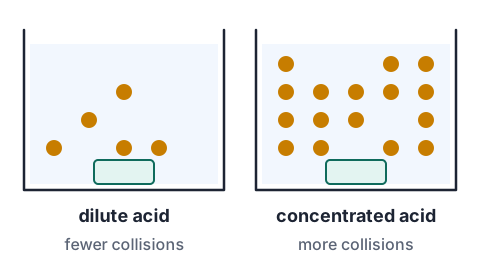
- Concentration and surface area change how many collisions happen each second, but not how much energy each collision has.
| Factor | What changes | Why the rate rises |
|---|---|---|
| Concentration | more particles in the same volume | particles collide more often, so more successful collisions per second |
| Surface area | smaller pieces or a powder | more reactant particles are exposed, so more collisions per second |
| Temperature | particles move faster | more frequent collisions, and a bigger fraction have at least Ea |
| Catalyst | another pathway with a lower Ea | a bigger fraction of collisions have enough energy; the catalyst is not used up |
Temperature does two things
- Heated particles have more kinetic energy and move faster, so they collide more often.
- More importantly, a much bigger fraction of the collisions now have energy equal to or greater than the activation energy, so a bigger share of them succeed.
- That second effect is why a small temperature change can make a big difference, such as food keeping far longer in the fridge than on the bench.
- Excellence answers give both effects and say which one matters more; Merit answers usually give only the first.
Activation energy diagrams
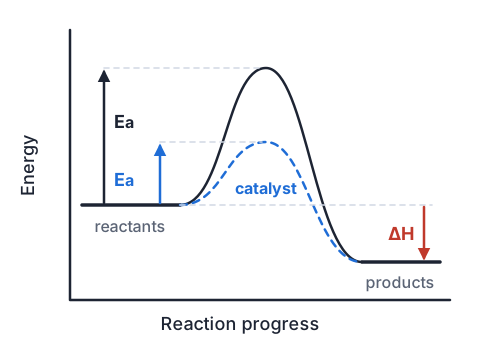
- An energy diagram plots the energy of the particles as the reaction goes from reactants to products.
- The activation energy, Ea, is the height of the hump measured from the reactants' level.
- ΔH is the energy change from reactants to products: negative (products lower) for an exothermic reaction, positive for an endothermic one.
- A catalyst gives a lower hump, a smaller Ea, but the reactants and products stay at the same levels, so ΔH does not change.
- Enzymes such as catalase, found in potato and liver, are biological catalysts.
Example: marble chips and powder in acid
- A class added 0.35 g of marble (calcium carbonate) to 50 mL of 1.0 mol L⁻¹ hydrochloric acid, which is an excess, and collected the CO₂ in a gas syringe. They did it once with chips and once with the same mass of powder.
- Use the results to compare the rates and explain the difference.
| Time (s) | CO₂ from chips (mL) | CO₂ from powder (mL) |
|---|---|---|
| 0 | 0 | 0 |
| 30 | 30 | 64 |
| 60 | 52 | 80 |
| 90 | 66 | 84 |
| 120 | 75 | 85 |
| 180 | 82 | 85 |
| 240 | 85 | 85 |
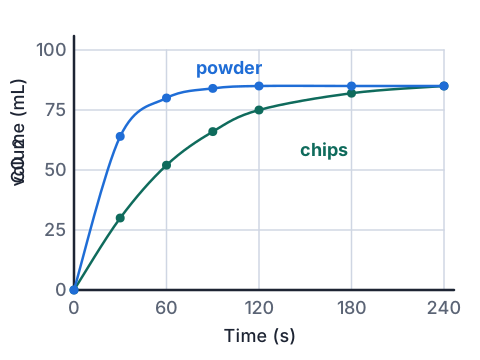
- chips, first 30 s: 30 mL ÷ 30 s = 1.0 mL s⁻¹average rate = volume ÷ time
- powder, first 30 s: 64 mL ÷ 30 s = 2.1 mL s⁻¹about twice as fast
- chips, 120 to 180 s: (82 − 75) mL ÷ 60 s = 0.12 mL s⁻¹the rate falls as the marble is used up
- both finish at 85 mLsame mass of marble, acid in excess, so the same amount of CO₂
- the powder exposes more CaCO₃ particles to the acid, so there are more collisions, and more successful collisions, per second
Reading rate graphs
- The gradient of an amount against time graph is the rate: a steeper curve means a faster reaction.
- The curve is steepest at the start and flattens because the reactants' concentration falls, so collisions become less frequent.
- It goes flat when the limiting reactant is used up. The final height depends on the amount of the limiting reactant, not on how fast it reacted.
- A faster run (hotter, more concentrated acid, powder, a catalyst) is steeper at the start and, with the same limiting reactant, levels at the same height, just sooner.
- Only more of the limiting reactant raises the final height; a catalyst never does.
What Achieved, Merit and Excellence look like
- Achieved states the effect; Merit explains it with collisions per second; Excellence links every step, from the particles' energy to the rate, and weighs the two effects of temperature.
| Grade | A model answer |
|---|---|
| Achieved | At a higher temperature the particles move faster, so the reaction is faster. |
| Merit | The particles have more kinetic energy and collide more often, so there are more successful collisions per second and the rate increases. |
| Excellence | At 40 °C the particles have more kinetic energy. They collide more often, and a much larger fraction of the collisions have energy equal to or greater than the activation energy. Both mean more successful collisions per second, so the rate is higher; the larger fraction with enough energy is the main reason. |
Common mistakes
- A catalyst gives the particles more energy.A catalyst provides another pathway with a lower activation energy; the particles' energies are unchanged.
- A higher concentration makes the particles move faster.Concentration only changes how many particles are in a volume, making collisions more frequent; only temperature changes their speed.
- Powdered marble makes more gas than chips.With the same mass and the acid in excess, both make the same volume; the powder just makes it sooner.
- The rate is the number of collisions.The rate depends on the number of successful collisions per second; most collisions lack the energy to react.
Race the fizzing tablets
You need: 4 effervescent vitamin C tablets of the same brand, 4 glasses, cold and hot tap water, a measuring cup, a zip-lock bag and a spoon, a phone stopwatch
- Put 200 mL of cold tap water in two glasses and 200 mL of hot tap water in the other two.
- Seal one tablet in the zip-lock bag and crush it to powder with the back of the spoon.
- Drop a whole tablet into a cold glass and time how long it takes for the fizzing to stop; do the same with a whole tablet in a hot glass.
- Tip the crushed tablet into the second cold glass and time it, then drop the last whole tablet into the second hot glass as a repeat.
- Look for: the hot water and the powder both finish well before the whole tablet in cold water. Once wet, the tablet's acid reacts with its hydrogencarbonate, and heat or a bigger surface area means more successful collisions per second.
Safety: Hot tap water can scald, so fill those glasses at the sink and leave them standing there, and do not drink the results: four tablets is four doses.
Your turn
40 mL of hydrogen is made in the first 20 s of a reaction. What is the average rate?
A flask loses 0.66 g of CO₂ in 3.0 minutes. What is the average rate in g min⁻¹?
Which two factors increase the fraction of collisions that have enough energy to react?
Why does a graph of gas volume against time level off?
A catalyst lowers Ea from 80 kJ mol⁻¹ to 50 kJ mol⁻¹ for a reaction with ΔH = −30 kJ mol⁻¹. What is ΔH with the catalyst?
Show answer
1. 40 mL ÷ 20 s = 2.0 mL s⁻¹. 2. 0.66 g ÷ 3.0 min = 0.22 g min⁻¹. 3. Temperature and a catalyst: heating gives more particles at least Ea, and a catalyst lowers Ea; concentration and surface area only make collisions more frequent. 4. A reactant has been used up, so no more product forms. 5. ΔH is still −30 kJ mol⁻¹: a catalyst lowers Ea but does not change the energies of the reactants or products.
Exam-style question: decomposing hydrogen peroxide
- Hydrogen peroxide slowly breaks down: 2H₂O₂(aq) → 2H₂O(l) + O₂(g). A student adds manganese dioxide powder, a catalyst, to 50 mL of the solution and records the oxygen collected every 20 s: 0, 24, 40, 50, 55, 57 and 57 mL at 0 to 120 s.
Calculate the average rate of oxygen production over the first 40 s.
Describe how the rate changes over the 120 s, and explain the change using collision theory.
Explain how manganese dioxide speeds up the reaction, and state what it does to the final volume of oxygen.
Discuss how running the same reaction at a higher temperature would change the graph of volume against time.
Show answer
1. 40 mL ÷ 40 s = 1.0 mL s⁻¹ (Achieved). 2. The rate is fastest at the start and falls until it stops by about 100 s. As H₂O₂ is used up its concentration falls, so its particles collide with the catalyst surface less often, giving fewer successful collisions per second; once all the H₂O₂ has decomposed no more oxygen forms (Merit for the link between concentration and collision frequency). 3. The catalyst provides another pathway with a lower activation energy, so a greater fraction of collisions have enough energy to react, giving more successful collisions per second. It is not used up and does not change the amount of H₂O₂, so the final volume stays 57 mL (Merit, Excellence with the final volume justified). 4. The curve would be steeper at the start and level off sooner, at the same 57 mL. Particles move faster and collide more often, and a larger fraction of collisions have at least the activation energy, so there are more successful collisions per second; the amount of H₂O₂ is unchanged, so the final volume is too (Excellence).
Recap
- Rate = change in amount ÷ time; it is fastest at the start and falls as reactants are used up.
- Reactions need collisions with at least the activation energy, in the right orientation.
- Concentration and surface area raise the number of collisions per second.
- Temperature raises the collision frequency and, more importantly, the fraction of collisions with enough energy.
- A catalyst gives a lower-Ea pathway, is not used up, and changes neither ΔH nor the amount of product.
The maths behind it
How is NCEA Level 2 maths going?
See the NCEA Level 2 maths guide