Oxidation and reduction: electrons, colours and equations
What this lesson covers
- Oxidation and reduction as loss and gain of electrons, and as a rise or fall in oxidation number.
- The rules for working out oxidation numbers, including in ions like MnO₄⁻ and Cr₂O₇²⁻.
- The common oxidants and reductants, what they turn into, and the colour changes you see.
- Balancing half equations in acid with H₂O, H⁺ and electrons, and combining them into an overall equation.
- Redox around us: rusting, galvanised iron, and linking observations, equations and electron transfer for Excellence.
Oxidation, reduction, oxidant, reductant
- Oxidation is loss of electrons and a rise in oxidation number. Reduction is gain of electrons and a fall in oxidation number. They always happen together: the electrons one species loses, another gains.
- The oxidant (oxidising agent) takes electrons, so the oxidant is itself reduced. The reductant (reducing agent) gives electrons, so it is itself oxidised.
- Example: magnesium burning, 2Mg + O₂ → 2MgO. Mg goes from 0 to +2 (oxidised, the reductant), O goes from 0 to −2 (reduced, the oxidant).
- Every answer needs a reason: say oxidised or reduced because electrons are lost or gained, or because the oxidation number goes up or down, with the numbers.
Working out oxidation numbers
- Use the rules in order, then make the total come out to the charge on the particle.
- Write the sign before the number (+6, −2) so it is not confused with an ion charge (6+, 2−).
| Rule | Example |
|---|---|
| An element on its own is 0 | Fe, O₂, Cl₂: 0 |
| A simple ion is its charge | Fe³⁺: +3, Cl⁻: −1 |
| Oxygen is −2, except in peroxides (−1) | H₂O: −2, H₂O₂: −1 |
| Hydrogen is +1 with non-metals | H₂O, HCl, H⁺: +1 |
| The total equals the overall charge | MnO₄⁻: x + 4(−2) = −1, so Mn is +7 |
- Cr₂O₇²⁻: 2x + 7(−2) = −2, so 2x = +12 and Cr = +6two Cr share the total
- SO₂: x + 2(−2) = 0, so S = +4neutral molecule
- SO₄²⁻: x + 4(−2) = −2, so S = +6total is the ion's charge
- SO₂ → SO₄²⁻: S rises from +4 to +6, so SO₂ is oxidised
Oxidants, reductants and the colours you see
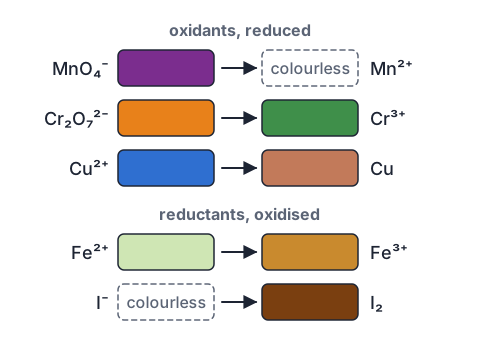
- Most marks for observations come from knowing what each species looks like before and after. Learn the pairs in the table.
- Describe what you would see, not the name of a product: say the purple solution turns colourless, not that Mn²⁺ forms.
- Some species can act either way. Hydrogen peroxide is usually an oxidant (it becomes water), but with a strong oxidant like permanganate it is a reductant (it becomes oxygen gas, seen as bubbles).
| Species | Role | Becomes | You see |
|---|---|---|---|
| MnO₄⁻ / H⁺ | Oxidant | Mn²⁺ | Purple solution turns colourless |
| Cr₂O₇²⁻ / H⁺ | Oxidant | Cr³⁺ | Orange solution turns green |
| Cu²⁺ | Oxidant | Cu | Blue fades; pink-brown solid forms |
| Cl₂ or Br₂ | Oxidant | Cl⁻ or Br⁻ | Pale green gas or orange solution goes colourless |
| Fe²⁺ | Reductant | Fe³⁺ | Pale green turns yellow-brown |
| I⁻ | Reductant | I₂ | Colourless turns brown |
| SO₂ | Reductant | SO₄²⁻ | Colourless gas; no change of its own |
| Metals such as Mg, Zn | Reductant | Mg²⁺, Zn²⁺ | Grey metal dissolves |
Example: zinc in copper sulfate solution
- A strip of zinc is put in blue copper(II) sulfate solution. After a few minutes the strip has a pink-brown coating and the blue colour is fading.
- Write the half equations and the overall equation, name the oxidant and reductant, and link them to what you see.
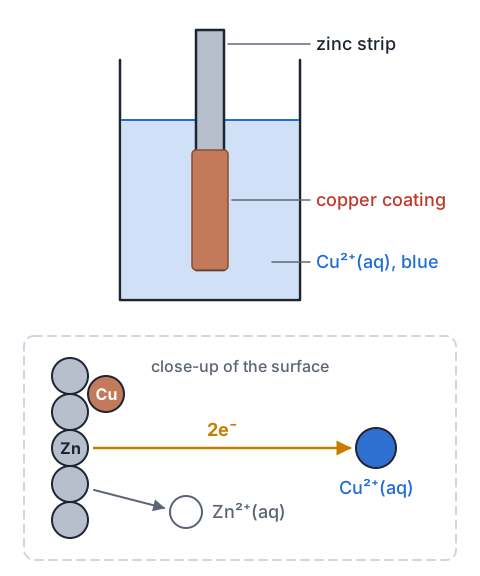
- Zn → Zn²⁺ + 2e⁻oxidation: Zn goes from 0 to +2; the zinc dissolves
- Cu²⁺ + 2e⁻ → Cureduction: Cu goes from +2 to 0; the pink-brown solid is copper
- Zn + Cu²⁺ → Zn²⁺ + Cutwo electrons on each side, so they cancel
- charge check: +2 on the left, +2 on the right
- oxidant Cu²⁺ (blue fades as it is used up); reductant Zn (Zn²⁺ is colourless)
Example: acidified permanganate and iron(II)
- Acidified potassium permanganate is added to iron(II) sulfate solution. The purple colour disappears as it is added, and the pale green solution turns yellow-brown.
- Balance each half equation in this order: the main atom, then O with H₂O, then H with H⁺, then charge with electrons. Then multiply so the electrons match, and add.
- MnO₄⁻ → Mn²⁺Mn is balanced
- MnO₄⁻ → Mn²⁺ + 4H₂O4 O on the left, so add 4 H₂O on the right
- MnO₄⁻ + 8H⁺ → Mn²⁺ + 4H₂O8 H on the right, so add 8 H⁺ on the left
- MnO₄⁻ + 8H⁺ + 5e⁻ → Mn²⁺ + 4H₂Ocharge: +7 on the left, +2 on the right, so add 5e⁻ to the left
- Fe²⁺ → Fe³⁺ + e⁻, × 5five electrons to match
- MnO₄⁻ + 8H⁺ + 5Fe²⁺ → Mn²⁺ + 5Fe³⁺ + 4H₂O
- charge check: −1 + 8 + 10 = +17 and +2 + 15 = +17
Example: dichromate and sulfur dioxide, cancelling H⁺ and H₂O
- Sulfur dioxide is bubbled through acidified potassium dichromate solution, which turns from orange to green.
- When both half equations contain H⁺ or H₂O, cancel what appears on both sides after adding.
- Cr₂O₇²⁻ + 14H⁺ + 6e⁻ → 2Cr³⁺ + 7H₂Oreduction: Cr +6 to +3, two Cr so 6e⁻
- SO₂ + 2H₂O → SO₄²⁻ + 4H⁺ + 2e⁻oxidation: S +4 to +6
- 3SO₂ + 6H₂O → 3SO₄²⁻ + 12H⁺ + 6e⁻× 3 so both have 6e⁻
- Cr₂O₇²⁻ + 14H⁺ + 3SO₂ + 6H₂O → 2Cr³⁺ + 7H₂O + 3SO₄²⁻ + 12H⁺add the two
- Cr₂O₇²⁻ + 2H⁺ + 3SO₂ → 2Cr³⁺ + 3SO₄²⁻ + H₂Ocancel 12H⁺ and 6H₂O from both sides
- charge: −2 + 2 = 0 and +6 − 6 = 0; O: 7 + 6 = 13 and 12 + 1 = 13
Example: one reaction written up for each grade
- The permanganate and iron(II) reaction, written three ways. Each grade keeps what the one before it said and adds to it.
| Grade | What the student wrote |
|---|---|
| Achieved | MnO₄⁻ is reduced to Mn²⁺ because Mn's oxidation number falls from +7 to +2. Fe²⁺ is oxidised to Fe³⁺ because it loses an electron. The purple colour goes colourless. |
| Merit | MnO₄⁻ + 8H⁺ + 5e⁻ → Mn²⁺ + 4H₂O: each Mn gains 5 electrons, so the purple permanganate is reduced to colourless Mn²⁺. Fe²⁺ → Fe³⁺ + e⁻: each pale green Fe²⁺ loses one electron, forming yellow-brown Fe³⁺. |
| Excellence | Each MnO₄⁻ gains 5 electrons but each Fe²⁺ loses only 1, so five Fe²⁺ react with each MnO₄⁻: MnO₄⁻ + 8H⁺ + 5Fe²⁺ → Mn²⁺ + 5Fe³⁺ + 4H₂O. The purple disappears as soon as it is added while Fe²⁺ remains, because it is reduced to colourless Mn²⁺; the solution turns yellow-brown as Fe³⁺ builds up. Once all the Fe²⁺ is oxidised, the purple stays. |
Redox around us: rust and galvanised roofs
- Rusting is iron being oxidised by oxygen in the presence of water: Fe → Fe²⁺ + 2e⁻ and O₂ + 2H₂O + 4e⁻ → 4OH⁻.
- Doubling the iron half equation to match electrons gives 2Fe + O₂ + 2H₂O → 2Fe(OH)₂, which is oxidised further by air to orange-brown iron(III) oxides, the rust you see. Salt water speeds it up because the ions let charge flow more easily.
- Galvanised iron, used for roofs and fences all over New Zealand, is coated with zinc. Zinc is a stronger reductant than iron, so where the coating is scratched, zinc is oxidised instead of the iron, protecting it.
Common mistakes
- The oxidant is the substance that gets oxidised.The oxidant takes electrons, so it is reduced; the reductant is the one oxidised.
- MnO₄⁻ + 8H⁺ + 5Fe²⁺ + 5e⁻ → Mn²⁺ + 5Fe³⁺ + 4H₂O + 5e⁻Electrons must cancel completely; the overall equation never shows e⁻.
- Observation: Mn²⁺ ions are formed.Describe what you see: the purple solution turns colourless.
- Mn has an oxidation number of 7+ in MnO₄⁻.Oxidation numbers put the sign first: +7. A charge such as 2+ is written after.
Make iron rust fast, and feel the energy
You need: plain steel wool (no soap in it), white vinegar, salt, 2 zip-lock bags, a cup, rubber gloves, a teaspoon
- Put on the gloves and pull two equal tufts of steel wool, each about the size of a golf ball.
- Stir a teaspoon of salt into half a cup of vinegar. Soak one tuft in it for one minute to strip its protective coating, then squeeze it out well.
- Put the wet tuft in one bag and the dry tuft in the other. Press out most of the air, then seal both.
- Every two minutes for ten minutes, hold each bag in your palm and compare how warm it feels. Then check both for orange-brown patches.
- Look for: the wet, salted tuft warms up and starts to rust; the dry one does not. Iron is oxidised (Fe → Fe²⁺ + 2e⁻) while oxygen is reduced, and the reaction releases energy as heat.
Safety: Steel wool sheds sharp splinters that stick in skin, so wear gloves throughout, and keep it away from batteries because it can catch fire if it touches both terminals.
Your turn
Find the oxidation number of Cr in Cr₂O₇²⁻.
Find the oxidation number of N in NO₃⁻ and in NO₂, and say whether N is oxidised or reduced when NO₃⁻ becomes NO₂.
Balance the half equation for hydrogen peroxide acting as a reductant: H₂O₂ → O₂.
Acidified hydrogen peroxide is added to colourless potassium iodide solution. Write the overall equation and describe what you see.
A copper wire is put in colourless silver nitrate solution. Write the overall equation, name the oxidant, and describe two observations.
Show answer
1. 2x + 7(−2) = −2, so Cr = +6. 2. NO₃⁻: x + 3(−2) = −1, so N = +5; NO₂: x + 2(−2) = 0, so N = +4; N falls from +5 to +4, so it is reduced. 3. H₂O₂ → O₂ + 2H⁺ + 2e⁻. 4. H₂O₂ + 2H⁺ + 2e⁻ → 2H₂O and 2I⁻ → I₂ + 2e⁻ add to H₂O₂ + 2H⁺ + 2I⁻ → 2H₂O + I₂; the colourless solution turns brown as iodine forms. 5. Cu + 2Ag⁺ → Cu²⁺ + 2Ag; the oxidant is Ag⁺; grey-silver crystals grow on the wire and the solution slowly turns blue.
Recap
- Oxidation: electrons lost, oxidation number up. Reduction: electrons gained, oxidation number down. The oxidant is reduced.
- Balance half equations with the main atom, then H₂O, then H⁺, then e⁻; match electrons, add and cancel.
- Observations describe colours, solids and gases you can see, and each one links to a species in an equation.
- Excellence links all of it: half equations, the overall equation, observations and electron transfer, with reasons.
| Half equation | Process | Seen |
|---|---|---|
| MnO₄⁻ + 8H⁺ + 5e⁻ → Mn²⁺ + 4H₂O | Reduction | Purple to colourless |
| Cr₂O₇²⁻ + 14H⁺ + 6e⁻ → 2Cr³⁺ + 7H₂O | Reduction | Orange to green |
| Fe²⁺ → Fe³⁺ + e⁻ | Oxidation | Pale green to yellow-brown |
| 2I⁻ → I₂ + 2e⁻ | Oxidation | Colourless to brown |
How is NCEA Level 2 maths going?
See the NCEA Level 2 maths guide