Equilibrium, acids, bases and pH
What this lesson covers
- Dynamic equilibrium: in a closed system the forward and reverse rates are equal, so concentrations stay constant while both reactions continue.
- Le Chatelier's principle predicts how an equilibrium shifts when concentration, pressure or temperature changes; a catalyst causes no shift.
- Kc expressions for homogeneous equilibria, what a large or small Kc means, and that only temperature changes Kc.
- Acids donate protons and bases accept them; strong ones react completely with water, weak ones only partly.
- At the same concentration, strong and weak acids and bases differ in pH, conductivity and rate of reaction.
- pH = −log[H₃O⁺] and Kw = [H₃O⁺][OH⁻] = 1.0 × 10⁻¹⁴ for strong acids and bases.
Dynamic equilibrium
- Many reactions are reversible: the products can react to re-form the reactants, shown by ⇌.
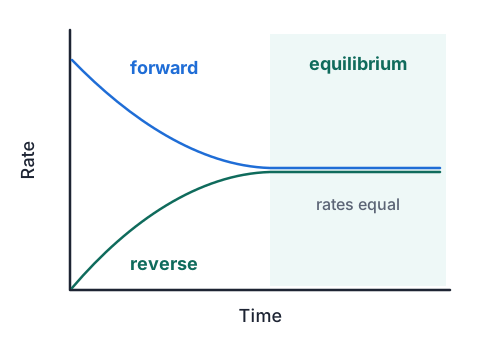
- In a closed system the forward reaction starts fast and slows as reactants are used up, while the reverse starts at zero and speeds up as products build up.
- When the two rates are equal the system is at equilibrium: both reactions carry on, but the concentrations no longer change.
- Constant does not mean equal: at equilibrium there may be far more products than reactants, or far fewer.
Le Chatelier's principle
- If a system at equilibrium is changed, the position of equilibrium shifts to partly oppose the change.
- For pressure, count the moles of gas on each side; if they are equal, pressure has no effect.
- Merit answers say which reaction is favoured and why; Excellence answers also say what happens to each species and to Kc.
| Change | Equilibrium shifts | Why |
|---|---|---|
| Add a reactant | to the right (forward favoured) | to use up some of the added reactant |
| Remove a product | to the right | to replace some of the lost product |
| Increase pressure (smaller volume) | towards fewer moles of gas | fewer gas particles lower the pressure |
| Increase temperature | in the endothermic direction | the endothermic reaction absorbs some of the added heat |
| Add a catalyst | no shift | both rates rise equally, so equilibrium is only reached sooner |
Example: brown NO₂ and colourless N₂O₄
- N₂O₄(g) ⇌ 2NO₂(g): N₂O₄ is colourless, NO₂ is brown, and the forward reaction is endothermic.
- Predict what happens to the colour when a sealed syringe of the mixture is heated, and when it is pushed in to half its volume.
- heating: the endothermic forward reaction is favouredit absorbs some of the added heat
- more NO₂ forms, so the gas turns darker brown, and Kc increasesa temperature change is the only thing that changes Kc
- compressing: 1 mol of gas on the left, 2 mol on the rightcount moles of gas
- the gas darkens at once (NO₂ squeezed into half the volume), then fades a little as the reverse reaction is favouredfewer gas particles lower the pressure
- hotter: darker, Kc up; squeezed: darker, then partly paler, Kc unchanged
The equilibrium constant, Kc
- For aA + bB ⇌ cC + dD, Kc = [C]ᶜ[D]ᵈ ÷ ([A]ᵃ[B]ᵇ): products over reactants, each concentration raised to the power of its coefficient.
- Square brackets mean the equilibrium concentration in mol L⁻¹. Level 2 uses homogeneous equilibria, with everything in the same state, and leaves water out when it is the solvent.
- Kc much larger than 1: products are favoured at equilibrium. Kc much smaller than 1: reactants are favoured.
- Only temperature changes Kc. For an exothermic forward reaction heating lowers Kc; for an endothermic one heating raises it.
- Changing a concentration or the pressure moves the position of equilibrium, but Kc stays the same, and a catalyst changes neither.
Example: Kc for making ammonia
- For N₂(g) + 3H₂(g) ⇌ 2NH₃(g) at a fixed temperature, the equilibrium concentrations are [N₂] = 0.50, [H₂] = 0.80 and [NH₃] = 0.20 mol L⁻¹. Write the Kc expression and calculate Kc.
- At the same temperature, another equilibrium mixture has [N₂] = 0.40 and [H₂] = 0.50 mol L⁻¹. Find [NH₃].
- Kc = [NH₃]² ÷ ([N₂][H₂]³)each power is the coefficient in the equation
- Kc = 0.20² ÷ (0.50 × 0.80³) = 0.040 ÷ (0.50 × 0.512) = 0.040 ÷ 0.256
- Kc = 0.156
- [NH₃]² = Kc × [N₂][H₂]³ = 0.156 × 0.40 × 0.50³ = 0.156 × 0.050 = 0.0078same temperature, so the same Kc
- [NH₃] = √0.0078 = 0.088 mol L⁻¹
- Kc is less than 1, so at this temperature the reactants are favoured
Acids and bases as proton transfer
- An acid is a proton (H⁺) donor and a base is a proton acceptor, so every acid-base reaction is a proton transfer.
- In water, an acid gives a proton to a water molecule, making the hydronium ion: HCl + H₂O → H₃O⁺ + Cl⁻.
- A base takes a proton from water, leaving hydroxide: NH₃ + H₂O ⇌ NH₄⁺ + OH⁻.
- Water can act as either (it is amphiprotic), and it reacts very slightly with itself: 2H₂O ⇌ H₃O⁺ + OH⁻.
- Some salts change the pH: NH₄⁺ from NH₄Cl donates a proton, so its solution is acidic; CH₃COO⁻ from CH₃COONa accepts one, so its solution is basic; NaCl does neither, so its solution has pH 7.
Strong and weak acids
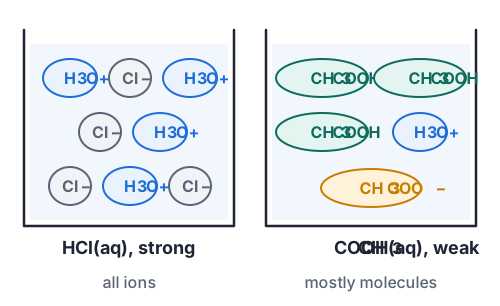
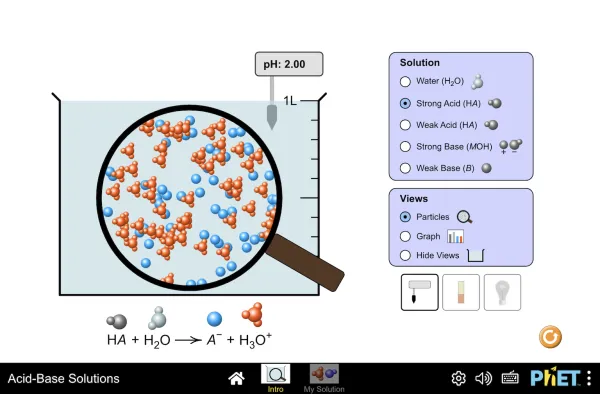
- A strong acid such as HCl reacts completely with water: every molecule gives up its proton, so the solution contains only ions.
- A weak acid such as CH₃COOH reacts only partly (CH₃COOH + H₂O ⇌ CH₃COO⁻ + H₃O⁺); at equilibrium most of its molecules are still whole.
- Strong bases such as NaOH dissociate completely to give OH⁻; weak bases such as NH₃ take protons from only a few water molecules.
- Strong and weak describe how far an acid reacts with water; concentrated and dilute describe how much acid is in each litre. They are separate ideas.
| Property | HCl (strong) | CH₃COOH (weak) |
|---|---|---|
| Reaction with water | complete | partial |
| [H₃O⁺] | 0.10 mol L⁻¹ | much lower |
| pH | 1.0 | higher, about 3 |
| Conductivity | high: many ions | low: few ions |
| Rate with Mg or CaCO₃ | fast fizzing | slow fizzing |
pH and Kw
- pH = −log[H₃O⁺], and back the other way [H₃O⁺] = 10^−pH. Each pH unit is a tenfold change in [H₃O⁺].
- In any water solution at 25 °C, Kw = [H₃O⁺][OH⁻] = 1.0 × 10⁻¹⁴, so if you know one concentration you can find the other.
- Neutral water has [H₃O⁺] = [OH⁻] = 1.0 × 10⁻⁷ mol L⁻¹ and pH 7; acids are below 7 and bases above.
- For a strong acid like HCl, [H₃O⁺] equals the acid's concentration. For a strong base like NaOH, [OH⁻] equals the base's concentration, and Ba(OH)₂ gives twice its concentration of OH⁻.
- Give pH to two decimal places, and concentrations to 2 or 3 significant figures with mol L⁻¹.
Example: three pH calculations
- Find the pH of 0.020 mol L⁻¹ HCl, the pH of 0.050 mol L⁻¹ NaOH, and the [OH⁻] in a solution of pH 3.40.
- HCl: [H₃O⁺] = 0.020 mol L⁻¹a strong acid reacts completely
- pH = −log(0.020) = 1.70
- NaOH: [OH⁻] = 0.050 mol L⁻¹, so [H₃O⁺] = 1.0 × 10⁻¹⁴ ÷ 0.050 = 2.0 × 10⁻¹³ mol L⁻¹from Kw
- pH = −log(2.0 × 10⁻¹³) = 12.70
- pH 3.40: [H₃O⁺] = 10^−3.40 = 3.98 × 10⁻⁴ mol L⁻¹
- [OH⁻] = 1.0 × 10⁻¹⁴ ÷ (3.98 × 10⁻⁴) = 2.51 × 10⁻¹¹ mol L⁻¹
- the acid is below pH 7, the base above, and the acidic solution has far less OH⁻ than H₃O⁺
Real data: the ocean off Otago
- Seawater absorbs CO₂ from the air, and the carbonic acid it forms gives up protons: CO₂ + H₂O ⇌ H₂CO₃, then H₂CO₃ + H₂O ⇌ HCO₃⁻ + H₃O⁺.
- More CO₂ in the air pushes these equilibria to the right, by Le Chatelier's principle, which raises [H₃O⁺] and lowers the pH.
- The Munida transect, sampled from Otago Harbour out into subantarctic water since 1998, is the Southern Hemisphere's longest-running record of ocean pH.
- From the trend values in the table, [H₃O⁺] rose from 10^−8.092 = 8.09 × 10⁻⁹ to 10^−8.057 = 8.77 × 10⁻⁹ mol L⁻¹, an 8.4% rise; Stats NZ's figure of 8.6% comes from the unrounded trend.
- Lower pH makes it harder for shellfish such as pāua and kuku (green-lipped mussels) to build their shells, which matters for kaimoana.
| Munida transect, 1998 to 2020 | Value |
|---|---|
| Surface pH, start of the trend | 8.092 |
| Surface pH, end of the trend | 8.057 |
| Average change | −0.0016 pH units a year |
| Rise in acidity ([H₃O⁺]) | 8.6% |
| Dissolved CO₂ (pCO₂) | 349.9 to 384.9 µatm, up 10.0% |
What Achieved, Merit and Excellence look like
- Achieved states the difference; Merit explains it with dissociation and an equation; Excellence compares both solutions side by side, with equations, for each property asked.
| Grade | A model answer |
|---|---|
| Achieved | NaOH is a strong base and NH₃ is a weak base, so NaOH has the higher pH and conducts better. |
| Merit | NaOH dissociates completely, NaOH → Na⁺ + OH⁻, so [OH⁻] is high and its pH is higher. NH₃ takes protons from only a few water molecules, NH₃ + H₂O ⇌ NH₄⁺ + OH⁻, so there are far fewer ions and it conducts poorly. |
| Excellence | Both are 0.10 mol L⁻¹. NaOH dissociates completely, so [OH⁻] = 0.10 mol L⁻¹, [H₃O⁺] = 1.0 × 10⁻¹³ mol L⁻¹ and the pH is 13.0. NH₃ is a weak base, so at equilibrium only a small fraction has accepted a proton; [OH⁻] is much lower and the pH lower, though still above 7. Conductivity needs freely moving charged particles: the NaOH solution is full of Na⁺ and OH⁻ ions, while the NH₃ solution is mostly neutral molecules with few NH₄⁺ and OH⁻ ions, so NaOH conducts far better. |
Common mistakes
- At equilibrium the concentrations of reactants and products are equal.The forward and reverse rates are equal; the concentrations are constant but usually different.
- Adding more reactant increases Kc.Only temperature changes Kc; adding reactant shifts the position of equilibrium and Kc stays the same.
- The pH of 0.020 mol L⁻¹ NaOH is −log(0.020) = 1.70.That uses [OH⁻]. Find [H₃O⁺] = 1.0 × 10⁻¹⁴ ÷ 0.020 = 5.0 × 10⁻¹³ mol L⁻¹ first, so the pH is 12.30.
- A weak acid is the same as a dilute acid.Weak means it reacts only partly with water; a weak acid can be concentrated and a strong acid can be dilute.
Push an indicator back and forth
You need: 2 red cabbage leaves, hot tap water, a jug, a clear glass, white vinegar, baking soda, a teaspoon
- Tear the cabbage leaves into the jug, cover them with hot tap water and leave for 10 minutes, then pour the purple liquid into the glass.
- Add a teaspoon of vinegar, stir, and note the colour.
- Add baking soda a pinch at a time, stirring, until the colour changes back past purple to blue or green.
- Add vinegar again a little at a time, and keep switching back and forth.
- Look for: the colour swings back every time. The dye is a weak acid in equilibrium with its ions, each a different colour; adding H₃O⁺ (vinegar) shifts it one way and removing H₃O⁺ (baking soda) shifts it back, as Le Chatelier's principle predicts.
Safety: Baking soda and vinegar can foam over quickly, so add them in small amounts with the glass in the sink, and do not drink the mixture.
Your turn
Write the Kc expression for H₂(g) + I₂(g) ⇌ 2HI(g).
What is the pH of 0.0050 mol L⁻¹ HCl?
What is the pH of 0.10 mol L⁻¹ KOH?
Find [H₃O⁺] in a solution of pH 9.20.
For 2SO₂(g) + O₂(g) ⇌ 2SO₃(g), which way does the equilibrium shift when the pressure is increased?
Show answer
1. Kc = [HI]² ÷ ([H₂][I₂]). 2. pH = −log(0.0050) = 2.30. 3. [OH⁻] = 0.10 mol L⁻¹, so [H₃O⁺] = 1.0 × 10⁻¹⁴ ÷ 0.10 = 1.0 × 10⁻¹³ mol L⁻¹ and the pH is 13.00. 4. [H₃O⁺] = 10^−9.20 = 6.31 × 10⁻¹⁰ mol L⁻¹. 5. To the right: 3 mol of gas become 2, and fewer gas particles lower the pressure.
Exam-style question: making methanol
- Methanol, a fuel and solvent, is made industrially from carbon monoxide and hydrogen: CO(g) + 2H₂(g) ⇌ CH₃OH(g). The forward reaction is exothermic.
Write the Kc expression for this equilibrium.
In a test vessel at equilibrium, [CO] = 0.20, [H₂] = 0.30 and [CH₃OH] = 0.045 mol L⁻¹. Calculate Kc and say what it shows.
Explain why the process is run at high pressure.
Discuss how raising the temperature affects the amount of methanol at equilibrium, the value of Kc, and the rate.
Equipment is rinsed with 0.010 mol L⁻¹ NaOH. Calculate its pH.
Show answer
1. Kc = [CH₃OH] ÷ ([CO][H₂]²) (Achieved). 2. Kc = 0.045 ÷ (0.20 × 0.30²) = 0.045 ÷ 0.018 = 2.5; Kc is a little above 1, so products are slightly favoured at this temperature (Achieved for the value, Merit for the meaning). 3. The left side has 3 mol of gas and the right side 1 mol. Raising the pressure favours the side with fewer moles of gas, which lowers the pressure again, so the forward reaction is favoured and more methanol forms; the higher concentration of gas also speeds up the reaction (Merit). 4. The forward reaction is exothermic, so heating favours the endothermic reverse reaction, which absorbs some of the added heat: less methanol forms and Kc gets smaller. But particles move faster and more collisions have at least the activation energy, so the rate rises and equilibrium is reached sooner; the plant runs at a compromise temperature (Excellence for weighing yield against rate). 5. [OH⁻] = 0.010 mol L⁻¹, so [H₃O⁺] = 1.0 × 10⁻¹⁴ ÷ 0.010 = 1.0 × 10⁻¹² mol L⁻¹ and the pH is 12.00 (Achieved).
Acid-Base Solutions
Full screen · PhET Interactive Simulations, University of Colorado Boulder, CC BY 4.0
Recap
- At equilibrium the forward and reverse rates are equal and the concentrations stay constant.
- A change shifts the equilibrium to partly oppose it; only temperature changes Kc, and a catalyst shifts nothing.
- Strong acids and bases react completely with water, weak ones partly, so at the same concentration they differ in pH, conductivity and rate.
- pH = −log[H₃O⁺], and Kw = [H₃O⁺][OH⁻] = 1.0 × 10⁻¹⁴ links the two ions.
| Formula | Use it to find |
|---|---|
| Kc = [C]ᶜ[D]ᵈ ÷ ([A]ᵃ[B]ᵇ) | Kc, or one equilibrium concentration |
| pH = −log[H₃O⁺] | pH from [H₃O⁺] |
| [H₃O⁺] = 10^−pH | [H₃O⁺] from pH |
| Kw = [H₃O⁺][OH⁻] = 1.0 × 10⁻¹⁴ | [H₃O⁺] from [OH⁻] for a base, or the reverse |
The maths behind it
How is NCEA Level 2 maths going?
See the NCEA Level 2 maths guide