Titration: how much acid is really in the vinegar?
What this lesson covers
- What a standard solution is, why some chemicals are primary standards and sodium hydroxide is not.
- Titration technique: rinsing, the indicator, reading the burette and getting concordant titres.
- Using n = m/M, n = cV and the mole ratio from a balanced equation, including a 1 : 2 ratio.
- Using a trial run to modify the sample or the procedure, such as diluting a product that is too concentrated.
- Controlling variables, using significant figures and units, and evaluating the result against the product's label.
What the investigation asks of you
- You are given an outline of a titration and a consumer product, such as vinegar, a cleaner or vitamin C tablets, and asked how much of one substance it contains.
- Achieved: plan whether the sample or the procedure needs changing, collect and process enough titres to reach a conclusion, find a concentration, and describe how you controlled the variables that matter.
- Merit: base your changes on trial runs, collect good quality data, find the concentration of your standard solution and of the substance accurately, and explain how controlling variables made the data better.
- Excellence: give the concentration in the product with correct significant figures and units, justify how each change made the result more valid and accurate, and evaluate what the result means for the product.
- The calculation must use mole ratios, n = m/M and n = cV, and at least one reaction in the task has a ratio that is not 1 : 1.
Standard solutions and primary standards
- A standard solution is one whose concentration is known accurately, because a weighed mass of solid was dissolved and made up to an exact volume in a volumetric flask.
- Only a primary standard can be weighed out this way: a pure, stable solid with a fairly high molar mass that does not take in water or gases from the air. Oxalic acid dihydrate, H₂C₂O₄·2H₂O, and anhydrous sodium carbonate, Na₂CO₃, are common ones.
- Sodium hydroxide is not a primary standard. Its pellets absorb water and carbon dioxide from the air, so a weighed mass is never all NaOH.
- So the class first titrates their sodium hydroxide against a standard oxalic acid solution to find its true concentration. This is called standardising it.
- Concentration is in mol L⁻¹, so volumes must be changed from mL to L before using n = cV: 20.00 mL is 0.02000 L.
Example: making the standard oxalic acid solution
- The class weighed 1.600 g of oxalic acid dihydrate, dissolved it in distilled water, and made the solution up to the mark in a 250.0 mL volumetric flask.
- Find the concentration of the standard solution. M(H₂C₂O₄·2H₂O) = 126.07 g mol⁻¹.
- M = 2(1.008) + 2(12.01) + 4(16.00) + 2(18.016) = 126.07 g mol⁻¹the two waters of crystallisation are part of the weighed solid
- n = m ÷ M = 1.600 ÷ 126.07 = 0.012691 moln = m/M
- c = n ÷ V = 0.012691 ÷ 0.2500 = 0.05077 mol L⁻¹250.0 mL = 0.2500 L
- c(H₂C₂O₄) = 0.05077 mol L⁻¹
Titration technique
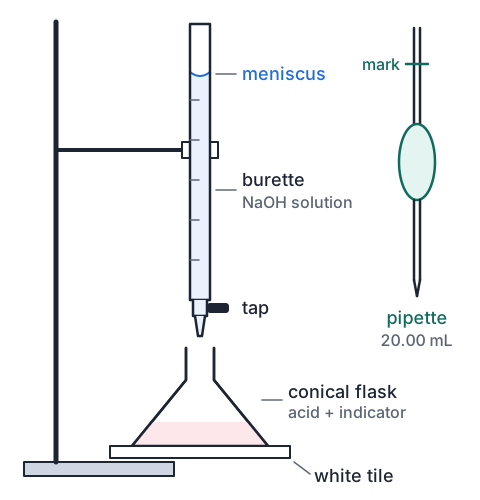
- Rinse the pipette with the solution it will measure and the burette with the solution it will hold, so leftover water does not dilute them. Rinse the conical flask with distilled water only, because the moles in it are already fixed by the pipette.
- Pipette the aliquot (20.00 mL here) into the conical flask, add 2 or 3 drops of indicator, and stand the flask on a white tile so the colour change is easy to see.
- Phenolphthalein suits a weak acid titrated with a strong base: it goes from colourless to the first pale pink that lasts about 30 seconds.
- Run in the titrant while swirling, then add it drop by drop near the end point, washing any drops off the flask walls with distilled water.
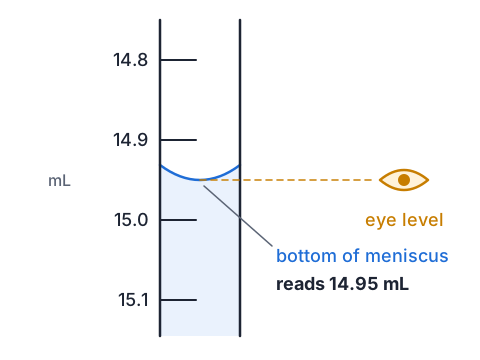
- Read the burette at eye level, at the bottom of the meniscus, to two decimal places. The titre is the final reading minus the initial reading.
Reading the burette and concordant titres
- A burette is marked every 0.1 mL, and you can read it to 0.05 mL by judging when the meniscus sits halfway between two lines.
- The first titration is a rough one: it shows roughly where the end point is, so you can go drop by drop near it next time. It is not used in the mean.
- Concordant titres are accurate titres that agree closely, usually within 0.10 mL (your task will say). Repeat until you have at least three.
- Average only the concordant titres. A titre that is clearly out, from overshooting the end point, is recorded with a reason and left out.
Example: standardising the sodium hydroxide
- 20.00 mL aliquots of the 0.05077 mol L⁻¹ oxalic acid were titrated with the sodium hydroxide, using phenolphthalein.
- H₂C₂O₄ + 2NaOH → Na₂C₂O₄ + 2H₂O, so each mole of acid needs two moles of base.
- Find the concentration of the sodium hydroxide.
| Titration | Rough | 1 | 2 | 3 |
|---|---|---|---|---|
| Titre (mL) | 21.30 | 20.85 | 20.80 | 20.90 |
- mean titre = (20.85 + 20.80 + 20.90) ÷ 3 = 20.85 mLthe three concordant titres agree within 0.10 mL; the rough one is left out
- n(H₂C₂O₄) = cV = 0.05077 × 0.02000 = 1.0154 × 10⁻³ molmoles in the 20.00 mL aliquot; keep an extra figure until the end
- n(NaOH) = 2 × 1.0154 × 10⁻³ = 2.0308 × 10⁻³ molmole ratio 1 : 2 from the equation
- c(NaOH) = n ÷ V = 2.0308 × 10⁻³ ÷ 0.02085 = 0.09740 mol L⁻¹the mean titre is the volume of NaOH
- forgetting the 2 gives 0.04870 mol L⁻¹, half the true value
- c(NaOH) = 0.09740 mol L⁻¹
Trial runs and modifying the sample
- Vinegar contains ethanoic (acetic) acid: CH₃COOH + NaOH → CH₃COONa + H₂O, a 1 : 1 ratio.
- In a trial run, 20.00 mL of undiluted vinegar had still not reached the end point after a full 50 mL burette of NaOH. A rough estimate said it would need about 140 mL.
- So the class modified the sample: they pipetted 25.00 mL of vinegar into a 250.0 mL volumetric flask and made it up to the mark with distilled water, a dilution factor of 10.
- The diluted vinegar needed about 14 mL per titration: a single burette filling, a titre large enough that a 0.05 mL reading error is under 0.5% of it, and enough left over for repeats.
- Other changes you might justify: a different indicator, a larger or smaller aliquot, crushing and dissolving tablets, or filtering a cloudy product.
Example: the concentration of acid in the vinegar
- 20.00 mL aliquots of the diluted vinegar were titrated with the 0.09740 mol L⁻¹ NaOH. The burette readings are in the table.
- Find the concentration of ethanoic acid in the original vinegar in mol L⁻¹ and in g L⁻¹. M(CH₃COOH) = 60.05 g mol⁻¹.
| Titration | Rough | 1 | 2 | 3 |
|---|---|---|---|---|
| Final reading (mL) | 15.10 | 14.60 | 28.95 | 14.95 |
| Initial reading (mL) | 0.00 | 0.20 | 14.60 | 0.50 |
| Titre (mL) | 15.10 | 14.40 | 14.35 | 14.45 |
- mean titre = (14.40 + 14.35 + 14.45) ÷ 3 = 14.40 mLconcordant titres only
- n(NaOH) = 0.09740 × 0.01440 = 1.4026 × 10⁻³ moln = cV
- n(CH₃COOH) = 1.4026 × 10⁻³ mol1 : 1 ratio
- c(diluted) = 1.4026 × 10⁻³ ÷ 0.02000 = 0.07013 mol L⁻¹the acid was in the 20.00 mL aliquot
- c(vinegar) = 10 × 0.07013 = 0.7013 mol L⁻¹undo the dilution: 25.00 mL made up to 250.0 mL
- mass concentration = 0.7013 × 60.05 = 42.11 g L⁻¹c × M turns mol L⁻¹ into g L⁻¹
- ethanoic acid: 0.7013 mol L⁻¹, or 42.1 g L⁻¹ (about 4.2 g per 100 mL)
Variables, significant figures and evaluating the result
- Significant variables to control: the same indicator and number of drops, the same end point colour, the same aliquot volume, a rinsed burette and pipette, and NaOH solution kept stoppered so it does not absorb carbon dioxide.
- Give the answer to the significant figures of your least precise measurement. Titres and volumes here have 4 significant figures, so 0.7013 mol L⁻¹ or 42.11 g L⁻¹; 42.1 g L⁻¹ is a fair everyday rounding.
- Compare with the label and the law. The Food Standards Code sets at least 40 g of acetic acid per kilogram of vinegar, which is about 40 g per litre because vinegar's density is close to 1 g mL⁻¹.
- Evaluate: 42.1 g L⁻¹ is a little above the 4% label claim and the legal minimum, so the vinegar meets both. Possible errors, such as overshooting the end point, would make titres larger and the result too high, so concordant titres matter.
- Make a fair limit to your claim: one bottle was tested, so the result describes that bottle, not every bottle of that brand.
| What | Acetic acid |
|---|---|
| Food Standards Code minimum for vinegar | 40 g per kg |
| The bottle's label | 4% acidity |
| The class's titration result | 42.1 g per L |
Example: one modification written up for each grade
- The same change, diluting the vinegar, written three ways. Each grade keeps what the one before it said and adds to it.
| Grade | What the student wrote |
|---|---|
| Achieved | We diluted the vinegar 10 times because it was too strong. Our concentration of ethanoic acid was 0.70 mol/L. We kept the indicator and aliquot the same each time. |
| Merit | Our trial run used a whole 50 mL burette without reaching the end point, so we diluted 25.00 mL of vinegar to 250.0 mL. This gave titres of about 14.4 mL from one burette filling, and three titres within 0.10 mL. Using the same end point colour each time kept the titres concordant. |
| Excellence | Diluting by 10 made the titres about 14.4 mL, so the ±0.05 mL reading error is under 0.4% of each titre and no refilling was needed, which made the result more accurate. Standardising the NaOH against oxalic acid made it valid, because NaOH absorbs CO₂ and its weighed mass is not reliable. The vinegar contains 0.7013 mol L⁻¹ (42.1 g L⁻¹) of ethanoic acid, just above its 4% label and the 40 g per kg legal minimum. |
Common mistakes
- I averaged all four titres, including the rough one.Only the concordant titres go in the mean; the rough titre only shows roughly where the end point is.
- n(NaOH) = n(H₂C₂O₄), so c(NaOH) = 0.04870 mol L⁻¹.Oxalic acid needs two NaOH per molecule, so n(NaOH) = 2 × n(H₂C₂O₄), giving 0.09740 mol L⁻¹.
- The vinegar's concentration is 0.07013 mol L⁻¹.That is the diluted solution; multiply by the dilution factor of 10 to get 0.7013 mol L⁻¹ in the bottle.
- I rinsed the burette with distilled water before filling it with NaOH.Rinse it with the NaOH; leftover water dilutes it, which makes the titres too large and the answer too high.
Titrate vinegar with baking soda in your kitchen
You need: 2 red cabbage leaves, hot tap water, baking soda, white vinegar, a 5 mL or 10 mL medicine syringe, a teaspoon, 3 clear glasses, a jug
- Tear the cabbage leaves into the jug, cover them with hot tap water, leave for 10 minutes, then pour off the purple liquid: this is your indicator.
- Dissolve one level teaspoon of baking soda in one cup (250 mL) of water. This is your base solution; using the same batch for every run keeps its concentration the same.
- Measure 10 mL of the base into a glass with the syringe and add a tablespoon of indicator. It turns blue-green.
- Fill the syringe with vinegar and add it 1 mL at a time, swirling, until the colour turns to purple. Note the volume: this is your rough titre.
- Repeat twice more with fresh 10 mL portions, adding the vinegar a few drops at a time near the end, until two runs agree within 0.5 mL.
- Look for: the fizz is carbon dioxide from the reaction, and the purple end point means the acid has just used up the base. Agreeing runs are your concordant titres.
Safety: Vinegar stings if it splashes into your eyes, so keep the syringe tip inside the glass, and wash the syringe well before it goes back in the medicine drawer.
Your turn
2.650 g of anhydrous sodium carbonate (M = 105.99 g mol⁻¹) is made up to 250.0 mL. Find its concentration.
A student's titres are 22.60 (rough), 22.15, 22.40, 22.20 and 22.10 mL. Which are concordant, and what is the mean titre?
Na₂CO₃ + 2HCl → 2NaCl + H₂O + CO₂. 20.00 mL of 0.1000 mol L⁻¹ Na₂CO₃ needs 22.15 mL of HCl. Find c(HCl).
A cleaner is diluted 25.00 mL to 250.0 mL, and the diluted solution is 0.0850 mol L⁻¹. What is the concentration in the bottle?
Explain why the student standardised the sodium hydroxide instead of weighing out the pellets.
Show answer
1. n = 2.650 ÷ 105.99 = 0.02500 mol; c = 0.02500 ÷ 0.2500 = 0.1000 mol L⁻¹. 2. 22.15, 22.20 and 22.10 mL agree within 0.10 mL; mean = (22.15 + 22.20 + 22.10) ÷ 3 = 22.15 mL. 22.40 mL is left out. 3. n(Na₂CO₃) = 0.1000 × 0.02000 = 2.000 × 10⁻³ mol; n(HCl) = 2 × 2.000 × 10⁻³ = 4.000 × 10⁻³ mol; c = 4.000 × 10⁻³ ÷ 0.02215 = 0.1806 mol L⁻¹. 4. Dilution factor 10, so 10 × 0.0850 = 0.850 mol L⁻¹. 5. NaOH absorbs water and carbon dioxide from the air, so a weighed mass is not all NaOH and its concentration would be wrong; titrating it against a primary standard gives its true concentration.
Molarity
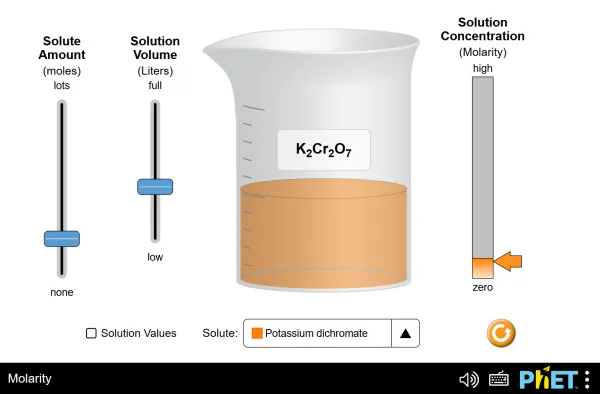
Full screen · PhET Interactive Simulations, University of Colorado Boulder, CC BY 4.0
Recap
- Make a standard solution from a weighed primary standard, then use it to standardise solutions like NaOH.
- Rinse with the right solutions, read the bottom of the meniscus at eye level, and average only concordant titres.
- Use trial runs to justify changes such as diluting the product, and remember the dilution factor at the end.
- Excellence: correct significant figures and units, modifications justified for validity and accuracy, and the result evaluated against the product.
| Step | Formula | This investigation |
|---|---|---|
| Standard solution | n = m/M, then c = n/V | 0.05077 mol L⁻¹ oxalic acid |
| Standardise NaOH | n = cV, ratio 1 : 2 | 0.09740 mol L⁻¹ NaOH |
| Diluted vinegar | n = cV, ratio 1 : 1 | 0.07013 mol L⁻¹ |
| Vinegar in the bottle | × 10, then × M | 0.7013 mol L⁻¹, 42.1 g L⁻¹ |
The maths behind it
How is NCEA Level 2 maths going?
See the NCEA Level 2 maths guide