Forces, torque and circular motion
What this lesson covers
- Newton's laws: no net force means constant velocity, F = ma for the net force, and force pairs act on different objects.
- A free-body diagram shows every force on one object, each as a labelled arrow from where it acts.
- A force at an angle splits into components F cos θ and F sin θ; on a slope the weight splits into mg sin θ along it and mg cos θ into it.
- Torque is force times perpendicular distance from the pivot (τ = Fd, in N m); in equilibrium the forces balance and the clockwise torques equal the anticlockwise torques.
- An object moving in a circle at constant speed accelerates towards the centre, a = v² ÷ r, so it needs a net force F = mv² ÷ r towards the centre.
Newton's three laws
- First law: if the forces on an object are balanced, it stays at rest or keeps moving at a constant velocity; it does not need a force to keep going.
- Second law: an unbalanced (net) force makes an object accelerate in the direction of that net force, F = ma, with F in newtons, m in kg and a in m s⁻².
- Third law: if A pushes on B, B pushes back on A with an equal and opposite force; the two forces act on different objects, so they never cancel each other out.
- Weight is F = mg with g = 9.8 m s⁻², so a 12.0 kg box has a weight of 117.6 N.
- A free-body diagram shows one object and every force acting on it: weight down, support (normal) force at right angles to the surface, friction against the motion, and any push, pull or tension.
Example: pulling a box with a rope
- A 12.0 kg box is pulled along a level floor by a rope at 30.0° above the horizontal with a force of 50.0 N. Friction on the box is 20.0 N.
- Find the box's acceleration and the support force from the floor.
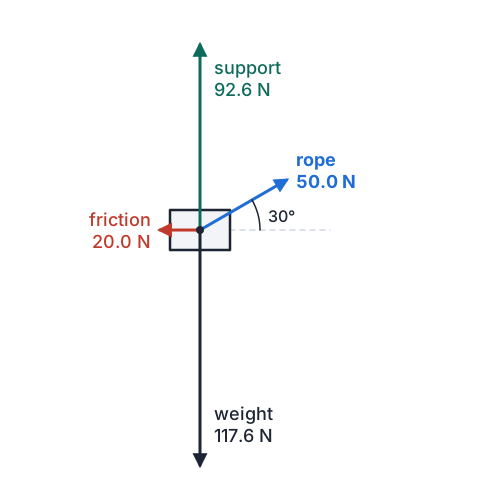
- horizontal part of the pull = 50.0 cos 30.0° = 43.30 N
- net force = 43.30 − 20.0 = 23.30 N forwardsfriction acts against the motion
- a = F ÷ m = 23.30 ÷ 12.0 = 1.942 m s⁻²
- vertical: weight = 12.0 × 9.8 = 117.6 N, rope's vertical part = 50.0 sin 30.0° = 25.0 N
- support = 117.6 − 25.0 = 92.6 Nno vertical acceleration, so the up forces equal the down forces
- up: 92.6 + 25.0 = 117.6 N = down
- a = 1.94 m s⁻² forwards, support force 92.6 N
Components and adding forces
- Two forces at right angles add with Pythagoras: 30.0 N east and 40.0 N north give 50.0 N, at tan⁻¹(40.0 ÷ 30.0) = 53.1° north of east.
- Two forces in a line add or subtract, so take one direction as positive.
- On a slope at angle θ, split the weight into mg sin θ down the slope and mg cos θ into the slope.
- The support force balances mg cos θ, and the net force along the slope is mg sin θ minus any friction.
- Check a component by sense: as θ gets bigger, mg sin θ grows, so a steeper slope pulls harder along it.
Example: a skier on a slope
- A 65.0 kg skier slides down a 15.0° slope. Friction and air resistance together are 45.0 N up the slope.
- Find the skier's acceleration and the support force from the snow.
- weight = mg = 65.0 × 9.8 = 637 N
- along the slope: 637 sin 15.0° = 164.9 N down the slope
- net force = 164.9 − 45.0 = 119.9 N down the slope
- a = 119.9 ÷ 65.0 = 1.844 m s⁻²
- support = 637 cos 15.0° = 615.3 Nit balances the part of the weight into the slope
- 164.9² + 615.3² = 405 800, and 637² = 405 800the two components rebuild the weight
- a = 1.84 m s⁻² down the slope, support 615 N
Torque and equilibrium
- Torque is the turning effect of a force: τ = Fd, where d is the perpendicular distance from the pivot to the line of the force, measured in N m.
- An object is in equilibrium when the net force is zero (up forces = down forces) and the net torque is zero (clockwise torques = anticlockwise torques about any point).
- The weight of a uniform beam acts at its centre, so include it as one force there.
- Take torques about the point where an unknown force acts: that force has zero distance, so it drops out and you can find the other one.
- Then use up forces = down forces to get the second unknown, and check it with torques about the other support.
Example: a painter on a plank
- A uniform plank 4.00 m long, weight 200 N, rests on supports at each end, A and B. A painter weighing 720 N stands 1.00 m from A.
- Find the support forces at A and B.
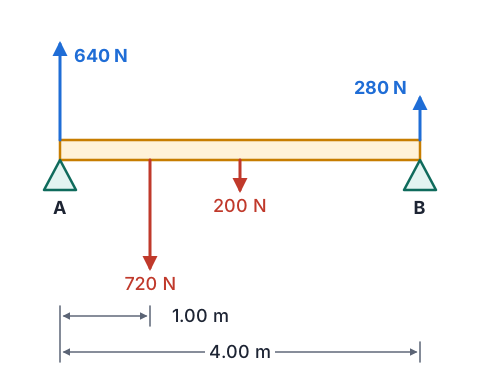
- torques about A: clockwise = 720 × 1.00 + 200 × 2.00 = 1120 N mF_A has no distance from A, so it drops out
- anticlockwise = F_B × 4.00
- F_B × 4.00 = 1120, F_B = 280 N
- up = down: F_A + 280 = 720 + 200, F_A = 640 N
- torques about B: F_A × 4.00 = 720 × 3.00 + 200 × 2.00 = 2560 N m, F_A = 640 N
- F_A = 640 N up, F_B = 280 N up; A carries more because the painter is nearer A
Circular motion at constant speed
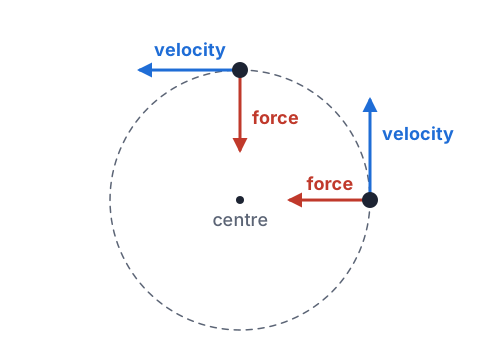
- Velocity is a vector, so an object going round a circle at constant speed is always changing velocity, because its direction changes; that is an acceleration.
- The acceleration points to the centre of the circle: a = v² ÷ r, called centripetal acceleration.
- By F = ma there must be a net force towards the centre, F = mv² ÷ r; it is at right angles to the velocity, so it changes the direction but not the speed.
- Centripetal force is not an extra force: it is whatever real force points to the centre, such as tension in a string, friction on tyres, or gravity on a satellite.
- If that force disappears, the object carries on in a straight line along the tangent, at the speed it had (Newton's first law); one lap takes T = 2πr ÷ v.
Example: a car on a roundabout
- A 1200 kg car goes round a roundabout of radius 15.0 m at a steady 8.00 m s⁻¹ on a level road.
- Find its acceleration, the force needed, and what provides that force.
- a = v² ÷ r = 8.00² ÷ 15.0 = 4.267 m s⁻² towards the centre
- F = ma = 1200 × 4.267 = 5120 N towards the centresame as mv² ÷ r = 1200 × 64.0 ÷ 15.0
- the force is friction between the tyres and the road, pointing to the centre
- one lap: T = 2πr ÷ v = 2π × 15.0 ÷ 8.00 = 11.78 s; a = 4π²r ÷ T² = 592.2 ÷ 138.8 = 4.267 m s⁻²
- a = 4.27 m s⁻², F = 5120 N from friction; at 16.0 m s⁻¹ it would need 4 × 5120 = 20 480 N
What Achieved, Merit and Excellence look like
- Achieved names the right idea; Merit gives the reason with one linked step; Excellence links velocity, force and acceleration all the way through, in the context of the question.
- Say which force provides the centripetal force: an answer that only says "centripetal force" misses the physics.
| Grade | A model answer |
|---|---|
| Achieved | Her direction keeps changing, so she is accelerating towards the centre. |
| Merit | Velocity is a vector, so changing direction changes her velocity, which is an acceleration. Friction on the tyres points to the centre and provides the centripetal force. |
| Excellence | Velocity is a vector, so as her direction changes her velocity changes, even at constant speed, and that is an acceleration (v² ÷ r) towards the centre. By F = ma this needs a net force towards the centre, supplied by friction between tyres and track; being at right angles to her velocity, it changes her direction but not her speed. On oil the friction is lost, there is no centripetal force, so she carries on in a straight line along the tangent at constant speed. |
Common mistakes
- Drawing friction, then a separate centripetal force arrow, on a car going round a corner.The centripetal force is the friction here, so draw one arrow, labelled friction, pointing to the centre.
- Torque of the plank's weight = 200 N × 4.00 m, using the plank's length.A uniform plank's weight acts at its centre, so use the distance from the pivot to the centre: 200 × 2.00.
- The table pushes up on the book and the book pushes down on the table, so those balance and the book stays still.Those are a third-law pair on different objects; the book stays still because its weight and the table's support force on it balance.
- In a circle, the object flies outwards when the string breaks.With no force it moves in a straight line along the tangent, the direction it was moving at that instant.
Balance a ruler with coins
You need: a 30 cm ruler, a round pencil, 6 identical coins, paper and a pen
- Balance the ruler on the pencil at the 15 cm mark, so its own weight acts at the pivot and makes no torque.
- Stack 2 coins centred on the 10 cm mark (5 cm left of the pivot), then slide a single coin along the right side until the ruler balances; note its distance from the pivot.
- Try 3 coins at 5 cm against 1 coin, then 2 coins at 6 cm against 3 coins, and record each balance distance.
- For each, multiply coins by distance on each side: 2 × 5 = 1 × 10, so the single coin should balance at the 25 cm mark.
- Look for: the products match on both sides, which is clockwise torque = anticlockwise torque, because each coin's weight is the same force.
Safety: Keep the coins away from any younger children while you work, because a small child can choke on a coin.
Your turn
What net force gives a 1500 kg car an acceleration of 2.4 m s⁻²?
A box is pushed with 30.0 N east and 40.0 N north at the same time. What is the resultant force?
A 40.0 N force pushes at right angles on the end of a spanner 0.250 m long. What torque does it make?
A 30.0 kg child sits 1.50 m from the pivot of a seesaw. How far from the pivot, on the other side, must a 45.0 kg child sit to balance it?
A 0.200 kg puck on a string moves in a horizontal circle of radius 0.800 m at 3.00 m s⁻¹ on a frictionless table. What is the tension in the string?
Show answer
1. F = ma = 1500 × 2.4 = 3600 N. 2. F = √(30.0² + 40.0²) = √2500 = 50.0 N; tan θ = 40.0 ÷ 30.0, θ = 53.1°, so 50.0 N at 53.1° north of east. 3. τ = Fd = 40.0 × 0.250 = 10.0 N m. 4. Weights: 30.0 × 9.8 = 294 N and 45.0 × 9.8 = 441 N; anticlockwise torque = 294 × 1.50 = 441 N m, so 441 × d = 441 and d = 1.00 m. 5. The tension is the centripetal force: F = mv² ÷ r = 0.200 × 3.00² ÷ 0.800 = 2.25 N.
Exam-style question: the diving board
- At the pools, a uniform diving board is 3.00 m long and weighs 300 N. Its left end, A, is bolted to the ground, and it rests on a support B, 1.00 m from A. A diver weighing 600 N stands at the far right end. Use g = 9.8 m s⁻².
State the two conditions for the board to be in equilibrium.
By taking torques about B, calculate the size and direction of the force the bolt at A exerts on the board.
Calculate the force from support B.
The diver walks slowly from above B to the far end. Discuss how the forces at A and B change, and why.
Show answer
1. The net force is zero (up forces = down forces) and the net torque about any point is zero (clockwise torques = anticlockwise torques) (Achieved). 2. About B, the board's weight acts 1.50 − 1.00 = 0.50 m to the right and the diver 2.00 m to the right, both clockwise: 300 × 0.50 + 600 × 2.00 = 150 + 1200 = 1350 N m. The bolt is 1.00 m to the left of B, so F_A × 1.00 = 1350 and F_A = 1350 N, and it must act downwards to make an anticlockwise torque on that side (Merit). 3. Up = down: F_B = 1350 + 300 + 600 = 2250 N upwards. Check about A: F_B × 1.00 = 300 × 1.50 + 600 × 3.00 = 450 + 1800 = 2250 N m (Merit for one force, Excellence for both with directions). 4. With the diver x metres right of B, F_A = 150 + 600x: the diver's distance from B grows, so the clockwise torque grows, and the bolt must pull down harder, from 150 N above B up to 1350 N at the end. F_B balances everything, F_B = F_A + 900, so it rises from 1050 N to 2250 N. Excellence links each change to the torque and force conditions.
Balancing Act
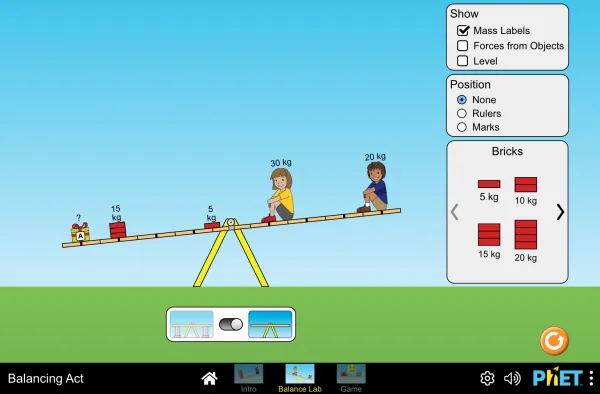
Full screen · PhET Interactive Simulations, University of Colorado Boulder, CC BY 4.0
Recap
- Net force = ma; balanced forces mean constant velocity, not necessarily rest.
- Split angled forces into F cos θ and F sin θ; on a slope use mg sin θ and mg cos θ.
- Equilibrium: up = down and clockwise torque = anticlockwise torque; take torques about an unknown force.
- Circular motion: velocity along the tangent, acceleration and net force to the centre, provided by a real force.
- Every answer needs a unit, and a direction when it is a force.
| Formula | Use it for |
|---|---|
| F = ma | net force and acceleration |
| F = mg | weight, with g = 9.8 m s⁻² |
| τ = Fd | torque about a pivot |
| a = v² ÷ r | centripetal acceleration |
| F = mv² ÷ r | the force needed to move in a circle |
The maths behind it
How is NCEA Level 2 maths going?
See the NCEA Level 2 maths guide