Momentum, energy and springs
What this lesson covers
- Momentum p = mv is a vector, in kg m s⁻¹, and impulse FΔt equals the change in momentum Δp.
- Making a collision last longer gives a smaller force for the same change in momentum.
- In a collision or explosion with no outside force, total momentum before equals total momentum after; kinetic energy is conserved only in elastic collisions.
- Work W = Fd and power P = W ÷ t; energy changes form (Ep = mgh, Ek = ½mv²) but the total is conserved.
- A spring obeys Hooke's law, F = kx, and stores elastic potential energy Ep = ½kx², the area under its force against extension graph.
Momentum and change in momentum
- Momentum is mass times velocity, p = mv, measured in kg m s⁻¹; it is a vector, so it has the direction of the velocity.
- Change in momentum is Δp = m(vf − vi), with vf and vi signed: pick a positive direction and make anything moving the other way negative.
- When an object bounces back, the change in momentum is bigger than when it stops dead, because the velocity changes sign: a ball arriving at +20 m s⁻¹ and leaving at −15 m s⁻¹ changes velocity by 35 m s⁻¹.
Impulse: force times time
- Impulse is the force multiplied by the time it acts, FΔt, in N s, and it equals the change in momentum: FΔt = Δp.
- So the average force in a collision is F = Δp ÷ Δt.
- For a person or object brought to a stop, Δp is fixed by the mass and the speed, so the only way to reduce the force is to make the stop take longer.
- That is how crumple zones, airbags, cycle helmets, padded goalposts and bending your knees on landing protect you: each stretches out the time of the collision.
Example: hitting a cricket ball
- A 0.160 kg cricket ball travels towards a bat at 30.0 m s⁻¹ and is hit straight back at 40.0 m s⁻¹. The ball is in contact with the bat for 2.00 ms.
- Find the change in momentum of the ball and the average force on it.
- take away from the bat as positive: vi = −30.0 m s⁻¹, vf = +40.0 m s⁻¹
- Δp = m(vf − vi) = 0.160 × (40.0 − (−30.0)) = 0.160 × 70.0 = 11.2 kg m s⁻¹
- Δt = 2.00 ms = 0.00200 smilli means divide by 1000
- F = Δp ÷ Δt = 11.2 ÷ 0.00200 = 5600 N
- a = Δv ÷ Δt = 70.0 ÷ 0.00200 = 35 000 m s⁻², F = ma = 0.160 × 35 000 = 5600 N
- Δp = 11.2 kg m s⁻¹ away from the bat, average force 5600 N away from the bat
Conservation of momentum
- When objects collide or push apart, the forces between them are equal and opposite (Newton's third law) and act for the same time, so one gains exactly the momentum the other loses.
- So if no outside net force acts, the total momentum before equals the total momentum after.
- Add momenta with signs: two objects moving towards each other have momenta of opposite sign, and the total can be small.
- In an explosion, such as two skaters pushing apart from rest, the total momentum is zero before and after, so they move off in opposite directions.
- Kinetic energy is conserved only in an elastic collision; in most collisions some kinetic energy becomes heat, sound and work done squashing the objects, which is why momentum is the more useful quantity for collisions.
Example: two trolleys collide and stick
- A 2.00 kg trolley moving right at 3.00 m s⁻¹ meets a 1.00 kg trolley moving left at 1.50 m s⁻¹. They stick together.
- Find their velocity after the collision, and how much kinetic energy is lost.
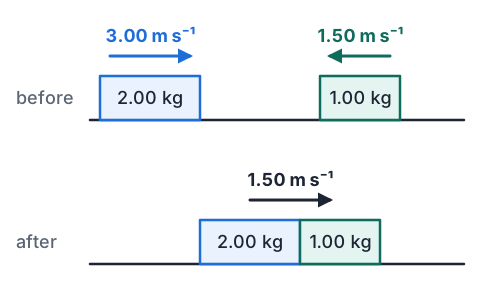
- right is positive: p before = 2.00 × 3.00 + 1.00 × (−1.50) = 6.00 − 1.50 = 4.50 kg m s⁻¹
- p after = (2.00 + 1.00) × v = 4.50, v = 1.50 m s⁻¹momentum is conserved
- Ek before = ½ × 2.00 × 3.00² + ½ × 1.00 × 1.50² = 9.00 + 1.125 = 10.125 J
- Ek after = ½ × 3.00 × 1.50² = 3.375 J
- Ek lost = 10.125 − 3.375 = 6.75 J, to heat, sound and deforming the trolleys
- p after = 3.00 × 1.50 = 4.50 kg m s⁻¹, the same as before
- 1.50 m s⁻¹ to the right; 6.75 J of kinetic energy lost, so the collision is inelastic
Work, energy and power
- Work is done when a force moves something in the direction of the force: W = Fd, in joules; the work done equals the energy transferred.
- Gravitational potential energy is Ep = mgh and kinetic energy is Ek = ½mv²; lifting a mass m by a height h takes work mgh, whatever path it takes.
- Energy is conserved: with no friction, Ep lost = Ek gained, so a falling object's speed after a drop h is v = √(2gh).
- With friction, the missing energy is the work done against friction, Ffriction × d, which becomes heat.
- Power is the rate of doing work: P = W ÷ t, in watts (1 W = 1 J s⁻¹); the same climb done faster takes the same work but more power.
Example: down a playground slide
- A 45.0 kg child starts from rest at the top of a slide 3.00 m high and reaches the bottom at 5.00 m s⁻¹. The slide is 5.00 m long.
- Find the speed she would have without friction, and the average friction force on her.
- Ep at the top = mgh = 45.0 × 9.8 × 3.00 = 1323 J
- no friction: ½mv² = mgh, v = √(2gh) = √(2 × 9.8 × 3.00) = √58.8 = 7.67 m s⁻¹the mass cancels
- Ek at the bottom = ½ × 45.0 × 5.00² = 562.5 J
- work against friction = 1323 − 562.5 = 760.5 J
- friction = W ÷ d = 760.5 ÷ 5.00 = 152.1 Nfriction acts along the whole 5.00 m of the slide
- 562.5 + 152.1 × 5.00 = 562.5 + 760.5 = 1323 Jthe energy out adds back to the energy in
- 7.67 m s⁻¹ without friction; average friction 152 N
Springs and Hooke's law
- A spring stretches (or compresses) in proportion to the force on it: F = kx, where x is the extension in metres and k is the spring constant in N m⁻¹.
- A bigger k means a stiffer spring: it needs more force for each metre of stretch.
- The spring pulls back the opposite way to the stretch, which is why the restoring force is written F = −kx.
- The energy stored is the area under the force against extension graph, a triangle: Ep = ½Fx = ½kx².
- Because x is squared, doubling the stretch stores four times the energy; past its limit of proportionality a spring no longer obeys F = kx.
Example: finding a spring constant
- A Year 12 class hung 100 g masses, one at a time, from a spring and measured its extension each time.
- Find the spring constant and the energy stored when the extension is 0.200 m.
| Mass (g) | Force (N) | Extension (cm) |
|---|---|---|
| 100 | 0.98 | 4.1 |
| 200 | 1.96 | 7.9 |
| 300 | 2.94 | 12.1 |
| 400 | 3.92 | 15.9 |
| 500 | 4.90 | 20.0 |
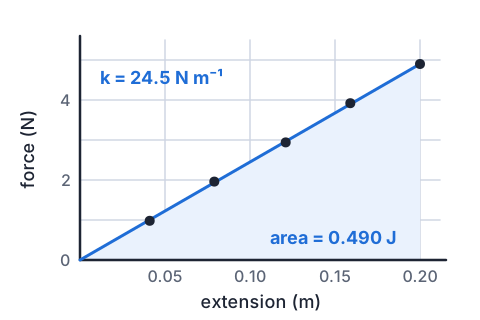
- force = weight = mg, so 100 g gives 0.100 × 9.8 = 0.98 Ngrams to kilograms first
- the points lie on a straight line through (0, 0), so F = kx holds
- k = gradient = 4.90 N ÷ 0.200 m = 24.5 N m⁻¹extension in metres, 20.0 cm = 0.200 m
- Ep = ½kx² = ½ × 24.5 × 0.200² = 0.490 J
- area of the triangle = ½ × 0.200 × 4.90 = 0.490 J
- k = 24.5 N m⁻¹, Ep = 0.490 J
Example: a spring-loaded toy dart
- A toy gun's spring, k = 800 N m⁻¹, is compressed 0.0500 m and fires a 0.0200 kg dart straight up. Ignore friction and air resistance.
- Find the dart's launch speed and how high it rises, then say what happens if the spring is compressed twice as far.
- Ep spring = ½kx² = ½ × 800 × 0.0500² = 1.00 J
- Ek = ½mv², so 1.00 = ½ × 0.0200 × v², v² = 100 m² s⁻², v = 10.0 m s⁻¹all the spring energy becomes kinetic energy
- Ep gravity = mgh, so 1.00 = 0.0200 × 9.8 × h, h = 5.10 m
- kinematics: 0 = 10.0² − 2 × 9.8 × h, h = 100 ÷ 19.6 = 5.10 m
- twice the compression: Ep = ½ × 800 × 0.100² = 4.00 J, four times as much
- 10.0 m s⁻¹, 5.10 m; doubling x gives 4 times the energy, 2 times the speed and 4 times the height
What Achieved, Merit and Excellence look like
- Achieved names one correct idea; Merit links two (cause and effect); Excellence gives the whole chain, from what stays the same to what changes and why.
- In a safety question, say first that Δp is fixed, then that the time is longer, then use F = Δp ÷ Δt to show the force is smaller.
| Grade | A model answer |
|---|---|
| Achieved | The foam squashes, so the head stops more slowly and the force is smaller. |
| Merit | The foam crushing makes the head take longer to stop, and since F = Δp ÷ Δt, a longer time gives a smaller force on the head. |
| Excellence | The head's change in momentum is the same with or without a helmet, because it goes from the same speed to rest: Δp = mv. Crushing foam makes the stop take longer, so by F = Δp ÷ Δt the same Δp spread over a longer Δt needs a smaller average force on the head, so less injury. The work done crushing the foam also turns the head's kinetic energy into heat in the foam rather than damage to the skull. |
Common mistakes
- A ball hits the wall at 20 m s⁻¹ and bounces back at 15 m s⁻¹, so Δv = 20 − 15 = 5 m s⁻¹.Directions matter: Δv = −15 − 20 = −35 m s⁻¹, a change of 35 m s⁻¹ away from the wall.
- Momentum was conserved in the collision, so the kinetic energy must have been conserved too.Momentum is conserved in every collision with no outside force; kinetic energy is conserved only in elastic ones.
- Doubling the compression of a spring doubles the energy it stores.Ep = ½kx², so doubling x makes the energy four times as big.
- Work to climb stairs = 60 kg × 3.5 m = 210 J.The force is the weight, mg: W = 60 × 9.8 × 3.5 = 2058 J.
How much energy does a bouncing ball keep?
You need: 2 or 3 different balls (tennis ball, rubber ball, ping-pong ball), a tape measure, masking tape, a phone camera, if you have one, paper and a pen
- Tape the tape measure upright against a wall on a hard floor, with 0 at the floor.
- Hold a ball with its bottom at 1.00 m and let it go without throwing it; note the height of the bottom of the ball at the top of its first bounce (a slow-motion phone clip makes this easy).
- Repeat 3 times for each ball and average the rebound height.
- Work out the fraction of energy kept: Ep = mgh, and m and g are the same, so it is rebound height ÷ drop height; a 0.60 m bounce keeps 60%.
- Look for: no ball bounces back to 1.00 m, because some of its kinetic energy becomes heat and sound as it squashes on the floor; try a carpet and compare.
Safety: Drop the balls well away from windows, lamps and anything breakable, and keep the floor clear so nobody trips chasing a ball.
Your turn
What is the momentum of a 1200 kg car travelling at 15.0 m s⁻¹?
A 0.0600 kg tennis ball hits a wall at 20.0 m s⁻¹ and bounces straight back at 15.0 m s⁻¹. What is its change in momentum?
A 60.0 kg skater and a 40.0 kg skater stand still on ice and push each other apart. The 60.0 kg skater moves off at 2.00 m s⁻¹. What is the other skater's velocity?
A 60.0 kg student runs up stairs 3.50 m high in 4.00 s. What power does she develop lifting herself?
A spring with k = 50.0 N m⁻¹ is stretched by 0.120 m. How much elastic potential energy does it store?
Show answer
1. p = mv = 1200 × 15.0 = 18 000 kg m s⁻¹ in the car's direction. 2. Away from the wall is positive: Δp = 0.0600 × (15.0 − (−20.0)) = 0.0600 × 35.0 = 2.10 kg m s⁻¹ away from the wall. 3. Total momentum is 0 before, so 60.0 × 2.00 + 40.0 × v = 0, v = −120 ÷ 40.0 = −3.00 m s⁻¹: 3.00 m s⁻¹ in the opposite direction. 4. W = mgh = 60.0 × 9.8 × 3.50 = 2058 J; P = W ÷ t = 2058 ÷ 4.00 = 514.5 W, about 515 W. 5. Ep = ½kx² = ½ × 50.0 × 0.120² = 0.360 J.
Exam-style question: coupling rail wagons
- In a rail yard, a 1500 kg wagon rolls at 2.00 m s⁻¹ towards a stationary 1000 kg wagon on a level track. They couple together and move off as one. Ignore friction.
Calculate the momentum of the moving wagon, with its unit.
Calculate the speed of the coupled wagons.
Show that kinetic energy is not conserved in the coupling, and say where it goes.
The coupled wagons then run into a spring buffer with k = 2.40 × 10⁵ N m⁻¹. Calculate how far the buffer compresses as it stops them.
Discuss whether a stiffer buffer (bigger k) would be better for the wagons and their load.
Show answer
1. p = mv = 1500 × 2.00 = 3000 kg m s⁻¹ along the track (Achieved). 2. Momentum is conserved: 3000 = (1500 + 1000) × v, v = 3000 ÷ 2500 = 1.20 m s⁻¹ in the same direction (Merit). 3. Ek before = ½ × 1500 × 2.00² = 3000 J; Ek after = ½ × 2500 × 1.20² = 1800 J; 1200 J has become heat and sound in the coupling, so the collision is inelastic (Merit). 4. All 1800 J is stored in the spring: ½kx² = 1800, x² = 2 × 1800 ÷ 240 000 = 0.0150 m², x = 0.122 m (Excellence). 5. The wagons' change in momentum is the same, 2500 × 1.20 = 3000 kg m s⁻¹, whatever the buffer. A stiffer spring stores the same 1800 J in a smaller compression (x = √(2Ek ÷ k)), so it stops them over a shorter distance and in a shorter time, and by F = Δp ÷ Δt the force on the wagons and load is bigger. A softer buffer is gentler, as long as it is long enough to compress the extra distance (Excellence links Δp, time, force and the energy stored).
Masses and Springs
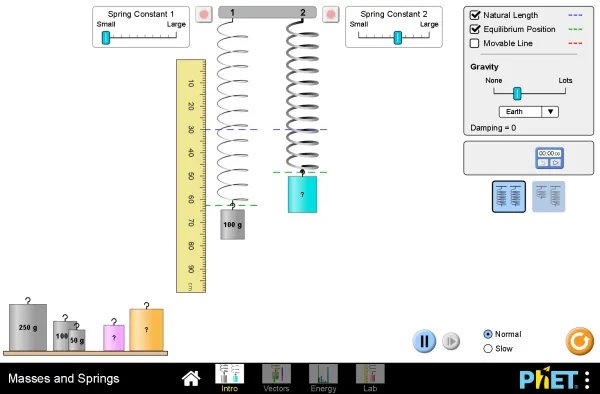
Full screen · PhET Interactive Simulations, University of Colorado Boulder, CC BY 4.0
Recap
- p = mv is a vector; give a direction, and use signs for opposite directions.
- Impulse FΔt = Δp: a longer stopping time means a smaller force.
- Total momentum is conserved in collisions and explosions; kinetic energy only in elastic collisions.
- W = Fd, P = W ÷ t, and the energy total stays the same as it changes form.
- Springs: F = kx, Ep = ½kx², the area under the force against extension graph.
| Formula | Use it for |
|---|---|
| p = mv | momentum |
| FΔt = Δp | impulse and collision forces |
| W = Fd, P = W ÷ t | work and power |
| Ep = mgh, Ek = ½mv² | gravitational and kinetic energy |
| F = kx, Ep = ½kx² | spring force and stored energy |
How is NCEA Level 2 maths going?
See the NCEA Level 2 maths guide