Atomic and nuclear physics: the nucleus, radiation and E = mc²
What this lesson covers
- Thomson's plum pudding model, the gold foil experiment, and how its results led to Rutherford's nuclear model.
- Nuclear notation, isotopes, and balancing equations by conserving mass number and atomic number.
- Alpha, beta and gamma radiation: what each is, and why their ionising and penetrating abilities differ.
- Half-life, decay curves and radiocarbon dating.
- Fission, fusion, chain reactions and power stations, with E = mc² and P = E/t.
How this internal is assessed
- Schools usually set a research task: a set of questions or a report on a context such as nuclear power, smoke alarms, medical imaging or carbon dating, written up over several lessons.
- Achieved describes the ideas and terms correctly; Merit explains why, giving reasons; Excellence connects ideas, for example linking a decay equation to conservation laws and to the new element made.
- Equations, diagrams and calculations count as evidence, so include them where they support a point.
- Copying or lightly reworded paragraphs from websites do not show understanding; process what you read into your own explanation, and list your sources.
From plum pudding to the nucleus
- After J. J. Thomson found the tiny negative electron, he pictured the atom as a sphere of spread-out positive charge with electrons dotted through it, like plums in a pudding, so the atom is neutral overall.
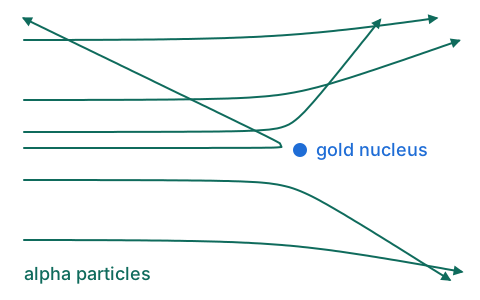
- Rutherford had Hans Geiger and Ernest Marsden fire alpha particles (small, fast and positive) at very thin gold foil and count where they went.
- Almost all went straight through, so the atom must be mostly empty space; a few were deflected, so there must be a concentrated positive charge that repels them.
- A very few bounced back, which spread-out charge could never do; the positive charge and almost all the mass must be packed into a tiny, dense centre, the nucleus.
- In 1911 Rutherford proposed his nuclear model: a tiny positive nucleus with the electrons around it, a long way away, and empty space in between.
| Year | Ernest Rutherford |
|---|---|
| 1871 | born at Spring Grove, near Nelson |
| 1890 to 1894 | studies at Canterbury College, Christchurch |
| 1908 | Nobel Prize in Chemistry for his work on radioactivity |
| 1911 | proposes the nuclear model from the gold foil results |
| 1919 | turns nitrogen into oxygen with alpha particles, the first artificial nuclear reaction |
| 1992 | his portrait goes on New Zealand's $100 note |
Nuclear notation and isotopes
- The nucleus holds protons (charge +1) and neutrons (no charge), together called nucleons.
- A nuclide is written ᴬ_Z X: the mass number A (top) is the number of nucleons, and the atomic number Z (bottom) is the number of protons, which fixes the element.
- Number of neutrons = A − Z, so uranium-235, ²³⁵₉₂U, has 92 protons and 235 − 92 = 143 neutrons.
- Isotopes are atoms of the same element (same Z) with different numbers of neutrons (different A); they react the same way chemically, but some are unstable and radioactive.
| Isotope | Symbol | Protons | Neutrons | Stable? |
|---|---|---|---|---|
| carbon-12 | ¹²₆C | 6 | 6 | yes |
| carbon-13 | ¹³₆C | 6 | 7 | yes |
| carbon-14 | ¹⁴₆C | 6 | 8 | no, beta decays |
Alpha, beta and gamma
- An unstable nucleus becomes more stable by giving out radiation; this is random, so you cannot say when one nucleus will decay.
- To ionise an atom, radiation must knock an electron out of it, and each ionisation takes some of the radiation's energy.
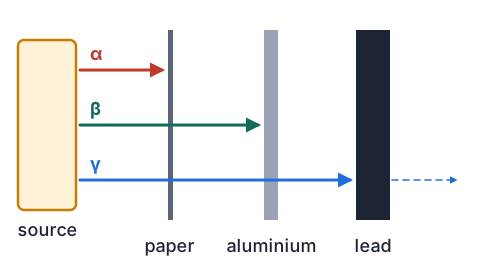
- Alpha particles are big and have a +2 charge, so they pull strongly on electrons and ionise almost every atom they pass; they lose their energy quickly and are stopped by a sheet of paper or a few centimetres of air.
- Beta particles are fast electrons with a −1 charge and far less mass, so they ionise less often and travel further, through paper but not a few millimetres of aluminium.
- Gamma rays are electromagnetic waves with no charge and no mass, so they rarely interact; they ionise least and penetrate most, needing thick lead or concrete to reduce them.
- The link: the more strongly radiation ionises, the faster it loses energy, so the less it penetrates.
| Alpha (α) | Beta (β) | Gamma (γ) | |
|---|---|---|---|
| What it is | helium nucleus, ⁴₂He | fast electron, ⁰₋₁e | electromagnetic wave |
| Charge | +2 | −1 | 0 |
| Ionising | strong | medium | weak |
| Stopped by | paper or a few cm of air | a few mm of aluminium | reduced by thick lead or concrete |
Decay equations and the conservation rules
- In every nuclear equation the mass numbers on each side add to the same total, and so do the atomic numbers (charge is conserved).
- Alpha decay removes 2 protons and 2 neutrons: A falls by 4 and Z by 2, for example ²³⁸₉₂U → ²³⁴₉₀Th + ⁴₂He.
- Beta decay turns a neutron into a proton and an electron, and the electron is thrown out: A stays the same and Z rises by 1, for example ¹⁴₆C → ¹⁴₇N + ⁰₋₁e.
- Gamma emission only removes energy, so A and Z do not change; it often follows an alpha or beta decay.
- A change in Z means a change of element, which is why decay turns one element into another.
Example: completing decay equations
- 1. Radium-226 (Z = 88) decays by alpha emission. What is the product?
- 2. Strontium-90 (Z = 38) decays by beta emission. What is the product?
- 3. In 1919 Rutherford fired alpha particles at nitrogen-14 and made oxygen-17. What else came out?
- ²²⁶₈₈Ra → ᴬ_Z X + ⁴₂Hewrite the alpha particle in
- A = 226 − 4 = 222, Z = 88 − 2 = 86, which is radonconserve A and Z
- ²²⁶₈₈Ra → ²²²₈₆Rn + ⁴₂He
- ⁹⁰₃₈Sr → ⁹⁰₃₉Y + ⁰₋₁eA same, Z = 38 + 1 = 39, which is yttrium
- ¹⁴₇N + ⁴₂He → ¹⁷₈O + ᴬ_Z X: A = 18 − 17 = 1, Z = 9 − 8 = 1totals: 14 + 4 = 18 and 7 + 2 = 9
- X is ¹₁H, a proton
Half-life
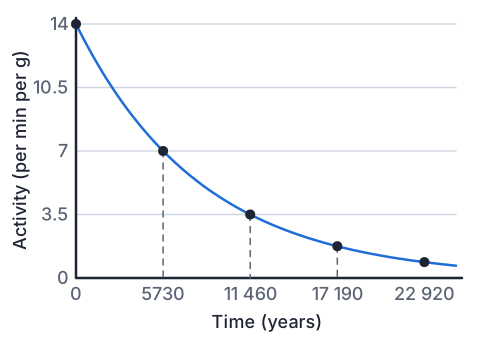
- The half-life is the time for half of the radioactive nuclei in a sample to decay, which also halves the activity (decays per second).
- You cannot predict when one nucleus will decay, but with billions of nuclei the fraction left after each half-life is reliably one half.
- After n half-lives the fraction left is (½)ⁿ: a quarter after 2, an eighth after 3, a sixteenth after 4, so it never quite reaches zero.
- Carbon-14 has a half-life of 5730 years. Living things keep topping up their carbon-14; once they die, it decays and is not replaced, so a lower activity means an older sample.
- For medical tracers a short half-life is chosen, long enough to take the scan but short enough that little radiation is left in the body afterwards.
| Time since death (years) | Half-lives | Activity (decays per minute per g) |
|---|---|---|
| 0 | 0 | 14 |
| 5730 | 1 | 7 |
| 11 460 | 2 | 3.5 |
| 17 190 | 3 | 1.75 |
Example: how old is the wood?
- A piece of wood from an old site has a carbon-14 activity of 1.75 decays per minute per gram of carbon. Living wood has 14.
- Find the age of the wood, and what fraction of its carbon-14 is left.
- 14 → 7 → 3.5 → 1.75halve until you reach the measured activity
- 3 halvings, so 3 half-lives
- age = 3 × 5730 = 17 190 years
- fraction left = (½)³ = 1/81.75 ÷ 14 = 0.125
Fission and nuclear power
- In fission a large nucleus absorbs a slow neutron, becomes unstable and splits into two smaller nuclei, releasing two or three neutrons and a lot of energy.
- One possible split: ¹₀n + ²³⁵₉₂U → ¹⁴¹₅₆Ba + ⁹²₃₆Kr + 3 ¹₀n. Check: 1 + 235 = 141 + 92 + 3 = 236, and 0 + 92 = 56 + 36 + 0 = 92.
- The neutrons released can split more uranium nuclei, a chain reaction; in a reactor, control rods absorb spare neutrons so that on average exactly one goes on to cause another fission, keeping the power steady.
- A moderator, such as water or graphite, slows the neutrons down so that uranium-235 captures them more easily.
- The fission products fly apart at high speed and heat the fuel; the heat boils water into steam, which spins a turbine that drives a generator.
- The products are themselves radioactive, which is why spent fuel must be stored safely for a very long time.
Fusion
- In fusion two light nuclei join to make a heavier one, for example deuterium and tritium (isotopes of hydrogen): ²₁H + ³₁H → ⁴₂He + ¹₀n.
- Both nuclei are positive and repel, so they must collide extremely fast, which needs temperatures of millions of degrees; this is what happens in the core of the Sun, where hydrogen fuses into helium.
- Fusion gives out more energy per kilogram of fuel than fission, and its product here, helium, is not radioactive, but no power station yet makes more electricity from it than it uses.
- ITER, an international experiment being built in France, is designed to get ten times as much fusion power out as the heating power put in.
| ITER design goal | Value |
|---|---|
| Heating power put into the plasma | 50 MW |
| Fusion power produced | 500 MW |
| Length of each run | 400 to 600 s |
Example: E = mc² for one fusion reaction
- Use the atomic masses in the table, a neutron mass of 1.008665 u, 1 u = 1.66054 × 10⁻²⁷ kg and c = 3.00 × 10⁸ m s⁻¹.
- Find the energy released by one ²₁H + ³₁H → ⁴₂He + ¹₀n reaction, and how many reactions per second ITER needs for 500 MW.
| Atom | Mass (u) |
|---|---|
| deuterium, ²₁H | 2.014102 |
| tritium, ³₁H | 3.016049 |
| helium-4, ⁴₂He | 4.002603 |
- mass before = 2.014102 + 3.016049 = 5.030151 u
- mass after = 4.002603 + 1.008665 = 5.011268 u
- mass lost Δm = 5.030151 − 5.011268 = 0.018883 uthe products have less mass than the reactants
- Δm = 0.018883 × 1.66054 × 10⁻²⁷ = 3.1356 × 10⁻²⁹ kgchange to kilograms before using E = mc²
- E = Δm c² = 3.1356 × 10⁻²⁹ × (3.00 × 10⁸)² = 2.82 × 10⁻¹² J
- reactions per second = P ÷ E = 500 × 10⁶ ÷ 2.82 × 10⁻¹² = 1.77 × 10²⁰P = E/t, so each second needs 500 × 10⁶ J
- mass lost per second = P ÷ c² = 5.00 × 10⁸ ÷ 9.00 × 10¹⁶ = 5.6 × 10⁻⁹ kga tiny mass for a huge power
What Achieved, Merit and Excellence look like
- Achieved describes what happened; Merit gives the reason for each observation; Excellence ties the observations together into the model and says what each one rules out.
- The same pattern works for every question in the task: describe, explain why, then connect.
| Grade | A model answer |
|---|---|
| Achieved | Alpha particles were fired at gold foil. Most went through and a few bounced back, so the atom has a small nucleus. |
| Merit | Most alpha particles went straight through, so the atom is mostly empty space. A few were deflected because they passed close to a concentrated positive charge that repelled them, and a very few bounced back because they hit something small, dense and massive. |
| Excellence | Thomson's model spread the positive charge thinly through the whole atom, so its electric force could only nudge a fast, heavy alpha particle. Back-scattering needs a huge repulsive force from charge packed into a tiny volume, and the rarity of large deflections shows that tiny volume is a minute part of the atom. Rutherford concluded that nearly all the mass and all the positive charge sit in a small nucleus, with the electrons far outside it. |
Common mistakes
- In beta decay, one of the atom's orbiting electrons is thrown out.The beta electron comes from the nucleus, where a neutron turns into a proton and an electron, so Z goes up by 1.
- After two half-lives, all of the sample has decayed.Each half-life halves what is left, so after two half-lives a quarter is still there.
- Gamma rays are the most ionising because they go through everything.Gamma is the least ionising; it penetrates furthest precisely because it rarely interacts with atoms.
- In fission the mass number is lost and turned into energy.Mass number and atomic number are both conserved; the energy comes from the products having slightly less mass, by E = mc².
Model half-life with coins
You need: 50 coins (or buttons marked with a pen on one side), a shoebox or a large container with a lid, paper and a pen, graph paper or a spreadsheet
- Put all 50 coins in the box, put the lid on, shake it well, and tip the coins out on a table.
- Take out every coin showing heads: these nuclei have decayed. Count the coins left and write the number down.
- Put the remaining coins back, shake, and repeat, recording the number left each time, until no coins remain.
- Plot the number of coins left against the number of shakes and join the points with a smooth curve.
- Look for: about half the coins go each shake, so one shake is one half-life; you cannot say which coin will go next, and with few coins left the halving gets bumpy, just as with a small radioactive sample.
Safety: Coins and buttons are a choking hazard, so keep them away from small children and pets and count them all back in at the end.
Your turn
How many protons and how many neutrons are in ²³⁹₉₄Pu?
Complete the alpha decay: ²⁴¹₉₅Am → ? + ⁴₂He.
Iodine-131 (Z = 53) is a beta emitter. Write the product.
What fraction of a radioactive sample is left after 4 half-lives?
Which radiation is stopped by a sheet of paper, and why does it travel so short a distance?
Show answer
1. 94 protons and 239 − 94 = 145 neutrons. 2. A = 241 − 4 = 237, Z = 95 − 2 = 93: ²³⁷₉₃Np (neptunium-237). 3. A stays 131, Z = 53 + 1 = 54: ¹³¹₅₄Xe (xenon-131), with ⁰₋₁e. 4. (½)⁴ = 1/16. 5. Alpha: its +2 charge and large mass make it ionise strongly, and every ionisation uses up some of its energy, so it is stopped after a very short distance.
Task: answering like an Excellence report
- Write a short answer to each question, then compare it with the model answers.
A uranium-235 nucleus absorbs a neutron and splits into barium-141 (Z = 56), krypton-92 and some neutrons. How many neutrons are released?
Explain where the energy released in this fission comes from, and how a reactor keeps the rate of fission steady.
Show answer
1. Before: A = 235 + 1 = 236 and Z = 92. After: Z of krypton = 92 − 56 = 36, and A left over = 236 − 141 − 92 = 3, so 3 neutrons are released: ¹₀n + ²³⁵₉₂U → ¹⁴¹₅₆Ba + ⁹²₃₆Kr + 3 ¹₀n. 2. The total mass of the barium, krypton and three neutrons is slightly less than the mass of the uranium and the neutron it absorbed. That missing mass Δm is released as energy E = Δmc², mostly as kinetic energy of the fragments, which heats the fuel; because c² is so large, a tiny Δm gives a huge energy. Each fission releases 3 neutrons, so the rate could grow very fast; control rods absorb the spare neutrons so that on average one from each fission causes the next, and a moderator slows neutrons so they can be captured. Connecting the mass loss to the energy, and the neutron count to the control of the chain reaction, is what makes this Excellence.
Build a Nucleus
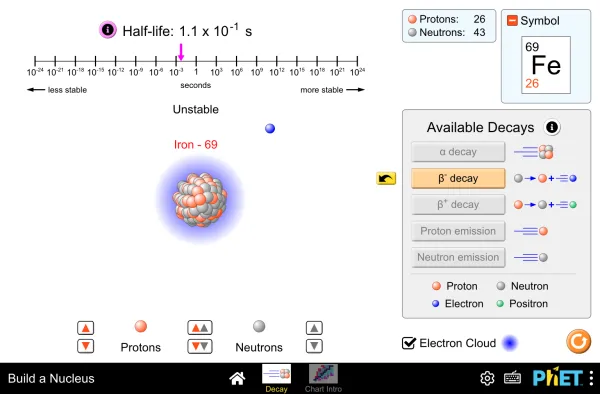
Full screen · PhET Interactive Simulations, University of Colorado Boulder, CC BY 4.0
Recap
- Gold foil: most alphas pass straight through (empty space), a few deflect and a very few bounce back (a tiny, dense, positive nucleus).
- ᴬ_Z X: A = protons + neutrons, Z = protons; isotopes share Z but not A.
- Alpha ionises most and penetrates least; gamma ionises least and penetrates most.
- In every nuclear equation A and Z balance; alpha lowers A by 4 and Z by 2, beta raises Z by 1.
- Half-life halves what is left each time; fission and fusion release energy E = mc² from a small loss of mass, and P = E/t.
| Process | What happens to A and Z |
|---|---|
| Alpha decay | A − 4, Z − 2 |
| Beta decay | A same, Z + 1 |
| Gamma emission | no change |
| Fission | a heavy nucleus splits; totals conserved |
| Fusion | light nuclei join; totals conserved |
The maths behind it
How is NCEA Level 2 maths going?
See the NCEA Level 2 maths guide