Surviving extreme environments: hot springs, ice and alpine cold
What this lesson covers
- What the report needs: why the environment is extreme, the adaptations that answer it, and sources recorded so they can be traced.
- The conditions that make an environment extreme and why each one threatens cells.
- Champagne Pool at Waiotapu and the heat-loving bacterium Venenivibrio stagnispumantis.
- Antarctic toothfish and the antifreeze proteins that stop ice growing in their blood.
- Alpine wētā and insects that survive by freezing, and humans who survive with technology.
- Linking each condition to the problem it causes and the adaptation that solves it, for Merit and Excellence.
What the report must include
- AS 91190 is an internal research report: you choose an extreme environment and one or more organisms that live there, which can include humans.
- You must say why the environment counts as extreme: which conditions would kill or harm most living things, with numbers.
- Then you describe the key adaptations, biological for living things or technological for humans, and how each one lets the organism survive.
- Merit explains the links: how each condition causes a problem for cells and how the adaptation solves it.
- Excellence joins these into connected chains and justifies them with evidence, often by showing how several adaptations work together or why one strategy suits that environment better than another.
- Record every source so a marker can find it: author or organisation, title, date, web address and the date you accessed it.
What makes an environment extreme
- An environment is extreme when a condition is far outside the range most organisms can survive: very hot or cold, very acid or alkaline, very salty, high pressure, little oxygen, strong radiation or toxic chemicals.
- Heat breaks the weak bonds that hold proteins in shape, so enzymes denature and stop working, membranes become leaky and DNA strands separate.
- Cold slows enzymes, and if ice forms in the body its sharp crystals tear cells and pull water out of them.
- Acid or alkali changes the charges on proteins, which also changes their shape.
- Low oxygen limits aerobic respiration, so less energy is released from food.
- Hot water holds less dissolved oxygen than cold water, so heat and low oxygen often come together.
Champagne Pool: hot, acidic and full of toxic elements
- Champagne Pool is a large hot spring at Waiotapu, south of Rotorua, named for the bubbles of carbon dioxide that rise through it.
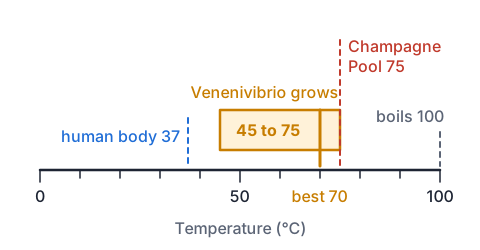
- GNS Science reports the water stays at about 75 °C, too hot for any plant or animal, and has a pH of 5.5 because the carbon dioxide forms bicarbonate.
- The water also carries arsenic, antimony, mercury and thallium, all poisonous to most life.
- Even so, microbes live in and around it. Under the water most are bacteria and archaea that do not need oxygen and use sulfur compounds instead.
| Champagne Pool condition | Value |
|---|---|
| Water temperature | About 75 °C |
| pH | 5.5 |
| Toxic elements dissolved | Arsenic, antimony, mercury, thallium |
Venenivibrio: a bacterium built for heat
- Venenivibrio stagnispumantis was discovered in a Waiotapu hot spring and described in 2008; its species name means 'of the foaming pool'.
- It grows between 45 and 75 °C, best at 70 °C: the human body, at 37 °C, would be too cold for it.
- Heat-stable enzymes: like other heat-loving microbes, its proteins are held together by extra bonds, so they keep their shape and active sites at temperatures that would denature ours.
- Energy without food or light: it releases energy by reacting hydrogen gas with a little oxygen, and needs sulfur compounds from the spring, so it needs no sunlight and no other organisms to eat.
- Low oxygen suits it: it grows best at 4 to 8% oxygen, far below the 21% in air, which matches hot water that holds little dissolved oxygen.
| Venenivibrio stagnispumantis | Range | Best |
|---|---|---|
| Temperature | 45 to 75 °C | 70 °C |
| pH | 4.8 to 5.8 | 5.4 |
| Oxygen in the gas around it | 1 to 10% | 4 to 8% |
Antarctic toothfish: blood that should freeze, but does not
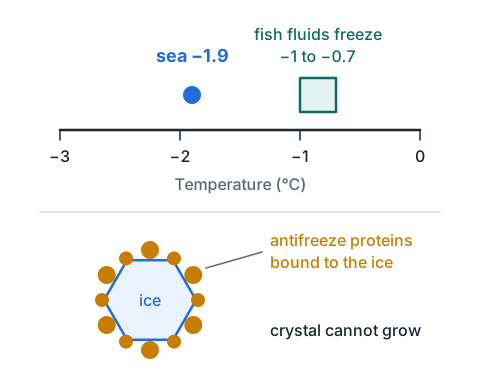
- Coastal Antarctic seawater, such as the Ross Sea where New Zealand works, sits at about −1.9 °C. Salt lets seawater stay liquid below 0 °C.
- A fish's body fluids are less salty, so they freeze at about −0.7 to −1 °C. In −1.9 °C water an unprotected fish would freeze.
- Ice crystals also get in: fish swallow seawater and food that carry tiny crystals, and those would grow and destroy cells.
- The Antarctic toothfish and its relatives, the notothenioids, make antifreeze glycoproteins. These stick to the surface of tiny ice crystals and stop water molecules joining, so the crystals cannot grow.
- The antifreeze is in the blood and in the gut fluid, exactly where ice would enter. These fish make up 90 to 95% of the fish mass in coastal Antarctic water, so the adaptation clearly works.
| Condition or feature | Value |
|---|---|
| Coastal Antarctic seawater | About −1.9 °C |
| Freezing point of fish body fluids without antifreeze | −0.7 to −1 °C |
| Share of coastal Antarctic fish species that are notothenioids | More than 50% |
| Share of coastal Antarctic fish mass that is notothenioids | 90 to 95% |
Example: the toothfish at each grade
- Achieved describes why the environment is extreme and what the adaptation does.
- Merit explains the link: why the condition is a problem for cells, and how the adaptation fixes that problem.
- Excellence joins the links into one justified chain, with evidence that the adaptation is the reason the fish survives.
| Grade | What the student wrote |
|---|---|
| Achieved | The Ross Sea is extreme because the water is about −1.9 °C, below freezing. The toothfish survives because it has antifreeze in its blood that stops it freezing. |
| Merit | Seawater stays liquid at −1.9 °C because of its salt, but the toothfish's body fluids would freeze at about −1 °C. Ice crystals would grow inside the fish and tear its cells. Its antifreeze glycoproteins bind to tiny ice crystals and stop them growing, so its blood stays liquid below its normal freezing point. |
| Excellence | The danger is the 0.9 °C gap between the sea at −1.9 °C and the −1 °C at which fish fluids freeze, plus ice crystals that enter in swallowed seawater and food. Antifreeze glycoproteins solve both, because they bind to any crystal and block its growth, and they are found in the blood and the gut fluid, exactly where ice enters. That notothenioids with this protein make up 90 to 95% of fish mass in these waters supports the claim that the antifreeze is what lets them live there. |
Alpine wētā: survive by freezing
- Alpine wētā, such as the mountain stone wētā of Central Otago's ranges, face winter nights well below freezing with no warm place to hide.
- Instead of stopping ice forming, like the toothfish, they are freeze tolerant: they let their bodies freeze, then thaw hours, days or even weeks later and walk away.
- Massey University researchers report that freezing starts in the gut, at temperatures just below 0 °C. Starting early and slowly keeps the ice under control, rather than letting it form suddenly at a much lower temperature.
- The same strategy turns up in unrelated New Zealand alpine grasshoppers, moths and cockroaches, which suggests it suits these mountains well.
- Comparing the strategies is a good Excellence move: the toothfish lives in water that never drops below −1.9 °C, so avoiding ice is enough, while an alpine wētā can meet much colder air, where freezing in a controlled way is safer than trying to stay liquid.
Humans: surviving with technology
- Humans have no biological adaptations for Antarctica, so people at Scott Base survive with technological modifications, which the standard accepts.
- Layered clothing traps still air, a poor conductor, so less heat flows from the body to the cold air.
- Insulated, heated buildings keep the inside near room temperature, and stored food and fuel supply the energy the body uses to stay warm.
- Write about technology the same way as biology: name the condition, the problem it causes for the body, and how the technology solves it.
Common mistakes
- The environment is extreme because it is really hot.Give the numbers and the reason: Champagne Pool is about 75 °C, hot enough to denature the enzymes of almost every plant and animal.
- The toothfish's antifreeze works by adding salt to its blood.Its antifreeze glycoproteins bind to tiny ice crystals and stop them growing; they do not work by making the blood saltier.
- The bacterium adapted to the heat because it wanted to survive.Organisms do not choose adaptations; those with heat-stable proteins survived and reproduced, so the feature became common.
- I listed five adaptations with a sentence on each.Merit and Excellence need links: for each key adaptation, say which condition it answers and how it solves the problem that condition causes.
Does salt water freeze at a lower temperature?
You need: two small plastic cups, tap water, table salt, a tablespoon, a freezer, a phone timer, a pen and labels
- Label the cups 'fresh' and 'salty'. Put 100 mL of tap water in each, and stir 1 tablespoon of salt into the salty cup until it dissolves.
- Stand both cups side by side in the freezer and start the timer.
- Check them every 30 minutes for 3 hours, noting whether each is liquid, slushy or frozen solid.
- Write your observations in a table and compare when each cup started to freeze.
- Look for: the fresh water freezes first and the salty water stays slushy for longer, because dissolved salt lowers the freezing point. That is why the Antarctic sea stays liquid at −1.9 °C, while the toothfish's antifreeze works a different way, by blocking ice crystals from growing.
Safety: Use plastic cups, not glass, because glass full of water can crack as it freezes, and wipe up salt water spills so nobody slips.
Your turn
Venenivibrio grows from 45 to 75 °C. Could it grow in water at 37 °C?
Antarctic seawater is −1.9 °C, and fish body fluids freeze at about −1 °C. By how many degrees is the sea colder than that freezing point?
Why would a human enzyme stop working in 75 °C water?
Which organism avoids freezing and which tolerates it: the toothfish or the alpine wētā?
Why does growing best at 4 to 8% oxygen help Venenivibrio in a hot spring?
Write one condition, problem, adaptation chain for the toothfish, as an Excellence answer would.
Show answer
1. No: 37 °C is below its lowest growth temperature of 45 °C. 2. −1 − (−1.9) = 0.9 °C colder. 3. Heat breaks the weak bonds holding the enzyme's shape, so its active site changes shape (it denatures) and the substrate no longer fits. 4. The toothfish avoids freezing with antifreeze glycoproteins; the alpine wētā tolerates freezing. 5. Hot water holds little dissolved oxygen, so needing only a little oxygen matches what the spring supplies. 6. For example: sea at −1.9 °C is colder than the −1 °C at which fish fluids freeze, so ice crystals entering in seawater and food would grow and tear cells; antifreeze glycoproteins in the blood and gut bind the crystals and stop them growing, so the fish stays unfrozen.
Recap
- Say why the environment is extreme, with numbers, and why each condition harms cells.
- Describe the key adaptations, biological or technological, and how each one lets the organism survive.
- Merit explains the link between each condition and its adaptation; Excellence joins them into justified chains with evidence.
- Record every source in a form a marker can trace.
| Organism | Condition | Adaptation |
|---|---|---|
| Venenivibrio stagnispumantis | About 75 °C, little oxygen | Heat-stable proteins, energy from hydrogen, grows best at low oxygen |
| Antarctic toothfish | Sea at −1.9 °C, ice crystals | Antifreeze glycoproteins in blood and gut |
| Alpine wētā | Freezing winter nights | Controlled freezing that starts in the gut |
| Humans at Scott Base | Extreme cold | Layered clothing, heated insulated buildings |
How is NCEA Level 2 maths going?
See the NCEA Level 2 maths guide