Earthquakes and volcanoes in Aotearoa
What this lesson covers
- New Zealand straddles the Australian and Pacific plates: subduction under the North Island, the Alpine Fault through the South Island, and subduction again south of Fiordland.
- Subduction makes magma: water from the sinking plate lowers the melting point of the mantle, and rising basaltic magma melts crust to become andesite or rhyolite.
- Earthquakes release elastic energy stored in rock when a fault ruptures; the energy travels out from the focus as seismic waves.
- Magnitude measures the energy released at the source on a logarithmic scale; intensity (MM scale) describes the shaking and damage at one place.
- Silica content controls viscosity and gas, which decide whether a volcano is a gentle basalt cone, a steep andesite stratovolcano or an explosive rhyolite caldera.
- Kaikōura 2016 and Whakaari 2019 show the causes and the linked processes that Merit and Excellence answers explain.
Aotearoa on a plate boundary
- New Zealand sits across the boundary between the Australian Plate and the Pacific Plate, and GeoNet measures the Pacific Plate moving west-south-west under us at about 50 mm a year.
- East of the North Island, the dense oceanic Pacific Plate dives (subducts) west under the lighter continental Australian Plate at the Hikurangi subduction zone.
- Through the South Island the plates slide past each other and push together along the Alpine Fault, which is why the Southern Alps keep rising.
- South-west of Fiordland the direction flips: at the Puysegur subduction zone the Australian Plate goes under the Pacific Plate.
- In Māori tradition, earthquakes and volcanoes come from Rūaumoko, son of Ranginui and Papatūānuku, carried beneath the earth when his mother was turned over and given fire to keep warm; the land rumbles as he walks about.
| New Zealand earthquakes | GeoNet figure |
|---|---|
| Pacific Plate motion under New Zealand | about 50 mm a year, west-south-west |
| Earthquakes GeoNet locates each year | around 20 000 |
| Earthquakes big enough to be felt each year | around 250 |
| Largest known New Zealand earthquake | magnitude 8.2, Wairarapa, 1855 |
How subduction makes andesitic magma
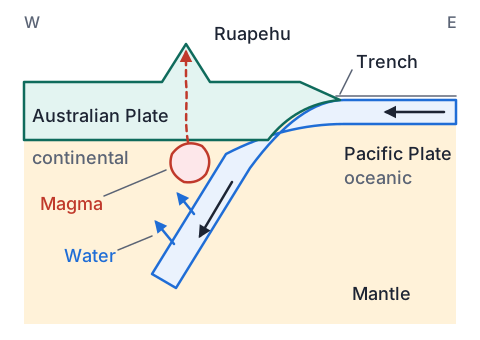
- The Pacific Plate is old, cold oceanic crust, denser than the mantle beside it, so gravity pulls it down at the trench and it slides under the Australian Plate.
- As it sinks to about 100 km, heat and pressure squeeze water out of minerals in the plate, and that water lowers the melting point of the hot mantle rock above it.
- Part of the mantle melts (partial melting), making basaltic magma, which is less dense than the solid rock around it, so it rises.
- The rising magma pools at the base of the thick continental crust and melts some of it; crust is rich in silica, so the magma becomes andesitic (more silica) or even rhyolitic (most silica).
- That is why a line of andesite volcanoes (Ruapehu, Ngauruhoe, Tongariro) and rhyolite calderas (Taupō, Okataina) runs through the central North Island, parallel to the subduction zone.
- Excellence answers keep the chain unbroken: density and gravity cause subduction, water causes partial melting, low density makes magma rise, melting crust adds silica.
Faults, focus and epicentre
- A fault is a fracture in the crust where the rock on one side has moved relative to the other.
- Plate motion keeps pushing, but friction locks the fault, so the rock bends and stores elastic potential energy, like a stretched rubber band.
- When the stress beats the friction, the fault ruptures and slips in seconds; the stored energy becomes kinetic energy carried away as seismic waves, plus heat and sound.
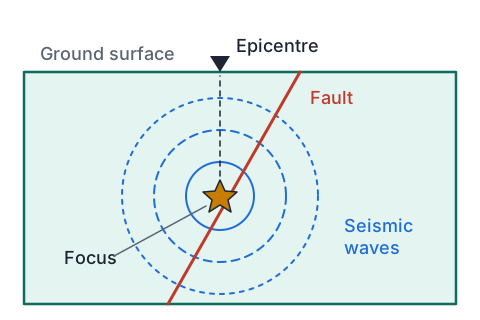
- The focus (hypocentre) is the point underground where the rupture starts; the epicentre is the spot at ground level directly above the focus.
- Seismic waves spread out in all directions and lose energy as they travel, so places further from the focus, including above a deep focus, shake less.
- Normal faults move apart (stretching), reverse faults push one block up over the other (squeezing), strike-slip faults slide sideways; oblique faults combine sideways and vertical movement.
Magnitude and intensity are different
- Magnitude measures the energy released at the source, so one earthquake has one magnitude.
- The scale is logarithmic: each whole step up releases about 32 times more energy, so two steps is about 1000 times.
- Intensity, on New Zealand's Modified Mercalli (MM) scale from 1 to 12, describes what the shaking did at one place: whether people felt it, what fell over, what broke.
- One earthquake has many intensities: highest near a shallow epicentre, lower with distance and depth, and higher again on soft, wet ground that amplifies shaking.
- GeoNet no longer uses the Richter scale; it reports a magnitude worked out from the energy of the waves.
| Compared with a magnitude 4 | Energy released |
|---|---|
| magnitude 5 | more than 30 times as much |
| magnitude 6 | more than 900 times as much |
Example: the 2016 Kaikōura earthquake
- Just after midnight on 14 November 2016, a magnitude 7.8 earthquake started near Waiau in North Canterbury, only 15 km down.
- It sits in the Marlborough fault system, where Pacific and Australian plate motion is shared between many faults that slide sideways and squeeze together.
- The rupture ran north-east for about 180 km, jumping from fault to fault: more than 20 faults moved, a world record.
- Where the faults reached the surface, the ground moved up to 12 m sideways and up, and the coast was lifted by up to 6.5 m, stranding kelp above the tide.
- The shallow focus and long rupture gave very strong shaking (MM 10 near the epicentre), which set off more than 10 000 landslides on the steep slopes.
- Merit links each effect to a cause; Excellence links them to each other: shallow rupture, strong shaking, steep slopes, landslides.
| Kaikōura earthquake | GeoNet figure |
|---|---|
| Magnitude | 7.8 |
| Depth of focus | 15 km |
| Faults that ruptured | more than 20 |
| Length of rupture | about 180 km, lasting nearly 2 minutes |
| Largest ground movement at a fault | up to 12 m |
| Coastal uplift | up to 6.5 m |
| Landslides | more than 10 000 |
Example: Kaikōura compared with East Cape
- In March 2021 a magnitude 7.2 earthquake struck offshore, east of Te Araroa, 33 km deep; GeoNet had over 52 000 felt reports, yet it caused little damage.
- How many times more energy did Kaikōura's magnitude 7.8 release, and why was Kaikōura so much more damaging?
| Earthquake | Magnitude | Depth | Epicentre |
|---|---|---|---|
| Kaikōura, 2016 | 7.8 | 15 km | on land, North Canterbury |
| East Cape, 2021 | 7.2 | 33 km | offshore, east of Te Araroa |
- difference in magnitude = 7.8 − 7.2 = 0.6compare the two
- energy ratio ≈ 32^0.6 ≈ 7.9about 32 times more energy for each whole step
- Kaikōura released about 8 times as much energy
- focus 15 km deep against 33 km: waves lost less energy before reaching the surfacedepth
- epicentre on land beside towns and steep hills against far offshoredistance
- more energy, shallower and closer: much stronger shaking where people live
Silica decides the volcano
- Silica molecules link into chains, so the more silica a magma has, the more viscous (sticky) it is.
- Sticky magma traps gas; when the pressure drops near the surface the gas expands violently, so high-silica eruptions are explosive.
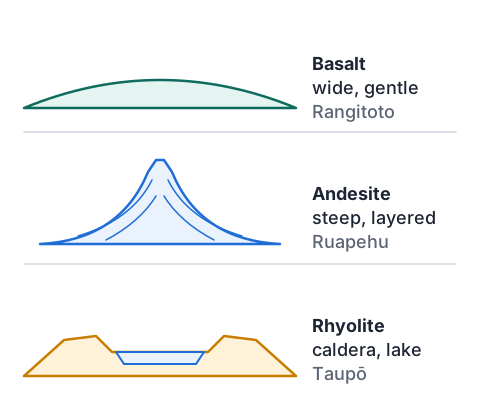
- Basalt (low silica, runny, little gas) flows far before it cools, building low, wide cones and lava fields, like Rangitoto and the Auckland volcanic field above a hot spot under the city.
- Andesite (medium silica) gives stratovolcanoes: ash and scoria from explosive eruptions alternate with short, thick lava flows that cool close to the vent, so the cone is steep and layered (Ruapehu, Ngauruhoe, Taranaki).
- Rhyolite (high silica, most gas) erupts so violently that huge volumes of pumice and ash leave the magma chamber, the roof collapses, and a caldera forms instead of a mountain (Taupō, Rotorua, Okataina).
| Magma | Silica | Viscosity and gas | Eruption style | NZ example |
|---|---|---|---|---|
| Basalt | low | runny, little gas | lava flows, fire fountains | Rangitoto |
| Andesite | medium | sticky, more gas | ash eruptions and short lava flows | Ruapehu |
| Rhyolite | high | very sticky, most gas | huge explosions, pumice, collapse | Taupō |
Taupō, a caldera volcano
- Taupō began erupting over 300 000 years ago and last erupted over 1800 years ago; Lake Taupō now fills much of the caldera.
- Its eruption about 1800 years ago was the most violent anywhere in the world in the last 5000 years.
- That eruption ended with a fast, very hot pyroclastic flow that swept over about 20 000 km² and filled the North Island's main river valleys with pumice.
- There is no big mountain because the material was blasted far from the vents, and the emptied ground above the magma chamber collapsed.
| Taupō volcano | GeoNet figure |
|---|---|
| First eruptions | over 300 000 years ago |
| Last eruption | over 1800 years ago |
| Area devastated by the final pyroclastic flow | about 20 000 km² |
Example: Whakaari/White Island, 2019
- Whakaari is an andesite stratovolcano 48 km off the Bay of Plenty coast; only about 30% of it shows above the sea.
- Above its magma, rainwater and seawater soak into hot rock and form a hydrothermal system of very hot water and gas, sealed in by altered rock.
- At 2:11 pm on 9 December 2019, pressure in that system broke the seal, the superheated water flashed to steam, and the steam blasted out of the crater with rock and ash.
- People visiting the crater floor were killed and many were badly injured, because the blast, rocks and hot ash reached the crater floor almost at once.
- Merit explains the cause (water heated by magma turns to steam and expands); Excellence links magma, water and pressure into one chain, and explains why there was almost no warning.
| Whakaari/White Island | GeoNet figure |
|---|---|
| Distance offshore | 48 km |
| Share of the volcano above sea level | about 30% |
| Fatal eruption | 2:11 pm, Monday 9 December 2019 |
What Achieved, Merit and Excellence look like
- Achieved describes: it names the plates, the magma, the fault or the wave, and says what happened.
- Merit explains: each point has a because, such as why the magma rises or why the shaking was weaker.
- Excellence links: the causes join into one chain, using the question's own place, numbers and diagram.
| Grade | A model answer |
|---|---|
| Achieved | The Pacific Plate subducts under the Australian Plate and melts, making magma that rises. |
| Merit | The denser oceanic Pacific Plate sinks under the continental Australian Plate. Water released from it lowers the melting point of the mantle, so it partly melts into basaltic magma, which rises because it is less dense. |
| Excellence | As above, then: the basaltic magma pools under the thick continental crust and melts some of it. That crust is rich in silica, so the magma becomes andesitic. The chain is density, subduction, water, partial melting, rising, then adding silica from the crust. |
Common mistakes
- The Pacific Plate melts because of friction as it rubs against the Australian Plate.Water released from the sinking plate lowers the melting point of the mantle above it; that is the main cause of melting.
- The epicentre is where the earthquake happens underground.The focus is the underground starting point of the rupture; the epicentre is the spot at ground level directly above it.
- A magnitude 7 is a bit bigger than a magnitude 6.Magnitude is logarithmic: one step up releases about 32 times more energy.
- Andesite volcanoes are steep because the lava is hot and flows fast.Andesite is sticky and cools close to the vent, so short lava flows and ash layers pile up steeply.
Runny magma, sticky magma
You need: a dinner plate, a tablespoon, golden syrup or honey, water, a little liquid dish soap, a ruler
- Hold the plate flat on the bench and pour one tablespoon of water slowly onto one side, from the same height each time.
- Pour one tablespoon of dish soap on another part of the plate, then one tablespoon of golden syrup on a third part.
- After one minute, measure how wide and how high each puddle is with the ruler.
- Pour a second spoonful of syrup on top of the first and measure again; this models a new eruption on top of an old one.
- Look for: the runniest liquid spreads wide and flat like a basalt shield, and the stickiest stays tall and steep near the vent like an andesite cone that builds up in layers.
Safety: Wipe up any spills straight away, because syrup and soap on the floor make it very slippery.
Your turn
Which plate subducts under the North Island, and what type of crust is it?
What lowers the melting point of the mantle above a subducting plate?
A magnitude 6.2 and a magnitude 7.2 earthquake: roughly how many times more energy does the bigger one release?
What is the epicentre of an earthquake?
Which magma has the most silica, and what kind of volcano does it build?
Show answer
1. The Pacific Plate, which is oceanic crust. 2. Water released from the subducting plate. 3. One step of magnitude, so about 32 times. 4. The spot at ground level directly above the focus. 5. Rhyolite, which builds a caldera through huge explosive eruptions.
Exam-style question: Ruapehu
- Ruapehu is an andesitic stratovolcano in the central North Island, inland from the Hikurangi subduction zone. Its eruptions alternate between ash eruptions and short lava flows.
Name the two plates involved and the type of crust each is made of.
Explain how tectonic processes form the magma that feeds Ruapehu.
Explain how andesitic magma produces a steep, layered cone.
A shallow magnitude 6 earthquake and a deep magnitude 6 earthquake happen under the central North Island. Explain which one is more likely to damage buildings near the epicentre.
Show answer
1. Pacific Plate, oceanic crust; Australian Plate, continental crust (Achieved). 2. Achieved: the Pacific Plate subducts and melts to make magma that rises. Merit: the denser oceanic plate sinks under the continental plate; water squeezed out of it lowers the melting point of the mantle, which partly melts into basaltic magma that rises because it is less dense. Excellence: the basaltic magma pools under the continental crust and melts some of it, adding silica, which turns it into andesitic magma; each step is linked to the next. 3. Achieved: andesite has medium silica, is sticky and has some gas; it erupts ash and lava. Merit: sticky lava cools before it can flow far, so it builds up near the vent; explosive ash eruptions add layers. Excellence: alternating layers of ash and short, thick lava flows pile up near the vent eruption after eruption, so the steep sides and the layers both come from the medium silica and the trapped gas. 4. The shallow one (Achieved). Merit: its seismic waves travel a shorter distance to the surface, so they lose less energy and the shaking at the epicentre is stronger. Excellence: both release the same energy, but waves from the deep focus spread out and lose energy on the way up, so they are felt over a wider area but more weakly; the shallow focus concentrates strong shaking (higher MM intensity) near the epicentre, which causes more damage.
Recap
- New Zealand is on the Australian and Pacific plate boundary; plate motion is about 50 mm a year.
- Subduction plus water gives partial melting; rising magma picks up silica from the crust to become andesite or rhyolite.
- Faults store elastic energy and release it as seismic waves from the focus; the epicentre is above it.
- Magnitude is the energy at the source (about 32 times per step); MM intensity is the shaking at a place.
- More silica means stickier magma, more trapped gas and more explosive eruptions: shield, stratovolcano, caldera.
| Event | Main cause |
|---|---|
| Andesite volcano | subduction, water, partial melting, crust adds silica |
| Earthquake | stress on a locked fault released as seismic waves |
| Caldera | huge rhyolite eruption empties the chamber, the roof collapses |
| Hydrothermal eruption | water heated by magma flashes to steam |
The maths behind it
How is NCEA Level 2 maths going?
See the NCEA Level 2 maths guide