Tsunami, landslides and linked hazards
What this lesson covers
- A tsunami is a set of waves caused by a sudden shift of the whole water column, usually from sea-floor uplift in an earthquake, but also from landslides and eruptions.
- In an uplift, gravitational potential energy given to the water becomes kinetic energy of waves spreading out in all directions.
- Tsunami speed depends on water depth: fast with a long wavelength and low height in the deep ocean, slower, shorter and taller in shallow water.
- Landslides happen when the force pulling material down a slope beats the friction and strength holding it; rain, weak rock, steep slopes and shaking tip the balance.
- One event can trigger others: an earthquake can cause uplift, a tsunami and thousands of landslides, and an eruption can cause a tsunami.
What a tsunami is
- A tsunami is a series of waves made when something suddenly moves a huge volume of sea water, from the sea floor right up to the surface.
- Wind waves only move the top few metres of water; a tsunami moves the whole depth of the ocean, so it carries vastly more energy.
- Most tsunami come from earthquakes under the sea floor; others come from landslides, undersea eruptions and, very rarely, meteorite impacts.
- Sometimes a trough reaches the coast first, so the sea pulls back from the beach before the wave arrives: that is a natural warning to get to high ground.
- For a local tsunami there may be only minutes, so the rule in New Zealand is: long or strong shaking, get gone, without waiting for an official warning.
| Tsunami fact | GeoNet figure |
|---|---|
| Speed in the open ocean | 600 to 700 km/h |
| Height of a large tsunami in the deep ocean | may be as little as 60 cm |
| Speed in shallow water near the coast | about 30 km/h |
| Tsunami higher than 5 m in New Zealand since 1840 | about 10 |
How an earthquake makes a tsunami
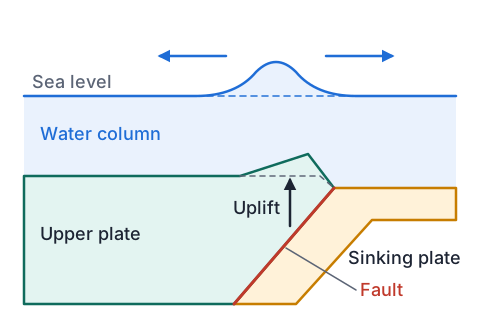
- At a subduction zone the two plates are locked, so the edge of the upper plate is dragged down and bent, storing elastic energy.
- In a megathrust earthquake the fault slips and the upper plate springs back up, lifting a large area of sea floor in seconds.
- The whole water column above is lifted too, giving the water gravitational potential energy (a hump of sea above sea level).
- Gravity pulls the hump back down, and its potential energy becomes kinetic energy of waves travelling outward in all directions.
- Faults that mostly slide sideways (strike-slip) barely move the sea floor up or down, so they rarely cause big tsunami; reverse and megathrust faults do.
- The bigger and faster the vertical movement and the larger the area lifted, the more water is displaced and the bigger the tsunami.
Why a tsunami grows near the coast
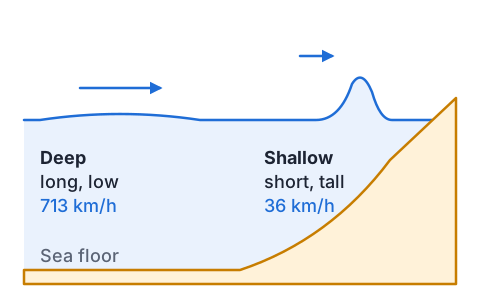
- In deep water a tsunami has a wavelength far longer than the ocean is deep and a small height, and it loses very little energy, so it can cross a whole ocean.
- Its speed depends on depth: v = √(gd), where g = 9.8 m/s² and d is the water depth in metres.
- As the sea shallows near the coast, friction with the sea floor slows the front of the wave, and the back catches up.
- The waves bunch up: the wavelength gets shorter, and because the same energy is squeezed into a shorter, slower wave, its height (amplitude) grows.
- Bays and harbours can focus the energy further, which is why run-up heights differ a lot along one coast.
Example: how fast does a tsunami travel?
- Use v = √(gd) to find the speed of a tsunami where the ocean is 4000 m deep, and where it is 10 m deep near the shore.
- Then work out how long it takes to cross 1000 km of 4000 m deep ocean.
- deep: v = √(9.8 × 4000) = √39 200 = 198 m/sd in metres
- 198 m/s × 3.6 = 713 km/h× 3.6 changes m/s to km/h
- shallow: v = √(9.8 × 10) = √98 = 9.9 m/s = 36 km/h
- t = distance ÷ speed = 1 000 000 m ÷ 198 m/s = 5050 s1000 km = 1 000 000 m
- 5050 s ÷ 60 = 84 minutes, about 1.4 hours
- 713 km/h and 36 km/h agree with GeoNet's 600 to 700 km/h and about 30 km/h
Example: three earthquakes, three tsunami, 2021
- In the early hours of 5 March 2021 an East Cape earthquake of magnitude 7.2 struck offshore, then a few hours later a magnitude 7.3 and a magnitude 8.1 struck near Rangitāhua/the Kermadec Islands.
- All three caused tsunami, and their waves combined in complicated ways along New Zealand's coast.
- The magnitude 8.1 was a megathrust earthquake on the Kermadec subduction zone: a large area of sea floor moved, so warnings went out across the Pacific, because in deep water the waves lose little energy over thousands of kilometres.
- Tsunami gauges recorded waves of about 30 to 35 cm at Lottin Point on East Cape and 10 to 20 cm at Great Barrier Island; small, but strong currents in harbours are dangerous even then.
| 5 March 2021 | GeoNet figure |
|---|---|
| East Cape earthquake | magnitude 7.2, felt reports over 52 000 |
| Kermadec earthquakes | magnitude 7.3, then magnitude 8.1 |
| Largest tsunami at Lottin Point, East Cape | about 30 to 35 cm |
| Tsunami at Great Barrier Island | about 10 to 20 cm |
Landslides and slope failure
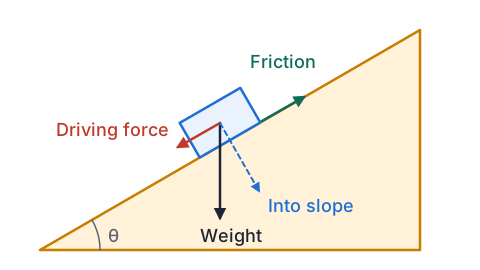
- On a slope, gravity pulls material down; part of its weight acts down the slope (the driving force), and part presses it into the slope, which creates friction (a resisting force).
- The slope fails when the driving force beats the friction and the strength of the rock or soil, so steeper slopes and weaker rock fail more easily.
- Heavy rain soaks in, adding weight and pushing the grains apart with water pressure, which cuts friction: that is why storms such as Cyclone Gabrielle in 2023 set off widespread slips.
- Earthquake shaking adds a sudden sideways push and can loosen rock, so strong shaking on steep land triggers many landslides at once.
- Removing forest takes away roots that bind the soil, so cleared hill country slips more in heavy rain.
| New Zealand landslides | GeoNet |
|---|---|
| Most common triggers | intense rainstorms and large earthquakes |
| Other factors | weak rock, steep slopes, deforestation |
| Largest known (Green Lake, Fiordland) | 26 km³, about 13 000 years ago |
Example: one earthquake, many hazards
- The 2016 Kaikōura earthquake ruptured faults on land and under the sea, and the sea-floor movement made the largest local tsunami recorded in New Zealand since 1947.
- The first wave arrived within 10 minutes and ran 6.9 m up the shore at Goose Bay, but damage was minor: the tide was mid to low, the quake had lifted much of the coast, and the beaches are steep.
- Strong shaking on steep slopes set off over 10 000 landslides; more than 200 blocked rivers and formed dams, the largest about 23 million m³ on the Hapuku River.
- A landslide dam can later burst and flood the valley below, so one earthquake creates hazards that last for months.
- Excellence answers follow the chain across Earth's systems: fault rupture (geosphere) lifts the sea (hydrosphere), and shaking plus rain on steep slopes (atmosphere) causes landslides that dam rivers.
| Kaikōura 2016 | GeoNet figure |
|---|---|
| First tsunami wave | within 10 minutes |
| Largest tsunami run-up | 6.9 m at Goose Bay |
| Landslides | more than 10 000 |
| Landslide dams | more than 200 |
| Largest landslide dam (Hapuku River) | about 23 million m³ |
Tsunami from volcanoes and landslides
- A landslide that falls into the sea, or slides down an underwater slope, pushes water aside from above or below, like a stone dropped into a pond.
- An underwater eruption can turn sea water to steam explosively when magma meets it, and the expanding gas lifts the water column above it.
- When a submarine caldera's magma chamber empties, its roof can collapse; the sea floor drops, water rushes in to fill the hole and then surges outward as waves.
- The steep walls of a volcano can also collapse into the sea as a giant landslide.
- This is why GeoNet watches the Kermadec volcanoes such as Raoul Island: one eruption could make a tsunami in several of these ways.
What Achieved, Merit and Excellence look like
- Achieved describes what happens; Merit gives the reason for each change; Excellence links speed, wavelength, height and energy together.
- In tsunami answers, always say what happens to all three: speed, wavelength and amplitude.
| Grade | A model answer |
|---|---|
| Achieved | In shallow water the tsunami slows down and gets much taller. |
| Merit | In shallow water friction with the sea floor slows the wave, so the waves bunch up: the wavelength shortens and the height increases. |
| Excellence | In the deep ocean the tsunami is fast, long and low, and loses little energy. Near the coast the depth falls, friction slows the front, and the back catches up, so the wavelength shortens. The same energy is packed into a shorter, slower wave, so its amplitude grows, and the whole water column surges far inland. |
Common mistakes
- A tsunami is a giant wind wave that is tall out at sea.It is made by moving the whole water column, and in the deep ocean it is usually less than a metre high.
- The tsunami speeds up as it reaches the shore, which is why it is so powerful.It slows down in shallow water; it grows taller because the waves bunch up and the energy is squeezed into a shorter wave.
- Every big earthquake under the sea makes a big tsunami.A tsunami needs vertical movement of the sea floor; strike-slip quakes move sideways and seldom make large tsunami.
- Rain causes landslides by washing the soil away.Rain adds weight and its water pressure pushes grains apart, cutting friction until the driving force wins.
A tsunami in a roasting dish
You need: a large roasting dish or plastic storage box, water, two thick books, a ruler, a small plastic lid or a sheet of card
- Raise one end of the empty dish on the books so it slopes, then pour in water until the deep end is about 4 cm deep and the shallow end is a thin film: that is your beach.
- At the deep end, hold the plastic lid flat on the bottom, then lift it quickly about 2 cm and hold it there, like sea floor uplift.
- Follow one wave as it travels from deep to shallow water; repeat a few times, and hold the ruler upright at two places to compare its height.
- Now push the lid sideways along the bottom instead of lifting it, and compare the waves.
- Look for: the wave slows and gets taller and steeper as it reaches the shallow end, and the sideways push (like a strike-slip fault) makes a much smaller wave.
Safety: Do it on a towel on the floor or outside, and mop up spills at once, because water on a hard floor is a slip hazard.
Your turn
What makes a tsunami different from a wind wave?
Find the speed of a tsunami where the ocean is 1000 m deep, in m/s.
What happens to a tsunami's wavelength as it moves into shallow water?
Why do strike-slip earthquakes seldom cause large tsunami?
Give two ways heavy rain makes a landslide more likely.
Show answer
1. A tsunami moves the whole water column, from sea floor to surface; a wind wave moves only the surface water. 2. v = √(9.8 × 1000) = √9800 = 99 m/s. 3. It gets shorter, because the front slows and the waves bunch up. 4. They move the sea floor sideways, with little vertical movement, so little water is displaced. 5. It adds weight to the slope, and the water pressure pushes grains apart and cuts friction.
Exam-style question: a Kermadec tsunami
- A magnitude 8.1 megathrust earthquake ruptures the Kermadec subduction zone, north-east of New Zealand, and tsunami warnings are issued around the Pacific.
Describe a tsunami wave, referring to the water column.
Explain how this earthquake generates a tsunami, including the energy changes.
Suppose the ocean between the source and a coast 1000 km away is 4000 m deep on average. Calculate how long the tsunami takes to arrive, in hours.
Explain the changes in speed, wavelength and amplitude as the tsunami approaches New Zealand's coast.
Show answer
1. A tsunami is a series of waves in which the whole water column, from sea floor to surface, is displaced by a sudden disturbance (Achieved). 2. Achieved: the sea floor is lifted and pushes the water up. Merit: the locked upper plate is bent down and stores elastic energy; when the fault slips it springs up, lifting the water column, which gains gravitational potential energy. Excellence: gravity pulls the raised water back down, and its gravitational potential energy becomes kinetic energy of waves spreading out in all directions; the larger the area and height of the uplift, the more water is displaced and the larger the tsunami. 3. v = √(9.8 × 4000) = 198 m/s; t = 1 000 000 ÷ 198 = 5050 s; 5050 ÷ 3600 = 1.4 hours (Merit for the working with units). 4. Achieved: it slows down and gets taller. Merit: friction with the shallowing sea floor slows the wave, so the wavelength shortens and the amplitude increases. Excellence: in deep water it travels at hundreds of km/h with little energy loss, which is why warnings go Pacific-wide; near the coast the front slows first, the back catches up, the wavelength shortens, and the same energy in a shorter, slower wave makes it much taller, so it floods far inland.
Recap
- A tsunami is made by suddenly displacing the whole water column: uplift, landslide, eruption or collapse.
- Uplift gives the water gravitational potential energy, which becomes kinetic energy of waves spreading in all directions.
- v = √(gd): fast, long and low in deep water; slow, short and tall in shallow water.
- Landslides happen when the driving force down a slope beats friction and strength; rain, weak rock, steep slopes and shaking tip the balance.
- Link the systems: an earthquake can cause uplift, a tsunami and landslides, and landslides can dam rivers.
| Water depth | Tsunami speed | Wavelength | Height |
|---|---|---|---|
| deep ocean | fast (about 700 km/h) | long | low |
| near the coast | slow (about 36 km/h) | short | tall |
How is NCEA Level 2 maths going?
See the NCEA Level 2 maths guide