Planetary systems: formation, orbits and exoplanets
What this lesson covers
- A planetary system is one star with its planets and their moons, formed together from a collapsing, spinning cloud that flattened into a disc.
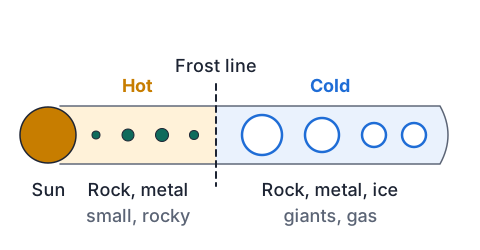
- Temperature in the disc decides what can condense: rock and metal near the star, ices beyond the frost line, which is why rocky planets are inside and giants outside.
- Moons form alongside their planet, are captured by its gravity, or form from the debris of a giant impact, as Earth's Moon did.
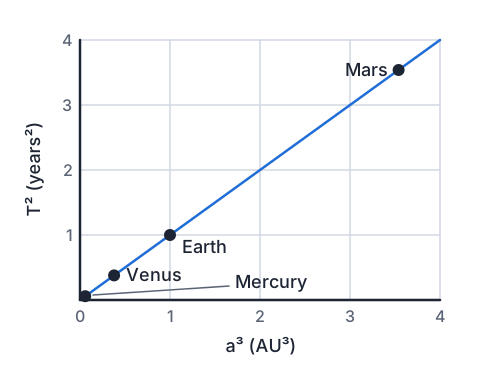
- Gravity keeps planets in orbit; closer planets move faster, and Kepler's third law links orbit size and period (T² = a³ in years and AU).
- Exoplanets are found by transits, star wobble, microlensing and direct imaging; a habitable zone is where liquid water could exist on a planet's surface.
From a cloud to a disc
- About 4.6 billion years ago a cloud of gas and dust, the solar nebula, began to collapse under its own gravity.
- As it shrank it spun faster, like a skater pulling in their arms, and the spinning flattened it into a disc with most of the mass in a hot, dense centre.
- The centre became the Sun, which holds 99.8% of the Solar System's mass; the rest stayed in the flat, rotating protoplanetary disc of gas and dust around it.
- That is why the planets all orbit in nearly the same flat plane and in the same direction as the Sun spins.
- Once the young Sun began fusion, its strong solar wind blew the leftover gas out of the inner Solar System, ending planet building there.
| The Solar System | NASA figure |
|---|---|
| Age | about 4.6 billion years |
| Share of the Solar System's mass in the Sun | 99.8% |
Temperature builds two kinds of planet
- Close to the young Sun the disc was hot, so only metals and rocky minerals could condense into solid grains; water and other ices stayed as gas.
- Beyond the frost line, between where Mars and Jupiter are now, it was cold enough for water, ammonia and methane to freeze, so there was far more solid material.
- Grains stuck together into pebbles, then kilometre-sized planetesimals, which pulled each other in by gravity and collided to form protoplanets (accretion).
- Collisions turned kinetic energy into heat, melting young planets so that dense iron sank to form cores and lighter rock floated up to form mantles and crusts.
- In the cold outer disc, icy cores grew big enough for their gravity to pull in huge amounts of hydrogen and helium gas, becoming the gas and ice giants.
- Excellence answers trace temperature at every stage: hot inner disc, cold outer disc, heating in collisions, then cooling to form solid crusts.
Example: what the planets tell us
- Use NASA's planet data to explain how the pattern of the planets supports the frost line idea.
| Planet | Distance from Sun (million km) | Mass (Earth = 1) | Density (kg/m³) | Moons |
|---|---|---|---|---|
| Mercury | 57.9 | 0.055 | 5429 | 0 |
| Venus | 108.2 | 0.82 | 5243 | 0 |
| Earth | 149.6 | 1 | 5514 | 1 |
| Mars | 228.0 | 0.11 | 3934 | 2 |
| Jupiter | 778.5 | 318 | 1326 | 95 |
| Saturn | 1432.0 | 95 | 687 | 274 |
| Uranus | 2867.0 | 14.5 | 1270 | 28 |
| Neptune | 4515.0 | 17.1 | 1638 | 16 |
- inner four: densities 3934 to 5514 kg/m³, small massesmade of rock and metal
- outer four: densities 687 to 1638 kg/m³, 14.5 to 318 Earth massesmostly hydrogen, helium and ices
- the change happens between Mars and Jupiterwhere the frost line was
- rocky planets formed where only rock and metal could be solid; giants formed where ices were solid too and cores could grab gas
- the giants also have many moons, made from their own discs of material
Three ways to make a moon
- Formed alongside (co-accretion): a young giant planet had its own small disc of gas and dust, which built large, round moons in neat, circular orbits in the planet's equator, like Jupiter's big moons.
- Captured: a passing asteroid or icy body comes close and is caught by the planet's gravity; captured moons are usually small, lumpy, dark and often have tilted or stretched orbits.
- Giant impact: a big collision blasts debris into orbit, where it gathers into a moon; this is how Earth's Moon formed.
- Mars's two moons, Phobos and Deimos, are small and lumpy and made of dark, carbon-rich rock like asteroids, which supports capture, although NASA notes that some evidence points the other way.
- Phobos is slowly spiralling in towards Mars, so one day it will crash or break up into a ring.
| Phobos | NASA figure |
|---|---|
| Size | 27 × 22 × 18 km |
| Orbits of Mars | three a day |
| Moving closer to Mars | 1.8 m every 100 years |
| Rock type | dark C-type, like carbon-rich asteroids |
Example: testing theories of the Moon's origin
- Apollo astronauts brought back 382 kg of Moon rock. Use the evidence to decide between capture, co-accretion and a giant impact.
| Evidence | NASA |
|---|---|
| Oxygen isotopes in Moon rock | match Earth rock too closely to be chance |
| Iron core as a share of mass | Earth about 30%, Moon only 1.6 to 1.8% |
| Elements that vaporise easily | only small amounts in Moon rock |
| Age | formed about 60 million years after the Solar System began |
| Early Moon | covered in a deep ocean of magma |
- capture: a captured body would have formed elsewhere, so its rock would not match Earth's
- co-accretion: forming together from the same material would give the Moon the same iron share and age as Earth
- giant impact: a Mars-sized body hit the young Earth and threw out mantle rock, which is low in ironexplains matching rock and the small core
- the impact's heat melted the debris and boiled off easily vaporised elementsexplains the magma ocean and few volatiles
- the giant impact theory fits all the evidence
Gravity and orbits
- A planet moves sideways at high speed, and the Sun's gravity pulls it towards the Sun; the pull keeps bending its path into an orbit instead of letting it fly off in a straight line.
- Gravity weakens with distance, so planets close to the Sun must move faster to stay in orbit, and they also have a smaller path to travel: inner planets have much shorter years.
- Kepler's third law: the square of a planet's period is proportional to the cube of its average distance; for the Sun's planets, T² = a³ with T in Earth years and a in astronomical units (1 AU = Earth's distance, 149.6 million km).
- The same law, with a different constant, works for moons around a planet and for exoplanets around their stars, which lets astronomers find a star's mass from its planets.
Example: predicting the length of a Martian year
- Mars is 228.0 million km from the Sun on average. Use Kepler's third law to predict its orbital period, and compare it with NASA's measured 687.0 days.
- a = 228.0 ÷ 149.6 = 1.524 AU1 AU = 149.6 million km
- T² = a³ = 1.524³ = 3.540Kepler's third law
- T = √3.540 = 1.881 years
- 1.881 × 365.2 = 687 daysone Earth year = 365.2 days
- matches NASA's 687.0 days
Finding planets around other stars
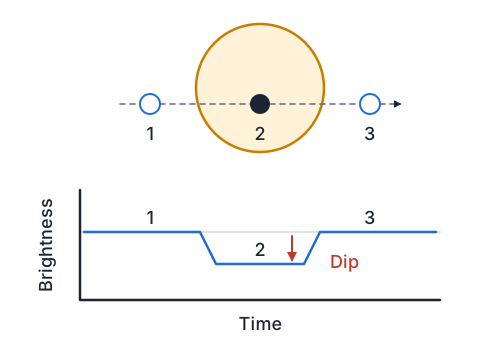
- Transit: when a planet crosses in front of its star, the star dims slightly; the size of the dip gives the planet's size, and the time between dips gives its year.
- Wobble (radial velocity): a planet's gravity pulls its star in a small circle, so the star's light shifts slightly blue then red; bigger wobbles mean heavier planets.
- Microlensing: a star with a planet passing in front of a more distant star bends and brightens its light for a few days; the MOA team, using a telescope at Mt John near Takapō, has found planets this way.
- Direct imaging: blocking the star's glare to photograph the planet itself, which works best for big young planets far from their stars.
- NASA has confirmed more than 6000 exoplanets; the first around a Sun-like star, 51 Pegasi b, was found in October 1995.
| Exoplanets | NASA figure |
|---|---|
| Confirmed exoplanets | more than 6000 |
| First planet found around a Sun-like star | 51 Pegasi b, October 1995 |
| Planets confirmed from the TESS transit mission | more than 1000 |
| TRAPPIST-1 system | seven Earth-sized planets, about 40 light-years away |
Example: how big is the dip?
- The fraction of starlight blocked in a transit is (planet radius ÷ star radius)². The Sun's radius is 695 700 km (NASA Sun Fact Sheet).
- How much would Jupiter and Earth dim the Sun for a distant observer?
| Planet | Diameter (km) | Radius (km) |
|---|---|---|
| Jupiter | 142 984 | 71 492 |
| Earth | 12 756 | 6378 |
- Jupiter: (71 492 ÷ 695 700)² = 0.1028² = 0.0106radius ratio, then square it
- dip = 1.06%
- Earth: (6378 ÷ 695 700)² = 0.00917² = 0.000084
- dip = 0.0084%
- an Earth-sized dip is about 1/126 of Jupiter's, which is why small planets are hard to find
Habitable zones
- A star's habitable zone is the range of distances where a planet's surface could be warm enough, but not too warm, for liquid water.
- Hotter, more luminous stars have wider habitable zones further out; cool, dim red dwarfs have narrow zones very close in, where planets get strong flares and radiation.
- Earth sits in the Sun's habitable zone; Venus is too hot and Mars too cold for liquid water on the surface today.
- Being in the zone is not enough: a planet also needs to be rocky and keep an atmosphere, which is why astronomers then study planets' atmospheres with telescopes like Webb.
| Proxima Centauri b | NASA figure |
|---|---|
| Star | Proxima Centauri, a red dwarf (M-type) |
| Mass | 1.07 Earths |
| Distance from its star | 0.04856 AU |
| Orbital period | 11.2 days |
What Achieved, Merit and Excellence look like
- Achieved describes a stage or a theory; Merit explains it with a cause; Excellence links several stages with temperature or energy changes, or weighs evidence for and against theories.
| Grade | A model answer |
|---|---|
| Achieved | The inner planets formed near the Sun where it was hot, and the gas giants formed further out where it was cold. |
| Merit | Near the Sun only rock and metal could condense, so the inner planets are small and rocky; beyond the frost line ices froze too, so there was more solid material and bigger cores formed. |
| Excellence | In the hot inner disc only rock and metal condensed, and accretion built small dense planets that melted and separated into core and mantle. Beyond the frost line, ices froze, so cores grew large enough for their gravity to capture hydrogen and helium before the young Sun's wind cleared the gas, forming giant, low-density planets. |
Common mistakes
- There is no gravity in space, so planets just keep moving.The Sun's gravity pulls every planet towards it; that pull is what keeps bending its path into an orbit.
- The gas giants are big because they are further from the Sun's gravity.They are big because ices could freeze in the cold outer disc, giving cores large enough to pull in gas.
- Earth's Moon was captured as it flew past.Its rock matches Earth's mantle and it has little iron, which fits a giant impact, not capture.
- The habitable zone is the same distance from every star.It depends on the star's luminosity: further out for hot bright stars, very close in for red dwarfs.
A toilet paper Solar System
You need: a roll of toilet paper, a marker pen, a long hallway or a lawn, a coin or bottle cap for the Sun
- Put the coin at one end for the Sun and unroll the paper in a straight line; the scale is 2 sheets for every 149.6 million km (1 AU).
- Mark the planets at these numbers of sheets from the Sun: Mercury 0.8, Venus 1.4, Earth 2, Mars 3.
- Keep unrolling and mark Jupiter at 10.4, Saturn at 19.1, Uranus at 38.3 and Neptune at 60.4 sheets.
- Draw a dashed line across the gap between Mars and Jupiter to show where the frost line was.
- Look for: the four rocky planets crowd into the first 3 sheets inside the frost line, while the giants are spread far out in the cold, and the gaps grow with distance.
Safety: Unroll the paper where nobody is running or cycling past, so it does not trip anyone, and use it afterwards rather than wasting it.
| Planet | Distance (AU) | Sheets |
|---|---|---|
| Mercury | 0.387 | 0.8 |
| Venus | 0.723 | 1.4 |
| Earth | 1 | 2 |
| Mars | 1.524 | 3.0 |
| Jupiter | 5.204 | 10.4 |
| Saturn | 9.572 | 19.1 |
| Uranus | 19.16 | 38.3 |
| Neptune | 30.18 | 60.4 |
Your turn
Why did the solar nebula flatten into a disc as it collapsed?
Why could water ice exist as a solid beyond the frost line but not close to the Sun?
Jupiter is 5.204 AU from the Sun. Use T² = a³ to find its period in years.
A star dims by 1% during a transit. What is the planet's radius as a fraction of the star's?
Give two pieces of evidence that Phobos may be a captured asteroid.
Show answer
1. As it shrank it spun faster, and the spin flattened it into a rotating disc. 2. Beyond the frost line the disc was cold enough for water to freeze; near the Sun it was too hot, so water stayed as gas. 3. T² = 5.204³ = 140.9, so T = √140.9 = 11.87 years. 4. (r ÷ R)² = 0.01, so r ÷ R = √0.01 = 0.1, a tenth of the star's radius. 5. It is small and lumpy, and it is made of dark carbon-rich rock like many asteroids.
Exam-style question: TRAPPIST-1
- TRAPPIST-1 is a small, cool red dwarf about 40 light-years away with seven Earth-sized planets. They were found by the transit method.
Describe a protoplanetary disc.
Explain how rocky planets like these form from the disc, referring to changes in temperature.
Explain how the transit method detected these planets.
Explain why the habitable zone of TRAPPIST-1 is much closer to its star than the Sun's habitable zone is to the Sun.
Earth's Moon has rock very like Earth's mantle but a tiny iron core. Explain how this evidence supports the collision theory and rules out capture.
Show answer
1. A flat, spinning disc of gas and dust around a newly formed star, which is the raw material for planets and moons (Achieved). 2. Achieved: dust grains stick together and grow into planets. Merit: close to the star it is hot, so only rock and metal condense; grains collide and stick into planetesimals, which attract each other by gravity and grow into protoplanets. Excellence: collisions turn kinetic energy into heat, so young planets melt, iron sinks to make a core and lighter rock a mantle; as the disc and planets cool, solid crusts form, giving small, dense rocky planets. 3. Achieved: the star gets dimmer when a planet passes in front. Merit: the planet blocks a small fraction of the star's light, giving a regular dip; the time between dips gives the period. Excellence: the depth of the dip, (planet radius ÷ star radius)², gives the planet's size, so Earth-sized planets give small dips, easier to detect around a small star; repeated dips at fixed intervals confirm each planet. 4. Merit: a red dwarf is cool and much less luminous than the Sun, so it gives out less energy each second. Excellence: the energy reaching a planet falls with the square of distance, so to receive enough energy for liquid water a planet must orbit much closer to a dim star; the zone is also narrower. 5. Merit: the matching rock means the Moon is made from Earth's material, which a captured body from elsewhere would not be. Excellence: a giant impact blasted out mantle rock, which is low in iron, so the Moon has a small core; capture cannot explain the matching composition, and co-accretion would give the Moon Earth's large iron share.
Kepler's Laws
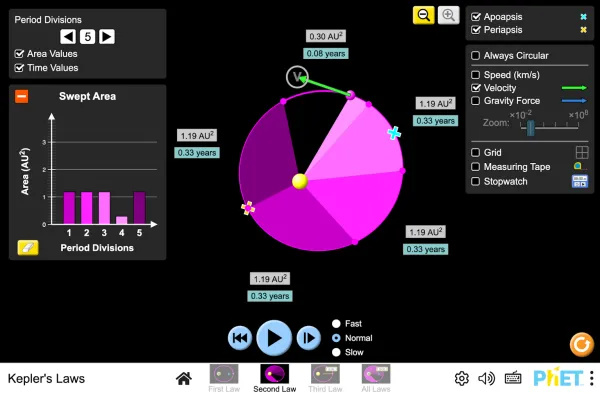
Full screen · PhET Interactive Simulations, University of Colorado Boulder, CC BY 4.0
Recap
- A collapsing, spinning nebula flattened into a disc; the Sun formed at the centre and planets formed in the disc.
- Hot inner disc: only rock and metal, so small rocky planets. Cold outer disc: ices too, so big cores that captured gas.
- Moons form alongside a planet, are captured, or come from giant impacts, like Earth's Moon.
- Gravity keeps planets in orbit, and T² = a³ (years and AU) links distance and period.
- Exoplanets are found by transits, wobble, microlensing and imaging; the habitable zone depends on the star's luminosity.
| Moon origin | Typical evidence |
|---|---|
| Co-accretion | large, round, circular orbits in the planet's equator |
| Capture | small, lumpy, asteroid-like rock, odd orbits |
| Giant impact | rock like the planet's mantle, little iron, few volatiles |
How is NCEA Level 2 maths going?
See the NCEA Level 2 maths guide