Density, pressure and convection in the Earth system
What this lesson covers
- Density is mass per unit volume, and material less dense than its surroundings is pushed up by buoyancy.
- Heating spreads particles apart, so a heated fluid becomes less dense and rises; cooling or added salt makes it denser so it sinks.
- Pressure grows with depth in rock, sea and air because of the weight of material above.
- Earth's internal heat comes from its formation, radioactive decay and the freezing of the core, and moves by conduction and convection.
- Convection currents in the mantle, the ocean and the atmosphere, and what drives each one.
- How an exam answer moves from describing (Achieved) to explaining (Merit) to linking ideas (Excellence).
Density and buoyancy
- Density is how much mass is packed into each unit of volume: ρ = m ÷ V, in kg m⁻³ or g cm⁻³, where 1 g cm⁻³ = 1000 kg m⁻³.
- A fluid pushes up on anything in it with a buoyancy force equal to the weight of the fluid that has been pushed aside.
- If something is less dense than the fluid around it, the buoyancy force is bigger than its weight and it rises; if it is denser, it sinks.
- The same rule works for rock in the mantle, water in the ocean and air in the atmosphere: less dense material rises, denser material sinks, and gravity does the sorting.
- It is also why Earth is layered: the densest material, mostly iron, sank to form the core, and the least dense rock sits on top as the crust.
Example: why pumice floats and basalt sinks
- A class found the mass of a piece of basalt and a piece of Taupō pumice, then measured each one's volume by the rise of water in a measuring cylinder, holding the pumice under with a thin wire.
- Find each density and say whether it floats in water (1.0 g cm⁻³).
| Rock | Mass (g) | Volume (cm³) |
|---|---|---|
| Basalt | 162 | 54 |
| Pumice | 18.0 | 30 |
- ρ basalt = m ÷ V = 162 g ÷ 54 cm³ = 3.0 g cm⁻³density = mass ÷ volume
- ρ pumice = 18.0 g ÷ 30 cm³ = 0.60 g cm⁻³
- 3.0 > 1.0, so basalt sinks; 0.60 < 1.0, so pumice floats
- pumice is frothy lava full of gas bubbles, so most of its volume has almost no mass
Heating changes density
- When a material is heated, its particles move faster and push further apart, so its volume goes up while its mass stays the same; its density falls.
- Cooling does the opposite: particles slow, pack closer and the density rises.
- A heated parcel of fluid is therefore less dense than the cooler fluid around it, and the denser surroundings push it up; nothing has become lighter.
- In the sea, salt matters too: dissolved salt adds mass without adding much volume, so saltier water is denser than fresher water at the same temperature.
- A convection current is the loop that results: fluid is heated in one place, rises, cools somewhere else and sinks, carrying heat energy with it as it moves.
- Convection only happens in fluids: liquids, gases, and rock hot enough to flow very slowly, like the mantle.
Pressure grows with depth
- Pressure is force per unit area, P = F ÷ A, measured in pascals (1 Pa = 1 N m⁻²).
- The deeper you go in rock, sea or air, the more material there is above pressing down, so pressure increases with depth; in a liquid, the extra pressure is P = ρgh.
- At sea level the air carries the weight of the whole atmosphere above it, which is why standard air pressure is 1013 hPa, and why pressure falls as you climb.
- Air that rises moves into lower pressure, so it expands and cools; air that sinks is squashed by higher pressure and warms.
- Deep in the mantle, huge pressure keeps hot rock solid. Where mantle rock rises and the pressure on it falls, under a mid-ocean ridge or a hotspot, some of it melts: this is decompression melting.
Example: pressure 1000 m under the sea
- Seawater has a density of about 1025 kg m⁻³. Take g = 9.8 N kg⁻¹ and the air pressure at the surface as 101 300 Pa.
- Find the total pressure 1000 m down, and compare it with the pressure at the surface.
- P water = ρgh = 1025 × 9.8 × 1000the weight of water above each square metre
- P water = 10 045 000 Pa
- P total = 10 045 000 + 101 300 = 10 146 300 Pathe air presses on the sea surface too
- 10 146 300 ÷ 101 300 ≈ 100how many times the surface pressure
- about 10.1 MPa, roughly 100 times the pressure at the surface
Where Earth's internal heat comes from
- Heat left over from Earth's formation: as rocky bodies collided and iron sank to the centre, kinetic and gravitational potential energy became heat, and much of it has not yet escaped.
- Radioactive decay: unstable isotopes of uranium, thorium and potassium in the mantle and crust break down and release energy from their nuclei, and they still produce heat today.
- Latent heat: as the liquid outer core slowly freezes onto the solid inner core, it gives out latent heat.
- Solar energy only warms the top few metres of the ground, so it plays no part in heating the interior.
- In drill holes near the surface the temperature rises by about 25 °C for every kilometre of depth, which shows heat flowing out from the hot interior.
| Layer | State | Main heat transfer |
|---|---|---|
| Inner core | Solid, about 80% iron with some nickel | Conduction |
| Outer core | Liquid iron and nickel | Convection |
| Mantle | Solid rock that flows very slowly, like bitumen | Convection |
| Crust | Rigid rock, about 30 km thick under continents and 5 to 10 km under oceans | Conduction, plus magma and hot water rising through cracks |
Convection in the mantle
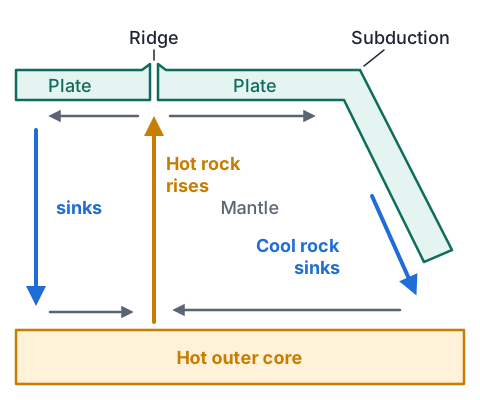
- The outer core heats the bottom of the mantle by conduction.
- Rock at the base expands, becomes less dense than the cooler rock above it, and slowly rises.
- Near the top it spreads sideways under the rigid plates and loses heat by conduction up through them, so it cools, becomes denser and sinks again, completing the convection current.
- Cold, dense oceanic plate sinking at a subduction zone, like the Pacific Plate going down under the east of the North Island, is the downward part of the loop and helps drag the plates along.
- Rock conducts heat poorly, so on its own conduction would take far longer; moving rock carries the heat outward much faster.
Convection in the ocean
- The Sun heats the sea from above, so warm, less dense water stays at the top and the ocean settles into layers: warm over cold.
- Near Antarctica in winter, sea water freezes into sea ice; ice holds very little salt, so the water left behind becomes saltier as well as close to freezing.
- Cold and salty makes it very dense, so it sinks to the sea floor and spreads north along the bottom as Antarctic Bottom Water.
- Surface water flows toward the poles to replace it, carrying heat from the tropics; this density-driven loop is the thermohaline circulation.
- Surface currents are mostly pushed along by wind dragging on the sea surface, so they are not convection, but they also carry heat away from the equator.
Convection in the atmosphere: lows and highs
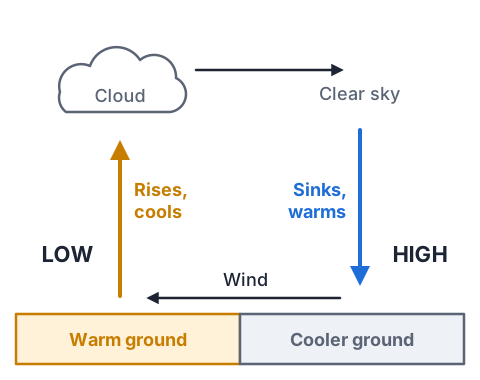
- The Sun's radiation mostly passes through the air and is absorbed by the ground, which then heats the air touching it by conduction.
- That air expands, becomes less dense and rises, so the pressure at the surface below it drops: a low.
- As the air rises into lower pressure it expands and cools, water vapour condenses into droplets, and clouds and rain form.
- High up, the air spreads out, loses heat by radiation, becomes denser and sinks elsewhere, warming as it is compressed: a high, with clear and settled weather.
- At the surface, air flows from the high toward the low as wind, which closes the loop.
Example: from describing to linking
- Achieved describes a process with correct terms; Merit explains why it happens, step by step; Excellence links the cause, the density change and the effect in one chain, using the context.
- Annotated diagrams count as evidence, so a labelled convection loop backs up any written answer.
| Grade | A model answer |
|---|---|
| Achieved | Hot rock in the mantle rises and cooler rock sinks, which makes a convection current. |
| Merit | Rock at the base of the mantle is heated by the core. It expands, so it becomes less dense than the rock above it and rises; at the top it cools, becomes denser and sinks. |
| Excellence | The core heats the base of the mantle by conduction. That rock expands, so its density falls below that of the cooler rock above, and buoyancy pushes it up. Under the plates it loses heat by conduction, contracts, becomes denser and sinks. The mantle is solid but hot enough to flow slowly, so this loop carries heat outward much faster than conduction could through rock, a poor conductor, and drags the plates with it. |
Common mistakes
- Hot air rises because heating makes its particles lighter.The mass stays the same; the particles spread apart, so the volume increases and the density falls, and denser surroundings push it up.
- The mantle is a sea of liquid magma, so it convects like water in a pot.The mantle is solid rock that flows very slowly because it is so hot; only small pockets melt, mostly where pressure drops.
- Heat rises.Hot fluid rises because it is less dense; heat itself moves in every direction by conduction and radiation, from hotter to colder.
- The core stays hot because the Sun's heat soaks down into the Earth.Sunlight only warms the top few metres; the interior's heat is left from Earth's formation and made by radioactive decay.
See a convection current and a sinking salty sea
You need: a large clear plastic container, a small plastic cup, food colouring in two colours, ice cubes, salt, hot tap water, cold tap water, a teaspoon
- Fill the large container with cold tap water and let it settle for two minutes.
- Half-fill the small cup with hot tap water, add a few drops of one food colouring, and gently stand the cup on the bottom of the container, tilting it so the coloured water flows out slowly.
- Stir two teaspoons of salt and a few drops of the other colour into a little cold water with an ice cube, then pour it slowly down the inside wall of the container.
- Keep your eyes on the side of the container for five minutes, without touching it.
- Look for: the hot coloured water rises and spreads along the top, while the cold salty water slides down and spreads across the bottom, just like Antarctic Bottom Water.
Safety: Hot tap water can scald, so run it only as hot as you can comfortably hold a finger under, and use plastic, not glass, in case the container is knocked over.
Your turn
A 54 g rock has a volume of 20 cm³. Find its density.
Find the pressure from seawater (ρ = 1025 kg m⁻³) 200 m below the surface, ignoring the air. Use g = 9.8 N kg⁻¹.
Explain why water under forming sea ice sinks.
Which kind of heat transfer carries most heat through the outer core, and which through the crust?
Does rising air or sinking air bring cloud, and why?
Show answer
1. ρ = m ÷ V = 54 ÷ 20 = 2.7 g cm⁻³. 2. P = ρgh = 1025 × 9.8 × 200 = 2 009 000 Pa, about 2.0 MPa. 3. Sea ice holds little salt, so the water left behind is saltier and close to freezing, which makes it denser than the water around it. 4. Convection in the liquid outer core; conduction through the rigid crust. 5. Rising air: it moves into lower pressure, expands and cools, so its water vapour condenses into cloud.
Exam-style question: hot pools in the Taupō Volcanic Zone
- Hot pools in the Taupō Volcanic Zone are fed by rainwater that soaks down through cracks in the rock, is heated deep underground, and returns to the surface.
Describe two sources of the heat inside the Earth.
Explain how heat is carried from the outer core up through the mantle.
Discuss how the rainwater is heated and why it returns to the surface, linking heat transfer, density and pressure.
Show answer
1. Achieved: any two of heat left from Earth's formation (collisions and iron sinking to the core), radioactive decay of uranium, thorium and potassium isotopes releasing energy from their nuclei, and latent heat given out as the outer core freezes onto the inner core. 2. Merit: the outer core heats the base of the mantle by conduction; that rock expands, becomes less dense than the rock above and rises; under the plates it loses heat by conduction, becomes denser and sinks, so the convection current carries heat outward. Excellence adds why: rock is a poor conductor, but hot mantle rock can flow, so moving rock carries the heat far faster. 3. Excellence: hot rock above magma several kilometres down heats the water in the cracks by conduction, as fast-vibrating particles of rock collide with water particles. The heated water expands, so it becomes less dense than the cold water above and is pushed up, while cold, denser rainwater sinks in to replace it: a convection loop through the cracks. The high pressure at depth stops the water boiling even above 100 °C; as it rises the pressure falls, so some boils to steam near the surface. Naming conduction or saying hot water rises earns Achieved; the density explanation earns Merit; linking the heat source, conduction, convection and pressure into one chain earns Excellence.
Recap
- ρ = m ÷ V: less dense material rises through denser material, and denser material sinks.
- Heating spreads particles apart and lowers density; cooling and added salt raise it.
- Pressure increases with depth; rising air expands and cools, and falling pressure lets rising mantle rock melt.
- Internal heat comes from Earth's formation, radioactive decay and the freezing core; it crosses the solid layers by conduction and the flowing layers by convection.
- For Merit, explain each step with density; for Excellence, link the heat source, the density change and the result in the context.
| Where | What drives it | Rising part | Sinking part |
|---|---|---|---|
| Mantle | heating by the core from below | hot rock under ridges and hotspots | cold plates at subduction zones |
| Ocean | cooling and sea ice salt near Antarctica | deep water slowly returning upward elsewhere | cold salty bottom water |
| Atmosphere | heating by the warm ground from below | air in a low, making cloud | air in a high, giving clear sky |
How is NCEA Level 2 maths going?
See the NCEA Level 2 maths guide