Qualitative analysis: which ions are in the sample?
What this lesson covers
- Solubility rules and the colours of the common precipitates.
- Testing for cations with sodium hydroxide and ammonia, a few drops then in excess, and with iodide ions.
- Testing for anions: chloride and iodide with silver ions, sulfate with barium ions, carbonate with acid.
- Ionic equations for precipitates and complex ions, without spectator ions.
- Identifying the compound, and describing, explaining and discussing why its ions matter for people or the environment.
What the investigation asks of you
- You are given one sample and an identification procedure. You run the tests, record what you see, and identify at least two chemical species (usually one cation and one anion), then the compound they make.
- Achieved: match your observations to the procedure to name the ions and the compound, and describe why one of the ions matters for people or the environment in the task's context.
- Merit: explain each identification by linking your observations to the procedure, write equations for every change you saw, and explain the ion's significance.
- Excellence: justify each identification using secondary data (solubility rules, complex ion formulae) and chemical principles to say why it could only be that ion, and discuss its significance from more than one side.
- Some tasks use organic samples and functional group tests instead; this lesson covers ions, which is the more common choice.
Solubility rules: the secondary data
- A precipitate forms when two ions meet that make an insoluble compound. The solubility rules tell you which pairs those are.
- Every sodium, potassium, ammonium and nitrate compound is soluble, which is why NaOH, KI, AgNO₃ and Ba(NO₃)₂ are used as test solutions: only the ion you want reacts.
- Read the table both ways: a white precipitate with Ba²⁺ points to sulfate, and a precipitate with OH⁻ rules out Na⁺, K⁺ and NH₄⁺.
| Anion | Usually | Exceptions |
|---|---|---|
| Nitrate, NO₃⁻ | Soluble | None |
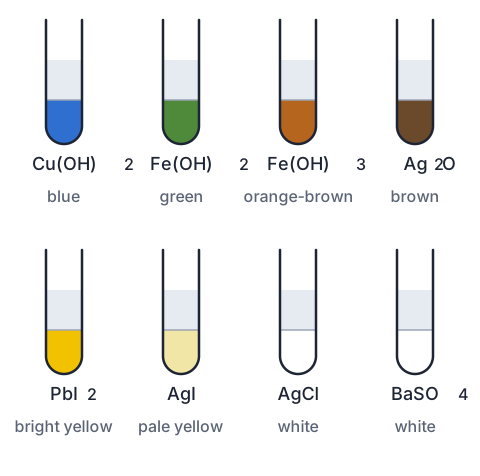
| Chloride, Cl⁻ | Soluble | AgCl and PbCl₂ (white) |
| Iodide, I⁻ | Soluble | AgI (pale yellow), PbI₂ (bright yellow) |
| Sulfate, SO₄²⁻ | Soluble | BaSO₄ and PbSO₄ (white) |
| Hydroxide, OH⁻ | Insoluble | Soluble with Na⁺, K⁺, NH₄⁺, Ba²⁺ |
| Carbonate, CO₃²⁻ | Insoluble | Soluble with Na⁺, K⁺, NH₄⁺ |
Testing for cations
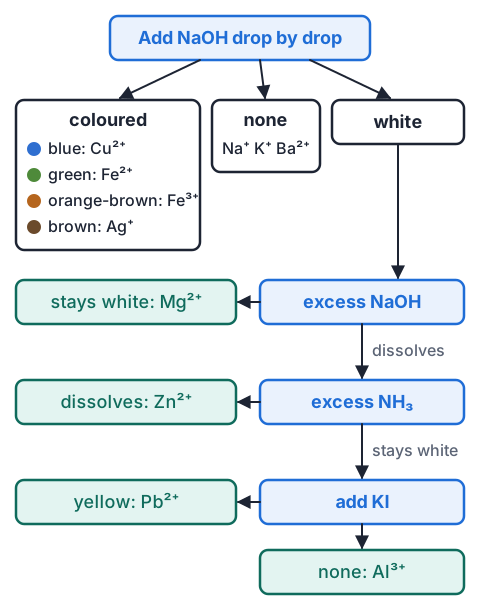
- Add sodium hydroxide a drop at a time, then in excess. Most metal ions make an insoluble hydroxide: Mg²⁺ + 2OH⁻ → Mg(OH)₂(s).
- A coloured precipitate names the ion straight away: blue Cu(OH)₂, green Fe(OH)₂, orange-brown Fe(OH)₃, brown Ag₂O.
- A white precipitate that dissolves in excess NaOH comes from an amphoteric hydroxide (Al³⁺, Zn²⁺ or Pb²⁺); one that stays is Mg²⁺.
- Ammonia solution then splits the three: only Zn²⁺ redissolves in excess NH₃. Potassium iodide splits the last two: Pb²⁺ gives bright yellow PbI₂, Al³⁺ gives nothing.
- Ammonia acts first as a weak base, NH₃ + H₂O ⇌ NH₄⁺ + OH⁻, so its first drops give the same hydroxide precipitates as NaOH.
Complex ions: why some precipitates dissolve
- A precipitate that dissolves in excess reagent has formed a soluble complex ion: a metal ion with OH⁻ ions or NH₃ molecules bonded around it.
- In excess hydroxide, Al³⁺, Zn²⁺ and Pb²⁺ form hydroxo complexes. In excess ammonia, Zn²⁺, Cu²⁺ and Ag⁺ form ammine complexes; the copper one is a deep blue solution.
- Write the first equation for the precipitate and a second one for it dissolving. Check that atoms and charges balance in each.
- Zn²⁺ + 2OH⁻ → Zn(OH)₂(s)a few drops: white precipitate
- Zn(OH)₂(s) + 2OH⁻ → [Zn(OH)₄]²⁻excess NaOH: colourless solution
- Al(OH)₃(s) + OH⁻ → [Al(OH)₄]⁻excess NaOH: colourless solution
- Pb(OH)₂(s) + 2OH⁻ → [Pb(OH)₄]²⁻excess NaOH: colourless solution
- Zn(OH)₂(s) + 4NH₃ → [Zn(NH₃)₄]²⁺ + 2OH⁻excess NH₃: colourless solution
- Cu(OH)₂(s) + 4NH₃ → [Cu(NH₃)₄]²⁺ + 2OH⁻excess NH₃: deep blue solution
- Ag₂O(s) + 4NH₃ + H₂O → 2[Ag(NH₃)₂]⁺ + 2OH⁻excess NH₃: colourless solution
- charge check, copper: 0 on the left, (+2) + 2(−1) = 0 on the right
Testing for anions
- Carbonate: add dilute nitric acid. Bubbles of carbon dioxide mean CO₃²⁻: CO₃²⁻ + 2H⁺ → CO₂ + H₂O.
- Chloride and iodide: acidify with dilute nitric acid, then add silver nitrate. White AgCl means Cl⁻, pale yellow AgI means I⁻: Ag⁺ + Cl⁻ → AgCl(s).
- Sulfate: acidify, then add barium nitrate. A white precipitate means SO₄²⁻: Ba²⁺ + SO₄²⁻ → BaSO₄(s).
- The acid comes first because carbonate and hydroxide ions also precipitate with Ag⁺ and Ba²⁺. Acid removes them, so a precipitate can only be the ion you are testing for.
- Nitrate gives no precipitate with anything here, so it is identified by elimination, after every other anion test is negative.
Example: the unlabelled garden product
- A bottle of pale green crystals was found in a garden shed. A class dissolved some in distilled water and ran the procedure on that one solution.
- Identify the cation, the anion and the compound, and write equations for every change.
| Test | Observation | Conclusion |
|---|---|---|
| NaOH, a few drops | Green precipitate | Fe²⁺ |
| NaOH in excess | Precipitate stays; top turns orange-brown after 10 min | Not amphoteric; Fe²⁺ oxidised by air |
| Dilute HNO₃ | No bubbles | No CO₃²⁻ |
| HNO₃, then AgNO₃ | No precipitate | No Cl⁻ or I⁻ |
| HNO₃, then Ba(NO₃)₂ | White precipitate | SO₄²⁻ |
- Fe²⁺ + 2OH⁻ → Fe(OH)₂(s)green precipitate
- 4Fe(OH)₂(s) + O₂ + 2H₂O → 4Fe(OH)₃(s)the surface turns orange-brown as air oxidises iron(II) to iron(III)
- Ba²⁺ + SO₄²⁻ → BaSO₄(s)white precipitate in acid
- Fe²⁺ and SO₄²⁻: the compound is FeSO₄, iron(II) sulfate
Example: one identification written up for each grade
- The same identification of Fe²⁺ written three ways. Each grade keeps what the one before it said and adds to it.
| Grade | What the student wrote |
|---|---|
| Achieved | With NaOH we got a green precipitate, which the procedure says is Fe²⁺. With barium nitrate we got a white precipitate, so sulfate is present. The compound is iron(II) sulfate, FeSO₄. |
| Merit | The green precipitate is iron(II) hydroxide: Fe²⁺ + 2OH⁻ → Fe(OH)₂(s). It did not dissolve in excess NaOH, so it is not an amphoteric ion. Its top turned orange-brown because oxygen oxidised it to Fe(OH)₃. The white precipitate in acid was BaSO₄: Ba²⁺ + SO₄²⁻ → BaSO₄(s). |
| Excellence | Only Fe²⁺ gives a green hydroxide: Cu²⁺ would be blue and Fe³⁺ orange-brown from the start. The precipitate staying in excess NaOH rules out Al³⁺, Zn²⁺ and Pb²⁺, which form soluble hydroxo complexes. The solubility rules say the only common insoluble barium salts are the sulfate and the carbonate; there were no bubbles with acid and the test was done in acid, so the white solid must be BaSO₄. |
Why the ion matters: significance
- Every grade needs the significance of one identified ion for people or the environment, set in the task's context. Achieved describes it, Merit explains it with chemistry, Excellence discusses it from more than one side.
- Iron(II) sulfate is sold as a moss killer and lawn tonic. Explaining it: on paths, Fe²⁺ is oxidised by air to Fe³⁺, and insoluble iron(III) hydroxide leaves orange-brown, rust-like stains. Discussing it: the iron helps the lawn, but runoff into drains carries the ions to streams, and the product is harmful if a child swallows it.
- For drinking water, the law sets a maximum acceptable value for each ion. Copper from pipes in soft or acidic water, lead from old fittings, and nitrate from fertiliser and farm runoff are the ones most often found in New Zealand homes.
- Compare a measured value with the limit: 3 mg L⁻¹ of copper would be over the limit of 2 mg L⁻¹.
| Ion in drinking water | Maximum acceptable value |
|---|---|
| Copper | 2 mg/L |
| Lead | 0.01 mg/L |
| Nitrate (short-term) | 50 mg/L as NO₃⁻ |
| Barium | 1.5 mg/L |
Common mistakes
- White precipitate with NaOH, so it is Zn²⁺.Mg²⁺, Al³⁺, Zn²⁺ and Pb²⁺ all give white precipitates; only the tests in excess NaOH, then NH₃, then KI tell them apart.
- 2NaOH + CuSO₄ → Cu(OH)₂ + Na₂SO₄ is my ionic equation.Leave out the spectator ions: Cu²⁺ + 2OH⁻ → Cu(OH)₂(s).
- I tipped in lots of NaOH at once and saw a clear solution, so there was no precipitate.Add a drop at a time first; an amphoteric hydroxide forms and then redissolves, so pouring in excess hides it.
- The green precipitate went brown on top, so the ion is Fe³⁺.Fe³⁺ gives orange-brown at once; green turning brown on top is Fe(OH)₂ being oxidised by air, so the ion is Fe²⁺.
Identify three white powders
You need: baking soda, Epsom salts, table salt, white vinegar, a bar of plain soap (not dishwashing liquid), warm tap water, 3 clear jars or glasses, masking tape and a pen
- Ask someone to dissolve half a teaspoon of each powder in half a cup of warm water in three jars, and label them only A, B and C.
- Make soapy water by rubbing the bar of soap in a cup of warm water for 30 seconds.
- Test 1: pour a third of each solution into a clean glass and add a teaspoon of vinegar. Fizzing (carbon dioxide) means hydrogen carbonate, HCO₃⁻: baking soda.
- Test 2: pour a fresh third of the two that did not fizz into clean glasses, add a tablespoon of soapy water to each, cover and shake. A white scum and little lather means Mg²⁺ from Epsom salts (magnesium sulfate), which forms an insoluble soap.
- The solution that does neither is the salt, found by elimination, just as nitrate is in the lab.
- Look for: each test responds to one ion only, so the order of tests matters. Write down each observation and the ion it points to.
Safety: Epsom salts are a strong laxative if swallowed, so keep the jars labelled, out of reach of small children, and pour everything down the sink when you finish.
Your turn
A solution gives a white precipitate with NaOH that dissolves in excess, and a white precipitate with NH₃ that also dissolves in excess. Which cation is present?
Write the ionic equation for a few drops of NaOH added to a solution of Cu²⁺ ions.
Excess ammonia then turns that precipitate into a deep blue solution. Write the equation.
A white precipitate with NaOH dissolves in excess. With NH₃ the white precipitate stays, and with KI a bright yellow precipitate forms. Name the cation and write the equation for the yellow precipitate.
Why is the sample acidified with dilute nitric acid before silver nitrate is added?
Tank water from an old house contains 3 mg/L of copper. Is it within the drinking water standard?
Show answer
1. Zn²⁺: only zinc hydroxide redissolves in excess NaOH and in excess NH₃. 2. Cu²⁺ + 2OH⁻ → Cu(OH)₂(s), a blue precipitate. 3. Cu(OH)₂(s) + 4NH₃ → [Cu(NH₃)₄]²⁺ + 2OH⁻. 4. Pb²⁺; Pb²⁺ + 2I⁻ → PbI₂(s). 5. The acid removes carbonate and hydroxide ions, which would also precipitate with Ag⁺, so a precipitate can only be a halide. 6. No: 3 mg/L is above the maximum acceptable value of 2 mg/L.
Recap
- Use the solubility rules to predict precipitates, and add reagents a drop at a time before adding excess.
- NaOH, then NH₃, then KI sorts the cations; acid, AgNO₃ and Ba(NO₃)₂ sort the anions.
- Ionic equations leave out spectator ions; complex ion equations explain precipitates that redissolve.
- Excellence justifies each ion by ruling out the others with secondary data, and discusses why the ion matters.
| Ion | Test | Result |
|---|---|---|
| Cu²⁺ | NaOH, then excess NH₃ | Blue precipitate, then deep blue solution |
| Fe²⁺ | NaOH | Green precipitate, browns on top |
| Zn²⁺ | Excess NaOH and excess NH₃ | White precipitate dissolves in both |
| Cl⁻ | HNO₃ then AgNO₃ | White precipitate |
| SO₄²⁻ | HNO₃ then Ba(NO₃)₂ | White precipitate |
How is NCEA Level 2 maths going?
See the NCEA Level 2 maths guide