Human-induced change in Aotearoa: soil, water and plastic
What this lesson covers
- Clearing forest from steep land speeds up erosion, sending sediment into rivers, estuaries and the sea.
- Nitrogen from urine patches and fertiliser leaches as nitrate into groundwater and rivers, feeding algae.
- Sealed urban surfaces increase runoff and carry metals such as copper and zinc into streams.
- Plastics persist, break into microplastics and spread through water, sediment and food webs.
- Each change crosses spheres, and discussing its implications (links, timescales, people, responses) earns Excellence.
Activity, change, effects, implications
- Every case in this standard has the same chain: a human activity causes a change in the Earth system, the change has effects in several spheres, and those effects have wider implications.
- Achieved names the activity and describes the change and its effects with science words.
- Merit explains how and why each effect happens, using a science idea (infiltration, solubility, toxicity, food webs).
- Excellence discusses the implications: how the spheres interact, how long the effects last, who and what is affected, and what responses would work.
- The four cases below are well measured in Aotearoa, so you can back every claim with real data.
| Activity | Change | Spheres affected |
|---|---|---|
| Clearing forest for pasture on hills | Faster erosion, more sediment | Geosphere, hydrosphere, biosphere |
| Intensive farming, nitrogen fertiliser | More nitrate in groundwater and rivers | Hydrosphere, biosphere, atmosphere |
| Urbanisation | Sealed ground, more stormwater carrying metals | Geosphere, hydrosphere, biosphere |
| Making and discarding plastics | Persistent litter and microplastics | Hydrosphere, biosphere, geosphere |
Deforestation and sediment
- Before people arrived, most of Aotearoa was forest. Much steep hill country was cleared for pasture in the last 150 years.
- A forest canopy catches rain and slows it, and deep roots bind the soil to the rock below. Grass roots are shallow, so in heavy rain whole slopes of soil can slip.
- The eroded soil becomes sediment. In rivers it makes the water murky, cutting the light that plants and algae need, and fills the gaps between stones where insects, kōura and fish eggs live.
- In estuaries it smothers seagrass and shellfish beds, such as tuangi (cockles), that are nurseries for fish and important mahinga kai.
- Harvesting plantation forest also leaves bare ground for a few years, and in storms such as Cyclone Gabrielle in 2023 logging debris (slash) was washed down rivers in Tairāwhiti.
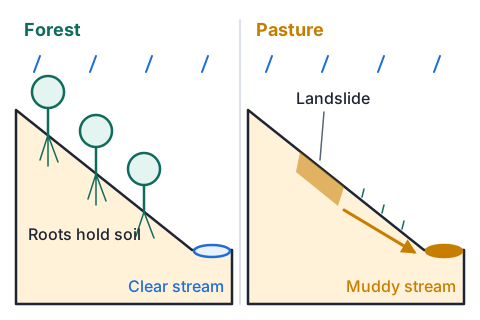
Example: is all erosion human-induced?
- Stats NZ modelled how much eroded soil enters waterways in each region, and how much of it comes from pasture (exotic grassland).
- Which regions' sediment is mostly human-induced, and which is mostly natural?
| Region | Sediment into waterways (million tonnes a year) | Share from pasture |
|---|---|---|
| West Coast | 49 | 5% |
| Gisborne | 40 | 70% |
| Otago | 18 | 10% |
| Canterbury | 17 | 20% |
| Northland | 15 | 82% |
| Manawatū-Whanganui | 13 | 86% |
- West Coast: the most sediment (49), but only 5% from pasturesteep, very wet, rising Southern Alps
- so West Coast sediment is mostly natural erosionhigh total does not mean human-induced
- Manawatū-Whanganui 86%, Northland 82%, Gisborne 70% from pasturecleared hill country
- Gisborne: 70% of 40 = 28 million tonnes a year from pasturethe biggest human-induced load in the table
- the share from pasture, not the total, shows how much is human-induced: mostly human-induced in Manawatū-Whanganui, Northland and Gisborne
Agriculture and nitrate
- A cow's urine patch puts far more nitrogen on a small area than the grass can use, and nitrogen fertiliser adds more.
- Soil bacteria turn the extra nitrogen into nitrate (NO₃⁻). Nitrate is very soluble and negatively charged, so soil particles do not hold it, and rain drains it down into groundwater.
- Groundwater moves slowly into springs, streams and lakes, so nitrate can take years to decades to arrive. Rivers can keep getting worse after farming changes.
- In rivers and lakes nitrate feeds algae and weeds. When they die and rot, bacteria use up the oxygen, which can kill fish (eutrophication). High nitrate is also toxic to sensitive species, and unsafe in drinking water from wells.
- Some nitrogen in soil becomes nitrous oxide (N₂O), a greenhouse gas, so this change reaches the atmosphere too.
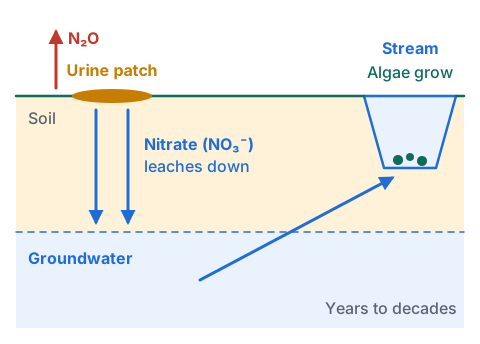
Example: land use and nitrate in rivers
- Councils measure nitrate at about 990 river sites. Each site is given a band from A (sensitive species well protected) to D (sensitive species at risk).
- The table gives the average share of human-modified land (farms, plantation forest and towns) upstream of the sites in each band. What does it suggest?
| Nitrate band | Human-modified land upstream (average) |
|---|---|
| A | 49% |
| B | 84% |
| C | 92% |
| D | 91% |
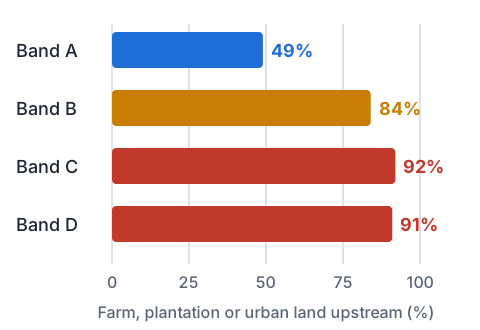
- band A sites: 49% modified land upstreamabout half natural cover
- bands B to D: 84% to 92% modified landmostly farmed or built on
- a pattern (correlation) between modified land and worse nitrateread across the bands
- the leaching mechanism explains the pattern, so it is likely cause and effectdata plus a science idea
- rivers draining mostly farmed or urban land carry more nitrate, so the change is human-induced
Urbanisation and stormwater
- Roofs, roads and car parks are impervious: rain cannot soak in, so it runs into stormwater drains and straight to streams and the sea.
- More water arrives faster, so floods peak higher and scour stream banks. With less rain soaking into the ground to recharge groundwater, streams run lower and warmer between storms.
- The runoff carries copper from brake pads and copper roofing, zinc from tyres and galvanised roofs, oil, and microplastics from tyre wear. Copper and zinc are toxic to stream insects and fish even at low levels.
- Metals settle into harbour and estuary mud, where they build up for decades and enter shellfish.
| Region | Monitored sites where copper often exceeded the guideline |
|---|---|
| Auckland | 25 of 34 |
| Wellington | 6 of 10 |
| Canterbury | 36 of 50 |
| Otago | 5 of 6 |
Plastics
- Most plastics are made from oil and natural gas, so making them draws on carbon from the geosphere, and burning them releases CO₂.
- Plastics do not biodegrade. Sunlight, waves and sand break them into smaller pieces, down to microplastics under 5 mm, which stay for decades or longer.
- Many plastics float, so rivers, stormwater drains and ocean currents carry them long distances to beaches and the seafloor.
- Seabirds, fish and turtles tangle in plastic or swallow it, filling their stomachs; microplastics are eaten by filter feeders such as mussels and pass up food webs.
- Beach surveys across Aotearoa show plastic is by far the largest share of litter.
| Material | Share of beach litter items |
|---|---|
| Plastic | 66.9% |
| Glass and ceramic | 14% |
| Foamed plastic | 8% |
| Metal | 3.2% |
| Wood | 2.5% |
| Paper and cardboard | 2% |
Discussing implications for Excellence
- Implications are what the change means beyond its first effect. Pick one change and work through the questions in the table.
- You do not need every row. Two or three, linked to each other and backed with data, are better than a long list.
- Include people and values where they fit. For iwi and hapū, a waterway's mauri and its mahinga kai matter, and kaitiakitanga guides how it is cared for; many iwi run their own monitoring, such as cultural health assessments of streams.
| Ask | Example for nitrate |
|---|---|
| Which other spheres does it reach? | Groundwater, rivers, algae and fish, and N₂O in the atmosphere |
| How long will it take to show, or to reverse? | Groundwater lag of years to decades, so rivers keep worsening after farming changes |
| How far does it spread? | From paddocks to aquifers, lakes, estuaries and the coast |
| Who and what is affected? | Sensitive fish, people drinking well water, mahinga kai, swimmers |
| What responses would work, and at what cost? | Fewer cows per hectare, less fertiliser, wetlands and riparian planting; each costs farm income or land |
Example: urbanisation at Achieved, Merit and Excellence
- Task: a new suburb is built beside a stream. Show your understanding of the change this causes in the Earth system.
- Each grade keeps the one below and adds to it.
- Achieved (describe): building houses and roads covers the soil with concrete and asphalt. Rain runs into stormwater drains instead of soaking in, carrying copper and zinc into the stream, which can harm stream life.activity, change, effects, science words
- Merit (explain): the sealed surfaces are impervious, so water cannot infiltrate. More water reaches the stream faster, raising flood peaks and scouring banks. Copper from brake pads and zinc from roofs dissolve in the runoff and are toxic to mayfly larvae and other insects, so sensitive species decline.how and why, with science ideas
- Excellence (discuss implications): less infiltration also means less groundwater recharge, so the stream runs lower and warmer in summer, stressing fish already hit by metals. The metals settle in harbour mud for decades and enter shellfish, affecting mahinga kai. Copper rose at all 22 Auckland sites with a trend, so the problem grows with the city. Rain gardens, permeable paving and copper-free brake pads cut it at the source, which is easier than treating water from thousands of drains.links spheres, timescales, people, data and responses
Try it: litter on our beaches
- Litter Intelligence volunteers count every item of litter in marked areas of beach. The table gives average items per 1000 m² by region.
- 1. How many times more litter per 1000 m² did Wellington's surveyed beaches have than the West Coast's?
- 2. Suggest one reason for the difference.
- 3. Paper and wood are only 4.5% of items, while plastic and foamed plastic are 74.9%. Explain why plastic builds up on beaches more than paper and wood.
| Region | Average litter items per 1000 m² |
|---|---|
| Wellington | 558 |
| Auckland | 416 |
| Hawke's Bay | 317 |
| Canterbury | 275 |
| Bay of Plenty | 104 |
| Gisborne | 74 |
| West Coast | 27 |
Show answer
1. 558 ÷ 27 ≈ 20.7, so about 21 times as much. 2. Wellington has far more people, roads and stormwater drains that wash litter straight into the harbour, and the harbour traps it along the shore; the West Coast has few people. 3. Paper and wood biodegrade, as microbes break them down, but plastic does not; plastic also floats and lasts for decades, so currents keep carrying it ashore and it accumulates.
Common mistakes
- The West Coast has the most erosion, so it has the worst human-induced erosion.Most West Coast erosion is natural (steep, wet, rising mountains); erosion is human-induced where land use speeds it up, such as pasture on cleared hills.
- Nitrate gets into rivers mainly by fertiliser washing off the paddock surface in rain.Most nitrate leaches down through the soil from urine patches and fertiliser, then reaches rivers through groundwater, often years later.
- Listing more effects is how you get Excellence.Excellence needs discussion of implications: links between spheres, timescales, who is affected and which responses would work.
- Plastic in the sea breaks down and disappears after a few years.Plastic breaks into microplastics but does not biodegrade, so it stays in water, sediment and animals for decades or longer.
Bare hillside or covered hillside?
You need: 2 large plastic drink bottles, scissors, garden soil, a piece of lawn turf or a thick mat of leaves, 2 clear glasses, a jug of water, a baking tray, a book
- With an adult, cut a long window out of one side of each bottle, lay them on their sides on the tray and fill both with the same amount of damp garden soil.
- Press the turf or a thick mat of leaves onto the soil in one bottle; leave the other bare.
- Prop the base end of both bottles on the book so they slope the same way, with the necks over the edge of the tray and a glass under each neck.
- Slowly pour one cup of water over each bottle from the same height, starting at the raised end.
- Look for: water from the bare soil runs out faster and is muddy brown, while water from the covered soil is slower and clearer, because roots and leaves hold the soil and slow the water, as forest does on a hillside.
Safety: Use garden soil, not bagged potting mix, which can carry Legionella bacteria; wash your hands afterwards, and let an adult start the cuts in the bottles.
Your turn
A new subdivision of houses and roads is built. Name the change it causes and two spheres it affects.
Explain why nitrate leaches through soil much more easily than phosphate.
A catchment was changed from pine forest to dairy farming. Nitrate in its spring water has kept rising for 15 years, although the farm has not changed since. Explain why.
Explain how clearing forest from steep hill country can harm an estuary downstream.
Discuss one implication of microplastics reaching the sea.
Show answer
1. Sealed (impervious) ground means more, faster stormwater carrying metals and litter; it affects the hydrosphere (streams, harbour) and the biosphere (stream life), and the geosphere (soil covered, metals in harbour mud). 2. Nitrate is very soluble and negatively charged, so soil particles do not hold it and it drains down with rainwater; phosphate binds tightly to soil particles and moves mainly when the soil itself erodes. 3. Nitrate leaches into groundwater, which moves slowly, so water reaching the spring now may have soaked in years to decades ago; the full effect of the change to dairy has not arrived yet. 4. Without deep roots, slopes slip in heavy rain and the soil washes into rivers as sediment; in the estuary it settles, smothering seagrass and shellfish beds such as tuangi, cutting light and removing nursery habitat for fish. 5. For example: filter feeders such as mussels take in microplastics, which pass up food webs to fish, birds and people who eat kaimoana; because plastic does not biodegrade the amount keeps building for decades, so the most effective response is stopping plastic at the source rather than cleaning it up later.
Recap
- Clearing forest from steep land speeds up erosion; check the share from pasture to tell human-induced from natural sediment.
- Nitrate from urine patches and fertiliser leaches through soil to groundwater and rivers, with a lag of years to decades.
- Sealed urban ground sends more, faster stormwater carrying copper and zinc into streams and harbours.
- Plastic does not biodegrade; it breaks into microplastics that spread through water, sediment and food webs.
- Excellence discusses implications: links between spheres, time, scale, people and responses.
| Case | Key science idea | NZ data |
|---|---|---|
| Deforestation | Roots bind soil; canopy slows rain | Up to 86% of a region's sediment from pasture |
| Agriculture | Nitrate is soluble and leaches | 68% of sites above the nitrate guideline |
| Urbanisation | Impervious surfaces stop infiltration | Copper rising at all 22 Auckland trend sites |
| Plastics | Persistent, floats, fragments | About 75% of beach litter items |
The maths behind it
How is NCEA Level 1 maths going?
See the NCEA Level 1 maths guide