Gene pools and how they change
What this lesson covers
- A gene pool is every allele in a population, and allele frequency is the share of the gene pool that one allele makes up.
- Natural selection changes allele frequencies because some phenotypes survive and reproduce better in an environment.
- Migration adds or removes alleles as individuals move between populations.
- Genetic drift changes allele frequencies by chance, most strongly in small populations, including after a bottleneck or a founder event.
- How these processes shaped the gene pools of the black robin, kākāpō and takahē.
Gene pools and allele frequencies
- A population is all the members of one species that live in an area and interbreed. Its gene pool is the total of all the alleles carried by all its members.
- Allele frequency is the proportion of all the copies of a gene in the gene pool that are one particular allele, given as a decimal or a percentage. For one gene, the allele frequencies always add up to 1 (or 100%).
- A gene pool with many alleles at many genes has high genetic diversity, which gives a population more chance that some individuals can survive a new disease or a change in climate.
- Mutation is the original source of new alleles, and meiosis and fertilisation reshuffle them into new combinations, but they do not by themselves make one allele more common.
- Evolution, at this level, is a change in allele frequencies in a gene pool over generations. The three processes that drive it in this standard are natural selection, migration and genetic drift.
Example: calculating allele frequencies
- Suppose a population of 200 moths has 98 dark BB moths, 84 dark Bb moths and 18 pale bb moths.
- Calculate the frequency of the B allele and the b allele in the gene pool.
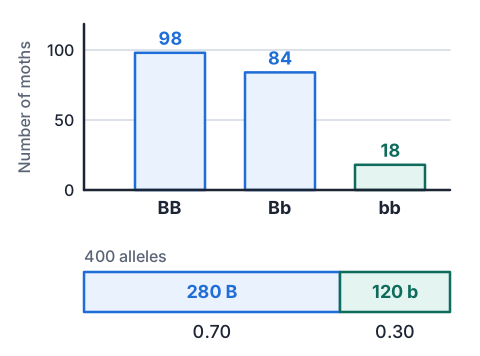
- total alleles = 200 moths × 2 = 400every moth carries two copies of the gene
- B alleles = (2 × 98) + 84 = 280each BB moth has two B, each Bb moth has one
- b alleles = (2 × 18) + 84 = 120
- f(B) = 280 ÷ 400 = 0.70 and f(b) = 120 ÷ 400 = 0.30
- 0.70 + 0.30 = 1the frequencies for one gene always add to 1
- f(b) = 18 ÷ 200 = 0.09counts only the bb moths, and forgets the b alleles hidden in Bb moths
Natural selection
- Individuals in a population vary, and much of that variation is inherited, coming from different alleles.
- More offspring are produced than the environment can support, so they compete for food, mates and shelter, and face predators and disease. These are selection pressures.
- Individuals whose phenotype suits the environment better are more likely to survive and reproduce, so they pass on more copies of their alleles.
- Over many generations the advantageous allele increases in frequency and the disadvantageous allele decreases, and it may be lost.
- Selection acts on phenotypes, not directly on alleles, so a harmful recessive allele can hide in heterozygotes and fall only slowly. Sexual selection is a kind of natural selection where the advantage is in winning mates.
Genetic drift, bottlenecks and founders
- Genetic drift is a change in allele frequency by chance: which individuals happen to breed, or which alleles happen to end up in the gametes that are fertilised, not which are better suited.
- Drift matters most in small populations, where a few chance events make a large difference. An allele can drift to a frequency of 1 (fixed) or 0 (lost) even if it is useful.
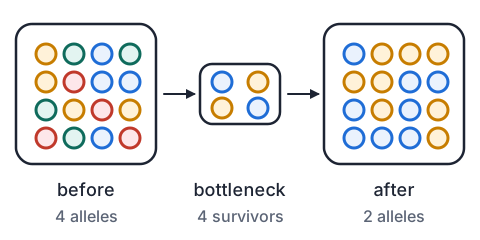
- A bottleneck is a sudden, big drop in population size, from a disaster, disease or hunting. The survivors carry only some of the original alleles, and their frequencies are a matter of chance.
- The founder effect happens when a few individuals start a new population somewhere else. The new gene pool holds only the founders' alleles, so it differs from the original one and has less diversity.
- After either event the population can grow back in number, but the lost alleles do not come back unless mutation or migration brings them in.
Migration (gene flow)
- Migration is the movement of individuals, and so their alleles, from one population to another, as long as they then breed there.
- Immigration adds alleles to a gene pool, and may bring in alleles it never had; emigration removes alleles.
- Gene flow makes neighbouring populations more alike, and it works against drift and against local selection pushing populations apart.
- A population that receives no migrants, such as on a remote island, drifts and adapts on its own, so it can end up with very different allele frequencies.
- When conservation staff move birds between sites, they are causing migration on purpose, to add diversity to a small gene pool.
Example: the black robin bottleneck
- The black robin lives only in the Chatham Islands. By 1980 just five birds were left, with one breeding pair: Old Blue (female) and Old Yellow.
- Every black robin alive now descends from Old Blue, so the whole species carries only the alleles that survived in that tiny group, and the robins have very similar DNA.
- The population has grown back to about 350 birds, but numbers do not restore diversity: the lost alleles are gone, and the birds share the same weaknesses, so a single disease could affect them all.
- In a population of five, which alleles survived was decided far more by chance (drift) than by how useful they were.
| Year | Black robins |
|---|---|
| 1972 | 18 birds on Little Mangere Island |
| 1976 | 7 birds |
| 1980 | 5 birds, one breeding pair |
| 2013 | about 250 |
| 2021 | about 300 |
| 2025 | about 350 |
Example: rim eggs, people and natural selection
- Some black robin females lay eggs on the rim of the nest, where they never hatch. To save every egg, the recovery team pushed rim eggs back into the nest, and they hatched.
- Researchers traced the trait back through the family tree to one of the founding males, and it fits a single dominant allele.
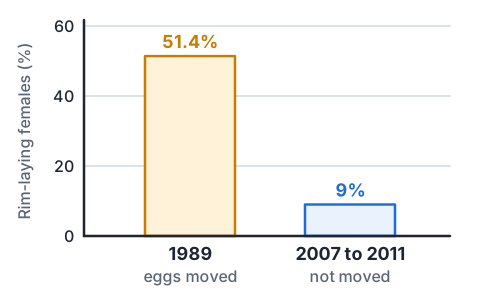
- With rim eggs rescued, the selection pressure against the allele was removed, and in such a small population it spread: by 1989, 18 of 35 females laid rim eggs.
- The team stopped moving eggs in 1990. Rim eggs failed again, rim-laying females raised fewer chicks, and natural selection pushed the allele's frequency back down.
| Measure | Value |
|---|---|
| Females laying rim eggs, 1989 | 51.4% (18 of 35) |
| Females laying rim eggs, 2007 to 2011 | 9% on average |
| Mean clutch size, 2007 to 2011 | 1.12 eggs for rim layers, 2.02 for normal layers |
Kākāpō: a bottleneck and a lost lineage
- Kākāpō once lived throughout Aotearoa, but by the mid-1900s they had nearly gone. Searches in Fiordland from 1949 found only males.
- In 1977 a population of about 200 was found on southern Rakiura, and females were confirmed there in 1980. Almost all of the species' remaining gene pool was in that one island population.
- By 1995 the population had fallen to 51 birds, a severe bottleneck; DOC's kākāpō page now counts 325.
- Kākāpō are taonga, and Ngāi Tahu work alongside DOC in their recovery. Breeding birds are managed so that alleles from as many founders as possible are passed on, slowing the loss of diversity by drift.
| Year | What happened |
|---|---|
| 1949 to 1973 | over 60 expeditions, mainly in Fiordland; six birds caught, all male |
| 1977 | 18 more found in Fiordland, still no females; about 200 found on Rakiura |
| 1980 | females confirmed on Rakiura |
| 1995 | population down to 51 birds |
Takahē: one surviving population
- Takahē were thought to be extinct for nearly 50 years until 1948, when Geoffrey Orbell's party found them in the Murchison Mountains in Fiordland.
- Every takahē today descends from that one surviving population, so their gene pool holds only the alleles that had survived there, a founder effect for every new site they are moved to.
- Numbers have grown to around 500, and birds are spread across several sites, which protects the species from a single disaster.
- Small, separate sites each drift on their own, so moving birds between them (migration) keeps their gene pools mixed.
| Year | Takahē |
|---|---|
| 1948 | rediscovered in the Murchison Mountains |
| 2016 | 300 birds |
| 2023 | around 500 birds |
What Achieved, Merit and Excellence look like
- Achieved defines the terms and names the process; Merit explains how the process changes allele frequencies, with an idea of an allele becoming more common, fixed or lost; Excellence links the processes to each other and to the evidence in the question.
| Grade | A model answer |
|---|---|
| Achieved | A gene pool is all the alleles in a population. A bottleneck is a sudden big drop in population size, like the black robin falling to five birds. |
| Merit | Only the alleles carried by the five survivors could be passed on, so many alleles were lost from the gene pool. Which ones survived was down to chance, which is genetic drift, so some alleles became fixed and genetic diversity fell. |
| Excellence | With one breeding pair, the gene pool shrank to at most four alleles of each gene, chosen by chance rather than by how useful they were. Drift kept acting while the population stayed tiny, fixing some alleles, and the rim-laying allele could rise to over half of females once rescue removed selection against it. Today's 350 birds all descend from Old Blue, so numbers recovered but diversity did not: the robins share the same weaknesses and could all be hit by one new disease, and no migrants exist to bring new alleles in. |
Common mistakes
- Individuals evolve when they adapt to their environment.Populations evolve: allele frequencies in the gene pool change over generations, while each individual keeps the alleles it was born with.
- After a bottleneck, once the population grows back, its genetic diversity comes back too.The alleles lost in the bottleneck are gone; growth only makes more copies of the survivors' alleles, unless mutation or migration adds new ones.
- Genetic drift means the best adapted alleles become more common.That is natural selection; drift is a change by chance, and it can even fix a harmful allele in a small population.
- With 98 BB, 84 Bb and 18 bb, the frequency of b is 18 ÷ 200.Count alleles, not individuals: b = (2 × 18) + 84 = 120 out of 400, so f(b) = 0.30.
Model genetic drift with dried beans
You need: 40 dried beans of one kind, 40 dried beans, pasta shapes or buttons of another kind, a mug or paper bag you cannot see into, a pen and paper
- Put 20 of each kind in the mug: a gene pool of 40 alleles with each allele at a frequency of 0.5.
- Without looking, take out 10 as the next generation's parents, count each kind and work out the frequencies (for example 7 and 3 gives 0.7 and 0.3).
- Refill the mug to 40 in that ratio (7 and 3 becomes 28 and 12), mix, and draw 10 again; repeat for 6 generations or until one kind is gone.
- Start again at 20 and 20, but now draw 30 each generation and refill to 40 in the new ratio.
- Look for: with only 10 parents the frequencies jump about and one allele is often lost within a few generations; with 30 they stay much closer to 0.5. Nothing about the beans is better, so this is drift, and it is strongest in small populations.
Safety: Do not eat the beans: raw dried beans, especially kidney beans, are poisonous until properly cooked, and keep them away from small children, who can choke on them.
Your turn
A population of 50 snails has 18 AA, 24 Aa and 8 aa. Find the frequency of A and of a.
The frequency of allele B in a population is 0.35. What is the frequency of its only other allele, b?
A storm kills most of a small island population of skinks, and which ones die is down to luck. Which process has changed the gene pool?
Six birds are blown to a new island and start a population there. What is this called?
In 1989, 18 of 35 black robin females laid rim eggs. What percentage is that, to one decimal place?
Which process adds alleles to a gene pool from another population of the same species?
Show answer
1. Total alleles = 50 × 2 = 100. A = (2 × 18) + 24 = 60, so f(A) = 0.60; a = (2 × 8) + 24 = 40, so f(a) = 0.40. 2. 1 − 0.35 = 0.65. 3. Genetic drift, as a bottleneck: survival was by chance, not by phenotype. 4. The founder effect, a kind of genetic drift: the new gene pool holds only the six founders' alleles. 5. 18 ÷ 35 × 100 = 51.4%. 6. Migration (immigration), also called gene flow.
Exam-style question: the black robin
- In 1980 only five black robins survived, with one breeding pair. Some females lay eggs on the rim of the nest, a trait that fits a single dominant allele (R). Rim eggs never hatch unless people move them into the nest. Staff did this until 1990: in 1989, 51.4% of females were rim layers, and in 2007 to 2011, after it stopped, 9% were.
Describe what is meant by a gene pool and allele frequency.
Explain why the 1980 bottleneck reduced the genetic diversity of the black robin.
Suppose a sample of 40 robins contained 2 RR, 12 Rr and 26 rr birds (practice numbers, not real counts). Calculate the frequency of R and of r.
Discuss how human management and natural selection changed the frequency of the rim-laying allele between 1980 and 2011.
Show answer
1. A gene pool is all the alleles of all the individuals in a population; allele frequency is the proportion of the copies of one gene that are a particular allele (Achieved). 2. Only the five survivors' alleles could be passed on, so all other alleles were lost; with so few birds, which alleles survived and how common they became was down to chance (drift), so some alleles were fixed and diversity fell (Merit). 3. Total alleles = 40 × 2 = 80; R = (2 × 2) + 12 = 16, so f(R) = 16 ÷ 80 = 0.20; f(r) = 1 − 0.20 = 0.80 (check: (2 × 26) + 12 = 64, and 64 ÷ 80 = 0.80) (Achieved for the method, Merit with full working). 4. Normally the R allele is selected against, because rim eggs fail and rim-laying females leave fewer offspring. Moving the eggs removed that selection pressure, so R-carrying females raised as many chicks as others; in a population descended from so few founders, chance (drift) let R spread until over half the females (51.4%) laid rim eggs by 1989. Once staff stopped in 1990, rim eggs failed again: rim layers laid smaller clutches and raised fewer chicks, so fewer copies of R were passed on each generation and natural selection cut the share of rim layers to 9% by 2007 to 2011. R is dominant, so every carrier shows the trait and is exposed to selection, which is why it fell quickly, though in a small population drift can keep it from being lost entirely (Excellence: links the removal and return of the selection pressure, drift in the small population, and the data).
Natural Selection
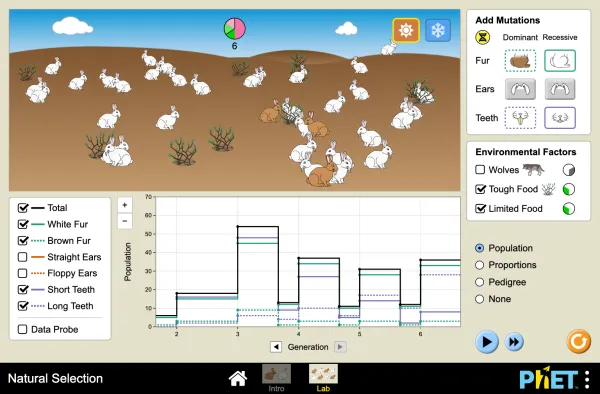
Full screen · PhET Interactive Simulations, University of Colorado Boulder, CC BY 4.0
Recap
- A gene pool is every allele in a population; allele frequencies for one gene add to 1.
- Count alleles, not individuals: each homozygote has two copies, each heterozygote one.
- Natural selection changes frequencies because of an advantage; drift changes them by chance; migration moves alleles between populations.
- Bottlenecks and founder events leave small gene pools that drift strongly, as in black robins, kākāpō and takahē.
| Process | What changes the frequencies | Strongest when |
|---|---|---|
| Natural selection | phenotypes that survive and breed better | selection pressure is strong |
| Genetic drift | chance | the population is small |
| Bottleneck | chance survival of a few | a disaster cuts numbers sharply |
| Founder effect | only the founders' alleles | very few individuals start the population |
| Migration | alleles carried in or out | many individuals move and breed |
The maths behind it
How is NCEA Level 2 maths going?
See the NCEA Level 2 maths guide