Compound and double-angle formulae
What this lesson covers
- sin(A + B) = sin A cos B + cos A sin B.
- cos(A + B) = cos A cos B − sin A sin B.
- sin 2A = 2 sin A cos A, and cos 2A has three forms.
The double angles
- Sin 2A = 2 sin A cos A.
- Cos 2A = cos²A − sin²A = 2cos²A − 1 = 1 − 2sin²A.
Try it: double-angle identities
An exact value of sin 75°
- Split 75° into 45° + 30°.
- sin 45° cos 30° + cos 45° sin 30°
- = (1/√2)(√3/2) + (1/√2)(1/2)
- = (√6 + √2) ÷ 4
Given sin A = 3/5, A acute
- Use a 3, 4, 5 triangle to get cos A = 4/5.
- sin 2A = 2 × 3/5 × 4/5 = 24/25
- cos 2A = 1 − 2(9/25)
- cos 2A = 7/25
The difference versions
- Sin(A − B) = sin A cos B − cos A sin B.
- Cos(A − B) = cos A cos B + sin A sin B.
- Put B = A in cos(A + B) and the double-angle forms appear: cos 2A = cos²A − sin²A.
Solving with a double angle
- Solve sin 2x = sin x for 0 ≤ x ≤ 2π. Expand, then factorise. Never divide by sin x.
- 2 sin x cos x − sin x = 0
- sin x (2 cos x − 1) = 0
- sin x = 0: x = 0, π, 2π
- cos x = 1/2: x = π/3, 5π/3
Two waves make one
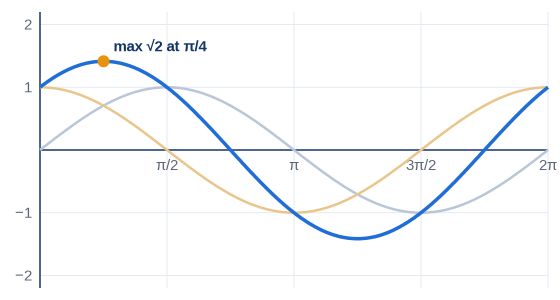
- Adding sin x and cos x gives a single wave: sin x + cos x = √2 sin(x + π/4).
- In general, a sin x + b cos x = R sin(x + α), where R = √(a² + b²) and tan α = b/a.
Try it: two waves make one
Writing one wave
- Write √3 sin x + cos x as R sin(x + α).
- R = √(3 + 1) = 2
- tan α = 1/√3, so α = π/6
- √3 sin x + cos x = 2 sin(x + π/6)
Common mistakes
- Writing sin(A + B) = sin A + sin B.Sine does not split across a plus sign.
- Using the wrong sign in cos(A + B).The cosine formula changes the sign.
Your turn
Which expansion is correct?
sin A = 1/3. Find cos 2A.
Find cos 75° exactly.
Find the maximum of 3 sin x + 4 cos x.
Show answer
1. sin(A − B) = sin A cos B − cos A sin B 2. 1 − 2(1/9) = 7/9 3. cos 45° cos 30° − sin 45° sin 30° = (√6 − √2) ÷ 4 4. R = √(9 + 16) = 5
Sample question: Achieved
Given sin A = 45 with A acute, find sin 2A.
Hint
Find cos A first from sin²A + cos²A = 1, then use sin 2A = 2 sin A cos A.
Answer
sin 2A = 2425
Step by step
- sin 2A = 2 sin A cos A, so we need cos A as well as sin A.
- sin A = 45: think of a right triangle with opposite side 4 and hypotenuse 5.
- Pythagoras: adjacent = √(5² − 4²) = √9 = 3, so cos A = 35. A is acute, so cos A is positive.
- sin 2A = 2 × 45 × 35 = 2425.
Full working
- cos A = √(1 − 1625) = 35A is acute, so cos A > 0
- sin 2A = 2 × 45 × 35sin 2A = 2 sin A cos A
- sin 2A = 2425
Sample questions: Merit
Solve cos 2x = cos x for 0 ≤ x ≤ 2π.
Hint
Use the form of cos 2x that has only cos x in it. That gives a quadratic in cos x.
Answer
x = 0, 2π3, 4π3 or 2π
Step by step
- There are two different angles, 2x and x. To solve, we want everything in terms of one thing: cos x.
- The formula sheet gives three forms of cos 2x. Pick 2cos²x − 1, because it has only cos x in it.
- Replace cos 2x: 2cos²x − 1 = cos x.
- Move everything to the left: 2cos²x − cos x − 1 = 0.
- This is a quadratic. Write c for cos x to see it: 2c² − c − 1 = 0.
- Factorise: (2c + 1)(c − 1) = 0, so c = −12 or c = 1.
- Solve cos x = 1. On the unit circle cos is 1 at the start of a turn: x = 0 and x = 2π.
- Solve cos x = −12. Ignore the minus sign first: cos x = 12 gives the reference angle π3.
- Cos is negative in quadrants 2 and 3. Quadrant 2: π − π3 = 2π3. Quadrant 3: π + π3 = 4π3.
- Put all the answers in order: x = 0, 2π3, 4π3, 2π.
- Check one: at x = 2π3, cos(4π3) = −12 and cos(2π3) = −12. Both sides match.
Full working
- 2cos²x − 1 = cos xcos 2x = 2cos²x − 1
- 2cos²x − cos x − 1 = 0a quadratic in cos x
- (2cos x + 1)(cos x − 1) = 0factorise
- cos x = 1 gives x = 0 or 2π
- cos x = −12 gives x = 2π3 or 4π3cos is negative in quadrants 2 and 3
- x = 0, 2π3, 4π3, 2π
Given cos A = −513 with π2 < A < π, find the exact values of sin 2A and cos 2A.
Hint
Find sin A from sin²A + cos²A = 1 (a 5, 12, 13 triangle). Its sign comes from the quadrant.
Answer
sin 2A = −120169 and cos 2A = −119169
Step by step
- sin 2A = 2 sin A cos A and cos 2A = cos²A − sin²A. Both need sin A, so find sin A first.
- cos A = −513: think of a right triangle with adjacent side 5 and hypotenuse 13 (leave the sign for later).
- Pythagoras: opposite = √(13² − 5²) = √(169 − 25) = √144 = 12. So sin A is 1213 in size.
- Now the sign. π2 < A < π puts A in quadrant 2, where sin is positive and cos is negative. So sin A = 1213.
- sin 2A = 2 × 1213 × (−513) = −120169.
- cos 2A = (−513)² − (1213)² = 25169 − 144169 = −119169.
- Check: (120169)² + (119169)² should be 1. 14400 + 14161 = 28561 = 169², so it is.
Full working
- sin²A = 1 − 25169 = 144169sin²A + cos²A = 1
- sin A = 1213A is in quadrant 2, where sin is positive
- sin 2A = 2 × 1213 × (−513) = −120169sin 2A = 2 sin A cos A
- cos 2A = 25169 − 144169 = −119169cos 2A = cos²A − sin²A
- sin 2A = −120169, cos 2A = −119169
Sample questions: Excellence
Write √3 sin x + cos x as R sin(x + α). Hence solve √3 sin x + cos x = 1 for 0 ≤ x ≤ 2π, and find the maximum value of √3 sin x + cos x and where it happens.
Hint
Expand R sin(x + α) = R sin x cos α + R cos x sin α and match it with √3 sin x + cos x. When you solve, shift the interval by α too.
Answer
2 sin(x + π6); x = 0, 2π3 or 2π; the maximum is 2, at x = π3
Step by step
- The aim: turn two terms, √3 sin x + cos x, into one sine. One sine is much easier to solve.
- Expand the form we want: R sin(x + α) = R sin x cos α + R cos x sin α.
- Match it with √3 sin x + 1 cos x: R cos α = √3 and R sin α = 1.
- Find R: square both and add. R² = 3 + 1 = 4, so R = 2.
- Find α: divide them. tan α = 1√3, so α = π6. Both parts are positive, so α is in quadrant 1.
- So √3 sin x + cos x = 2 sin(x + π6).
- Now solve 2 sin(x + π6) = 1, so sin(x + π6) = 12.
- Call the bracket θ. Since 0 ≤ x ≤ 2π, add π6 to both ends: π6 ≤ θ ≤ 13π6.
- sin θ = 12: sin is positive in quadrants 1 and 2, so θ = π6 or 5π6. One more turn gives π6 + 2π = 13π6, still in range.
- Take away π6: x = 0, 2π3 or 2π.
- Maximum: sin is never more than 1, so 2 sin(x + π6) is never more than 2.
- It reaches 2 when x + π6 = π2, so x = π2 − π6 = π3.
Full working
- R cos α = √3 and R sin α = 1match the sin x and cos x terms
- R = √(3 + 1) = 2, tan α = 1√3, so α = π6
- √3 sin x + cos x = 2 sin(x + π6)
- sin(x + π6) = 12, with π6 ≤ x + π6 ≤ 13π6add π6 to each end of 0 ≤ x ≤ 2π
- x + π6 = π6, 5π6 or 13π6
- x = 0, 2π3 or 2π
- Maximum 2 when x + π6 = π2sin is largest, 1, at π2
- x = 0, 2π3, 2π; maximum 2 at x = π3
Prove sin 3x = 3 sin x − 4 sin³x. Hence solve sin 3x = 2 sin x for 0 ≤ x ≤ 2π.
Hint
Write sin 3x as sin(2x + x) and use the compound angle formula. Then replace cos²x with 1 − sin²x. When you solve, factorise: do not divide by sin x.
Answer
x = 0, π6, 5π6, π, 7π6, 11π6 or 2π
Step by step
- Proof: start with the left side, sin 3x, and change it until it looks like the right side.
- Split the angle: 3x = 2x + x. Use sin(A + B) = sin A cos B + cos A sin B: sin 3x = sin 2x cos x + cos 2x sin x.
- Replace the double angles. sin 2x = 2 sin x cos x. For cos 2x choose 1 − 2sin²x, because the answer has only sin x.
- This gives 2 sin x cos²x + sin x − 2sin³x.
- There is still a cos²x. Replace it with 1 − sin²x: 2 sin x(1 − sin²x) = 2 sin x − 2sin³x.
- Add it all: 2 sin x − 2sin³x + sin x − 2sin³x = 3 sin x − 4sin³x. That is the right side, so it is proved.
- "Hence" means use this result: 3 sin x − 4sin³x = 2 sin x.
- Move everything to one side: sin x − 4sin³x = 0.
- Do not divide by sin x: you would lose the answers where sin x = 0. Factorise instead: sin x(1 − 4sin²x) = 0.
- First factor: sin x = 0 at x = 0, π and 2π.
- Second factor: 4sin²x = 1, so sin²x = 14 and sin x = 12 or −12.
- sin x = 12 gives π6 and 5π6. sin x = −12 gives 7π6 and 11π6.
- All together: x = 0, π6, 5π6, π, 7π6, 11π6, 2π.
Full working
- sin 3x = sin 2x cos x + cos 2x sin xsin(A + B) with A = 2x, B = x
- = 2 sin x cos²x + (1 − 2sin²x) sin xdouble angle formulas
- = 2 sin x(1 − sin²x) + sin x − 2sin³xcos²x = 1 − sin²x
- = 3 sin x − 4sin³xproved
- 3 sin x − 4sin³x = 2 sin xhence
- sin x(1 − 4sin²x) = 0dividing by sin x would lose sin x = 0
- sin x = 0 gives x = 0, π, 2π
- sin x = ±12 gives x = π6, 5π6, 7π6, 11π6
- x = 0, π6, 5π6, π, 7π6, 11π6, 2π
What to take away
- Split the angle into known pieces.
- Choose the cos 2A form that suits the question.
Practise this
Report a mistake
More in AS 91575

Is your child on track?
Take the free placement test