Modelling periodic situations

What this lesson covers
- The midline is the average of the maximum and minimum.
- The amplitude is half their difference.
- b = 2π ÷ period.
Building the model
- Use a cosine if it starts at a maximum.
- Use −cos if it starts at a minimum.
- Use sine if it starts on the midline, going up.
A tide
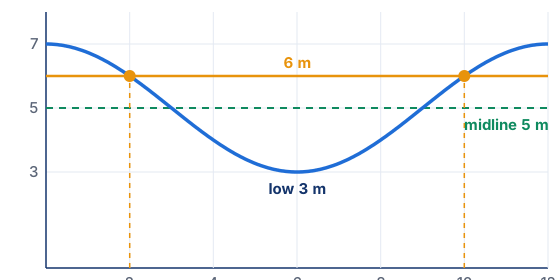
- High tide is 7 m at t = 0 and low tide is 3 m six hours later.
- midline = 5, amplitude = 2
- period 12, so b = π/6
- h = 2 cos(πt/6) + 5
When is the water 6 m deep?
- Solve with the model.
- 2 cos(πt/6) + 5 = 6
- cos(πt/6) = 1/2
- πt/6 = π/3 or 5π/3
- t = 2 and t = 10 hours
Try it: when is the water 6 m?
See the two answers
- The line h = 6 crosses the tide curve twice in 12 hours, at t = 2 and t = 10.
Try it: build a model
- Set a, b, c and the shift to fit a situation. Press Match this curve for practice.
Graphing calculator
Daylight hours
- In an invented town, daylight peaks at 15 hours in December and falls to 9 hours in June. Let t be months after December.
- midline = 12, amplitude = 3
- period 12, so b = π/6
- H = 3 cos(πt/6) + 12
- H = 13.5: cos(πt/6) = 1/2
- t = 2 and t = 10
Common mistakes
- Using the time from high to low as the period.That is half a period.
- Giving only the first solution.Check for every time in the range asked.
Your turn
A pattern repeats every 24 hours. Find b.
A model has a maximum of 20 and a minimum of 8. Find the midline and amplitude.
A model starts at its minimum. Which form fits?
Find the period of h = 3 sin(πt/2) + 5.
Show answer
1. 2π ÷ 24 = π/12 2. Midline 14, amplitude 6 3. A negative cosine: y = −a cos(bt) + c 4. 2π ÷ (π/2) = 4
Sample question: Achieved
A model has a maximum of 18, a minimum of 6 and a period of 12. Find a, b and c for y = a cos(bt) + c.
Hint
a is half the distance from the minimum to the maximum, c is the midline, and b = 2π ÷ period.
Answer
a = 6, b = π6, c = 12
Step by step
- The amplitude a is half the gap between the maximum and the minimum: (18 − 6) ÷ 2 = 6.
- The midline c is halfway between them: (18 + 6) ÷ 2 = 12.
- The period is 12, and period = 2π ÷ b, so b = 2π ÷ 12 = π6.
- Check: the largest value is 6 + 12 = 18 and the smallest is 12 − 6 = 6. Correct.
Full working
- a = (18 − 6) ÷ 2 = 6amplitude
- c = (18 + 6) ÷ 2 = 12midline
- b = 2π ÷ 12 = π6period = 2π ÷ b
- a = 6, b = π6, c = 12
Sample questions: Merit
With h = 4 cos(πt6) + 10, for how long in the 12 hours from t = 0 is the depth above 12 m?
Hint
Find when h = 12 first. Then use the starting depth to decide which parts are above 12 m.
Answer
4 hours (from t = 0 to 2 and from t = 10 to 12)
Step by step
- Read the model h = 4 cos(πt6) + 10: the midline is 10 m and the amplitude is 4 m, so the depth goes between 6 m and 14 m.
- The period is 2π ÷ (π6) = 12 hours, so 0 ≤ t ≤ 12 is exactly one cycle.
- Find when the depth is exactly 12 m: 4 cos(πt6) + 10 = 12.
- Subtract 10 and divide by 4: cos(πt6) = 12.
- Call the angle θ = πt6. For 0 ≤ t ≤ 12, θ goes from 0 to 2π. cos θ = 12 at θ = π3 and θ = 5π3.
- Change back to t: πt6 = π3 gives t = 2, and πt6 = 5π3 gives t = 10.
- Which parts are above 12 m? At t = 0 the depth is 4 + 10 = 14 m, above 12. So it is above from t = 0 to 2, below until t = 10, then above again to t = 12.
- Total: 2 + 2 = 4 hours.
Full working
- 4 cos(πt6) + 10 = 12, so cos(πt6) = 12
- πt6 = π3 or 5π30 ≤ πt6 ≤ 2π for 0 ≤ t ≤ 12
- t = 2 or t = 10
- h(0) = 14, above 12 mthe model starts at its maximum
- Above 12 m for 0 ≤ t < 2 and 10 < t ≤ 12
- 2 + 2 = 4 hours
A Ferris wheel has a radius of 20 m, its centre is 22 m above the ground and it turns once every 8 minutes. A rider gets on at the bottom at t = 0. Write a model for the rider's height h metres after t minutes, and find the exact height after 3 minutes.
Hint
Starting at the bottom means the height starts at its minimum, so use a negative cosine.
Answer
h = 22 − 20 cos(πt4); after 3 minutes h = 22 + 10√2 ≈ 36.1 m
Step by step
- Picture the wheel. The centre is 22 m up and the radius is 20 m, so the top is 42 m and the bottom is 2 m.
- Amplitude = radius = 20. Midline = height of the centre = 22.
- One turn takes 8 minutes, so the period is 8 and b = 2π ÷ 8 = π4.
- At t = 0 the rider is at the bottom. A cos graph starts at its top; a negative cos starts at its bottom. So use −20 cos.
- Model: h = 22 − 20 cos(πt4).
- Check: t = 0 gives 22 − 20 = 2 m, the bottom. t = 4 (half a turn) gives 22 + 20 = 42 m, the top.
- At t = 3: h = 22 − 20 cos(3π4).
- 3π4 is in quadrant 2, where cos is negative, with reference angle π4. So cos(3π4) = −√22.
- h = 22 − 20 × (−√22) = 22 + 10√2 ≈ 36.1 m.
Full working
- a = 20 and c = 22the radius and the height of the centre
- b = 2π ÷ 8 = π4one turn every 8 minutes
- h = 22 − 20 cos(πt4)check: h(0) = 2, the bottom
- h(3) = 22 − 20 cos(3π4)cos(3π4) = −√22
- h(3) = 22 + 10√2 ≈ 36.1 m
Sample questions: Excellence
High tide is 4.6 m at 3:00 am and the next low tide is 1.2 m at 9:15 am. A boat needs at least 2.5 m of water. Model the depth with a cosine function and find, to the nearest minute, the times when the boat cannot cross before the next high tide.
Hint
High tide to low tide is half a period. Measure t in hours from 3:00 am, so the model starts at a maximum and is a plain cosine.
Answer
h = 1.7 cos(4πt25) + 2.9; the boat cannot cross from about 6:36 am to 11:54 am
Step by step
- Set the clock: t is hours after 3:00 am. At t = 0 it is high tide, the maximum, so a plain cos curve fits.
- Amplitude = (high − low) ÷ 2 = (4.6 − 1.2) ÷ 2 = 1.7.
- Midline = (high + low) ÷ 2 = (4.6 + 1.2) ÷ 2 = 2.9.
- 3:00 am to 9:15 am is 6 h 15 min = 6.25 h. High to low is half a cycle, so the period is 12.5 h.
- b = 2π ÷ 12.5 = 4π25, about 0.5027.
- Model: h = 1.7 cos(4πt25) + 2.9.
- The boat is stuck when h < 2.5. Find when h = 2.5: 1.7 cos(4πt25) = −0.4, so cos(4πt25) = −0.2353.
- Calculator in radians: cos⁻¹(−0.2353) = 1.8083. The other angle in the same cycle is 2π − 1.8083 = 4.4749.
- Solve for t: t = 1.8083 × 25 ÷ 4π ≈ 3.598 h and t = 4.4749 × 25 ÷ 4π ≈ 8.902 h.
- Change to minutes: 0.598 × 60 ≈ 36 and 0.902 × 60 ≈ 54. So 3 h 36 min and 8 h 54 min after 3:00 am.
- That is 6:36 am and 11:54 am. Low tide (9:15 am) is between them, so the water is too shallow from about 6:36 am to 11:54 am.
Full working
- a = (4.6 − 1.2) ÷ 2 = 1.7, c = (4.6 + 1.2) ÷ 2 = 2.9amplitude and midline
- period = 2 × 6.25 = 12.5 h3:00 am to 9:15 am is half a period
- b = 2π ÷ 12.5 = 4π25 ≈ 0.5027
- h = 1.7 cos(4πt25) + 2.9t hours after 3:00 am
- 1.7 cos(4πt25) + 2.9 = 2.5, so cos(4πt25) = −0.4 ÷ 1.7 ≈ −0.2353
- 4πt25 = 1.8083 or 2π − 1.8083 = 4.4749calculator in radians
- t ≈ 3.598 h or 8.902 h3 h 36 min and 8 h 54 min after 3:00 am
- Below 2.5 m from about 6:36 am to 11:54 am
In a town, the longest day has 15 hours of daylight, on day 355 of the year, and the shortest has 9 hours, half a year later. Using a 365-day year, write a model for the hours of daylight D on day t, and find, to the nearest day, for how many days a year there is more than 13 hours of daylight.
Hint
The longest day is a maximum, so use a cosine shifted to t = 355. Then find the fraction of each cycle where D > 13.
Answer
D = 3 cos(2π(t − 355)365) + 12; about 143 days
Step by step
- Amplitude = (15 − 9) ÷ 2 = 3. Midline = (15 + 9) ÷ 2 = 12.
- One cycle is one year, 365 days, so b = 2π365.
- The longest day is a maximum. Cos starts at its maximum, so shift it to start at t = 355: D = 3 cos(2π(t − 355)365) + 12.
- Check: t = 355 gives 3 × 1 + 12 = 15 hours. Correct.
- We want D > 13: 3 cos(...) + 12 > 13, so cos(...) > 13.
- Calculator in radians: cos⁻¹(13) ≈ 1.231. Cos is above 13 when the angle is between −1.231 and 1.231, the part around each maximum.
- That window is 2 × 1.231 = 2.462 radians out of a full cycle of 2π ≈ 6.283.
- Fraction of the year: 2.462 ÷ 6.283 ≈ 0.392.
- Days: 0.392 × 365 ≈ 143 days.
Full working
- a = (15 − 9) ÷ 2 = 3, c = (15 + 9) ÷ 2 = 12, b = 2π365
- D = 3 cos(2π(t − 355)365) + 12maximum at t = 355
- D > 13 when cos(2π(t − 355)365) > 13
- cos θ > 13 for −1.231 < θ < 1.231cos⁻¹(13) ≈ 1.231
- fraction of the year = 2 × 1.231 ÷ 2π ≈ 0.392
- 0.392 × 365 ≈ 143 days
What to take away
- Max and min give the midline and amplitude.
- The period gives b.
Where science uses this
Practise this
Report a mistake
More in AS 91575



Is your child on track?
Take the free placement test