Trig functions and radians
What this lesson covers
- A radian is the angle whose arc equals the radius, so a full turn is 2π radians.
- On the unit circle, cos θ is the x value and sin θ is the y value.
- Exact values for π/6, π/4 and π/3 extend round the circle using symmetry.
- In y = a sin(b(x − d)) + c, a gives the amplitude, b sets the period, d shifts the graph and c is the midline.
- You can write an equation from a graph and solve simple equations exactly.
What a radian is
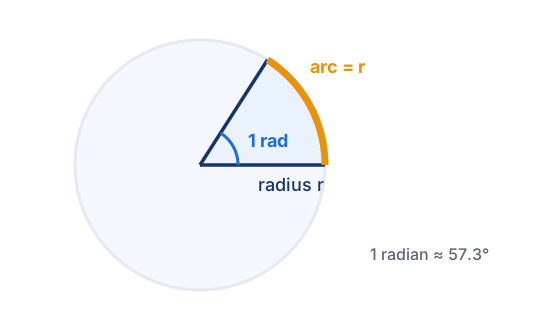
- Wrap the radius of a circle along its edge. The angle that arc makes at the centre is one radian.
- The whole circumference is 2πr, which is 2π radius lengths, so a full turn is 2π radians.
- That gives the one fact worth memorising: π radians = 180°.
Converting between degrees and radians
- Multiply by π/180 to reach radians. Multiply by 180/π to reach degrees.
- 150° = 150 × π/180degrees to radians
- = 5π/6simplify the fraction
- 3π/4 = 3π/4 × 180/πradians to degrees
- = 135°the π cancels
The unit circle
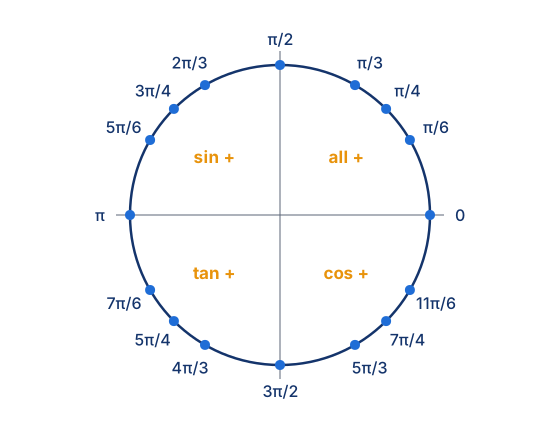
- Take a circle of radius 1 and turn anticlockwise from the positive x-axis by an angle θ.
- The point you reach is (cos θ, sin θ), and tan θ = sin θ ÷ cos θ.
- Each quadrant has its own signs, shown in orange below. All are positive in the first, sine in the second, tangent in the third and cosine in the fourth.
Watch the circle draw the wave
- Press Play. The height of the point on the circle is sin θ, and plotting that height against the angle draws the sine wave.
Exact values round the circle
- Learn the first quadrant, then find any other angle from its quadrant and its reference angle.
| θ | sin θ | cos θ | tan θ |
|---|---|---|---|
| 0 | 0 | 1 | 0 |
| π/6 | 1/2 | √3/2 | 1/√3 |
| π/4 | 1/√2 | 1/√2 | 1 |
| π/3 | √3/2 | 1/2 | √3 |
| π/2 | 1 | 0 | undefined |
- sin(5π/6) = sin(π/6) = 1/2second quadrant, sine positive
- cos(4π/3) = −cos(π/3) = −1/2third quadrant, cosine negative
- tan(7π/4) = −tan(π/4) = −1fourth quadrant, tangent negative
The sine and cosine graphs
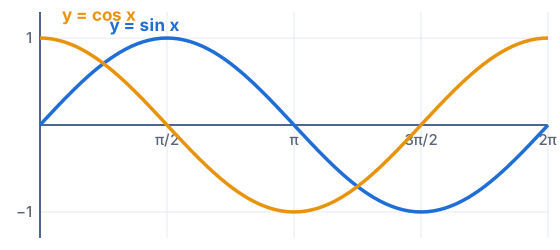
- Both repeat every 2π and stay between −1 and 1.
- Sine starts at 0 going up. Cosine starts at 1 and is the same wave shifted left by π/2.
The tangent graph
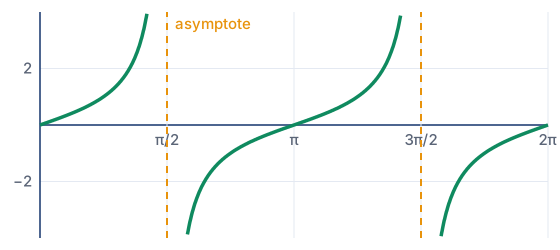
- Tangent repeats every π, not 2π.
- It has vertical asymptotes wherever cos x = 0, at x = π/2 + nπ, and its range is every real number.
What each number does
- Every sine or cosine graph fits y = a sin(b(x − d)) + c.
| Number | Job | Effect |
|---|---|---|
| a | Amplitude | Height above the midline is |a|; negative a flips the graph |
| b | Frequency | Period = 2π ÷ b |
| d | Horizontal shift | Moves the graph right by d |
| c | Midline | Moves the graph up by c |
Try it: change the numbers
- Move one slider at a time and watch which feature changes. Then press Match this curve and find the equation of the dashed graph.
Reading y = 3 sin(2x) + 1
- Each number gives one feature, and the maximum and minimum follow.
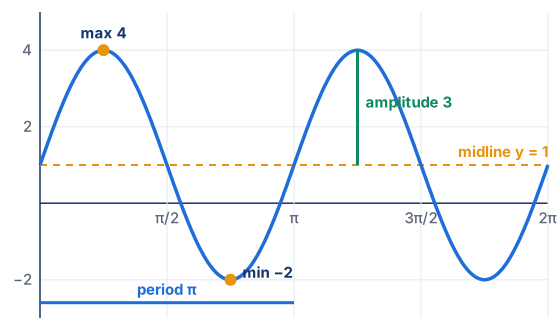
- amplitude = 3a = 3
- period = 2π ÷ 2 = πb = 2
- midline: y = 1c = 1
- maximum = 1 + 3 = 4, at x = π/4where sin(2x) = 1
- minimum = 1 − 3 = −2, at x = 3π/4where sin(2x) = −1
- range: −2 ≤ y ≤ 4
Writing the equation from a graph
- This graph has a maximum of 5, a minimum of −1, and one full wave from 0 to 4π. It starts on the midline going up, so it is a positive sine.
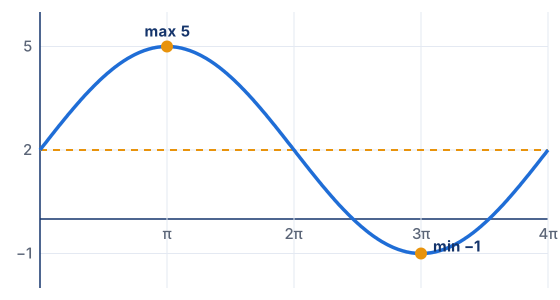
- c = (5 + (−1)) ÷ 2 = 2midline is the average
- a = (5 − (−1)) ÷ 2 = 3half the height
- b = 2π ÷ 4π = 1/2from the period
- y = 3 sin(x/2) + 2
Solving with a graph beside you
- Solve 2 sin x − 1 = 0 for 0 ≤ x ≤ 2π. The line y = 1/2 crosses the wave twice, so expect two answers.
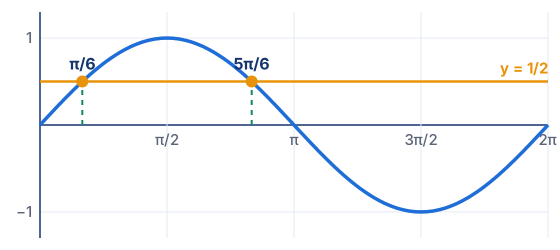
- sin x = 1/2rearrange
- reference angle = π/6
- x = π/6 or x = π − π/6sine is positive in quadrants 1 and 2
- x = π/6 or 5π/6
When the bracket is 2x
- Solve sin(2x) = √3/2 for 0 ≤ x ≤ π. Solve for 2x first, across the doubled range, and divide last.
- 0 ≤ 2x ≤ 2πdouble the range
- 2x = π/3 or 2π/3quadrants 1 and 2
- x = π/6 or π/3divide by 2
Common mistakes
- The period of sin(2x) is 4π, because the 2 stretches it.A bigger b squeezes the wave: the period is 2π ÷ 2 = π.
- In y = 2 sin x + 3, the maximum is 2.Add the amplitude to the midline: 3 + 2 = 5.
- Dividing sin(2x) = 1/2 by 2 to get sin x = 1/4.Sine is a function, so solve for 2x first and divide at the end.
- Giving only one solution to sin x = 1/2.Check every quadrant in the range: there are usually two answers per turn.
- Leaving the calculator in degrees.Set it to radians, and test it: sin(π/2) should give 1.
Your turn
What is the period of y = 4 sin(3x) − 2?
What is the range of y = 4 sin(3x) − 2?
Find cos(5π/3) exactly.
Write 150° in radians.
A graph starts at its maximum of 7, has a minimum of 1 and a period of π. Which equation fits?
Show answer
1. 2π ÷ 3 = 2π/3. 2. Midline −2 and amplitude 4 give −6 to 2. 3. Fourth quadrant with reference angle π/3, so 1/2. 4. 150 × π/180 = 5π/6. 5. Starting at a maximum means cosine: midline 4, amplitude 3, b = 2, so y = 3 cos(2x) + 4.
Sample question: Achieved
- For y = 5 sin(4x) + 2, state the amplitude, the period and the maximum value.
Show answer
Amplitude 5. Period 2π ÷ 4 = π/2. Maximum 2 + 5 = 7.
Sample question: Merit
- Find the exact solutions of 2 cos(2x) + 1 = 0 for 0 ≤ x ≤ π.
Show answer
cos(2x) = −1/2 with 0 ≤ 2x ≤ 2π. Cosine is negative in quadrants 2 and 3 with reference angle π/3, so 2x = 2π/3 or 4π/3, which gives x = π/3 or 2π/3.
Sample question: Excellence
- A graph y = a sin(bx) + c has a maximum of 9 at x = π/6, and its next minimum is −3 at x = π/2. Find a, b and c, then find the exact values of x in 0 ≤ x ≤ 2π/3 where y = 0.
Show answer
Midline c = (9 + (−3)) ÷ 2 = 3 and amplitude a = 6. Maximum to next minimum is half a period: π/2 − π/6 = π/3, so the period is 2π/3 and b = 3. Check: at x = π/6, sin(3x) = 1, so y = 9. Setting 6 sin(3x) + 3 = 0 gives sin(3x) = −1/2 with 0 ≤ 3x ≤ 2π, so 3x = 7π/6 or 11π/6, and x = 7π/18 or 11π/18.
What to take away
- π radians = 180°.
- On the unit circle, a point is (cos θ, sin θ).
- Amplitude is |a|, period is 2π ÷ b, midline is y = c.
- Solve for the whole bracket first, then divide.
More in AS 91575

Is your child on track?
Take the free placement test