Electron configuration and periodic trends
What this lesson covers
- Electron configurations in s, p, d notation for atoms of hydrogen to krypton, including the chromium and copper exceptions.
- Configurations of ions: transition metals lose 4s electrons before 3d.
- Atomic radius across a period and down a group, and why cations are smaller and anions larger than their atoms.
- First ionisation energy: the general trends and the dips at groups 13 and 16.
- Electronegativity trends, explained with nuclear charge, distance from the nucleus and shielding.
Shells, subshells and the filling order
- Each shell n is split into subshells: shell 1 has 1s; shell 2 has 2s and 2p; shell 3 has 3s, 3p and 3d; shell 4 starts with 4s and 4p.
- An s subshell has 1 orbital (2 electrons), p has 3 orbitals (6 electrons) and d has 5 orbitals (10 electrons); each orbital holds two electrons of opposite spin.
- Electrons fill the lowest energy subshell first, in the order 1s, 2s, 2p, 3s, 3p, 4s, 3d, 4p: 4s fills before 3d because, in the atom, it is slightly lower in energy.
- Within a p or d subshell, electrons go into separate orbitals before they pair up, because paired electrons repel.
- Write the configuration with superscripts for the number of electrons, in order of shell (3d before 4s): iron is 1s² 2s² 2p⁶ 3s² 3p⁶ 3d⁶ 4s², shortened to [Ar] 3d⁶ 4s².
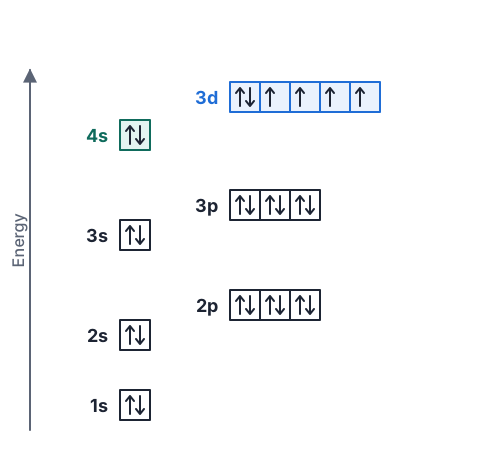
Example: configurations of atoms
- Write the full electron configurations of sodium (Z = 11), bromine (Z = 35) and chromium (Z = 24).
- Na: 1s² 2s² 2p⁶ 3s¹2 + 2 + 6 + 1 = 11
- Br: 1s² 2s² 2p⁶ 3s² 3p⁶ 3d¹⁰ 4s² 4p⁵2 + 2 + 6 + 2 + 6 + 10 + 2 + 5 = 35
- Cr expected [Ar] 3d⁴ 4s², but
- Cr: 1s² 2s² 2p⁶ 3s² 3p⁶ 3d⁵ 4s¹a half-filled 3d⁵ with 4s¹ is more stable
- copper does the same for a full 3d subshell: [Ar] 3d¹⁰ 4s¹
Configurations of ions
- A negative ion gains electrons into the next available subshell: Cl⁻ is 1s² 2s² 2p⁶ 3s² 3p⁶, the same as argon.
- A positive ion of a main group element loses its outer electrons: Al³⁺ is 1s² 2s² 2p⁶.
- A transition metal loses its 4s electrons first, then 3d: once 3d is filled it is lower in energy than 4s, and 4s is the outermost shell.
- So iron [Ar] 3d⁶ 4s² forms Fe²⁺ [Ar] 3d⁶ and Fe³⁺ [Ar] 3d⁵, and zinc [Ar] 3d¹⁰ 4s² forms Zn²⁺ [Ar] 3d¹⁰.
Example: configurations of ions
- Write the configurations of Mn²⁺ (Z = 25), Cr³⁺ (Z = 24) and Se²⁻ (Z = 34).
- Mn: [Ar] 3d⁵ 4s², so Mn²⁺: [Ar] 3d⁵both 4s electrons go
- Cr: [Ar] 3d⁵ 4s¹, so Cr³⁺: [Ar] 3d³the 4s electron goes first, then two 3d
- Mn²⁺ as [Ar] 3d³ 4s² is wrongit removes 3d electrons before 4s
- Se: [Ar] 3d¹⁰ 4s² 4p⁴, so Se²⁻: [Ar] 3d¹⁰ 4s² 4p⁶two electrons into 4p, the same as krypton
- Mn²⁺ [Ar] 3d⁵, Cr³⁺ [Ar] 3d³, Se²⁻ [Ar] 3d¹⁰ 4s² 4p⁶
Try it: match the ion to its configuration
Three factors behind every trend
- Nuclear charge: more protons pull every electron harder.
- Distance: electrons in a higher shell are further from the nucleus and feel a weaker attraction.
- Repulsion (shielding): inner electrons repel the valence electrons, cancelling much of the nuclear charge; electrons in the same shell shield each other only a little.
- Across a period, protons are added but the valence electrons stay in the same shell with the same inner shielding, so the attraction for them increases.
- Down a group, each element has one more shell, so the valence electrons are further away and more shielded; that outweighs the larger nuclear charge.
Atomic radius and ionic radius
- Atomic radius decreases across a period, because the stronger attraction pulls the same shell closer, and increases down a group, because of the extra shell.
- A positive ion is smaller than its atom: a main group cation has lost its whole valence shell, and every cation has fewer electrons repelling each other but the same number of protons.
- A negative ion is larger than its atom: same nuclear charge, more electrons in the valence shell, so more repulsion pushes them further apart.
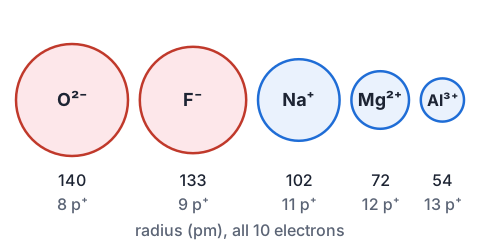
- In an isoelectronic series (same number of electrons), the ion with the most protons is smallest, because the same electron cloud is pulled in harder.
| Ion | Protons | Electrons | Radius (pm) |
|---|---|---|---|
| O²⁻ | 8 | 10 | 140 |
| F⁻ | 9 | 10 | 133 |
| Na⁺ | 11 | 10 | 102 |
| Mg²⁺ | 12 | 10 | 72 |
| Al³⁺ | 13 | 10 | 54 |
First ionisation energy
- The first ionisation energy is the energy needed to remove one mole of electrons from one mole of gaseous atoms: Mg(g) → Mg⁺(g) + e⁻.
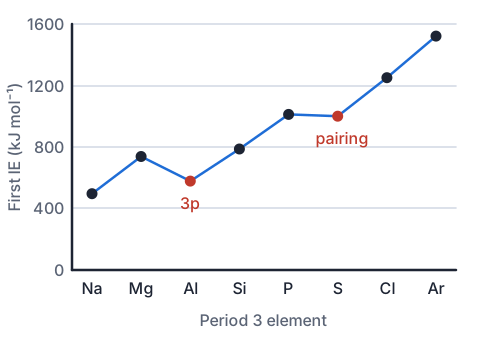
- It increases across a period (stronger attraction for electrons in the same shell) and decreases down a group (outer electron further away and more shielded).
- Dip at aluminium: its outer electron is in 3p, slightly higher in energy and partly shielded by the 3s² electrons, so it is easier to remove than magnesium's 3s electron.
- Dip at sulfur: its fourth 3p electron has to pair up in an orbital, and the repulsion between the pair makes one of them easier to remove than phosphorus's unpaired 3p electrons.
| Element | Na | Mg | Al | Si | P | S | Cl | Ar |
|---|---|---|---|---|---|---|---|---|
| First IE (kJ mol⁻¹) | 496 | 738 | 578 | 787 | 1012 | 1000 | 1251 | 1521 |
Try it: see the trends on the periodic table
Electronegativity
- Electronegativity is how strongly an atom attracts the bonding pair of electrons in a covalent bond, on Pauling's scale from about 0.7 to 4.0.
- It increases across a period: more protons, same shell, so the bonding electrons are pulled harder; fluorine is the most electronegative element.
- It decreases down a group: the bonding electrons are further from the nucleus and more shielded by inner shells.
- Noble gases are usually left out because they rarely form bonds; the difference in electronegativity between two atoms tells you how polar their bond is.
| Element | Na | Mg | Al | Si | P | S | Cl | F | Br | I |
|---|---|---|---|---|---|---|---|---|---|---|
| Electronegativity | 0.93 | 1.31 | 1.61 | 1.90 | 2.19 | 2.58 | 3.16 | 3.98 | 2.96 | 2.66 |
What Achieved, Merit and Excellence look like
- Achieved names a correct trend or one factor; Merit explains a trend with at least two factors; Excellence uses every relevant factor (protons, shells or distance, shielding or repulsion, strength of attraction) and links them to the answer for this pair of particles.
- In a comparison, say what is the same for both particles as well as what is different.
| Grade | A model answer |
|---|---|
| Achieved | S²⁻ has fewer protons than Cl⁻. |
| Merit | Both ions have 18 electrons in the same three shells, but S²⁻ has 16 protons and Cl⁻ has 17, so the electrons in S²⁻ are attracted less strongly. |
| Excellence | S²⁻ and Cl⁻ both have 18 electrons arranged 1s² 2s² 2p⁶ 3s² 3p⁶, so the distance of the outer shell and the shielding by inner electrons are the same. S²⁻ has 16 protons compared with 17 in Cl⁻, so the electrostatic attraction between its nucleus and the outer electrons is weaker, they are held less tightly, and the S²⁻ ion is larger. |
Common mistakes
- Fe²⁺ is [Ar] 3d⁴ 4s², because the last electrons in are the first out.Transition metals lose 4s electrons first: Fe²⁺ is [Ar] 3d⁶.
- Atomic radius gets bigger across a period because there are more electrons.The extra electrons go into the same shell while protons increase, so the radius gets smaller.
- Chromium is [Ar] 3d⁴ 4s², following the filling order.Chromium is [Ar] 3d⁵ 4s¹ and copper is [Ar] 3d¹⁰ 4s¹: a half-full or full 3d is more stable.
- Ionisation energy decreases down a group because there are more protons.There are more protons, but the outer electron is in a higher shell, further away and more shielded, which outweighs the extra protons.
Model shielding with a magnet and paper
You need: a fridge magnet, a box of steel paper clips, a stack of printer paper, a ruler
- Hang a chain of paper clips from the fridge magnet, adding clips one at a time, and record how many it holds.
- Put one sheet of paper between the magnet and the first clip, hold the paper against the magnet, and count again.
- Repeat with 2, 4, 8 and 16 sheets, and record the number of clips each time.
- Plot clips held against number of sheets.
- Look for: the magnet (the nucleus) holds fewer clips (electrons) as the gap grows, just as outer electrons in a higher shell, further out and shielded by inner shells, are held less strongly.
Safety: Small strong magnets are very dangerous if a child swallows two of them, so use a large fridge magnet and keep magnets away from young children.
Your turn
Write the electron configuration of titanium (Z = 22).
Write the electron configuration of Fe²⁺ (Z = 26).
Which is larger, a magnesium atom or a Mg²⁺ ion?
Which has the higher first ionisation energy, phosphorus or sulfur?
Put nitrogen, oxygen and fluorine in order of increasing electronegativity.
Show answer
1. 1s² 2s² 2p⁶ 3s² 3p⁶ 3d² 4s², or [Ar] 3d² 4s². 2. Iron is [Ar] 3d⁶ 4s²; the two 4s electrons go first, so Fe²⁺ is [Ar] 3d⁶. 3. The Mg atom: Mg²⁺ has lost its whole third shell, and its 12 protons pull the remaining 10 electrons in closer. 4. Phosphorus: its three 3p electrons are unpaired, while sulfur's fourth 3p electron is paired, and the repulsion makes it easier to remove. 5. N < O < F: across Period 2 the nuclear charge increases while the shell stays the same.
Exam-style question: particles of Period 3 and 4
Write the electron configurations of vanadium, V (Z = 23), and Ni²⁺ (Z = 28), using s, p, d notation.
Explain why the first ionisation energy of aluminium (578 kJ mol⁻¹) is lower than that of magnesium (738 kJ mol⁻¹).
The K⁺ ion has a radius of 138 pm and the Cl⁻ ion 181 pm. Explain why K⁺ is smaller, even though both ions have the same number of electrons.
Justify the trend in electronegativity from chlorine (3.16) to bromine (2.96) to iodine (2.66).
Show answer
1. V: 1s² 2s² 2p⁶ 3s² 3p⁶ 3d³ 4s²; Ni: [Ar] 3d⁸ 4s², so Ni²⁺: 1s² 2s² 2p⁶ 3s² 3p⁶ 3d⁸ (Achieved for both correct). 2. Magnesium's outer electron is in 3s and aluminium's is in 3p. The 3p electron is higher in energy and is partly shielded from the nucleus by the 3s² electrons, so although aluminium has one more proton, its 3p electron is held less tightly and less energy is needed to remove it (Merit links the subshell to the shielding; Excellence also explains why the extra proton does not outweigh it). 3. Both ions have 18 electrons as 1s² 2s² 2p⁶ 3s² 3p⁶, so the same number of shells and the same shielding. K⁺ has 19 protons and Cl⁻ only 17, so the nucleus of K⁺ attracts the same electron cloud more strongly and pulls it closer, making K⁺ smaller (Excellence names what is the same as well as the difference in protons). 4. Down group 17 each atom has an extra shell (Cl three, Br four, I five), so the bonding pair is further from the nucleus and more shielded by inner electrons. Although the number of protons increases, the greater distance and shielding weaken the attraction for the bonding electrons, so electronegativity decreases from 3.16 to 2.96 to 2.66 (Excellence uses all of protons, shells, shielding and attraction).
Build an Atom
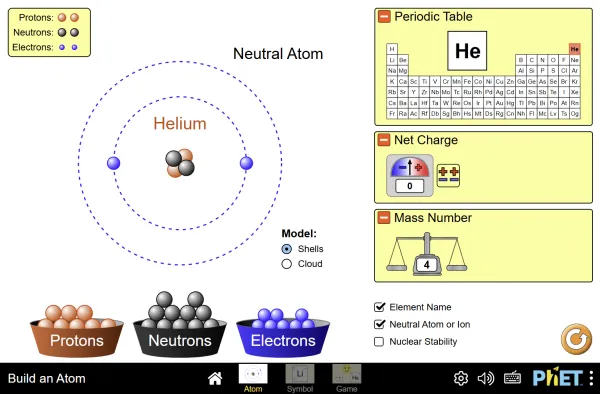
Full screen · PhET Interactive Simulations, University of Colorado Boulder, CC BY 4.0
Recap
- Fill 1s 2s 2p 3s 3p 4s 3d 4p; chromium and copper take 4s¹ to make 3d⁵ and 3d¹⁰.
- Ions: anions fill the next subshell; transition metal cations lose 4s before 3d.
- Every trend comes from nuclear charge, distance (number of shells) and shielding or repulsion.
- Radius falls across a period and rises down a group; cations shrink, anions grow; isoelectronic ions shrink as protons rise.
- Ionisation energy and electronegativity rise across a period and fall down a group; IE dips at groups 13 and 16.
| Property | Across a period | Down a group |
|---|---|---|
| Atomic radius | Decreases | Increases |
| First ionisation energy | Increases (dips at groups 13 and 16) | Decreases |
| Electronegativity | Increases | Decreases |
Report a mistake
How is NCEA Level 3 maths going?
See the NCEA Level 3 maths guide