Shapes, polarity and intermolecular forces
What this lesson covers
- Lewis structures for molecules and ions, including central atoms with more than eight electrons and multiple bonds.
- VSEPR: electron regions repel, so 2 to 6 regions give linear, trigonal planar, tetrahedral, trigonal bipyramidal and octahedral arrangements.
- How lone pairs give bent, trigonal pyramid, seesaw, T-shaped, square pyramid and square planar shapes, with their bond angles.
- Polar bonds from electronegativity differences, and polar molecules when the bond dipoles do not cancel.
- Temporary dipole attractions, permanent dipole attractions and hydrogen bonding, and what makes each stronger.
Lewis structures with up to six electron pairs
- Count the valence electrons of every atom, adding one for each negative charge and taking one away for each positive charge.
- Put the least electronegative atom (not H) in the centre, join each outer atom to it with a single bond (2 electrons), then complete the octets of the outer atoms with lone pairs.
- Any electrons left over go on the central atom as lone pairs; if the central atom then has fewer than eight, turn outer lone pairs into double bonds.
- Atoms from Period 3 onwards (P, S, Cl, Br, I, Xe) can hold more than eight electrons around them, so PCl₅ has 10 and SF₆ has 12; atoms of Period 2 (C, N, O, F) never exceed eight.
Example: Lewis structures of ClF₃ and XeF₄
- Draw the Lewis structures of chlorine trifluoride, ClF₃, and xenon tetrafluoride, XeF₄, and count the electron regions around each central atom.
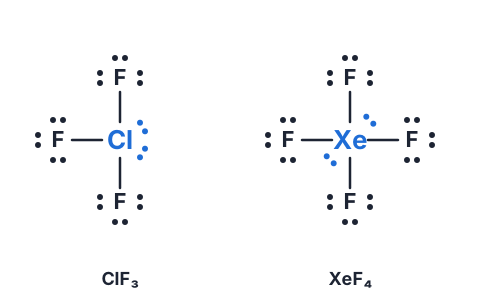
- ClF₃: 7 + 3 × 7 = 28 electrons, 14 pairs
- 3 bonds use 3 pairs; 3 lone pairs on each F use 9 pairs; 2 pairs left go on Cl
- Cl: 3 bonding regions + 2 lone pairs = 5 regions
- XeF₄: 8 + 4 × 7 = 36 electrons, 18 pairs
- 4 bonds use 4 pairs; 12 lone pairs on the F atoms; 2 pairs left go on Xe
- Xe: 4 bonding regions + 2 lone pairs = 6 regions
Shapes from electron regions
- Regions of electron density (a single, double or triple bond, or a lone pair) repel each other and spread out as far apart as possible, to minimise repulsion; a double bond counts as one region.
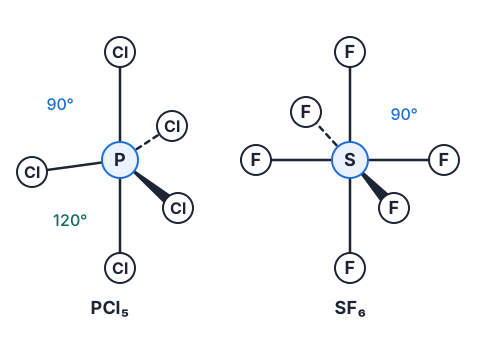
- The number of regions sets the arrangement: 2 linear, 3 trigonal planar, 4 tetrahedral, 5 trigonal bipyramidal, 6 octahedral.
- The shape names only where the atoms are; lone pairs are part of the arrangement but invisible in the shape.
- Lone pairs repel more strongly than bonding pairs, so they squeeze bond angles slightly: NH₃ is about 107° and H₂O about 104.5°, not 109.5°.
- With 5 regions, lone pairs go in the middle (equatorial) positions, where they have more room; with 6 regions, two lone pairs sit opposite each other.
| Regions | Lone pairs | Shape | Bond angle | Example |
|---|---|---|---|---|
| 2 | 0 | Linear | 180° | CO₂ |
| 3 | 0 | Trigonal planar | 120° | BF₃, NO₃⁻ |
| 3 | 1 | Bent | about 119° | SO₂ |
| 4 | 0 | Tetrahedral | 109.5° | CH₄, SiCl₄ |
| 4 | 1 | Trigonal pyramid | about 107° | NH₃, PCl₃ |
| 4 | 2 | Bent | about 104.5° | H₂O |
| 5 | 0 | Trigonal bipyramid | 90°, 120° and 180° | PCl₅ |
| 5 | 1 | Seesaw | less than 90° and 120° | TeCl₄ |
| 5 | 2 | T-shaped | about 87° | ClF₃ |
| 5 | 3 | Linear | 180° | XeF₂, I₃⁻ |
| 6 | 0 | Octahedral | 90° | SF₆ |
| 6 | 1 | Square pyramid | less than 90° | BrF₅ |
| 6 | 2 | Square planar | 90° | XeF₄ |
Try it: shapes in 3D
Example: naming shapes
- Give the shape and bond angles of ClF₃, XeF₄ and the nitrate ion, NO₃⁻.
- ClF₃: 5 regions, 2 lone pairs in equatorial positionstrigonal bipyramidal arrangement
- ClF₃ is T-shaped, F–Cl–F about 87°
- XeF₄: 6 regions, 2 lone pairs opposite each otheroctahedral arrangement
- XeF₄ is square planar, F–Xe–F 90°
- NO₃⁻: 5 + 3 × 6 + 1 = 24 electrons; one N=O and two N–O, no lone pairs on N, so 3 regions
- NO₃⁻ is trigonal planar, O–N–O 120°
Polar bonds and polar molecules
- A covalent bond between atoms of different electronegativity is polar: the bonding pair is pulled towards the more electronegative atom, which becomes δ−, leaving the other δ+.
- A molecule is polar only if its bond dipoles do not cancel, which depends on the shape.
- Symmetrical shapes with identical outer atoms cancel and are non-polar: linear CO₂ and XeF₂, trigonal planar BF₃, tetrahedral CH₄, trigonal bipyramidal PCl₅, octahedral SF₆ and square planar XeF₄.
- Shapes with lone pairs that make them lopsided are polar: bent, trigonal pyramid, seesaw, T-shaped and square pyramid.
- A symmetrical shape with different outer atoms can be polar too: CH₃Cl is tetrahedral, but the C–Cl dipole is not cancelled by the C–H bonds.
Example: is it polar?
- Decide whether BrF₅ and XeF₄ are polar, and explain.
- F (3.98) is more electronegative than Br (2.96) or Xe, so every bond is polar with F δ−
- BrF₅: square pyramid; the lone pair sits opposite the top F, so the dipoles are not arranged symmetrically
- BrF₅ is polar: the bond dipoles do not cancel
- XeF₄: square planar; each Xe–F dipole has an equal one directly opposite it
- XeF₄ is non-polar: the bond dipoles cancel
Try it: polar or non-polar?
Forces between molecules
- Temporary dipole (TD) attractions act between all molecules: electrons move around, so at an instant the cloud is uneven, and that temporary dipole induces dipoles in neighbours.
- TD attractions get stronger as the electron cloud gets larger (more electrons, roughly a larger molar mass), because a large cloud is more easily distorted; long, straight molecules also touch over more surface than compact, branched ones.
- Permanent dipole (PD) attractions act between polar molecules, the δ+ end of one attracting the δ− end of the next, in addition to TD attractions.
- Hydrogen bonding is a strong permanent dipole attraction between an H atom bonded to N, O or F and a lone pair on an N, O or F atom of another molecule; the H is very δ+ and very small, so it gets close to the lone pair.
- Name every type of attraction present, then compare: hydrogen bonds are the strongest per attraction, but a very large electron cloud can give TD attractions that add up to more.
Example: boiling points of the hydrides
- The table gives the boiling points of the hydrides of groups 14 to 17. Explain the pattern for group 14, and why NH₃, H₂O and HF break the pattern of their groups.
| Period | Group 14 | Group 15 | Group 16 | Group 17 |
|---|---|---|---|---|
| 2 | CH₄ −162 °C | NH₃ −33 °C | H₂O 100 °C | HF 20 °C |
| 3 | SiH₄ −112 °C | PH₃ −88 °C | H₂S −60 °C | HCl −85 °C |
| 4 | GeH₄ −88 °C | AsH₃ −62 °C | H₂Se −41 °C | HBr −67 °C |
| 5 | SnH₄ −52 °C | SbH₃ −17 °C | H₂Te −2 °C | HI −35 °C |
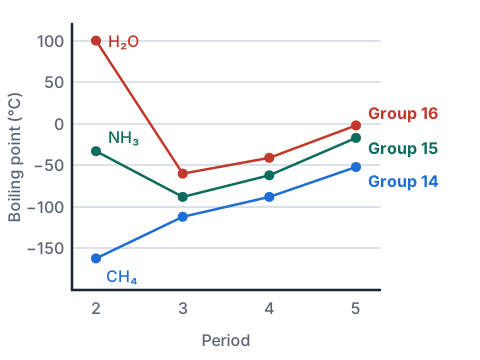
- group 14 hydrides are tetrahedral and non-polar: TD attractions only
- down the group the electron cloud grows (10, 18, 36, 54 electrons), so TD attractions strengthen and boiling points rise from −162 to −52 °C
- N, O and F are small and very electronegative, so NH₃, H₂O and HF form hydrogen bondsPH₃, H₂S and the rest cannot
- breaking hydrogen bonds needs much more energy, so the Period 2 hydrides boil far above the trend
- water is highest: each molecule has two δ+ H atoms and two lone pairs, so it forms up to four hydrogen bonds
What Achieved, Merit and Excellence look like
- Achieved names the attractions or a correct shape; Merit explains a difference using the type and strength of the attractions; Excellence compares all the substances, weighing hydrogen bonding and permanent dipoles against the size of the electron cloud.
- Always say that energy is needed to overcome the attractions between molecules, not to break the covalent bonds inside them.
| Grade | A model answer |
|---|---|
| Achieved | NH₃ has hydrogen bonding, and SbH₃ has the largest molecules. |
| Merit | NH₃ boils higher than PH₃ because NH₃ molecules are held by hydrogen bonds, which need more energy to overcome than the weak attractions between PH₃ molecules. SbH₃ is highest because its large electron cloud gives strong temporary dipole attractions. |
| Excellence | All three are trigonal pyramids with TD attractions. N is very electronegative, so NH₃ also has hydrogen bonds, which need much more energy to overcome than PH₃'s TD and weak PD attractions (P and H have almost equal electronegativity). SbH₃ cannot hydrogen bond, but with 54 electrons against NH₃'s 10, its electron cloud is so large and polarisable that its TD attractions are stronger in total than NH₃'s hydrogen bonds, so it boils highest. |
Common mistakes
- XeF₄ has six regions, so its shape is octahedral.The arrangement of regions is octahedral, but the shape names only the atoms: with two lone pairs, XeF₄ is square planar.
- When water boils, the O–H bonds break.Boiling overcomes the hydrogen bonds between molecules; the covalent O–H bonds inside each molecule stay intact.
- CH₃Cl contains a hydrogen atom and a chlorine atom, so it has hydrogen bonding.Hydrogen bonding needs H bonded directly to N, O or F; CH₃Cl has only TD and PD attractions.
- XeF₄ has polar bonds, so it is a polar molecule.Its square planar shape is symmetrical, so the four equal Xe–F dipoles cancel out, giving a non-polar molecule.
Drops on a coin: hydrogen bonding at work
You need: a 10 cent coin, an eye dropper or a drinking straw, a glass of tap water, dishwashing liquid, a paper towel
- Dry the coin and lay it flat on the paper towel.
- Add tap water one drop at a time from the same height, counting, until the dome of water spills over; repeat twice and average the count.
- Dry the coin, stir one drop of dishwashing liquid into the glass of water, and repeat the count with the soapy water.
- Look at the dome from the side each time, just before it spills.
- Look for: plain water piles up into a high dome because hydrogen bonds pull surface molecules inwards; detergent molecules get between the water molecules, weakening the pull, so the soapy dome spills after far fewer drops.
Safety: Coins are a choking hazard for small children, so put the coin away as soon as you finish.
Your turn
XeF₂ has 2 bonding regions and 3 lone pairs on xenon. What is its shape?
What is the shape and bond angle of SiCl₄?
What is the shape of BrF₅?
Is PCl₅ polar or non-polar?
Which attractions act between CH₃Cl molecules?
Show answer
1. Linear: the 3 lone pairs take the equatorial positions of a trigonal bipyramid, leaving the two F atoms opposite each other at 180°. 2. Tetrahedral, 109.5°: 4 bonding regions and no lone pairs on Si. 3. Square pyramid: 6 regions, 5 bonding and 1 lone pair. 4. Non-polar: the P–Cl bonds are polar, but the trigonal bipyramid is symmetrical and the dipoles cancel. 5. Temporary dipole and permanent dipole attractions; no hydrogen bonding, because no H is bonded to N, O or F.
Exam-style question: shapes and boiling points
Draw the Lewis structure of the ICl₄⁻ ion and name its shape.
Explain why the bond angle in NH₃ is about 107°, while in BF₃ it is 120°.
ClF₃ is polar but PCl₅ is non-polar. Explain why.
Ethanol, CH₃CH₂OH (46 g mol⁻¹), boils at 78 °C, methoxymethane, CH₃OCH₃ (46 g mol⁻¹), at −24 °C, and propane, C₃H₈ (44 g mol⁻¹), at −42 °C. Justify the order of boiling points.
Show answer
1. Electrons: 7 + 4 × 7 + 1 = 36 (18 pairs); 4 I–Cl bonds, 3 lone pairs on each Cl, 2 lone pairs on I. Six regions in an octahedral arrangement with the lone pairs opposite, so the shape is square planar (Achieved for the structure or shape, Merit for both). 2. NH₃ has 4 regions (3 bonding pairs and 1 lone pair), which repel into a tetrahedral arrangement; the lone pair repels more strongly than bonding pairs, squeezing the angle from 109.5° to about 107°. BF₃ has only 3 bonding regions and no lone pair, so they spread to 120° in a trigonal planar shape (Excellence compares the number of regions and the effect of the lone pair). 3. Both have polar bonds, as F and Cl are more electronegative than the central atoms. ClF₃ is T-shaped because two lone pairs occupy equatorial positions, so its three dipoles are not symmetrical and do not cancel; PCl₅ has no lone pairs and is a symmetrical trigonal bipyramid, so its five dipoles cancel. 4. The three molecules have similar numbers of electrons, so their TD attractions are similar. Propane is non-polar with TD attractions only, so it boils lowest. Methoxymethane has polar C–O bonds in a bent C–O–C, so it adds PD attractions and boils higher. Ethanol has an O–H group, so it also forms hydrogen bonds, the strongest attractions here, so far more energy is needed to separate its molecules and it boils highest, at 78 °C (Excellence links each attraction to its strength with the similar electron clouds as the control).
Molecule Shapes
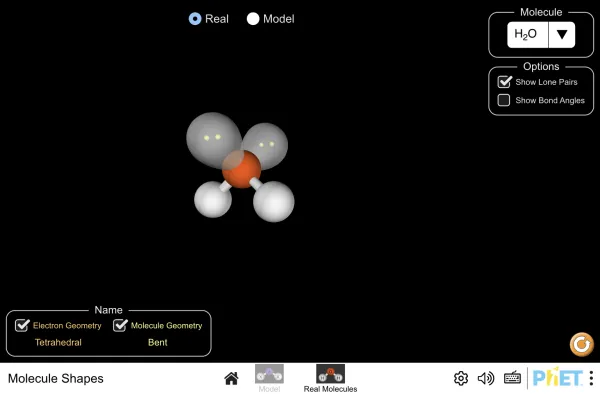
Full screen · PhET Interactive Simulations, University of Colorado Boulder, CC BY 4.0
Recap
- Lewis: count electrons, bond, fill outer atoms, extras on the centre; Period 3 and beyond can exceed eight.
- Regions repel: 2 to 6 give linear, trigonal planar, tetrahedral, trigonal bipyramid, octahedral; lone pairs change the shape name and squeeze angles.
- Polar bonds plus an unsymmetrical shape give a polar molecule.
- TD attractions everywhere, growing with electron cloud size; PD in polar molecules; hydrogen bonding with H on N, O or F.
| Attraction | Acts between | Stronger when |
|---|---|---|
| Temporary dipole | All molecules | Larger electron cloud, more surface contact |
| Permanent dipole | Polar molecules | Larger dipole |
| Hydrogen bonding | H on N, O or F to a lone pair on N, O or F | More H bonds per molecule |
Report a mistake
How is NCEA Level 3 maths going?
See the NCEA Level 3 maths guide