Melting, boiling, solubility and spontaneity
What this lesson covers
- Melting and boiling points of ionic, metallic, covalent network and molecular substances, from the forces that must be overcome.
- Comparing molecular substances by the type of attraction, the size of the electron cloud and the shape of the molecule.
- Solubility: why ionic and polar substances dissolve in water and non-polar substances dissolve in non-polar solvents.
- Entropy as the spreading out of matter and energy, and predicting the sign of the entropy change for a change of state or a reaction.
- Spontaneity: a change happens on its own when the total entropy of the system and surroundings increases, and how ΔH, ΔS and temperature decide it.
Melting and boiling: what has to be overcome
- To melt or boil a substance, energy must overcome the attractions holding its particles together, so stronger attractions mean higher melting and boiling points.
- Ionic solids (NaCl) have strong electrostatic attractions between oppositely charged ions in a 3D lattice; metals have attractions between cations and delocalised electrons; covalent networks (SiO₂, diamond) have strong covalent bonds throughout.
- Molecular substances (I₂, H₂O, CH₄) have strong covalent bonds inside each molecule, but only weak attractions between molecules, and melting or boiling overcomes only those.
- That is why molecular substances melt and boil far lower than the other three types.
| Substance | Type | Melting point (°C) | Boiling point (°C) |
|---|---|---|---|
| Sodium chloride, NaCl | Ionic | 801 | 1465 |
| Copper, Cu | Metallic | 1085 | 2562 |
| Silicon dioxide, SiO₂ | Covalent network | 1713 | Over 2200 |
| Iodine, I₂ | Molecular | 114 | 184 |
| Water, H₂O | Molecular | 0 | 100 |
| Methane, CH₄ | Molecular | −182 | −162 |
Comparing molecular substances
- Name every attraction present: temporary dipole (all molecules), permanent dipole (polar molecules) and hydrogen bonding (H on N, O or F).
- Compare like with like: if the electron clouds are similar in size, the substance with permanent dipoles or hydrogen bonds boils higher.
- If one molecule has a much larger electron cloud, its temporary dipole attractions can outweigh another's hydrogen bonds: I₂ (a solid) beats H₂O.
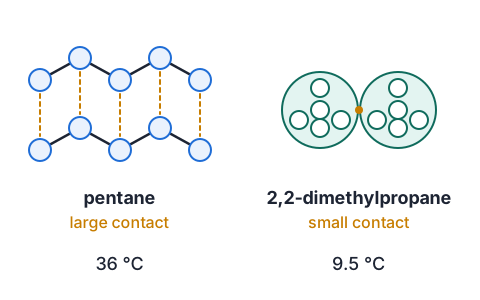
- Shape matters too: isomers have the same number of electrons, but a long chain has more surface contact with its neighbours than a compact, branched molecule, so its temporary dipole attractions are stronger.
| Isomer of C₅H₁₂ | Shape | Boiling point (°C) |
|---|---|---|
| Pentane | Straight chain | 36.1 |
| 2-methylbutane | One branch | 27.8 |
| 2,2-dimethylpropane | Compact, nearly spherical | 9.5 |
Solubility in polar and non-polar solvents
- A substance dissolves when the attractions it forms with the solvent are comparable in strength to the attractions broken in the solute and in the solvent.
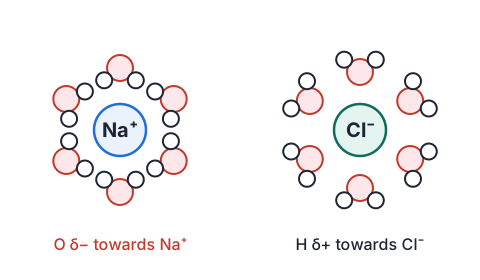
- Ionic solids dissolve in water because each ion is attracted to the polar water molecules: the δ− oxygen ends surround cations and the δ+ hydrogen ends surround anions, and these ion-dipole attractions pull ions off the lattice.
- Polar molecules that can hydrogen bond, such as ethanol and glucose, dissolve in water by forming hydrogen bonds with it.
- Non-polar substances such as iodine and fats dissolve in non-polar solvents like hexane, because both have only temporary dipole attractions; in water they would break water's hydrogen bonds without making anything as strong.
- So: like dissolves like, and the reason is always the balance of attractions broken and formed.
Try it: water or hexane?
Example: alcohols in water
- The table shows how the solubility of straight-chain alcohols in water changes with chain length. Explain the trend.
| Alcohol | Carbons | Solubility in water at about 25 °C |
|---|---|---|
| Methanol | 1 | Mixes in all proportions |
| Ethanol | 2 | Mixes in all proportions |
| Propan-1-ol | 3 | Mixes in all proportions |
| Butan-1-ol | 4 | About 7 g per 100 mL |
| Pentan-1-ol | 5 | About 2.2 g per 100 mL |
| Hexan-1-ol | 6 | About 0.6 g per 100 mL |
- every alcohol has one O–H group, which forms hydrogen bonds with water
- each extra CH₂ makes the non-polar hydrocarbon chain longerthe chain has only temporary dipole attractions
- a long chain breaks water's hydrogen bonds but cannot form hydrogen bonds itself
- solubility falls as the chain grows: the non-polar part outweighs the single O–H
- the same alcohols dissolve better and better in hexane as the chain grows
Enthalpy and entropy
- Enthalpy change, ΔH, is the heat energy taken in from or given out to the surroundings at constant pressure: negative for exothermic, positive for endothermic.
- Entropy, S, measures how spread out (dispersed) the matter and energy of a system are; the more ways the particles and their energy can be arranged, the higher the entropy.
- Entropy rises from solid to liquid to gas, when a solid dissolves, when a reaction makes more moles of gas, and when a substance is heated.
- To predict the sign of ΔS for a reaction, look at gases first: more moles of gas on the product side means ΔS is positive; fewer means negative.
| Change | Sign of ΔS (system) | Reason |
|---|---|---|
| H₂O(s) → H₂O(l) | Positive | Liquid particles move past each other |
| H₂O(l) → H₂O(g) | Positive | Gas particles spread through the whole container |
| NaCl(s) → Na⁺(aq) + Cl⁻(aq) | Positive | Ions spread through the solution |
| 2SO₂(g) + O₂(g) → 2SO₃(g) | Negative | 3 mol of gas become 2 mol |
| CaCO₃(s) → CaO(s) + CO₂(g) | Positive | A gas is made from a solid |
Predicting whether a change is spontaneous
- A spontaneous change happens on its own once started, without continuing outside help; it may still be slow (diamond turning into graphite).
- A change is spontaneous when the total entropy, of the system plus the surroundings, increases.
- An exothermic change releases heat into the surroundings, spreading energy and increasing the entropy of the surroundings; an endothermic change takes heat from the surroundings and decreases their entropy.
- The surroundings' entropy change matters most at low temperature, because a given amount of heat makes a bigger difference to cold surroundings than to hot ones.
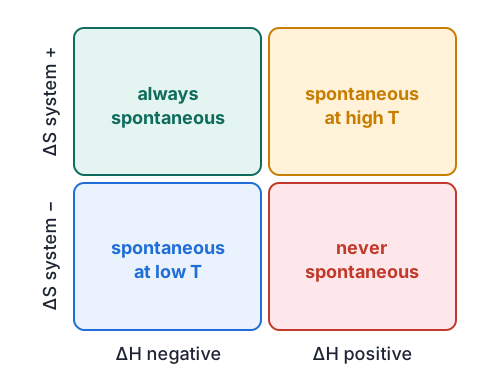
- So the sign of ΔH and the sign of ΔS (system) together decide it, and when they disagree, temperature decides.
Try it: when is it spontaneous?
Example: limestone and a cold pack
- Limestone decomposes, CaCO₃(s) → CaO(s) + CO₂(g), ΔrH = +178 kJ mol⁻¹, but only in a kiln heated above about 840 °C.
- Ammonium nitrate dissolves in water, NH₄NO₃(s) → NH₄⁺(aq) + NO₃⁻(aq), ΔH = +26 kJ mol⁻¹, by itself at room temperature: that is how an instant cold pack works.
- Explain each in terms of entropy.
- CaCO₃: a gas forms from a solid, so ΔS (system) is positive
- it is endothermic, so heat is taken from the surroundings and their entropy falls
- the surroundings' decrease is smaller at high temperature, so above about 840 °C the system's increase wins: spontaneous only when hot
- NH₄NO₃: the lattice breaks up and ions spread through the water, so ΔS (system) is large and positive
- it is endothermic, but the system's entropy increase outweighs the surroundings' decrease even at room temperature: spontaneous
What Achieved, Merit and Excellence look like
- Achieved recognises one idea, such as that entropy increases when particles become more spread out; Merit explains the entropy change of the system or of the surroundings; Excellence justifies spontaneity by weighing both.
- In every answer, name the system's change, the surroundings' change, which is bigger, and why.
| Grade | A model answer |
|---|---|
| Achieved | Melting increases entropy because the water molecules become more disordered. |
| Merit | When ice melts, molecules in the lattice become free to move past each other, so the entropy of the system increases. Melting is endothermic, so heat is taken from the surroundings and their entropy decreases. |
| Excellence | Melting increases the entropy of the system as molecules leave the ordered lattice. Because it is endothermic, it takes heat from the surroundings and lowers their entropy, and that decrease is larger when the surroundings are colder. At 10 °C the system's increase outweighs the surroundings' decrease, so total entropy rises and ice melts; at −10 °C the surroundings' decrease is bigger, total entropy would fall, so ice does not melt (and the reverse change, freezing, is spontaneous). |
Common mistakes
- Iodine melts at 114 °C because its covalent I–I bonds are weak.Melting overcomes the temporary dipole attractions between I₂ molecules; the I–I bond inside each molecule does not break.
- Endothermic reactions cannot be spontaneous.An endothermic change is spontaneous if the system's entropy increase outweighs the surroundings' decrease, like ice melting at 10 °C.
- Iodine does not dissolve in water because iodine is non-polar and repels water.Dissolving would break strong hydrogen bonds between water molecules and replace them with only weak attractions to I₂.
- 2SO₂(g) + O₂(g) → 2SO₃(g) has a positive ΔS because the SO₃ molecules are bigger.Three moles of gas become two, so the system's entropy decreases and ΔS is negative.
A reaction that cools itself down
You need: baking soda, white vinegar, a teaspoon, a tall glass or jar, a kitchen thermometer, if you have one, a tray or the sink
- Stand the glass on the tray, pour in half a cup of vinegar, and measure its temperature (or hold the glass in your palm to feel how cool it is).
- Add two heaped teaspoons of baking soda and stir gently.
- Measure the temperature again once the fizzing slows, or feel the glass.
- Look for: the mixture gets a few degrees colder, so the reaction is endothermic, yet it happens by itself because it makes a gas, CO₂, and the big increase in the system's entropy outweighs the decrease in the surroundings.
Safety: The mixture foams up fast and vinegar stings the eyes, so use a tall glass over a tray or sink and keep your face away from the rim.
Your turn
Butane (a straight chain) and 2-methylpropane (branched) are both C₄H₁₀. Which has the higher boiling point?
Which is more soluble in water: sodium chloride or iodine?
What is the sign of ΔS (system) for H₂O(l) → H₂O(g)?
What is the sign of ΔS (system) for N₂(g) + 3H₂(g) → 2NH₃(g)?
A reaction is endothermic and its system entropy decreases. When is it spontaneous?
Show answer
1. Butane: the same number of electrons, but the straight chain has more surface contact, so stronger temporary dipole attractions (it boils at −0.5 °C against −12 °C). 2. Sodium chloride: water's polar molecules form ion-dipole attractions with Na⁺ and Cl⁻, while non-polar iodine cannot replace water's hydrogen bonds. 3. Positive: gas particles are far more spread out than liquid. 4. Negative: 4 mol of gas become 2 mol. 5. Never: the system's entropy falls and the surroundings' entropy falls too, so the total cannot increase at any temperature.
Exam-style question: properties and spontaneity
Magnesium oxide melts at 2825 °C and iodine at 114 °C. Explain the difference in terms of the particles and the attractions between them.
Explain why iodine dissolves in hexane but hardly at all in water.
Hydrogen peroxide decomposes: 2H₂O₂(l) → 2H₂O(l) + O₂(g), ΔrH = −196 kJ mol⁻¹. State the sign of the entropy change of the system, and decide whether the reaction is spontaneous at all temperatures.
Dinitrogen tetroxide decomposes: N₂O₄(g) → 2NO₂(g), ΔrH = +57 kJ mol⁻¹. Using the entropy change of the system and of the surroundings, justify why it happens on its own only at higher temperatures.
Show answer
1. MgO is an ionic lattice of Mg²⁺ and O²⁻ ions; melting must overcome very strong electrostatic attractions between ions with 2+ and 2− charges throughout the lattice, which needs a great deal of energy. Iodine is molecular: melting overcomes only the temporary dipole attractions between I₂ molecules, which are much weaker, so far less energy is needed (Merit names both particles and both attractions; Excellence compares their strengths). 2. Iodine and hexane are both non-polar with only temporary dipole attractions, so the attractions formed between I₂ and hexane are similar to those broken, and iodine dissolves. To dissolve in water, I₂ would have to break water's hydrogen bonds but could form only weak temporary dipole attractions with water, so it hardly dissolves. 3. Positive: 2 mol of liquid produce 2 mol of liquid and 1 mol of gas. It is exothermic, so the entropy of the surroundings also increases; both increase, so the total entropy always increases and the reaction is spontaneous at all temperatures (it is slow without a catalyst). 4. One mole of gas becomes two, so the entropy of the system increases. The reaction is endothermic, so it absorbs heat from the surroundings and their entropy decreases; this decrease is larger when the surroundings are cold. At low temperature the surroundings' decrease outweighs the system's increase, so total entropy falls and the reaction is not spontaneous; at higher temperature the surroundings' decrease is smaller, the system's increase wins, and the reaction is spontaneous (Excellence weighs both changes and links them to temperature).
Recap
- Ionic, metallic and covalent network solids melt high because strong forces run through the whole structure; molecular substances melt low because only attractions between molecules are overcome.
- Among molecules: hydrogen bonds and permanent dipoles help, but electron cloud size and surface contact can outweigh them.
- Dissolving needs attractions formed that are similar to those broken: ions and hydrogen-bonding molecules in water, non-polar in non-polar.
- Spontaneous means the total entropy of system and surroundings increases; temperature decides when ΔH and ΔS disagree.
| ΔH | ΔS (system) | Spontaneous? |
|---|---|---|
| Negative (exothermic) | Positive | At all temperatures |
| Negative (exothermic) | Negative | Only at low temperatures |
| Positive (endothermic) | Positive | Only at high temperatures |
| Positive (endothermic) | Negative | Never |
Report a mistake
How is NCEA Level 3 maths going?
See the NCEA Level 3 maths guide