Functional groups, naming and isomers
What this lesson covers
- The ten functional groups, from alkenes and haloalkanes to esters, acyl chlorides and amides, and how to recognise each.
- IUPAC names for chains of up to eight carbons, including which group sets the suffix and which become prefixes.
- Constitutional isomers: the same molecular formula with the atoms joined differently (chain, position or functional group).
- Geometric (cis-trans) isomers from a C=C with two different groups on each carbon, and optical isomers from an asymmetric carbon.
- Using boiling point, solubility and the rotation of plane-polarised light to tell compounds apart, with reasons.
The ten functional groups
- A functional group is the part of a molecule that reacts; the rest is a hydrocarbon chain that mostly goes along for the ride.
- Level 3 uses ten groups. Learn each one's structure, its suffix or prefix, and whether it makes the molecule polar or able to hydrogen bond.
- Alcohols are primary, secondary or tertiary by how many carbons are bonded to the C carrying the OH; haloalkanes are classed the same way, and amines by how many carbons are bonded to the N.
| Group | Structure | Name ending | Example |
|---|---|---|---|
| Alkene | C=C | -ene | but-2-ene |
| Haloalkane | C-X (X = Cl, Br, I) | chloro-, bromo-, iodo- | 2-bromopropane |
| Amine | C-NH₂ | -amine | ethanamine |
| Alcohol | C-OH | -ol | propan-2-ol |
| Aldehyde | -CHO, at the end of a chain | -al | butanal |
| Ketone | C=O inside the chain | -one | pentan-3-one |
| Carboxylic acid | -COOH | -oic acid | ethanoic acid |
| Ester | -COO- between two chains | alkyl -oate | methyl propanoate |
| Acyl chloride | -COCl | -oyl chloride | ethanoyl chloride |
| Amide | -CONH₂ | -amide | propanamide |
IUPAC names, step by step
- Find the longest carbon chain that contains the main functional group; its length gives the stem (meth, eth, prop, but, pent, hex, hept, oct).
- The highest-priority group gives the suffix: carboxylic acid, then acyl chloride and ester, then amide, aldehyde, ketone, alcohol, amine. Any other group becomes a prefix, such as hydroxy- for OH, oxo- for C=O, amino- for NH₂ and methyl- for a branch.
- Number from the end that gives the suffix group the lowest number. The carbon of -COOH, -CHO, -COCl and -CONH₂ is always carbon 1, so it needs no number.
- Esters are named in two words: the alkyl group from the alcohol first, then the acid part ending in -oate. CH₃COOCH₂CH₃ is ethyl ethanoate.
- On an amide or amine, a group on the nitrogen is shown with N-, so CH₃CONHCH₃ is N-methylethanamide.
Try it: build and name a molecule
Example: naming four compounds
- Name: (a) CH₃CH(CH₃)CH₂COOH, (b) CH₃CH₂COOCH₂CH₂CH₃, (c) CH₃CH(OH)CH₂CHO, (d) CH₃COCHO, the main antibacterial compound in mānuka honey, measured by its MGO rating.
- (a) 4 C in the chain with COOH; C1 is the COOH carbon, the CH₃ branch is on C3the acid carbon is always C1
- (a) 3-methylbutanoic acid
- (b) acid part CH₃CH₂COO- is propanoate; alcohol part -CH₂CH₂CH₃ is propylsplit at the single-bonded O
- (b) propyl propanoate
- (c) the aldehyde outranks the alcohol, so -al is the suffix and OH is hydroxy- on C3
- (c) 3-hydroxybutanal
- (d) the aldehyde is C1, the ketone C=O is on C2 and becomes oxo-
- (d) 2-oxopropanal (methylglyoxal)
Constitutional isomers
- Isomers have the same molecular formula but different structures. Constitutional (structural) isomers have their atoms joined in a different order.
- Chain isomers have a different carbon skeleton: butan-1-ol and 2-methylpropan-1-ol.
- Position isomers have the same group in a different place: propan-1-ol and propan-2-ol.
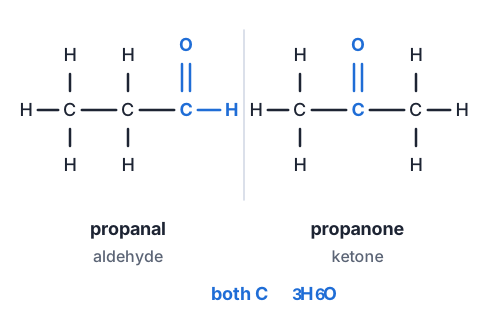
- Functional group isomers belong to different families: propanal and propanone are both C₃H₆O, and so are an acid and an ester of the same size, such as propanoic acid and methyl ethanoate (C₃H₆O₂).
- Because the groups differ, functional group isomers have different chemical reactions as well as different physical properties.
Geometric (cis-trans) isomers
- A C=C double bond cannot rotate, so groups on each end are locked on one side or the other.
- Geometric isomers need two different groups on each carbon of the C=C. But-2-ene (CH₃CH=CHCH₃) qualifies; but-1-ene does not, because one carbon carries two H atoms.
- In the cis isomer the matching groups are on the same side; in the trans isomer they are on opposite sides.
- Cis and trans isomers have slightly different boiling and melting points. Cis-but-2-ene is slightly polar and boils at about 4 °C, while trans-but-2-ene, whose bond dipoles cancel, boils at about 1 °C.
Optical isomers (enantiomers)
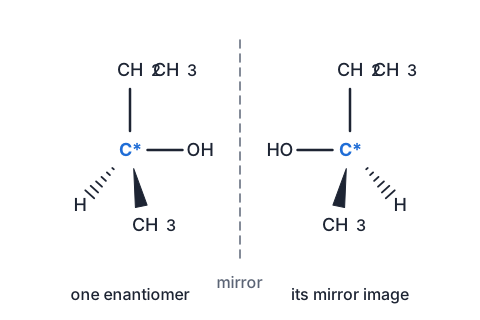
- A carbon bonded to four different groups is an asymmetric (chiral) carbon, marked with an asterisk. A molecule with one has two forms that are mirror images and cannot be superimposed, like left and right hands.
- Draw enantiomers in 3D: two bonds in the plane, one wedge coming out and one dashed going back, then reflect the whole molecule in a mirror line.
- Enantiomers have identical boiling points, solubility and reactions with ordinary reagents. The one difference is that they rotate plane-polarised light by the same angle in opposite directions.
- A 50:50 mixture of the two (a racemic mixture) shows no rotation, because the two effects cancel.
- Living things often treat enantiomers differently: one carvone enantiomer smells of spearmint and the other of caraway, because our smell receptors are chiral too.
Example: which kind of isomerism?
- For each compound, say whether it has geometric isomers, optical isomers, or neither: (a) 2-chlorobutane, (b) pent-2-ene, (c) 2-methylbut-2-ene, (d) 2-aminopropanoic acid (alanine).
- (a) C2 carries H, Cl, CH₃ and CH₂CH₃: four different groupsan asymmetric carbon
- (a) optical isomers
- (b) CH₃CH=CHCH₂CH₃: C2 has H and CH₃, C3 has H and CH₂CH₃two different groups on each end
- (b) geometric isomers (cis and trans)
- (c) (CH₃)₂C=CHCH₃: C2 carries two identical CH₃ groupsswapping them gives the same molecule
- (c) neither
- (d) C2 carries H, NH₂, CH₃ and COOHfour different groups
- (d) optical isomers
Try it: which kind of isomerism?
Physical properties come from the groups
- Molecules of similar size have similar dispersion forces, so differences in boiling point come mostly from the functional group.
- Alcohols, carboxylic acids, primary amines and amides have O-H or N-H bonds, so their molecules hydrogen bond to each other and boil higher. Carboxylic acids form pairs held by two hydrogen bonds; amides hydrogen bond through both N-H and C=O, so propanamide is a solid at room temperature.
- Aldehydes, ketones, esters, acyl chlorides and haloalkanes are polar but have no O-H or N-H, so only permanent dipole attractions add to their dispersion forces.
- Small molecules that can hydrogen bond with water dissolve in it; as the hydrocarbon chain gets longer, solubility falls because the non-polar part cannot.
- Acyl chlorides react with water rather than dissolving, giving off steamy HCl fumes.
| Compound | Group | Boiling point (°C) |
|---|---|---|
| Propane | none | −42 |
| 1-chloropropane | haloalkane | 47 |
| Propanal | aldehyde | 48 |
| Propan-1-amine | amine | 48 |
| Propanone | ketone | 56 |
| Propanoyl chloride | acyl chloride | 80 |
| Propan-1-ol | alcohol | 97 |
| Propanoic acid | carboxylic acid | 141 |
| Propanamide | amide | 213 |
Example: telling three isomers apart
- Three unlabelled liquids are butan-1-ol, butan-2-ol and 2-methylpropan-2-ol, all C₄H₁₀O. The butan-2-ol was made as a single enantiomer.
- Explain which property picks out butan-2-ol, and why the other two cannot show it.
- butan-2-ol: C2 carries H, OH, CH₃ and CH₂CH₃the only one with four different groups on a carbon
- butan-1-ol: C1 carries two H atoms; 2-methylpropan-2-ol: C2 carries three CH₃ groupsno asymmetric carbon, so no enantiomers
- shine plane-polarised light through each: only a single enantiomer of butan-2-ol rotates it
- a racemic sample of butan-2-ol would not rotate the light, so the test needs one enantiomer
What Achieved, Merit and Excellence look like
- Achieved names or draws correctly and states a property. Merit explains the property from the structure. Excellence compares the compounds, links each structure to its forces or its isomerism, and justifies every conclusion.
| Grade | A model answer |
|---|---|
| Achieved | Propanoic acid can form hydrogen bonds and methyl ethanoate cannot, so propanoic acid has the higher boiling point. |
| Merit | Both are C₃H₆O₂, so their dispersion forces are similar. Propanoic acid has an O-H bond, so its molecules hydrogen bond to each other; methyl ethanoate has no O-H, so it has only weaker permanent dipole attractions. More energy is needed to separate the acid molecules. |
| Excellence | Both are C₃H₆O₂ with similar shape and electron number, so their dispersion forces are similar and cannot explain an 84 °C gap. In propanoic acid the O-H hydrogen is strongly positive and bonds to the C=O oxygen of a neighbour, so pairs of molecules are held by two hydrogen bonds. Methyl ethanoate is polar, with C=O and C-O dipoles, but its H atoms are all on carbon, so it has only permanent dipole attractions. Hydrogen bonds are much stronger, so far more heat energy is needed to boil the acid. |
Common mistakes
- But-1-ene has cis and trans isomers because it has a C=C bond.Each carbon of the C=C needs two different groups; C1 of but-1-ene has two H atoms, so it has no geometric isomers.
- CH₃COOCH₂CH₃ is ethanoyl ethyl, or ethyl ester ethanoate.Name an ester alkyl first, then the acid part: ethyl ethanoate.
- Enantiomers have different boiling points because they are different compounds.Enantiomers have identical physical properties; only the direction they rotate plane-polarised light differs.
- The carbon in a C=O or CH₃ group can be an asymmetric carbon.An asymmetric carbon has four single bonds to four different groups, so a C=O carbon or a CH₃ carbon never qualifies.
See sugar twist polarised light
You need: white sugar, hot tap water, a clear glass jar, a laptop, tablet or phone screen showing a white page, polarised sunglasses, a spoon
- Fill the jar two-thirds with sugar, add hot tap water, and stir until the syrup is clear.
- Turn the screen to a plain white page. Its light is already polarised. Look at it through the sunglasses and turn them until the screen looks darkest.
- Hold the jar of syrup between the screen and the sunglasses, looking through the syrup.
- Slowly turn the sunglasses while you look, then compare with a jar of plain water.
- Look for: through the syrup, the screen is no longer dark and colours appear that change as you turn the glasses. Sucrose molecules contain asymmetric carbons, so the syrup rotates the plane of polarised light, and different colours are turned by different amounts. Plain water does nothing.
Safety: Use hot tap water only, not boiled water, because a full jar of hot syrup can scald, and keep the syrup well away from the screen and keyboard.
Your turn
Name CH₃CH₂CH₂COCl.
Name CH₃CH(CH₃)CH₂CHO.
Which of these has optical isomers: propan-2-ol, butan-2-ol, butanone or but-1-ene?
Which of these has geometric isomers: pent-1-ene, pent-2-ene, 2-methylbut-2-ene or pentane?
How many aldehydes and ketones have the formula C₄H₈O?
Show answer
1. Butanoyl chloride. 2. 3-methylbutanal: the CHO carbon is C1 and the branch is on C3. 3. Butan-2-ol: C2 carries H, OH, CH₃ and CH₂CH₃. 4. Pent-2-ene: each C of the C=C has an H and a different alkyl group. 5. Three: butanal, 2-methylpropanal and butanone.
Exam-style question: isomers of C₄H₈O₂
- Butanoic acid, ethyl ethanoate and 3-hydroxybutanal all have the formula C₄H₈O₂.
Name the ester CH₃CH₂COOCH₃, another isomer of C₄H₈O₂.
Name the branched carboxylic acid with this formula.
Which of the three compounds above exists as enantiomers?
Explain why butanoic acid boils at 164 °C and ethyl ethanoate at 77 °C.
Give a test that tells butanoic acid from ethyl ethanoate, with the observation.
Show answer
1. Methyl propanoate (Achieved). 2. 2-methylpropanoic acid, (CH₃)₂CHCOOH (Achieved). 3. 3-hydroxybutanal: C3 carries H, OH, CH₃ and CH₂CHO, four different groups, so it has two non-superimposable mirror images that rotate plane-polarised light in opposite directions (Merit with the reason). 4. Both are C₄H₈O₂, so dispersion forces are similar. Butanoic acid has an O-H group, so its molecules hydrogen bond to each other; ethyl ethanoate has no O-H, so it has only permanent dipole attractions, which are weaker. More energy is needed to separate the acid molecules (Merit; Excellence also notes the acid forms hydrogen-bonded pairs and that size cannot explain the gap). 5. Add sodium carbonate solution: butanoic acid fizzes, giving CO₂, because it is an acid; ethyl ethanoate does not react (Achieved for the observation, Merit for the reason).
Build a Molecule
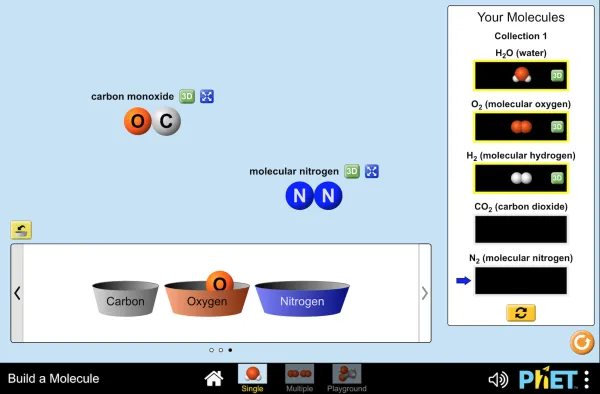
Full screen · PhET Interactive Simulations, University of Colorado Boulder, CC BY 4.0
Recap
- Ten groups, ten name endings: the highest-priority group sets the suffix and the others become prefixes.
- Constitutional isomers join the atoms differently; geometric isomers need a C=C with two different groups on each carbon; optical isomers need a carbon with four different groups.
- Enantiomers differ only in the direction they rotate plane-polarised light; a racemic mixture shows no rotation.
- O-H and N-H groups mean hydrogen bonding, higher boiling points and better solubility in water.
| Isomer type | What to look for |
|---|---|
| Constitutional | Same formula, atoms joined in a different order |
| Geometric (cis-trans) | C=C with two different groups on each carbon |
| Optical (enantiomers) | A carbon with four different groups |
Report a mistake
How is NCEA Level 3 maths going?
See the NCEA Level 3 maths guide