Substitution reactions: from haloalkanes to amides
What this lesson covers
- Substitution: one atom or group on a molecule is replaced by another, and which reagent does each swap.
- Haloalkanes to alcohols and amines; alcohols to haloalkanes; amines as bases.
- Making acyl chlorides with SOCl₂, and their fast reactions with water, alcohols, ammonia and amines.
- Making esters and amides, and hydrolysing them in acid and in base, with the different products each gives.
- Planning a reaction scheme that converts one compound into another in two or three steps.
What substitution means
- In a substitution reaction an atom or group on a carbon is replaced by another; the carbon chain itself is unchanged.
- The carbon being attacked is slightly positive (δ+) because it is bonded to a more electronegative atom such as Cl, Br or O. The attacking species has a lone pair, like OH⁻, NH₃ or the O of an alcohol.
- At Level 3, esterification, condensation, hydrolysis and condensation polymerisation all count as substitution reactions.
- Always give the reagent and the conditions with the product: 'KOH(aq), heat' and 'KOH in alcohol, heat' give different products from the same haloalkane.
| Starting group | Reagent | Product |
|---|---|---|
| Haloalkane | KOH(aq) or NaOH(aq), heat | Alcohol |
| Haloalkane | concentrated NH₃, heat | Amine |
| Alcohol | concentrated HCl or HBr, or SOCl₂ | Haloalkane |
| Alcohol | carboxylic acid with H⁺ (conc. H₂SO₄), heat | Ester |
| Carboxylic acid | SOCl₂ | Acyl chloride |
| Acyl chloride | H₂O, alcohol, NH₃ or a primary amine | Acid, ester, amide or N-substituted amide |
| Ester or amide | H₂O/H⁺ or H₂O/OH⁻, heat | Hydrolysis products |
Try it: what does the reaction make?
Haloalkanes and alcohols
- Heated with aqueous KOH or NaOH, a haloalkane becomes an alcohol: CH₃CH₂CH₂Br + OH⁻ → CH₃CH₂CH₂OH + Br⁻.
- Heated with concentrated ammonia, a haloalkane becomes a primary amine. A second NH₃ takes the H⁺ that is released: CH₃CH₂Cl + 2NH₃ → CH₃CH₂NH₂ + NH₄Cl.
- Going the other way, an alcohol becomes a haloalkane with concentrated HCl or HBr, or with thionyl chloride: CH₃CH₂OH + SOCl₂ → CH₃CH₂Cl + SO₂ + HCl. Tertiary alcohols react fastest with concentrated HCl.
- If the KOH is dissolved in alcohol instead of water, the haloalkane mostly loses a hydrogen halide, such as HBr, to form an alkene instead. That is elimination, covered in the next lesson.
Amines are bases
- The N in an amine has a lone pair that can accept a proton, so amines are weak bases, like ammonia: CH₃NH₂ + H₂O ⇌ CH₃NH₃⁺ + OH⁻.
- Small amines are soluble in water, turn damp red litmus blue, and smell fishy.
- With an acid they form a salt: CH₃NH₂ + HCl → CH₃NH₃⁺Cl⁻ (methylammonium chloride), which is ionic, odourless and soluble.
- The same lone pair lets an amine attack the δ+ carbon of an acyl chloride, which is how N-substituted amides are made.
Acyl chlorides: the fast route
- A carboxylic acid becomes an acyl chloride with thionyl chloride: CH₃COOH + SOCl₂ → CH₃COCl + SO₂ + HCl.
- The C of -COCl is bonded to both O and Cl, so it is very δ+, and acyl chlorides react quickly and completely at room temperature.
- Each reaction swaps the Cl for another group and releases HCl, seen as steamy fumes in moist air: CH₃COCl + H₂O → CH₃COOH + HCl.
- With an alcohol it makes an ester; with ammonia an amide, CH₃COCl + 2NH₃ → CH₃CONH₂ + NH₄Cl; with a primary amine an N-substituted amide, CH₃COCl + CH₃NH₂ → CH₃CONHCH₃ + HCl.
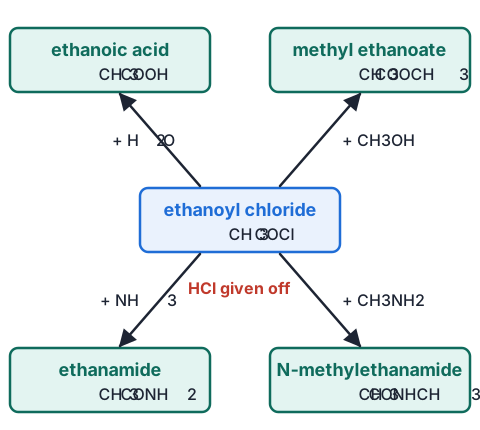
Making esters and amides
- Esterification: a carboxylic acid and an alcohol heated under reflux with a few drops of concentrated H₂SO₄ give an ester and water: CH₃CH₂CH₂COOH + CH₃CH₂OH ⇌ CH₃CH₂CH₂COOCH₂CH₃ + H₂O.
- This makes ethyl butanoate, a fruity ester found in kiwifruit. The reaction is reversible and slow, so the yield is limited; H₂SO₄ is the catalyst and also removes some of the water.
- Using the acyl chloride instead, CH₃CH₂CH₂COCl + CH₃CH₂OH → CH₃CH₂CH₂COOCH₂CH₃ + HCl, is fast and goes to completion.
- Amides are made from an acyl chloride and ammonia or an amine. The ester or amide link joins the two pieces, and a small molecule (H₂O or HCl) is lost, which is why these are called condensation reactions.
Hydrolysis in acid and in base
- Hydrolysis uses water to split an ester or amide back into its two pieces. It needs heating under reflux with dilute acid or with a base such as NaOH(aq).
- In acid, the products are the carboxylic acid plus the alcohol (from an ester) or an ammonium ion (from an amide), because the amine or NH₃ takes a proton from the acid.
- In base, the acid part comes out as its carboxylate ion, because OH⁻ removes the proton; the other product is the alcohol, or NH₃ or the amine.
- Acid hydrolysis of an ester is reversible, so it is incomplete. Base hydrolysis goes to completion because the carboxylate ion cannot react back with the alcohol.
| Compound | H₂O / H⁺, heat | H₂O / OH⁻, heat |
|---|---|---|
| Ester RCOOR' | RCOOH + R'OH | RCOO⁻ + R'OH |
| Amide RCONH₂ | RCOOH + NH₄⁺ | RCOO⁻ + NH₃ |
| N-substituted amide RCONHR' | RCOOH + R'NH₃⁺ | RCOO⁻ + R'NH₂ |
Try it: acid or base hydrolysis?
Example: hydrolysing an ester and an amide
- Give the organic products when (a) methyl propanoate and (b) N-methylethanamide are each heated under reflux with dilute HCl, and then with NaOH(aq).
- (a) CH₃CH₂COOCH₃: acid part propanoate, alcohol part methylsplit at the single-bonded O
- (a) in HCl: CH₃CH₂COOH (propanoic acid) + CH₃OH (methanol)
- (a) in NaOH: CH₃CH₂COO⁻ (propanoate ion, as sodium propanoate) + CH₃OH
- (b) CH₃CONHCH₃: acid part ethanoyl, amine part CH₃NH-split at the C-N bond
- (b) in HCl: CH₃COOH (ethanoic acid) + CH₃NH₃⁺ (methylammonium ion)
- (b) in NaOH: CH₃COO⁻ (ethanoate ion) + CH₃NH₂ (methanamine)
- acid gives the protonated amine; base gives the deprotonated acid
Planning a reaction scheme
- Start from the target and work backwards: an amide needs an acyl chloride and an amine; an acyl chloride needs a carboxylic acid; an amine can come from a haloalkane.
- Count carbons: substitution never changes the chain length, so the pieces of the product must already exist in the starting materials.
- Write every step with its reagent and conditions, and name or draw every intermediate.
- Check each step uses a reagent you are allowed: in the exam you are often given a short list and must choose from it.
Example: making N-ethylethanamide
- Plan a scheme to make N-ethylethanamide, CH₃CONHCH₂CH₃, from chloroethane and ethanoic acid. You may use SOCl₂ and concentrated NH₃.
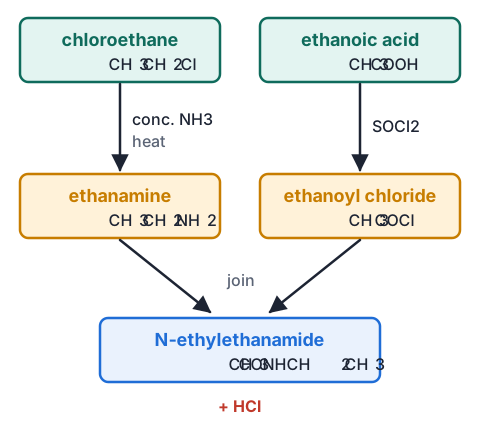
- target CH₃CO-NH-CH₂CH₃: the CH₃CO part comes from ethanoic acid, the NHCH₂CH₃ part from ethanaminesplit the amide at C-N
- step 1: CH₃CH₂Cl + 2NH₃ → CH₃CH₂NH₂ + NH₄Clconcentrated NH₃, heat
- step 2: CH₃COOH + SOCl₂ → CH₃COCl + SO₂ + HClmakes the reactive acyl chloride
- step 3: CH₃COCl + CH₃CH₂NH₂ → CH₃CONHCH₂CH₃ + HClroom temperature, fast
- three steps; every carbon in the product came from a starting material
What Achieved, Merit and Excellence look like
- Achieved gives correct products and names a reaction type. Merit explains what happens in each step and why the products form. Excellence links observations, reagents and products for every step and compares the alternatives.
| Grade | A model answer |
|---|---|
| Achieved | Both are hydrolysis. With NaOH the products are sodium ethanoate and ethanol; with H₂SO₄ they are ethanoic acid and ethanol. |
| Merit | Both are hydrolysis (substitution): water breaks the ester link into an acid part and an alcohol part. In acid the acid part stays as CH₃COOH; in base the OH⁻ removes its proton, giving CH₃COO⁻, so sodium ethanoate forms. |
| Excellence | Both reactions break the ester link, CH₃COOCH₂CH₃, into the CH₃CO- part and ethanol. In dilute H₂SO₄ the products are CH₃COOH and CH₃CH₂OH, but the reaction is reversible, so some ester remains at equilibrium. In NaOH the ethanoic acid formed is deprotonated to CH₃COO⁻, which cannot react with ethanol, so the reaction goes to completion and gives a better yield. To get ethanoic acid from the base route, acidify the sodium ethanoate afterwards. |
Common mistakes
- 1-bromopropane with KOH always gives propan-1-ol.Only KOH(aq) gives the alcohol; KOH in alcohol mostly gives propene by elimination.
- Hydrolysing an amide in acid gives the carboxylic acid and ammonia.In acid the NH₃ is protonated, so the products are the carboxylic acid and NH₄⁺.
- The ester from propanoic acid and methanol is propyl methanoate.The alcohol gives the first word and the acid the second: methyl propanoate.
- An acyl chloride dissolves in water to give a solution of the acyl chloride.It reacts with the water, giving the carboxylic acid and HCl, seen as steamy fumes.
Model esterification and hydrolysis
You need: plasticine or playdough in three colours, a box of toothpicks, paper, a pen
- Make balls for atoms: one colour for C, one for O and one for H. Use toothpicks as bonds, two side by side for a double bond.
- Build ethanoic acid (CH₃COOH) and ethanol (CH₃CH₂OH), with every atom having its right number of bonds: C four, O two, H one.
- Pull the OH off the acid and the H off the alcohol's OH. Join the H and OH to make water, then join the two pieces through the alcohol's O to make ethyl ethanoate.
- Now run it backwards: break the ester at the single-bonded O, add water back, and check you get the acid and alcohol again. Write each equation as you go.
- Look for: the same atoms rearranged each time, with water lost on joining and taken in on splitting, which is why these are called condensation and hydrolysis.
Safety: Toothpick points are sharp, so push them into the plasticine away from your fingers and keep them away from your face and eyes.
Your turn
Name the organic product when 2-bromobutane is heated with KOH(aq).
Name the organic product when propanoic acid reacts with SOCl₂.
Name the organic product when ethanoyl chloride reacts with propan-1-ol.
Give the organic products when propanamide is heated with NaOH(aq).
What is seen when water is added to ethanoyl chloride, and why?
Show answer
1. Butan-2-ol: OH⁻ replaces Br. 2. Propanoyl chloride, CH₃CH₂COCl, with SO₂ and HCl. 3. Propyl ethanoate, CH₃COOCH₂CH₂CH₃, with HCl. 4. The propanoate ion, CH₃CH₂COO⁻, and ammonia, NH₃. 5. Steamy fumes: the acyl chloride is hydrolysed to ethanoic acid and HCl gas, which forms droplets with moisture in the air.
Exam-style question: a family of propyl compounds
- 1-bromopropane is heated with concentrated NH₃ to give compound A. 1-bromopropane is also heated with KOH(aq) to give compound B. Propanoic acid reacts with SOCl₂ to give compound C.
Name compound A, and say what it does to damp red litmus paper.
Name compound B.
Compound C reacts with A. Name the organic product and the type of link it contains.
Compound C reacts with B. Name the organic product.
The product from part 3 is heated under reflux with dilute HCl. Give the two organic products and explain why one of them is an ion.
Show answer
1. A is propan-1-amine, CH₃CH₂CH₂NH₂; it turns damp red litmus blue because its N lone pair accepts a proton from water, releasing OH⁻ (Achieved; Merit with the reason). 2. B is propan-1-ol (Achieved). 3. CH₃CH₂COCl + CH₃CH₂CH₂NH₂ → CH₃CH₂CONHCH₂CH₂CH₃ + HCl: N-propylpropanamide, which contains an amide (peptide-type) link (Achieved for the name, Merit with the equation). 4. Propyl propanoate, CH₃CH₂COOCH₂CH₂CH₃ (Achieved). 5. Propanoic acid, CH₃CH₂COOH, and the propylammonium ion, CH₃CH₂CH₂NH₃⁺. Water breaks the C-N bond, and the propan-1-amine released is a base, so it accepts a proton from the excess acid and ends up as its ammonium ion (Merit; Excellence also contrasts the products in NaOH, propanoate ion and propan-1-amine, and explains the difference).
Recap
- Substitution swaps one group for another on the same carbon chain; the reagent and the conditions decide the product.
- SOCl₂ turns acids into acyl chlorides and alcohols into chloroalkanes; acyl chlorides react fast with water, alcohols, NH₃ and amines, giving HCl fumes.
- Esters and amides form by condensation and split by hydrolysis: acid hydrolysis gives the acid and the protonated amine, base hydrolysis gives the carboxylate ion and the free amine or alcohol.
- Plan schemes backwards from the target, one reagent per step.
| Make | From | With |
|---|---|---|
| Alcohol | haloalkane | KOH(aq), heat |
| Amine | haloalkane | concentrated NH₃, heat |
| Acyl chloride | carboxylic acid | SOCl₂ |
| Ester | acyl chloride or acid | alcohol (with H⁺ for the acid) |
| Amide | acyl chloride | NH₃ or a primary amine |
Report a mistake
How is NCEA Level 3 maths going?
See the NCEA Level 3 maths guide