Titration curves and indicators
What this lesson covers
- The shapes of titration curves for strong acid with strong base, weak acid with strong base, and weak base with strong acid.
- Calculating the pH at the start, in the buffer region, at the equivalence point and after it.
- The half-equivalence point, where pH = pKa, and why the buffer region is flat.
- Why the equivalence point is above 7, at 7 or below 7, depending on the salt formed.
- Choosing an indicator whose colour change lies within the steep part of the curve.
Reading a titration curve
- A titration curve plots the pH of the flask against the volume of solution added from the burette.
- The equivalence point is where the moles of acid and base added are exactly in the ratio of the equation; for monoprotic acids and bases, equal moles. It sits in the middle of the steep section.
- The end point is where the indicator changes colour. A good indicator makes the end point fall at the equivalence point.
- Find the equivalence volume first: n(acid) = c × V, then V(base) = n ÷ c(base).
Strong acid with strong base
- Adding 0.100 mol L⁻¹ NaOH to 25.0 mL of 0.100 mol L⁻¹ HCl: the pH starts at 1.00 and rises only slowly while excess H₃O⁺ remains.
- Near 25.0 mL the last of the H₃O⁺ is used up and the pH leaps from about 3 to about 11.
- At equivalence the flask holds only NaCl and water. Neither Na⁺ nor Cl⁻ reacts with water, so the pH is 7.00 at 25 °C.
- After equivalence, the excess OH⁻ sets the pH, which levels off near 12 to 13.
Try it: a strong acid titration curve
Weak acid with strong base
- The curve starts higher than for a strong acid, because a weak acid makes less H₃O⁺.
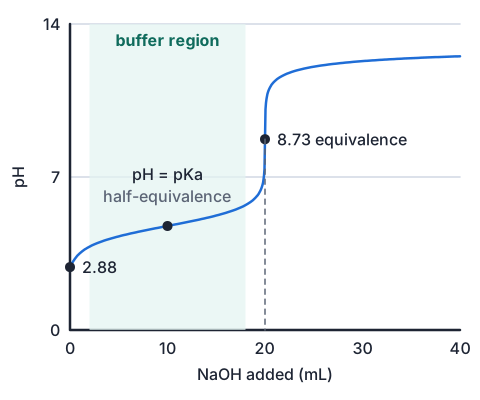
- After a small rise, the curve flattens: the flask now holds CH₃COOH and CH₃COO⁻ together, which is a buffer.
- Halfway to equivalence, half the acid has become its conjugate base, so [CH₃COOH] = [CH₃COO⁻] and [H₃O⁺] = Ka: pH = pKa. This is how pKa is read from a curve.
- At equivalence the flask holds sodium ethanoate. CH₃COO⁻ is a weak base, so the pH is above 7.
- The steep section is shorter, from about pH 7 to 11, because it starts higher.
Graphing calculator: change the pKa of the weak acid
Example: four points on the ethanoic acid curve
- 20.0 mL of 0.100 mol L⁻¹ CH₃COOH is titrated with 0.100 mol L⁻¹ NaOH. Ka = 1.74 × 10⁻⁵, pKa = 4.76. Find the pH at 0, 10.0, 20.0 and 25.0 mL of NaOH.
- 0 mL: [H₃O⁺] = √(1.74 × 10⁻⁵ × 0.100) = 1.32 × 10⁻³ mol L⁻¹, pH = 2.88weak acid alone
- equivalence: n(acid) = 0.100 × 0.0200 = 2.00 × 10⁻³ mol, so 20.0 mL of NaOH
- 10.0 mL: half the acid has reacted, [CH₃COOH] = [CH₃COO⁻], so pH = pKa = 4.76half-equivalence
- 20.0 mL: [CH₃COO⁻] = 2.00 × 10⁻³ ÷ 0.0400 = 0.0500 mol L⁻¹total volume 40.0 mL
- [H₃O⁺] = √(1.74 × 10⁻⁵ × 1.0 × 10⁻¹⁴ ÷ 0.0500) = 1.87 × 10⁻⁹ mol L⁻¹, pH = 8.73weak base
- 25.0 mL: excess OH⁻ = 0.100 × 0.0050 = 5.0 × 10⁻⁴ mol in 45.0 mL, so [OH⁻] = 0.0111 mol L⁻¹
- [H₃O⁺] = 1.0 × 10⁻¹⁴ ÷ 0.0111 = 9.0 × 10⁻¹³ mol L⁻¹, pH = 12.05
- pH 2.88, 4.76, 8.73 and 12.05
Weak base with strong acid
- Now the acid is in the burette, so the curve runs downhill. 25.0 mL of 0.100 mol L⁻¹ NH₃ starts at pH 11.12.
- As 0.100 mol L⁻¹ HCl is added, NH₄⁺ forms, and NH₃ with NH₄⁺ is a buffer: the curve flattens.
- At half-equivalence, [NH₃] = [NH₄⁺], so pH = pKa(NH₄⁺) = 9.24.
- At equivalence the flask holds NH₄Cl. NH₄⁺ is a weak acid, so the pH is below 7: [NH₄⁺] = 0.0500 mol L⁻¹ gives [H₃O⁺] = √(5.75 × 10⁻¹⁰ × 0.0500) = 5.36 × 10⁻⁶ mol L⁻¹ and pH 5.27.
- After equivalence the excess H₃O⁺ sets the pH: after 30.0 mL, [H₃O⁺] = 5.0 × 10⁻⁴ mol ÷ 0.0550 L = 9.09 × 10⁻³ mol L⁻¹, pH 2.04.
Why the buffer region is flat
- Between the start and the equivalence point of a weak acid titration, each OH⁻ added turns one CH₃COOH into one CH₃COO⁻: CH₃COOH + OH⁻ → CH₃COO⁻ + H₂O.
- [H₃O⁺] = Ka × [CH₃COOH] ÷ [CH₃COO⁻] depends only on the ratio of the two, which changes slowly in the middle of the region, so the pH changes slowly.
- The ratio changes fastest near the start and near equivalence, where one partner is nearly gone, so the curve is steepest there.
- Buffering is strongest at the half-equivalence point, where the two are equal.
Choosing an indicator
- An indicator is itself a weak acid, HIn ⇌ In⁻ + H₃O⁺, where HIn and In⁻ are different colours. It changes colour over about pKa(HIn) ± 1.
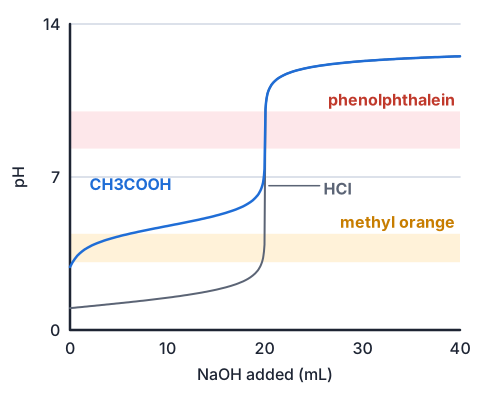
- Choose an indicator whose colour change range lies entirely within the steep, vertical part of the curve, so one drop at equivalence changes the colour.
- Weak acid with strong base: equivalence above 7, so phenolphthalein. Methyl orange would change in the buffer region, far too early.
- Weak base with strong acid: equivalence below 7, so methyl red or methyl orange. Phenolphthalein would change in the buffer region.
- Strong acid with strong base: the steep section is so long that any of them works.
| Indicator | pKa | Colour change range | Colours (acid to base) |
|---|---|---|---|
| Methyl orange | 3.7 | 3.1 to 4.4 | red to yellow |
| Methyl red | 5.1 | 4.4 to 6.2 | red to yellow |
| Bromothymol blue | 7.1 | 6.0 to 7.6 | yellow to blue |
| Phenolphthalein | 9.3 | 8.3 to 10.0 | colourless to pink |
Conductivity during a titration
- At the start of the NH₃ titration the flask conducts poorly: NH₃ is a weak base, so there are few NH₄⁺ and OH⁻ ions.
- Each HCl added makes a pair of ions, NH₃ + HCl → NH₄⁺ + Cl⁻, so conductivity rises steadily up to equivalence.
- In a strong acid with strong base titration the opposite happens at first: fast-moving H₃O⁺ ions are replaced by slower Na⁺ ions, so conductivity falls until equivalence, then rises as excess OH⁻ is added.
What Achieved, Merit and Excellence look like
- Achieved names a suitable indicator. Merit explains the choice using the pH at equivalence and the salt formed. Excellence links the indicator's range to the steep section of this curve and explains why the alternative fails.
| Grade | A model answer |
|---|---|
| Achieved | Phenolphthalein, because the equivalence point is above pH 7. |
| Merit | At equivalence the flask holds sodium ethanoate. CH₃COO⁻ is a weak base, CH₃COO⁻ + H₂O ⇌ CH₃COOH + OH⁻, so the pH is about 8.7. Phenolphthalein changes colour between 8.3 and 10.0, which matches. |
| Excellence | The salt at equivalence, CH₃COONa, is basic, so the equivalence point is at pH 8.73, in a steep section running from about 7 to 11. Phenolphthalein's range, 8.3 to 10.0, lies entirely within it, so the colour changes with one drop at equivalence. Methyl orange's range, 3.1 to 4.4, lies in the buffer region around pKa 4.76, where the pH changes slowly, so it would change gradually and far too early, giving a titre that is much too small. |
Common mistakes
- The pH at the equivalence point is always 7.Only for strong with strong; a weak acid gives a basic salt (pH above 7) and a weak base an acidic salt (pH below 7).
- At the half-equivalence point, pH = ½ pKa.At half-equivalence [HA] = [A⁻], so [H₃O⁺] = Ka and pH = pKa.
- At equivalence, [CH₃COO⁻] = 0.100 mol L⁻¹, the same as the acid.The volume has doubled to 40.0 mL, so [CH₃COO⁻] = 0.0500 mol L⁻¹; always use the total volume.
- Choose an indicator whose pKa equals the pKa of the acid.Choose one whose range lies in the steep section around the equivalence point, not near the acid's pKa, which is in the buffer region.
A kitchen titration
You need: 2 red cabbage leaves, hot tap water, a jug, white vinegar, baking soda, a clear glass, a teaspoon, a measuring cup
- Tear the cabbage leaves into the jug, cover them with hot tap water and leave for 10 minutes to make a purple indicator.
- Stir 2 teaspoons of baking soda into a cup of water to make your base solution.
- Put 2 teaspoons of vinegar and 4 teaspoons of indicator in the glass. It should be pink.
- Add the base solution a teaspoon at a time, stirring, and record the colour after each one, until it has turned blue.
- Look for: the colour moves gradually from pink through purple to blue, with no sudden jump. Both vinegar and baking soda are weak, so the curve has no steep section, which is why weak acids are always titrated with a strong base in the lab.
Safety: Add the base slowly with the glass standing in the sink, because it fizzes and can overflow, and do not drink the mixtures.
Your turn
25.0 mL of 0.120 mol L⁻¹ CH₃COOH is titrated with 0.150 mol L⁻¹ NaOH. What volume of NaOH reaches equivalence?
What is the pH at the half-equivalence point when NH₃ is titrated with HCl? pKa(NH₄⁺) = 9.24.
Which indicator suits NH₃ titrated with HCl: methyl red or phenolphthalein?
What is the pH at the equivalence point when HCl is titrated with NaOH?
Name the two carbon-containing species in the buffer region of CH₃COOH titrated with NaOH.
Show answer
1. n = 0.120 × 0.0250 = 3.00 × 10⁻³ mol; V = 3.00 × 10⁻³ ÷ 0.150 = 0.0200 L = 20.0 mL. 2. pH = pKa = 9.24. 3. Methyl red: the equivalence point is about pH 5.3, inside its range of 4.4 to 6.2. 4. pH 7.00: NaCl does not react with water. 5. CH₃COOH and CH₃COO⁻.
Exam-style question: methanoic acid
20.0 mL of 0.0850 mol L⁻¹ methanoic acid, HCOOH, is titrated with 0.100 mol L⁻¹ NaOH. Ka(HCOOH) = 1.78 × 10⁻⁴, pKa = 3.75. Calculate the volume of NaOH needed to reach equivalence.
Calculate the pH before any NaOH is added.
State the pH after 8.50 mL of NaOH has been added, and explain why.
Calculate the pH at the equivalence point.
Choose phenolphthalein or methyl orange for this titration, and justify your choice.
Calculate the pH after 20.0 mL of NaOH has been added.
Show answer
1. n(HCOOH) = 0.0850 × 0.0200 = 1.70 × 10⁻³ mol, so V = 1.70 × 10⁻³ ÷ 0.100 = 17.0 mL (Achieved). 2. [H₃O⁺] = √(1.78 × 10⁻⁴ × 0.0850) = 3.89 × 10⁻³ mol L⁻¹, so pH = 2.41 (Merit). 3. pH = 3.75: 8.50 mL is half of 17.0 mL, so half the HCOOH has become HCOO⁻; [HCOOH] = [HCOO⁻], so [H₃O⁺] = Ka and pH = pKa (Merit). 4. [HCOO⁻] = 1.70 × 10⁻³ ÷ 0.0370 = 0.0459 mol L⁻¹; [H₃O⁺] = √(1.78 × 10⁻⁴ × 1.0 × 10⁻¹⁴ ÷ 0.0459) = 6.23 × 10⁻⁹ mol L⁻¹, so pH = 8.21 (Excellence). 5. Phenolphthalein: HCOO⁻ is a weak base, so the equivalence point is above 7 (8.21), and phenolphthalein's range, 8.3 to 10.0, lies in the steep section. Methyl orange, 3.1 to 4.4, would change in the buffer region around pH 3.75, long before equivalence (Excellence). 6. Excess OH⁻ = 0.100 × 0.0030 = 3.0 × 10⁻⁴ mol in 40.0 mL, so [OH⁻] = 7.5 × 10⁻³ mol L⁻¹, [H₃O⁺] = 1.33 × 10⁻¹² mol L⁻¹ and pH = 11.88 (Merit).
Recap
- Find the equivalence volume first; always use the total volume for concentrations after mixing.
- Weak acid with strong base: pH = pKa at half-equivalence, a buffer region before it, and a basic equivalence point.
- Weak base with strong acid: pH = pKa of the conjugate acid at half-equivalence, and an acidic equivalence point.
- Pick an indicator whose colour change range sits inside the steep section.
| Titration | pH at equivalence | Indicator |
|---|---|---|
| Strong acid, strong base | 7 | any of them |
| Weak acid, strong base | above 7 | phenolphthalein |
| Weak base, strong acid | below 7 | methyl red or methyl orange |
Report a mistake
How is NCEA Level 3 maths going?
See the NCEA Level 3 maths guide