Weak acids, bases, pH and buffers
What this lesson covers
- Acids donate protons and bases accept them; conjugate pairs, and strong versus weak acids and bases.
- Ka and pKa: what they mean and how they rank acid strength, and that a weaker acid has a stronger conjugate base.
- Calculating pH for weak acids, weak bases and salts, using the approximation that the weak species barely reacts.
- Ranking the concentrations of species in a solution, and linking ion concentrations to conductivity.
- How a buffer resists pH change, how to calculate its pH, and how to make a buffer of a chosen pH.
Strong and weak, and conjugate pairs
- An acid donates a proton to a base. When CH₃COOH gives its proton to water, it becomes CH₃COO⁻, its conjugate base; H₂O becomes H₃O⁺, its conjugate acid.
- Strong acids such as HCl, HBr and HNO₃ react completely with water: the reaction goes to completion (→). Strong bases such as NaOH and KOH dissociate completely to give OH⁻.
- Weak acids, such as carboxylic acids and NH₄⁺, and weak bases, such as NH₃, amines and CH₃COO⁻, react only partly: CH₃COOH + H₂O ⇌ CH₃COO⁻ + H₃O⁺. At equilibrium most of the weak acid is still present as molecules.
- Salts can be acidic or basic: NH₄Cl contains the weak acid NH₄⁺, and CH₃COONa contains the weak base CH₃COO⁻. NaCl contains neither, so its solution is neutral.
Try it: strong or weak?
Ka and pKa
- For a weak acid HA + H₂O ⇌ A⁻ + H₃O⁺, the acid dissociation constant is Ka = [A⁻][H₃O⁺] ÷ [HA]. Water is left out because it is the solvent.
- pKa = −log Ka, and Ka = 10^−pKa. A larger Ka, or a smaller pKa, means a stronger acid.
- A weak base is described by the Ka of its conjugate acid: the Ka of NH₄⁺ tells you about NH₃. The weaker the acid, the stronger its conjugate base, so CH₃NH₂ (pKa of CH₃NH₃⁺ = 10.6) is a stronger base than NH₃ (pKa of NH₄⁺ = 9.24).
- Kw = [H₃O⁺][OH⁻] = 1.0 × 10⁻¹⁴ at 25 °C, so [OH⁻] can always be found from [H₃O⁺].
| Acid | Conjugate base | Ka | pKa |
|---|---|---|---|
| HCOOH | HCOO⁻ | 1.78 × 10⁻⁴ | 3.75 |
| CH₃COOH | CH₃COO⁻ | 1.74 × 10⁻⁵ | 4.76 |
| HOCl | OCl⁻ | 2.95 × 10⁻⁸ | 7.53 |
| NH₄⁺ | NH₃ | 5.75 × 10⁻¹⁰ | 9.24 |
| CH₃NH₃⁺ | CH₃NH₂ | 2.51 × 10⁻¹¹ | 10.6 |
Example: pH of a weak acid
- Calculate the pH of 0.10 mol L⁻¹ ethanoic acid. Ka(CH₃COOH) = 1.74 × 10⁻⁵.
- Assume [H₃O⁺] = [CH₃COO⁻], since each comes from one dissociated molecule, and [CH₃COOH] at equilibrium ≈ 0.10 mol L⁻¹, since so little reacts.
- Ka = [H₃O⁺]² ÷ [CH₃COOH][H₃O⁺] = [CH₃COO⁻]
- [H₃O⁺] = √(Ka × c) = √(1.74 × 10⁻⁵ × 0.10) = 1.32 × 10⁻³ mol L⁻¹
- pH = −log(1.32 × 10⁻³) = 2.88
- only 1.3% has reacted, so treating [CH₃COOH] as 0.10 was fair; 0.10 mol L⁻¹ HCl would have pH 1.00
Example: pH of a weak base and two salts
- Calculate the pH of 0.10 mol L⁻¹ NH₃, 0.10 mol L⁻¹ NH₄Cl and 0.10 mol L⁻¹ CH₃COONa. Ka(NH₄⁺) = 5.75 × 10⁻¹⁰, Ka(CH₃COOH) = 1.74 × 10⁻⁵.
- For a weak base B with conjugate acid BH⁺: [H₃O⁺] = √(Ka × Kw ÷ [B]). For a weak acid, including an acidic ion like NH₄⁺: [H₃O⁺] = √(Ka × [HA]).
- NH₃: [H₃O⁺] = √(5.75 × 10⁻¹⁰ × 1.0 × 10⁻¹⁴ ÷ 0.10) = 7.58 × 10⁻¹² mol L⁻¹NH₃ + H₂O ⇌ NH₄⁺ + OH⁻
- pH(NH₃) = 11.12
- NH₄Cl: [H₃O⁺] = √(5.75 × 10⁻¹⁰ × 0.10) = 7.58 × 10⁻⁶ mol L⁻¹NH₄⁺ + H₂O ⇌ NH₃ + H₃O⁺
- pH(NH₄Cl) = 5.12
- CH₃COONa: [H₃O⁺] = √(1.74 × 10⁻⁵ × 1.0 × 10⁻¹⁴ ÷ 0.10) = 1.32 × 10⁻⁹ mol L⁻¹CH₃COO⁻ is a weak base
- pH(CH₃COONa) = 8.88
- acidic salt below 7, basic salt above 7, weak base well above 7
Which species, and how much of each?
- List the species, then rank them using the equilibrium and the size of Ka. Leave out water unless asked.
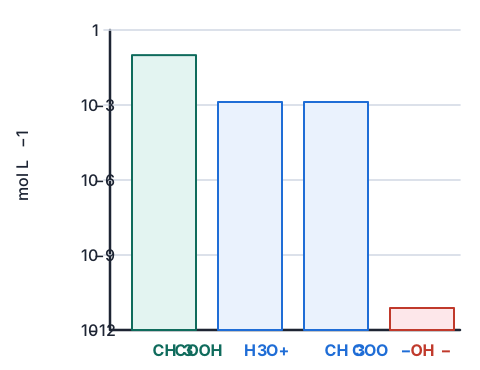
- Weak acid, 0.10 mol L⁻¹ CH₃COOH: CH₃COOH > CH₃COO⁻ = H₃O⁺ > OH⁻, because only about 1% of the molecules react.
- Weak base, NH₃: NH₃ > NH₄⁺ = OH⁻ > H₃O⁺.
- Acidic salt, NH₄Cl: Cl⁻ > NH₄⁺ > NH₃ = H₃O⁺ > OH⁻. The Cl⁻ does not react, but a little NH₄⁺ does, so [NH₄⁺] is just below [Cl⁻].
- Basic salt, CH₃COONa: Na⁺ > CH₃COO⁻ > CH₃COOH = OH⁻ > H₃O⁺.
Conductivity follows the ions
- A solution conducts electricity because charged ions can move through it. More ions, and ions with more charge, mean higher conductivity.
- Strong acids, strong bases and all soluble salts are fully ionised, so their solutions conduct well. Weak acids and weak bases are mostly molecules, so they conduct poorly.
- This is why 0.10 mol L⁻¹ NH₄Cl conducts far better than 0.10 mol L⁻¹ NH₃, even though both contain the NH₄⁺/NH₃ pair.
| Solution | Main ions | Conductivity |
|---|---|---|
| HCl | H₃O⁺, Cl⁻ (all of it) | high |
| CH₃COOH | H₃O⁺, CH₃COO⁻ (1.32 × 10⁻³ mol L⁻¹ each) | low |
| NH₃ | NH₄⁺, OH⁻ (a small fraction) | low |
| NH₄Cl | NH₄⁺, Cl⁻ (all of it) | high |
| CH₃COONa | Na⁺, CH₃COO⁻ (all of it) | high |
How a buffer works
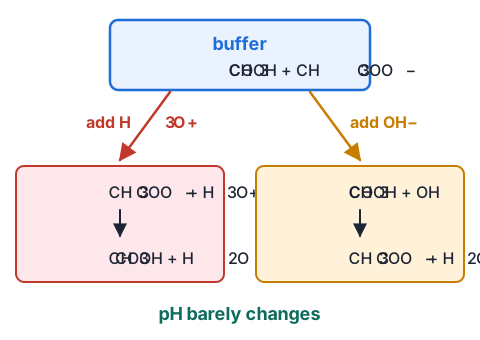
- A buffer resists a change in pH when a small amount of acid or base is added. It contains a weak acid and its conjugate base, both in significant amounts, such as CH₃COOH with CH₃COONa, or NH₄Cl with NH₃.
- Added acid is used up by the base in the buffer: CH₃COO⁻ + H₃O⁺ → CH₃COOH + H₂O.
- Added base is used up by the acid in the buffer: CH₃COOH + OH⁻ → CH₃COO⁻ + H₂O.
- Either way the ratio [CH₃COO⁻] ÷ [CH₃COOH] changes only slightly, so [H₃O⁺] = Ka × [HA] ÷ [A⁻] barely moves.
- A buffer works best when [HA] = [A⁻], where pH = pKa, and only within about one pH unit of the pKa. Too much added acid or base uses up one partner, and the buffer fails.
Example: the pH of a buffer, and making one
- (a) A buffer contains 0.10 mol of CH₃COOH and 0.050 mol of CH₃COONa in 500 mL. Calculate its pH. Ka(CH₃COOH) = 1.74 × 10⁻⁵.
- (b) What mass of CH₃COONa (M = 82.0 g mol⁻¹) must be added to 250 mL of 0.200 mol L⁻¹ CH₃COOH to make a buffer of pH 5.00?
- (a) [CH₃COOH] = 0.10 ÷ 0.500 = 0.20 mol L⁻¹; [CH₃COO⁻] = 0.050 ÷ 0.500 = 0.10 mol L⁻¹
- [H₃O⁺] = Ka × [HA] ÷ [A⁻] = 1.74 × 10⁻⁵ × 0.20 ÷ 0.10 = 3.48 × 10⁻⁵ mol L⁻¹rearranged Ka expression
- (a) pH = 4.46
- pKa is 4.76 and there is less base than acid, so the pH is a little below pKa
- (b) [H₃O⁺] = 10^−5.00 = 1.0 × 10⁻⁵ mol L⁻¹
- [CH₃COO⁻] = Ka × [HA] ÷ [H₃O⁺] = 1.74 × 10⁻⁵ × 0.200 ÷ 1.0 × 10⁻⁵ = 0.348 mol L⁻¹
- n = 0.348 × 0.250 = 0.0870 mol; m = 0.0870 × 82.0n = cV, m = nM
- (b) m = 7.13 g of CH₃COONa
Graphing calculator: buffer pH against the ratio [A⁻] ÷ [HA]
Buffers in the body
- Blood is buffered mainly by carbonic acid and hydrogen carbonate: H₂CO₃ + H₂O ⇌ HCO₃⁻ + H₃O⁺.
- Lactic acid from hard exercise is neutralised by HCO₃⁻, and the H₂CO₃ formed breaks down to CO₂, which is breathed out faster. An all-out sprint can still push blood pH briefly below 7.35, but the buffer keeps the fall small and the pH soon returns to the normal 7.35 to 7.45.
- In the body this pair behaves as if its pKa were about 6.1, and blood holds about 20 times more HCO₃⁻ than H₂CO₃, which gives pH 6.1 + log 20 = 7.4.
What Achieved, Merit and Excellence look like
- Achieved states which solution has the higher pH or conductivity. Merit explains it with the extent of reaction and an equation. Excellence compares every solution, with equations and the relative concentrations of the ions that decide the property.
| Grade | A model answer |
|---|---|
| Achieved | HCl < NH₄Cl < CH₃COONa. HCl is a strong acid, NH₄Cl is a weak acid and CH₃COONa is basic. |
| Merit | HCl reacts completely, HCl + H₂O → H₃O⁺ + Cl⁻, so [H₃O⁺] is high and pH is lowest. NH₄⁺ reacts only partly, NH₄⁺ + H₂O ⇌ NH₃ + H₃O⁺, so [H₃O⁺] is lower and the pH higher, but below 7. CH₃COO⁻ accepts protons, CH₃COO⁻ + H₂O ⇌ CH₃COOH + OH⁻, so the pH is above 7. |
| Excellence | HCl is fully ionised, so [H₃O⁺] = 0.10 mol L⁻¹ and pH = 1.00. NH₄⁺ is a weak acid (pKa 9.24); only a small fraction reacts, giving [H₃O⁺] = 7.58 × 10⁻⁶ mol L⁻¹ and pH 5.12. In CH₃COONa the Na⁺ does not react, but CH₃COO⁻ is a weak base, so [OH⁻] > [H₃O⁺] and the pH is 8.88. The higher [H₃O⁺], the lower the pH, so the order is HCl < NH₄Cl < CH₃COONa. |
Common mistakes
- For 0.10 mol L⁻¹ CH₃COOH, [H₃O⁺] = 0.10 mol L⁻¹, so the pH is 1.00.A weak acid reacts only partly: [H₃O⁺] = √(Ka × c) = 1.32 × 10⁻³ mol L⁻¹, so the pH is 2.88.
- NH₄Cl is a salt, so its solution has pH 7.NH₄⁺ is a weak acid, so NH₄Cl solution is acidic; only salts whose ions do not react with water are neutral.
- A buffer keeps the pH exactly constant whatever is added.A buffer only resists small additions; enough acid or base uses up one partner and the pH then changes sharply.
- A weak acid conducts poorly because it is dilute.It conducts poorly because few of its molecules form ions; concentration and strength are separate ideas.
Test a kitchen buffer
You need: 2 red cabbage leaves, hot tap water, white vinegar, baking soda, 2 clear glasses, a teaspoon, a jug
- Tear the cabbage leaves into the jug, cover them with hot tap water, and after 10 minutes pour off the purple indicator.
- Glass A: half a cup of tap water with 3 teaspoons of indicator. Glass B: the same, plus 6 teaspoons of vinegar and then a quarter teaspoon of baking soda, stirred until the fizzing stops. Glass B now holds ethanoic acid and ethanoate ions, a buffer.
- Make a little base: stir half a teaspoon of baking soda into a cup of water.
- Add the base solution to each glass a teaspoon at a time, stirring, and count how many teaspoons it takes for the colour to turn blue.
- Look for: glass A turns blue after one or two teaspoons, but glass B holds its pink-purple colour for many more. The ethanoic acid in the buffer uses up the added base, so the pH barely moves until it runs out.
Safety: Vinegar and baking soda foam up quickly, so mix them slowly with the glass in the sink, and do not drink any of the mixtures.
Your turn
Write the Ka expression for HCOOH.
Calculate the pH of 0.050 mol L⁻¹ HCOOH. Ka = 1.78 × 10⁻⁴.
Calculate the pH of 0.20 mol L⁻¹ NH₄Cl. Ka(NH₄⁺) = 5.75 × 10⁻¹⁰.
Which solution conducts better, 0.10 mol L⁻¹ CH₃COOH or 0.10 mol L⁻¹ CH₃COONa?
A buffer has [NH₃] = [NH₄⁺] = 0.10 mol L⁻¹. What is its pH? pKa(NH₄⁺) = 9.24.
Show answer
1. Ka = [HCOO⁻][H₃O⁺] ÷ [HCOOH]. 2. [H₃O⁺] = √(1.78 × 10⁻⁴ × 0.050) = 2.98 × 10⁻³ mol L⁻¹, so pH = 2.53. 3. [H₃O⁺] = √(5.75 × 10⁻¹⁰ × 0.20) = 1.07 × 10⁻⁵ mol L⁻¹, so pH = 4.97. 4. CH₃COONa: it is fully dissociated into Na⁺ and CH₃COO⁻ ions, while the acid is mostly molecules. 5. [NH₃] = [NH₄⁺], so [H₃O⁺] = Ka and pH = pKa = 9.24.
Exam-style question: pool chlorine
- Pools are disinfected with sodium hypochlorite, NaOCl. Hypochlorous acid, HOCl, is the better disinfectant. Ka(HOCl) = 2.95 × 10⁻⁸, pKa = 7.53.
Write the Ka expression for HOCl.
Calculate the pH of 0.050 mol L⁻¹ NaOCl.
List the species in 0.050 mol L⁻¹ NaOCl, except water, in order of decreasing concentration.
A pool is kept at pH 7.50. Calculate the ratio [OCl⁻] ÷ [HOCl], and say which is present in the greater amount.
Compare the conductivity of 0.050 mol L⁻¹ NaOCl and 0.050 mol L⁻¹ HOCl.
Show answer
1. Ka = [OCl⁻][H₃O⁺] ÷ [HOCl] (Achieved). 2. OCl⁻ is a weak base: [H₃O⁺] = √(Ka × Kw ÷ c) = √(2.95 × 10⁻⁸ × 1.0 × 10⁻¹⁴ ÷ 0.050) = 7.68 × 10⁻¹¹ mol L⁻¹, so pH = 10.11 (Merit). 3. Na⁺ > OCl⁻ > HOCl = OH⁻ > H₃O⁺: NaOCl dissociates fully, a small fraction of OCl⁻ reacts, OCl⁻ + H₂O ⇌ HOCl + OH⁻, giving equal small amounts of HOCl and OH⁻, and [H₃O⁺] is tiny in a basic solution (Merit; Excellence with the reasons). 4. [H₃O⁺] = 10^−7.50 = 3.16 × 10⁻⁸ mol L⁻¹; [OCl⁻] ÷ [HOCl] = Ka ÷ [H₃O⁺] = 2.95 × 10⁻⁸ ÷ 3.16 × 10⁻⁸ = 0.93, so there is slightly more HOCl. The pH is just below the pKa, which is why pools are not allowed to drift much higher (Excellence). 5. NaOCl is a soluble salt, fully dissociated into Na⁺ and OCl⁻, so it conducts well. HOCl is a weak acid: very few molecules form H₃O⁺ and OCl⁻, so it conducts poorly (Merit; Excellence with equations for both).
Acid-Base Solutions
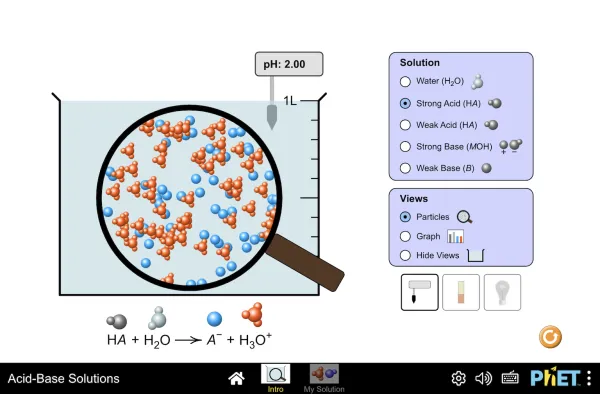
Full screen · PhET Interactive Simulations, University of Colorado Boulder, CC BY 4.0
Recap
- Ka = [A⁻][H₃O⁺] ÷ [HA] and pKa = −log Ka; a smaller pKa is a stronger acid and a weaker conjugate base.
- Weak acid: [H₃O⁺] = √(Ka × c). Weak base: [H₃O⁺] = √(Ka × Kw ÷ c), using the Ka of its conjugate acid.
- Conductivity depends on how many ions are present: salts, strong acids and strong bases conduct well; weak acids and bases poorly.
- A buffer is a weak acid with its conjugate base; [H₃O⁺] = Ka × [HA] ÷ [A⁻], and pH = pKa when the two are equal.
| Solution | Find [H₃O⁺] with |
|---|---|
| Weak acid or acidic salt | √(Ka × [HA]) |
| Weak base or basic salt | √(Ka × Kw ÷ [B]) |
| Buffer | Ka × [HA] ÷ [A⁻] |
| Any solution, from [OH⁻] | Kw ÷ [OH⁻] |
The maths behind it
Report a mistake
How is NCEA Level 3 maths going?
See the NCEA Level 3 maths guide